The Commensal Pathway Hypothesis
Compound evidence detail1 SCR / 2 parts
- Documentedpeer-reviewed evolutionary-biology research establishing commensal scavenging at human settlements as the leading model of dog domestication
- HeuristicJB-specific reading that the Five Pillars correspond to selection pressures operating during the commensal phase of canine evolution
The commensal pathway hypothesis argues that the first steps toward dog domestication did not begin with deliberate human breeding, formal taming, or sentimental wolf adoption. They began when some wolf-like animals were better than others at living near humans without fleeing, attacking, or falling apart under the social and ecological pressures of that proximity. Raymond and Lorna Coppinger turned this model into the most famous popular account of dog origins, but the deeper scientific logic is ecological: human camps created a new niche, and animals capable of tolerating that niche could feed, survive, and reproduce more effectively than animals that kept a longer flight distance. In that framework, domestication begins as natural selection acting on fear, reactivity, and social flexibility. Later phases can include tighter mutualism, human preference, and eventually more intentional breeding, but the opening filter is tolerance. The source review for this dispatch treats the commensal pathway as a prominent and widely discussed model, yet also insists on a crucial ceiling: it is a leading hypothesis, not a completed consensus. That distinction matters because 2021 and 2022 critiques grounded in hunter-gatherer ecology argue that a pure scavenger story may be too simple. Documented
Still, the model remains influential for good reasons. It explains why the earliest selection target would be emotional and social before it was morphological. It fits later genomic evidence showing dog-wolf divergence around social behavior and stress pathways. Documented It also fits modern observations of free-ranging village dogs, which often live by proximity to human refuse, roads, settlements, and resource edges without requiring active day-to-day human management.
JB has a direct stake in this discussion because the commensal pathway itself is documented, while the claim that the Five Pillars name the kinds of social conditions favored by that pathway is an interpretive step that must remain explicitly heuristic.
What It Means
What "Commensal" Actually Means
In evolutionary biology, a commensal pathway describes domestication that begins because one species benefits from living around another species' modified environment. Documented The benefit is ecological first, not sentimental. Human camps create food scraps, carcass remnants, predictable movement patterns, shelter edges, and zones where some predators are excluded while others are attracted. A wolf-like animal that can navigate that landscape without wasting energy on constant panic may gain a significant survival advantage.
That is why this model is not really about friendliness in the modern pet sense. It is about reduced reactive aggression, lower flight distance, and increased capacity to function in human-adjacent spaces. treats this as the most stable shared denominator across otherwise competing models: regardless of whether campside scavenging, pup adoption, or a hybrid route opened the process, selection for animals that could better tolerate humans sits near the center.
Why the Coppinger Model Became So Influential
The Coppingers made the commensal story memorable because it solves several puzzles at once. It explains why dog domestication could begin without advanced human planning. Documented It explains why the first major target would be temperament rather than coat color or ear shape. It explains why village dogs, pariah dogs, and loosely human-associated dogs still look ecologically relevant to the story. And it fits later work showing that once fear and aggression shift, a cascade of social and developmental changes can follow.
Their framing also challenged the older fantasy that early humans intentionally adopted wild wolf pups, somehow repeated that act across generations, and produced dogs through a steady personal taming project. That is not impossible in small cases, but as a species-level origin story it asks for repeated human labor before there is clear evidence of stable benefit. The commensal model instead lets natural selection do the opening work.
The commensal pathway matters to JB because it locates the first dog-human bond in an evolved ecological relationship, not in a formalized training method. The relationship comes first. Technique comes much later.
What Evidence Supports the Model
The support is convergent rather than singular. First, the broader domestication timeline predates modern breeding and strongly suggests a gradual process. Second, village-dog ecology shows that dogs can sustain themselves around human settlements as scavengers and opportunists without being tightly managed in the modern pet sense. Third, genomic work identifies signals around behavior, stress, sociability, and dietary flexibility that fit an animal adapting to human-shaped conditions. Axelsson et al. 2013 is especially important because it tied dogs to starch-rich human food ecologies. vonHoldt et al. 2017 and related domestication work then made it harder to dismiss the idea that hypersociability and human orientation were part of the package.
The model is also strengthened indirectly by comparative evidence. Hare et al. 2005 found that foxes selected for tameness became better at reading human communicative cues. That does not prove dogs arose through an identical route, but it does make the core logic biologically plausible: select on reduced fear and social tolerance, and interspecies communication becomes easier.
Where the Critiques Land
The strongest critiques target ecological realism. Some archaeologists and evolutionary anthropologists argue Late Pleistocene hunter-gatherer camps may not have generated enough persistent refuse to support the classic scavenger picture. Others argue wolves may have been too wary for an unsupervised commensal relationship to get started cleanly. That is why the source review includes pup-adoption and multistage models as serious alternatives rather than as fringe objections.
So the best current reading is not "the commensal pathway is proven." It is "the commensal pathway remains one of the most coherent and influential explanations, especially when framed as an early filter for tolerance rather than as a fully complete story of every later step."
Why It Matters for Your Dog
The commensal pathway matters in ordinary life because it reorients what families think dogs were selected to do. If the earliest successful proto-dogs were the ones that could remain near humans without escalating conflict, without bolting from every novelty, and without collapsing under social pressure, then emotional stability around people is not a luxury trait added late by clever trainers. It sits near the core of what being dog-like means.
That does not mean every modern dog is naturally calm in every home. It means the species was shaped in a direction where human proximity could become ordinary rather than intolerable. A dog who watches your movement, tracks your tone, settles more easily in predictable spaces, and organizes his choices around the human household is behaving in ways that fit the long logic of domestication more than the modern market often admits.
This also explains why relationship quality matters so much more than some families expect. If dog origins involved repeated selection for functioning around humans, then the human is not merely a dispenser of rewards or punishments from outside the animal's social world. The human is part of the animal's evolved niche. Families often feel this intuitively before they can explain it. A dog does not merely react to what you do; the dog organizes around what you are like to live beside.
The model further helps families resist mythology. It pushes back on the idea that dogs need to be managed as if they are frustrated wolves yearning for rank struggles. A commensal origin story suggests the opposite direction of travel: the successful early dog lineage was the lineage increasingly shaped to avoid unnecessary conflict in human space. Range and Viranyi 2022 sharpen this by describing conflict avoidance and rule-following as cleaner dog-wolf differences than simple low aggression. That nuance is practically useful. Many companion dogs are not trying to dominate anyone. They are trying to navigate a human system that may or may not be coherent.
Households see this every day in small moments. The dog pauses at a doorway waiting for the adults' pattern. The puppy checks a face before approaching a noisy object. The adolescent becomes harder, not because he forgot human relevance, but because the environment has become harder to read or more arousing to manage. These are not proofs of the commensal pathway on their own, but they are the kind of modern behavior that makes the model intuitively legible.
There is also a market implication. Training culture often talks as if the human-dog relationship begins when the formal training plan begins. The commensal model says the relationship is older, deeper, and prior. Dogs did not become successful through artificial cue systems first. They became successful by getting better at inhabiting human ecology and human presence. Training can layer on top of that, but it does not create the species-level starting point.
For Goldens, this matters because the breed's sociability can be misread in opposite directions. Some families sentimentalize it and offer too little structure. Others fear adolescence and impose too much pressure. The commensal lens suggests a better balance. The dog is biologically prepared to live in close relationship with people, which makes structure and guidance more natural, not less. The same lens also suggests that an incoherent home is especially costly because it disturbs precisely the kind of human-associated functioning the species was shaped to perform. Documented
Another practical consequence is patience about development. A lineage selected for human tolerance is not the same thing as a finished adult dog at ten weeks or ten months. A puppy still needs gradual exposure, conflict avoidance, sleep, and predictable adults. Selection can create a preparedness for human co-living, but that preparedness still needs an environment that does not constantly overwhelm the nervous system.
Seen this way, household management stops looking like a secondary concern beside "actual" training. The way people move through the house, interrupt conflict, regulate noise, and make expectations legible becomes part of the same evolutionary story. A dog that can live well in human space is not only a dog that can perform tasks. It is a dog that can remain behaviorally organized in the daily ecology of family life.
Read that way, the commensal hypothesis becomes less like a distant origin myth and more like a statement about the kind of conditions dogs are expected to work inside. A family is not inventing an artificial softness by making the home calm and legible. It is offering a domesticated animal a version of the human niche that is easier to succeed in.
That is part of why the model remains so useful even for non-specialists. It turns a long evolutionary argument into a practical question about what kind of human environment makes dog success easier rather than harder.
What This Means for a Just Behaving Family
JB families should take one core lesson from the commensal pathway: the dog was not built to need a fight with humans in order to become socially functional. The first selection pressure was more likely tolerance, readability, and successful nearness.
That gives real weight to Calmness and Prevention. A home that reduces unnecessary conflict, lowers emotional noise, and makes adult behavior easy to read is not being indulgent. It is aligning more closely with the documented evolutionary direction of the species.
This is also where JB has to stay intellectually clean. The commensal pathway itself is documented as a leading model. The JB claim that the Five Pillars describe the kinds of social pressures favored by that pathway is a further synthesis and should be named as such when stated.
In practical terms, a JB family should think less about forcing a dog into obedience from outside and more about building a stable human environment that a domesticated canid can organize around from within. Heuristic Structure still matters. Boundaries still matter. What changes is the picture of what sort of animal is being raised.
That shift has a useful emotional consequence for the adults as well. People become less theatrical and more parental. They stop trying to prove authority through visible struggle and start focusing on whether the household is readable enough for the dog to settle into it. In a species story built around successful nearness, that is a more defensible goal than manufacturing intensity.
That picture matters because it shapes tone. Adults become steadier when they stop seeing themselves as wolf managers and start seeing themselves as the mature social center of a human-associated species. That shift in posture changes a surprising amount in the home.
The commensal pathway does not settle every question in dog evolution. It does settle enough to tell JB families that relationship, environmental legibility, and conflict avoidance belong near the front of the story rather than at the margins.
That is already a major correction to the way much of the commercial dog world still frames the species.
It also gives the family a better starting tone. If successful dogness began with workable nearness rather than theatrical conflict, then everyday raising should be biased toward readability, conflict reduction, and ordinary social usefulness long before it starts worrying about looking tough.
That is a useful correction because it makes successful co-living look like a serious biological outcome rather than like softness layered on top of a harder truth.
That is already enough to move the family's whole posture in a better direction.
That is enough to matter in the home.
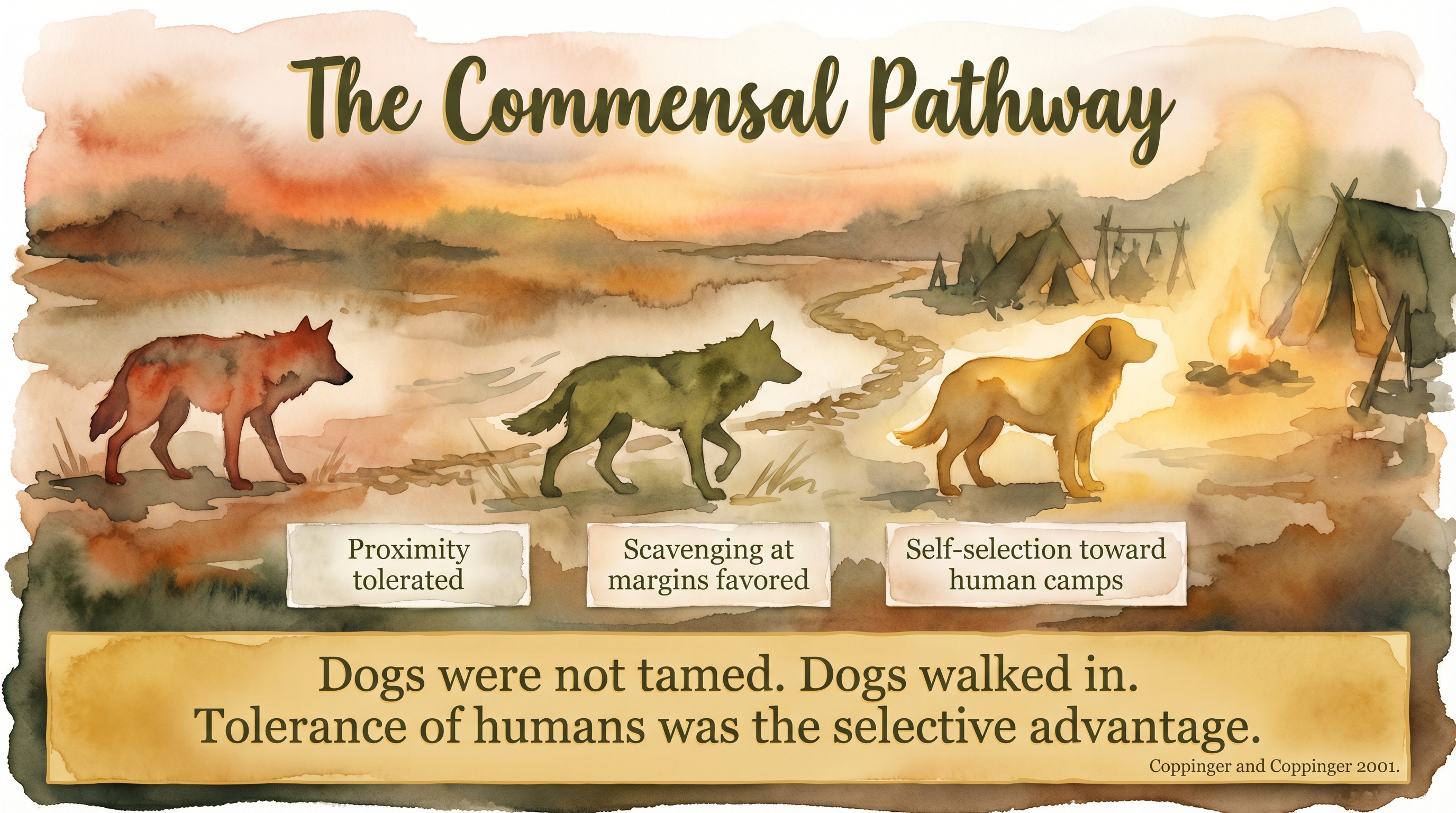
Dogs were not tamed. Dogs walked in. Tolerance was the advantage.
Key Takeaways
- The commensal pathway says early dog domestication likely began through tolerance of human proximity rather than through deliberate formal taming.
- Its strongest logic is ecological: human camps created a niche that some wolf-like animals could exploit better than others.
- The model is influential and well supported, but it is still a leading hypothesis rather than an uncontested consensus.
- For JB, the commensal story helps explain why calm human-adjacent functioning belongs near the center of dog biology.
The Evidence
This entry uses heuristic claim-level tags beyond the dedicated EvidenceBlocks below. These tags mark JB interpretive application rather than direct study findings.
- Coppinger and Coppinger (2001)dogs and village dogs
Popularized the view that dogs emerged through adaptation to human settlements rather than through deliberate human taming alone. - comparative domestication literature
Treats commensal self-selection as a prominent model while preserving the SCR-001 ceiling that it is not full consensus. - Axelsson et al. (2013)dogs and wolves
Found domestication-related genomic signatures consistent with adaptation to human ecological conditions, including diet. - Range and Viranyi (2022)dogs and wolves
Argued that conflict avoidance and rule-following better capture dog-wolf divergence than simplistic claims that dogs are merely less aggressive.
No published study directly tests the practical implications of the commensal pathway hypothesis for domestic dog raising programs. The application to household dog raising remains an interpretive synthesis rather than a directly tested intervention finding.
SCR References
Sources
- Coppinger, R., and Coppinger, L. (2001). Dogs: A New Understanding of Canine Origin, Behavior, and Evolution.
- Axelsson, E., et al. (2013). The genomic signature of dog domestication reveals adaptation to a starch-rich diet. Nature.
- Range, F., and Viranyi, Z. (2022). Comparing wolves and dogs: current status and implications for human self-domestication. Trends in Cognitive Sciences.
- Hare, B., et al. (2005). Social cognitive evolution in captive foxes is a correlated by-product of experimental domestication. Current Biology.