The Calming Signal System
Compound evidence detail1 SCR / 2 parts
- Observed-JBthe ethological evidence that adult dogs deploy specific social signals with situational selectivity and brief contextual deployment (Abrantes, Bekoff, Mech) together with the Bray, MacLean et al. 2021 retriever puppy demonstration that canine attention to human gestural cues is biologically pre-loaded
- Heuristicthe JB application generalizing the dog signal-precision pattern into a universal social-signaling principle and the corollary claim that high-frequency human verbal praise categorically degrades communicative information in household contexts
Dogs already possess a conflict-management language. Pilot ethological data in domestic dogs show that calming signals are associated with de-escalation, while play-signal research shows that dogs place social signals with striking timing and audience sensitivity. The stronger JB contrast, that dogs use signals selectively while humans flood the channel, is an observational synthesis rather than a quantified laboratory ratio. Mixed Evidence
What It Means
The first point is straightforward: canine communication is not just barking or obvious threat displays. Dogs use body orientation, curved approaches, head turns, lip licking, freezing, gaze shifts, play bows, and disengagement behaviors as part of a graded social system. In domestic dogs, these behaviors appear most often when social tension is present and least often when the interaction is already safe and settled. That is exactly what a real communicative system should look like.
Play bows make the precision especially visible. In domestic dogs, Bekoff (1995) showed that play signals are positioned around rough or potentially ambiguous play actions, functioning as behavioral modifiers rather than random movements. Ambiguous In domestic dogs, Horowitz (2009) showed that dogs direct play signals toward attentive partners and use attention-getting behavior first when the partner is not oriented. In domestic dogs, Byosiere et al. (2016) showed that play bows cluster around pauses and transitions in play. The signal appears where it is needed.
The Mariti et al. (2017) pilot study gave the calming-signal question its most concrete numbers so far. Documented Across 96 off-leash dog encounters involving 2,130 coded calming-signal instances, aggression was not preceded by a calming signal from the target dog, and post-aggression calming signals de-escalated the interaction in 79.4 percent of coded cases. That is still pilot evidence and should be written with the pilot qualifier, but it is enough to move calming signals out of folklore and into documented ethology.
The same language extends into dog-human interaction. Firnkes et al. (2017) documented that domestic dogs use signals such as lip licking, turning away, and sitting in response to human approach. Documented Dogs do not reserve social regulation for conspecifics. They recruit the same signal families when navigating us.
The next step is where the evidence ceiling changes. JB consistently observes that humans erode this kind of system by making every interaction noisy. Constant praise, constant verbalization, repeated cueing, and high-arousal narration turn the channel into static. The direct quantitative contrast between selective canine signaling and flooded human signaling is not itself a measured ratio in the literature. It is an interpretive read built from the documented ethology plus habituation and praise data. That read is still useful, but it has to stay in the right register.
Why It Matters for Your Dog
For families, this Foundation changes the goal from "talk more" to "mean more." A dog living in a precise signal environment does not need a stream of commentary to understand what is happening. Mixed Evidence The dog needs readable posture, consistent boundaries, and low-noise communication that preserves contrast between ordinary social contact and actual information.
Indirect Correction works best when it uses the same low-threat communication logic dogs already understand: body position, spatial pressure, disengagement, and brief signals that end when the message lands.
This is also why JB is so wary of praise flooding. Praise is not bad because affection is bad. Praise becomes a problem when it is so constant that it stops carrying information. If every glance, every step, and every neutral moment receives the same verbal celebration, then the dog is not living in a precise channel anymore. Mixed Evidence It is living in wallpaper.
The calming-signal system also helps families understand why conflict often resolves faster when the adult gets quieter rather than louder. The dog already has a species-typical language for saying, "slow down," "I mean no threat," "give me space," or "we can return to baseline now." The more the human learns to see and mirror that structure, the less often the relationship has to escalate into confusion.
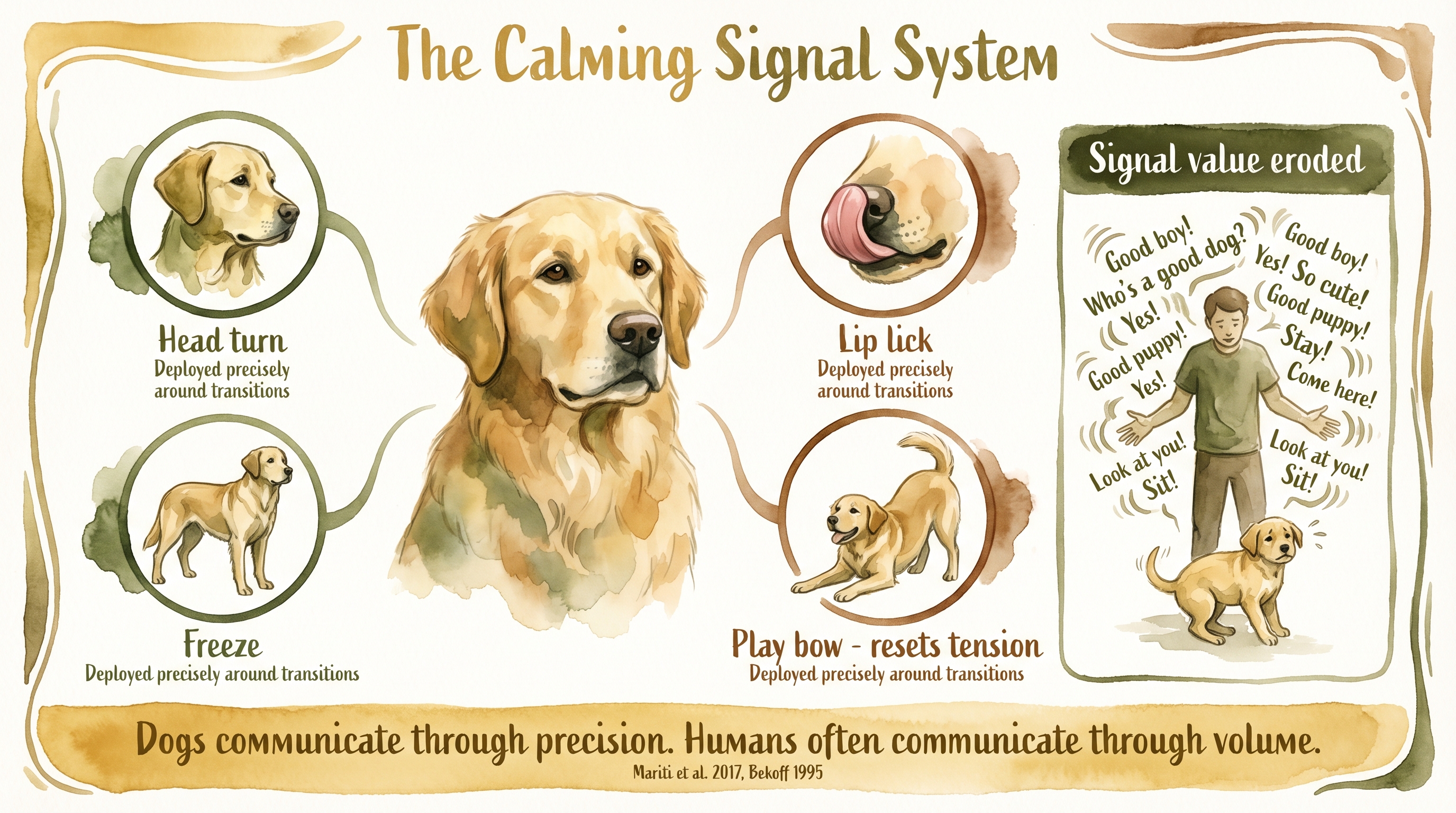
Dogs possess a real conflict-management language deployed precisely around tension - constant human verbalization erodes the signal value the puppy depends on.
Key Takeaways
- Dogs use a real social signaling system that includes calming signals, curved approaches, play bows, disengagement, and body orientation.
- Pilot data in domestic dogs show that calming signals are associated with conflict de-escalation, which makes them more than folklore.
- Play-signal research shows that dogs place signals with timing and audience sensitivity rather than emitting them randomly.
- The JB claim that humans flood the channel is an observational synthesis, which is why the practical lesson is precision: fewer signals, clearer meaning, calmer delivery.
The Evidence
This entry uses ambiguous claim-level tags beyond the dedicated EvidenceBlocks below. These tags mark claims where the literature remains unsettled or multiple interpretations coexist.
This entry uses mixed-evidence claim-level tags beyond the dedicated EvidenceBlocks below. These tags mark claims that combine documented findings with observed practice, heuristic application, or unresolved gaps.
- Mariti, C. et al. (2017)domestic dogs
In a pilot dataset of 96 off-leash encounters with 2,130 calming-signal instances, aggression was not preceded by a calming signal from the target dog and post-aggression calming signals de-escalated conflict in 79.4 percent of coded cases. - Firnkes, A. et al. (2017)domestic dogs
Documented context-linked appeasement and calming-type signals during dog-human interaction, showing that dogs recruit the same communication repertoire when navigating people.
- Bekoff, M. (1995)domestic dogs
Showed that play signals function as behavioral modifiers around rough or potentially ambiguous actions. - Horowitz, A. (2009)domestic dogs
Showed that dogs direct play signals to attentive partners and use attention-getting behavior when needed. - Byosiere, S.-E. et al. (2016)domestic dogs
Showed that play bows cluster around pauses and transitions in social play, reinforcing the timing-specific interpretation.
- SCR-003 boundaryfamily-raised dogs and humans
JB consistently observes that dogs deploy socially meaningful signals with far more selectivity than humans, but the contrast remains an observational framing rather than a measured ratio. - Feuerbacher, E. N. & Wynne, C. D. L. (2015)domestic dogs
Showed that verbal praise rapidly loses reinforcer value relative to physical contact, which supports the broader concern that overused human signals can lose informational weight.
No large replicated sequence-analysis study has yet mapped calming-signal use across diverse household, shelter, and free-interaction settings with enough scale to establish stable frequency norms. The existing Mariti dataset is meaningful, but it remains pilot work.
No controlled household study has directly compared signal-precise human interaction to signal-flooded human interaction while measuring downstream effects on canine attention, stress, or conflict recovery.
SCR References
Sources
Bekoff, M. (1995). Play signals as punctuation: The structure of social play in canids. Behaviour, 132(5-6), 419-429.
Byosiere, S.-E., Espinosa, J., Cruz-Romero, R., Carballo, F., & Bentosela, M. (2016). Investigating the function of play bows in adult pet dogs. Behavioural Processes, 125, 106-113. https://doi.org/10.1016/j.beproc.2016.02.018
Feuerbacher, E. N., & Wynne, C. D. L. (2015). Shut up and pet me! Domestic dogs prefer petting to vocal praise in concurrent and single-alternative choice procedures. Behavioural Processes, 110, 47-59. https://doi.org/10.1016/j.beproc.2014.08.019
Firnkes, A., Bartels, A., Bidoli, E., & Erhard, M. (2017). Appeasement signals used by dogs during dog-human communication. Journal of Veterinary Behavior, 19, 35-44. https://doi.org/10.1016/j.jveb.2017.02.004
Horowitz, A. (2009). Attention to attention in domestic dog dyadic play. Animal Cognition, 12(1), 107-118. https://doi.org/10.1007/s10071-008-0175-y
Mariti, C., Falaschi, C., Zilocchi, M., Fatjo, J., Sighieri, C., Ogi, A., & Gazzano, A. (2017). Analysis of intraspecific visual communication in the domestic dog (Canis familiaris): A pilot study on the case of calming signals. Journal of Veterinary Behavior, 18, 49-55. https://doi.org/10.1016/j.jveb.2016.12.009