Overimitation in Dogs
Overimitation is one of the clearest demonstrations that dogs are not only copying outcomes. Sometimes they copy the exact method an adult used, even when a simpler path would work. For JB, that matters because it means the quality of the model is not a minor detail. Documented The puppy may be absorbing the adult's whole style, not just the end result.
What It Means
In an overimitation task, the demonstrator performs an unnecessary action before completing the action that actually leads to the reward. If the observer only cares about efficiency, the irrelevant step should disappear. In dogs, that is not always what happens. Dogs sometimes copy the unnecessary step anyway. Documented
That finding matters because it suggests that social learning in dogs is not always pure shortcut hunting. Documented The demonstrator is not just showing the dog what works. The demonstrator is also becoming part of how the dog organizes the behavior.
This is where the mentorship relevance becomes immediate. If a puppy naturally tends to copy the adult's demonstrated sequence with more fidelity than strict efficiency would predict, then the adult's rhythm, pacing, and style matter a great deal. Documented Calmness matters. Structure matters. The precise way the adult handles the environment matters.
The relationship side matters too. The overimitation literature is built around caregiver-linked demonstration, not anonymous mechanical modeling. Dogs appear more willing to copy irrelevant steps from a trusted human than from a stranger. That does not prove a full human-style norm psychology. It does show that the social bond changes what gets copied.
This is one reason JB treats modeling as more than explicit demonstration. The puppy may be taking in small behavioral choices that humans barely notice they are broadcasting. If the adult always rushes doorways, narrates constantly, or escalates arousal around transitions, the puppy is not only learning household facts. Documented The puppy is learning method and tempo.
Overimitation also pushes against a narrow efficiency model of dog cognition. The question is no longer just, "Can the dog solve the problem?" The question becomes, "What does the dog do with a trusted model's example, even when strict problem-solving efficiency would not require copying every detail?" That is a much more social picture of learning.
JB does not need to overclaim here. The documented point is already strong enough. Dogs do show overimitation. The safest interpretation is that social affiliation matters to their copying behavior. The stronger claim that this is canine "norm absorption" in the full human sense remains more interpretive. But even the documented layer is enough to explain why Mentorship matters so much.
Why It Matters for Your Dog
If dogs copy more than bare efficiency, then adult example is carrying more information than families usually assume. Observed-JB Your puppy may be learning not only what you permit, but also the exact manner in which you move through daily life.
Overimitation means your example is doing more than showing the puppy how to get a result. It may also be teaching the puppy how adults in this household do things.
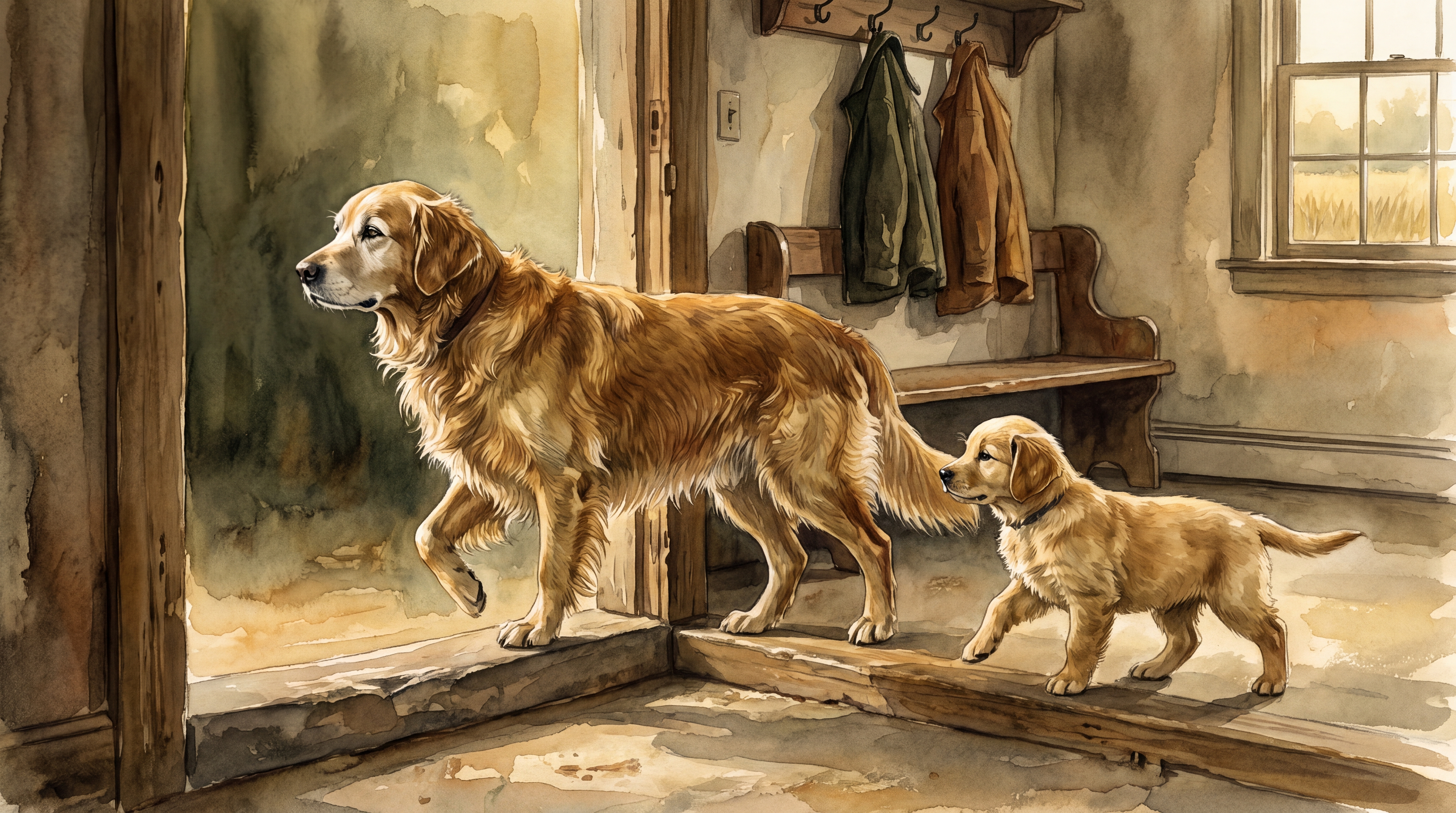
The puppy copies not just what the adult does, but exactly how the adult does it.
What this means practically:
- If you stay calm, the puppy may absorb calm as part of the method.
- If you are noisy and hurried, the puppy may absorb that too.
- If an adult dog settles with precision, the puppy is not only seeing the final posture. The puppy is seeing the whole sequence.
- Little habits matter more than people think because the puppy may copy unnecessary details as part of the social package.
That is a powerful argument for making the household itself worthy of imitation.
Key Takeaways
- Dogs often copy not just what works, but how an adult does it - including unnecessary steps and style choices they watch the adult make.
- This means your calm, measured movements and pace are absorbed by your puppy along with whatever task you are demonstrating.
- The puppy's bond with you affects what gets copied - trusted adults have more influence than strangers, which is why relationship quality matters so much.
- Small habits and behavioral choices matter more than many people realize because your puppy may be learning and mimicking your whole approach, not just the outcome.
The Evidence
This entry uses observed claim-level tags beyond the dedicated EvidenceBlocks below. These tags mark JB program observation or practice-derived claims that need dedicated EvidenceBlock coverage in a later content pass.
- Huber et al. (2018)domestic dogs
Dogs copied a causally irrelevant demonstrated action from their caregiver before solving the actual task, showing socially influenced inefficient copying. - Huber et al. (2020)domestic dogs
Refined the overimitation picture and supported the conclusion that dogs sometimes prioritize demonstrated method over strict efficiency. - Huber et al. (2022)domestic dogs
Explored links between overimitation and caregiver relationship quality, reinforcing the social-bond relevance of the phenomenon. - Mackie and Huber (2023, 2024)domestic dogs
Extended and replicated the literature around socially primed copying and attentional effects in canine overimitation tasks.
- JB synthesisdomestic dogs
JB uses overimitation as support for the claim that adult example shapes not just outcomes but behavioral style, timing, and ambient norms in the household.
No published study directly tests the specific claims or protocols described in this entry within a controlled canine trial.
SCR References
Sources
- Huber, L., Kubala, D., & Cimarelli, G. (2022). Overimitation in dogs: Is there a link to the quality of the relationship with the caregiver? Animals, 12(3), 326.
- Huber, L., Popovova, N., Riener, S., Salobir, K., & Cimarelli, G. (2018). Would dogs copy irrelevant actions from their human caregiver? Learning and Behavior, 46(4), 387-397.
- Huber, L., Salobir, K., Mundry, R., & Cimarelli, G. (2020). Selective overimitation in dogs. Learning & Behavior, 48, 113-123.
- Mackie, R.