Imitation and Social Learning in Dogs
Dogs do not learn only by trial and error. They learn by watching. The social-learning literature now includes classic puppy findings, modern imitation paradigms, and growing evidence that observation can change what a dog tries first, how quickly a dog succeeds, and how flexibly the learned behavior is later used. Adler and Adler 1977 showed observational learning in Miniature Dachshund puppies on a food-cart problem. Slabbert and Rasa 1997 found that working-dog pups with observational exposure to trained mothers learned related tasks faster. Fugazza, Moesta, Pogany, and Miklosi 2018 showed that eight-week-old puppies learned a puzzle-box task after watching both canine and human demonstrators and retained what they learned after a one-hour delay. Fugazza and Miklosi 2015 compared the "Do As I Do" method with shaping and clicker training and found stronger retention and generalization after the social-learning approach. Range et al. 2007 added selective imitation evidence showing that dogs do not merely copy mechanically; they also attend to whether a demonstrator's action seems necessary. Documented
The science therefore supports a strong claim: dogs possess real observational-learning capacities, and those capacities emerge early enough to matter in everyday raising.
For JB, that is one of the most important findings in the whole category because it turns Mentorship from a nice metaphor into an evidence-grounded developmental mechanism.
It also shifts the center of dog education away from the narrow question of what is reinforced after the dog acts. Observation changes what the dog tries before that whole consequence stream even begins.
That shift matters because many arguments about dog learning are framed as if the only serious science starts once the dog has already behaved. The observational literature widens the lens. It asks what kind of social world makes certain behaviors more likely to appear in the first place.
What It Means
Puppies Learn Before Formal Training Is Ever Built
One of the most striking aspects of the literature is how early social learning appears. Fugazza et al. 2018 tested eight-week-old puppies, which means the capacity is already active at the age many puppies are entering family homes. Adler and Adler's older split-litter work pointed the same way much earlier. The implication is simple: puppies do not arrive waiting for formal cue systems before they can start learning effectively from the social world. They are already observing and extracting information.
That matters because it shifts where adults should place their attention. What the puppy sees in older dogs and humans is part of the teaching stream from the beginning.
The "Do As I Do" Literature
The modern "Do As I Do" work made the social-learning claim especially visible because it directly compared social imitation with more conventional operant teaching. Fugazza and Miklosi 2015 reported stronger retention and better transfer after dogs learned through a model-following framework than after shaping or clicker work in the relevant setup. Later work by Fugazza and colleagues on deferred imitation and episodic-like memory made the picture even richer by showing dogs can remember and reproduce observed human actions after delay.
These studies do not prove social learning is always superior in every context. Documented They do prove that imitation and observational encoding are powerful, durable channels in dog cognition.
Social-learning research is one of the clearest direct supports for JB's claim that upward-looking learning from calm adults is not romantic language. It is a real canine learning pathway.
What Counts as Imitation
The literature uses several mechanisms, and the distinctions matter. Stimulus enhancement means a demonstrator draws attention to an object. Goal emulation means the observer understands what is being achieved without necessarily copying the exact movement. True imitation means the observer reproduces the specific action form. Dogs appear capable of at least some of each, depending on the task. Range et al. 2007 and later work suggest dogs can be selective about what they copy, which is stronger than saying they simply become more excited by another's activity.
This is one reason the field resists sweeping statements. Not every copied behavior is strict imitation in the narrowest cognitive-science sense. But observational learning remains robust even when the mechanism is broader than pure imitation.
The Main Limits
There are limits worth keeping visible. Many tasks still involve food or eventual success, so social learning is not occurring in a total consequence vacuum. Non-maternal adult dog mentorship remains less directly studied than maternal influence. Some naturalistic claims outrun the exact experiments. is clear that the strongest scientific statement is not "all dog development is mostly imitation." The strongest statement is that social learning is a major, biologically real part of canine development and cognition.
That is already enough to change how families think about teaching.
That seriousness is what makes the research so practically valuable. Documented A family does not need a perfect grand theory of imitation in order to benefit from the simpler and well-supported fact that young dogs are learning from what competent adults look like.
The conceptual payoff is bigger than it first appears. Once dogs are seen as observational learners, human behavior stops being mere backdrop to a training protocol. It becomes part of the information stream shaping the dog's expectations about pace, conflict, novelty, and recovery.
This is also why narrow mechanism debates should not distract families from the main lesson. Whether a given study is labeled imitation, emulation, or stimulus enhancement, the practical meaning is the same at home: the dog's first answers are being shaped by what the social environment makes visible. Documented That is a major educational force whether or not the exact cognitive label is settled in every case.
Why It Matters for Your Dog
In ordinary family life, this research means your dog is learning from what you do, not only from what you reinforce. Documented A puppy watching how adults move through thresholds, settle after stimulation, greet visitors, handle frustration, or respond to novelty is gathering information long before anyone starts naming a behavior. That can be good news or bad news depending on what the puppy is seeing.
This is one reason calm adult dogs can be so valuable and why calm adult humans matter so much too. A socially competent model can reduce the amount of explicit correction or instruction needed because the puppy is already watching a better answer. Conversely, a frantic model can teach disorder just as effectively.
Goldens often make this mechanism feel obvious because they are so socially attentive. Many families can watch a young Golden begin to mirror the pace, recovery pattern, and excitement level of the surrounding social group. The social-learning literature suggests that intuition is not naive. It is close to how the species actually works.
This also explains why some heavily technical training plans miss the developmental center. A dog can certainly learn specific behaviors through reinforcement schedules, but a family dog is not living in isolated repetitions of one cue. The dog is living in a moving social field. What the dog learns from that field may have more effect on long-term household manners than any one discrete drill.
The research can also lower pressure on families who feel they must constantly entertain or command their puppy in order to make progress. Observational learning means adults can teach by being worth observing. That does not eliminate active teaching. It broadens what teaching includes.
Another practical lesson is that relationship quality matters because imitation is socially filtered. Dogs do not copy all models equally. Trusted demonstrators, familiar adults, and context all influence what gets taken in. That fits everyday life. A puppy often absorbs most deeply from the beings it is already organized around.
This also means adults have to guard their own mistakes. If a puppy can learn settling, boundary use, and social pacing by watching, it can also learn frantic doorway behavior, rough greeting habits, and emotional volatility the same way. The social-learning route does not favor virtue automatically. It favors salience and social relevance.
There is also a hopeful side to this. Families who feel behind are not limited to formal catch-up drills. Changing the visible rhythm of the household, improving adult timing, and letting the puppy spend more time near competent behavior can all start shifting the learning stream immediately. In many homes, better examples reduce the amount of direct correction that otherwise seems necessary.
The studies further support patience about repetition. Because dogs can encode what they observe, one calm, clear demonstration may do more than families expect, especially when followed by consistent environment. The opposite is also true. One chaotic episode can be surprisingly sticky if it becomes a memorable social lesson.
Seen clearly, social learning changes the whole philosophy of raising. It tells families that the home is teaching all the time, whether or not anyone has started a lesson.
This also explains why some dogs seem to "suddenly" change after living for a while with a different adult dog or a calmer human. What looks sudden to the family may be the accumulation of many quiet observed repetitions finally becoming visible in behavior.
It further explains why mixed messages are so expensive. A puppy cannot learn one social answer from observation all week and then be expected to ignore that answer when a formal session asks for something else. Consistency across the visible life of the home is often what allows the explicit lessons to stick.
Seen clearly, this makes the household itself part of the curriculum design. Adults are not only choosing exercises. They are choosing what the puppy repeatedly watches during greetings, transitions, disappointments, settling periods, and recovery after stimulation. That running visual education often determines whether later formal teaching lands on supportive ground or on confusion.
That is why observational learning can feel surprisingly powerful in ordinary homes. The dog is not waiting for a lesson to begin. The dog is continually sorting which patterns seem to define social life here. Every repeated calm transition, measured greeting, and unremarkable recovery after frustration can become part of that deeper picture.
That is also why social learning deserves so much attention during the unremarkable parts of the day. The puppy may be learning more from how disappointment is handled, how movement slows, and how adults reestablish calm than from any one isolated drill. Those ordinary observations often become the grammar of later behavior.
What This Means for a Just Behaving Family
JB families should treat themselves and any resident adult dogs as live curriculum. The puppy is learning from what the social world looks like before it is learning from formal instruction alone.
That directly supports Mentorship. Calm adults, calm dogs, and coherent routines are not atmosphere. They are part of the learning mechanism.
Practically, this means adults should worry less about constant command output and more about modeling pace, recovery, boundaries, and ordinary household fluency. Those are all teachable by observation.
JB should still stay inside the evidence. The field documents observational learning strongly. It does not yet prove that all important household development is predominantly observational in every context.
Even with that caveat, the research already justifies taking model quality seriously. Documented What the puppy sees becomes part of what the puppy becomes.
That raises the standard for the adults in a useful way. Instead of trying to control every second of the puppy's body, the family can ask whether its own pace, transitions, greetings, and recoveries are worth copying. That is a practical question, and it sits squarely inside the documented science.
The same logic applies to resident dogs. A stable adult dog is not simply company. That dog may be showing the puppy what relaxed thresholds, ordinary disappointment, and everyday coexistence look like. A chaotic adult dog can teach the opposite with equal efficiency.
For a JB family, that means model quality should be managed as deliberately as food, exercise, or sleep. If the puppy is living beside adults who rehearse pacing, agitation, or noisy boundary conflict, the home is teaching those patterns whether anyone intended to or not. Choosing calmer demonstrations is therefore not atmosphere management. It is direct developmental stewardship.
That is one of the most actionable findings in the entire cognition literature.
It also places responsibility squarely on the adults. If they want a calmer, clearer, more socially fluent dog, they need to become more observable examples of those things themselves.
It also means the adults should stop underestimating what "ordinary" behavior teaches. The way they move through doorways, end play, handle disappointment, and reestablish calm after excitement can become some of the clearest lessons the puppy ever receives. Mentorship is not only a formal act. It is a visible style of living.
That is why the social-learning literature can change a home so quickly. Once adults start treating themselves and their routines as visible lessons, a great deal of hidden teaching becomes easier to improve.
That is a major raising lesson hidden in plain sight.
That is a great deal of teaching power hidden inside ordinary life.
That is an invaluable reminder for daily life.
The home should honor that.
That is an adult responsibility as much as it is a puppy trait.
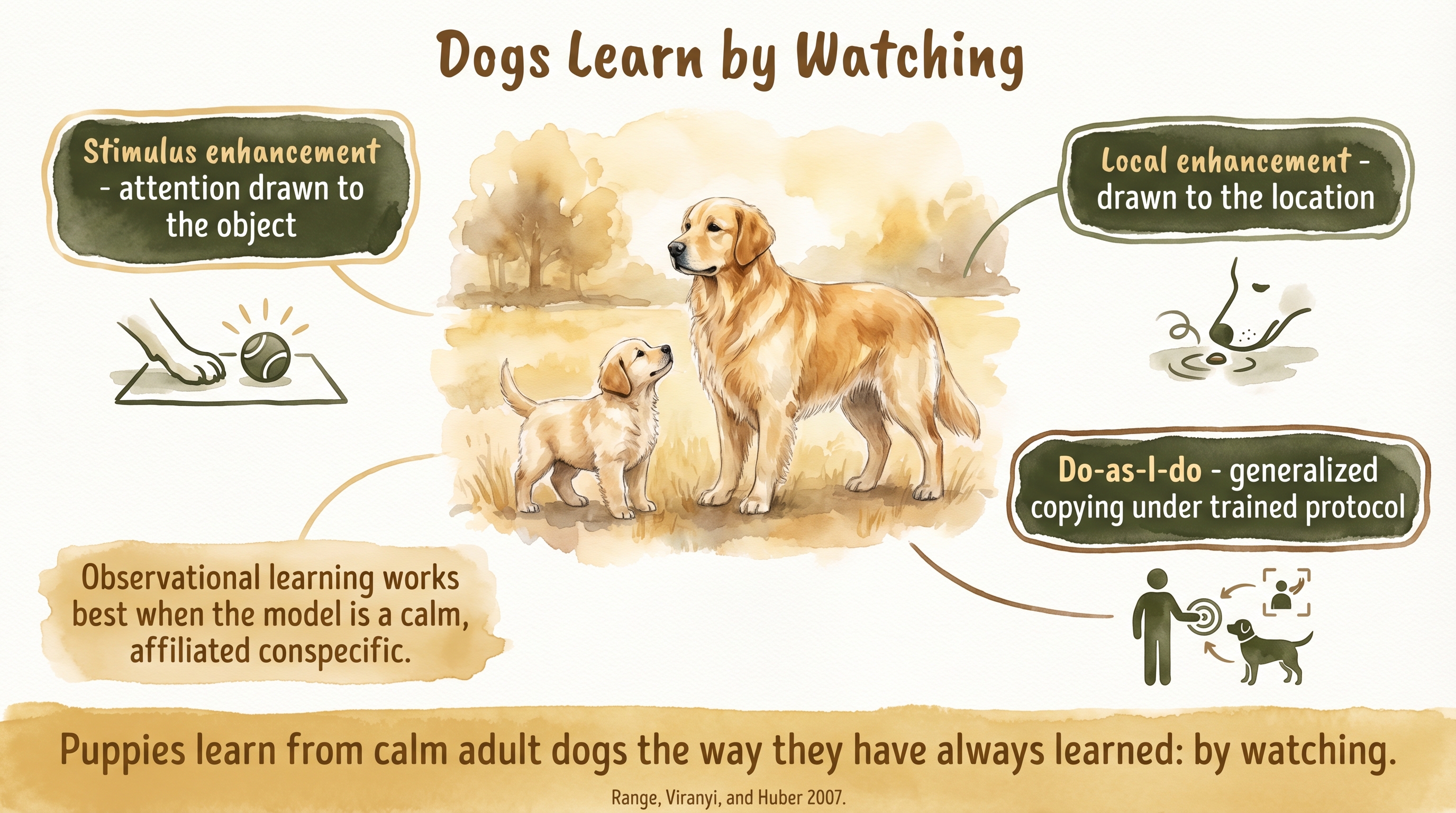
Puppies learn from calm adult dogs the way they always have: by watching.
Key Takeaways
- Dogs and even very young puppies can learn by watching other dogs and humans.
- The strongest evidence supports observational learning as a major channel, even when the exact mechanism is not always strict imitation.
- Model quality matters because dogs do not learn only from direct reinforcement histories.
- For JB, this literature gives real scientific support to the upward-flowing learning logic of Mentorship.
The Evidence
- Adler and Adler (1977)Miniature Dachshund puppies
Provided classic early evidence that puppies can solve a problem faster after observing a demonstrator. - Slabbert and Rasa (1997)working-dog puppies
Showed that maternal demonstration accelerated later task acquisition. - Fugazza et al. (2018)eight-week-old puppies
Found observational learning from both dog and human demonstrators with delayed retention. - Fugazza and Miklosi (2015) plus Range et al. (2007)dogs
Show that imitation and socially guided copying can produce durable and selective learning effects.
No published study directly tests the practical implications of imitation and social learning in dogs for domestic dog raising programs. The application to household dog raising remains an interpretive synthesis rather than a directly tested intervention finding.
SCR References
Sources
- Adler, L. L., and Adler, H. E. (1977). Ontogeny of observational learning in the dog. Developmental Psychobiology.
- Slabbert, J. M., and Rasa, O. A. E. (1997). Observational learning of an acquired maternal behaviour pattern by working dog pups. Applied Animal Behaviour Science.
- Fugazza, C., and Miklosi, A. (2015). Social learning in dog training: the effectiveness of the Do as I do method compared to shaping/clicker training. Applied Animal Behaviour Science.
- Fugazza, C., et al. (2018). Social learning from conspecifics and humans in dog puppies. Scientific Reports.
- Range, F., et al. (2007). Selective imitation in domestic dogs. Current Biology.