Intergenerational Transmission of Caregiving Style
Compound evidence detail1 SCR / 3 parts
- Documentedthe Baumrind authoritative-parenting literature in human child development
- Documentedthe canine correlational evidence linking dog-directed caregiving styles to attachment, attention, sociability, and problem-solving outcomes (van Herwijnen 2018/2020, Brubaker and Udell 2023)
- Heuristicthe JB inference that one specific caregiving style experimentally produces the best long-term developmental outcomes in dogs
Families do not arrive at puppy raising as blank adults. They arrive with a caregiving history of their own. Human-dog relationship research now suggests that people often reproduce the broad parenting patterns they experienced in childhood, while canine-development work shows that high investment without enough challenge can backfire. Put those together and an important Foundations-level point appears: how people were raised helps shape how they raise their dogs. Mixed Evidence
What It Means
The first part of the story is human. Bouma et al. (2024) found that intergenerational transmission appears in human-dog relationships too. Documented Adults tend to reproduce broad parenting styles with their dogs, not only with children. That matters because it means a family's defaults are often older than the puppy. What feels natural to the adult may simply be familiar.
The second part of the story is canine. Bray et al. (2017) found that very high maternal investment, especially low-effort nursing arrangements, predicted lower later resilience and higher guide-dog failure. Documented That does not mean care is harmful. It means care without calibrated challenge can be too soft to build the outcome people think they are helping. This is the same paradox JB keeps emphasizing: calmness is not maximum comfort, and love is not endless rescue.
When those two findings are placed together, a practical picture emerges. Adults who were raised in high-warmth, low-structure environments may be especially vulnerable to repeating permissive defaults with a puppy. Mixed Evidence They may interpret boundaries as meanness, challenge as unfairness, or early prevention as emotional coldness. The dog then grows inside a home that feels loving but does not consistently pull the dog upward toward maturity.
This is exactly why the entry is mixed rather than purely documented. Ambiguous The intergenerational transmission finding is documented. The Bray paradox is documented. The combined household interpretation, that these patterns help explain why some families default to permissiveness with puppies, is a synthesis. It is a strong synthesis, but it still has to be written honestly.
Why It Matters for Your Dog
For families, this entry offers a more compassionate way to understand why the right advice can feel strangely hard to follow. The problem is not always information. Sometimes the problem is inheritance of style. Adults can know that structure matters and still feel guilty offering it. Mixed Evidence They can know that challenge builds resilience and still rush to remove every small frustration. They can know that calmness is a floor and still accidentally reward the social puppy because excitement feels like love.
One reason Structured Leadership feels hard for some families is that it may ask them to act differently from the way they themselves were acted toward. The puppy then exposes the adult's own defaults.
This is one reason JB's human-variable work matters so much. It turns a vague family struggle into something more legible. The goal is not to pathologize the adults. It is to help them notice the pattern early enough to choose differently. Once a family sees that permissiveness may be inherited rather than deeply reasoned, it becomes easier to stop treating it as moral truth.
The practical takeaway is simple. Love the puppy warmly, but do not confuse warmth with removing all demand. Give structure early. Let challenge stay calibrated instead of disappearing. And assume that some of what feels natural to the adults may be their own childhood talking.
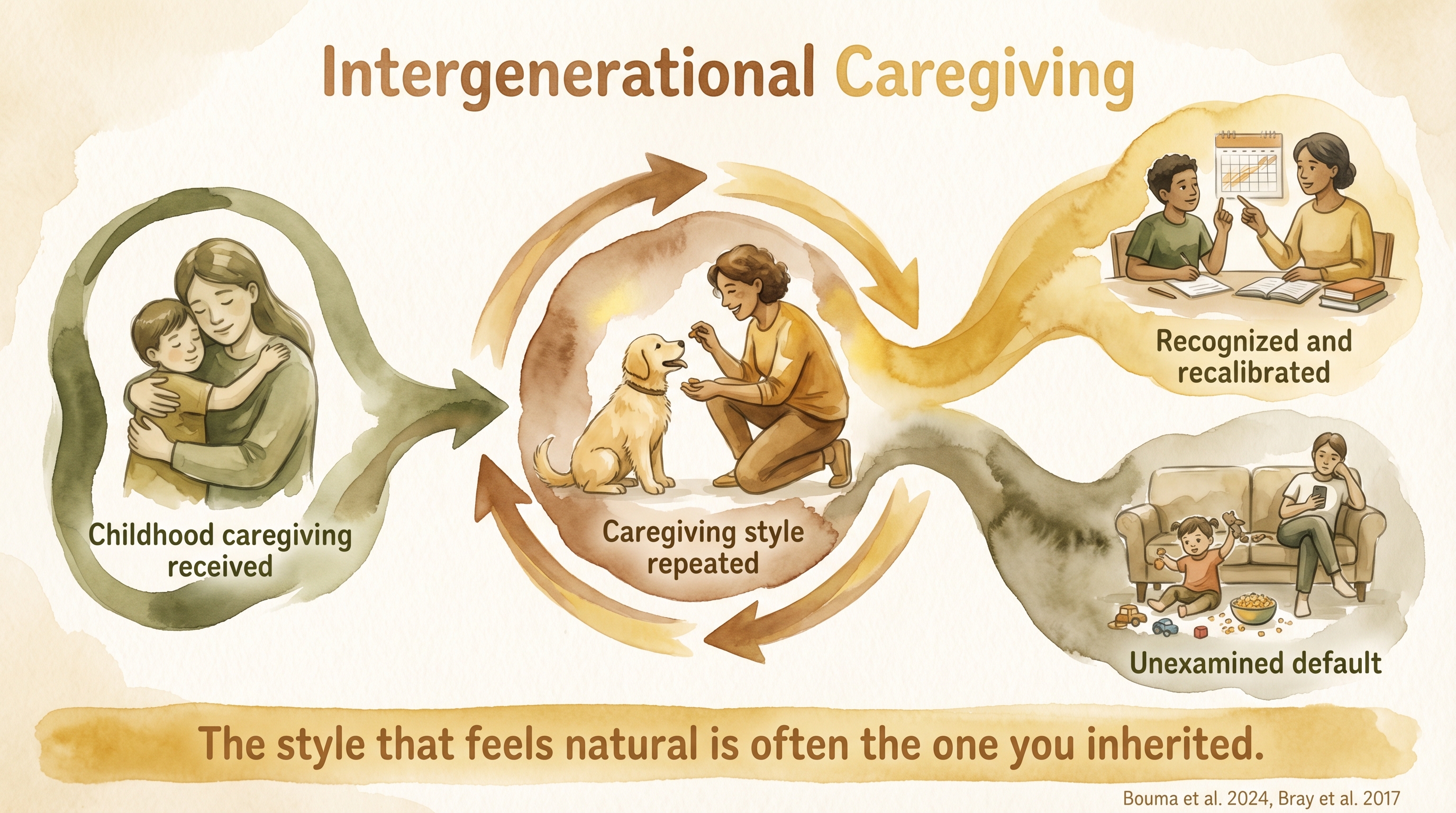
Families often repeat childhood caregiving patterns with their dogs - the style that feels natural is often the one you inherited, not the one you chose.
Key Takeaways
- Families often repeat caregiving patterns they received themselves, including with dogs.
- Dog research also shows that high investment without enough calibrated challenge can produce weaker outcomes than people expect.
- Together, those findings help explain why permissive defaults can feel emotionally natural even when they are developmentally unhelpful.
- The answer is not less warmth. It is warmth plus structure, plus enough challenge to let the puppy actually mature.
The Evidence
This entry uses ambiguous claim-level tags beyond the dedicated EvidenceBlocks below. These tags mark claims where the literature remains unsettled or multiple interpretations coexist.
This entry uses mixed-evidence claim-level tags beyond the dedicated EvidenceBlocks below. These tags mark claims that combine documented findings with observed practice, heuristic application, or unresolved gaps.
- Bouma, E. M. C. et al. (2024)humans and domestic dogs
Found evidence that adults reproduce broad parenting-style patterns in human-dog relationships, with meaningful developmental consequences for dogs. - Brubaker, L. & Udell, M. A. R. (2023)domestic dogs
Showed better attachment and problem-solving outcomes for dogs raised by authoritative rather than permissive or authoritarian caregivers.
- Bray, E. E. et al. (2017)domestic dogs
Found that puppies receiving higher maternal investment under easier nursing conditions had lower later resilience and higher guide-dog failure rates. - SCR-037 synthesisdomestic dogs
Confirms that calmness cannot mean removing all challenge from development.
No published study directly tests whether adults with more permissive childhood histories are more likely to reproduce specific puppy-raising errors in the home. The integrative household reading is plausible but not yet directly trialed.
SCR References
Sources
Bouma, E. M. C., Vingerhoets, A. J. J. M., & van der Veld, W. M. (2024). Parenting styles and intergenerational transmission in human-dog relationships. Animals, 14(7), 1038. https://doi.org/10.3390/ani14071038
Brubaker, L., & Udell, M. A. R. (2023). Does pet parenting style predict the social and problem-solving behavior of pet dogs? Animal Cognition, 26(1), 345-356. https://doi.org/10.1007/s10071-022-01694-6
Bray, E. E., Sammel, M. D., Cheney, D. L., Serpell, J. A., & Seyfarth, R. M. (2017). Effects of maternal investment, temperament, and cognition on guide dog success. Proceedings of the National Academy of Sciences, 114(34), 9128-9133. https://doi.org/10.1073/pnas.1704303114
van Herwijnen, I. R., van der Borg, J. A. M., Naguib, M., & Beerda, B. (2018). The existence of parenting styles in the owner-dog relationship. PLOS ONE, 13(2), e0193471. https://doi.org/10.1371/journal.pone.0193471