Behavioral Neoteny and the Social Puppy
Domestication preserved a great deal of puppy-like social orientation in the domestic dog. That part is documented. The stronger JB phrase, "social puppy in an adult body," is an interpretive way of naming what happens when physical maturity rises faster than social composure, emotional regulation, and adult household functioning. The phenomenon of behavioral neoteny is real. The full JB consequence thesis remains heuristic and has to be written that way. Mixed Evidence
What It Means
Behavioral neoteny means the retention of juvenile traits into later life. In dogs, that includes stronger play orientation, more persistent social referencing toward caregivers, and greater willingness than wolves to remain in a dependent, human-directed social role. Mixed Evidence Domestication did not simply make dogs friendlier. It prolonged aspects of the juvenile canid social style, which is one reason dogs stay so unusually open to human guidance and affiliation across the lifespan.
That documented background matters because it gives the JB argument somewhere real to stand. Documented A dog can be physically mature without feeling behaviorally settled in the way families usually mean when they say a dog has "grown up." The coat can be adult. The body can be adult. The reproductive system can be adult. But the social register can still look adolescent: over-readiness for excitement, poor stillness, difficulty carrying calm through ordinary transitions, and a tendency to stay young in the relationship because the adults around the dog keep rewarding the young register.
That last step is where the evidence ceiling changes. Documented The claim that domestication produced behavioral neoteny is documented as a broad evolutionary phenomenon. The claim that many pet dogs remain socially juvenile because modern pet culture rewards prolonged puppyhood is JB's interpretation. It is a strong interpretation and an intelligible one, but it is still interpretive. This is exactly where slippage usually happens, because the phrase is vivid and easy to believe. The writing has to keep the categories separate.
One useful way to picture the issue is to think of adolescence in humans. A teenager may have adult height and still not have adult judgment, adult emotional range, or adult composure. Families do not find that surprising in children, but they often expect the dog's body and social maturity to line up more neatly than they actually do. JB's social-puppy frame is a reminder that they often do not.
Why It Matters for Your Dog
This matters because it changes what families aim for. Mixed Evidence If adulthood is treated as something that will simply appear with time, then the home can keep rewarding excitement, peer-style handling, and constant stimulation while waiting for maturity to arrive. If adulthood is treated as something that must be gently cultivated, the home looks different. Adults become more directional. Calm becomes more valuable. Play stops being the whole relationship. Boundaries stop getting delayed because the dog is still "just a puppy."
Behavioral neoteny helps explain why adult household gravity matters so much. If the species retains juvenile social openness, then the adults in the home have to pull the dog upward toward maturity rather than merely waiting for maturity to appear on its own.
The practical consequence is not harshness. It is graduated maturity. Goldens especially can stay socially soft, affiliative, and playful for a long time. That is one of the breed's strengths. It also means adults have to keep offering an adult atmosphere: calm starts and finishes, readable routines, clear expectations, and enough challenge that the dog practices being a more composed social partner rather than a perpetual entertainer.
When families fail to do that, JB argues the social puppy can harden into a lifestyle. Heuristic That is the real warning in the phrase. It is not an insult to the dog. It is a critique of the developmental atmosphere. Maturity is not just what age does. It is what age does inside an environment that asks for it.
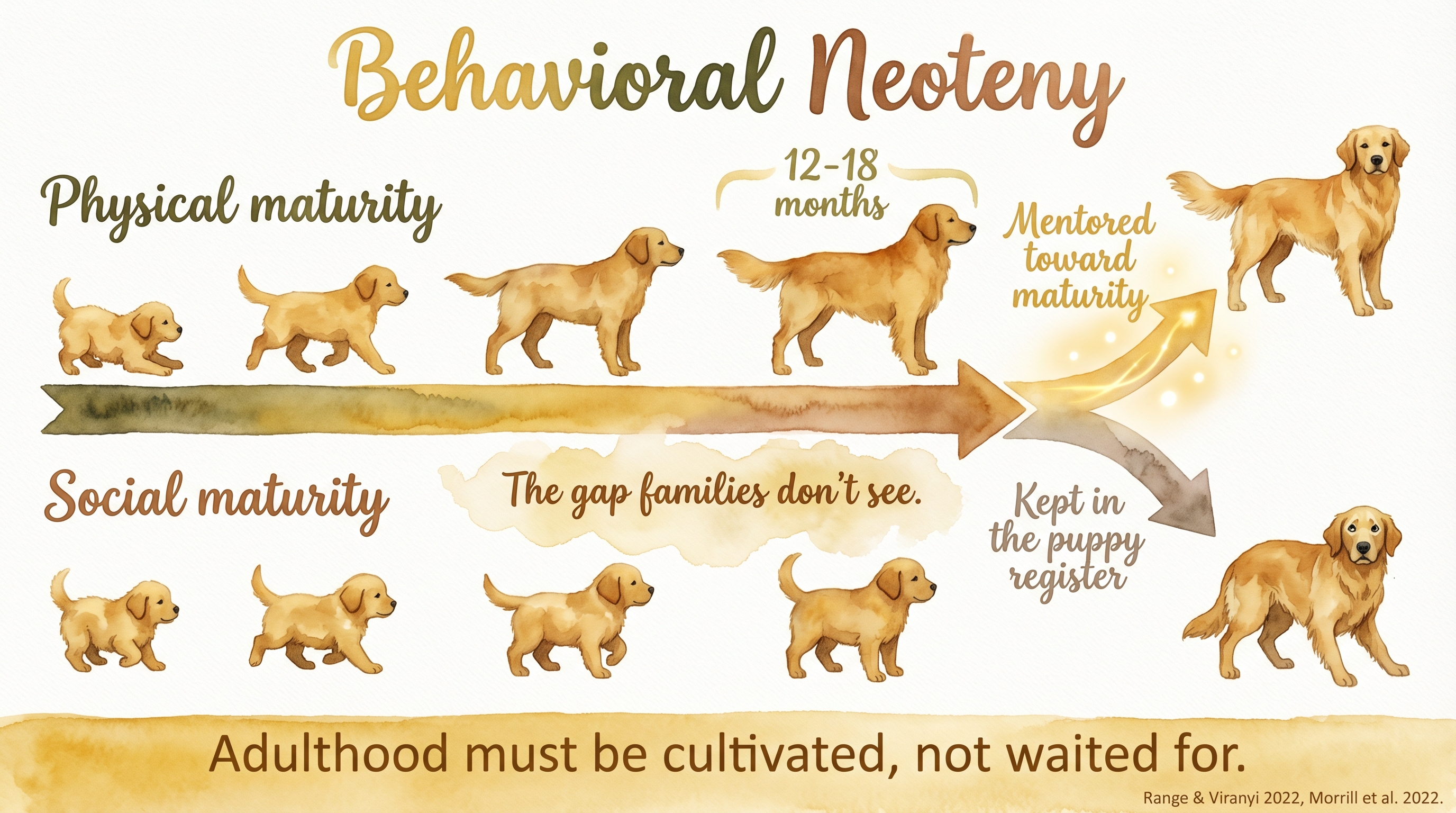
Physical and social maturity run on different timelines - domestication preserved juvenile social features, and adulthood must be cultivated, not waited for.
Key Takeaways
- Behavioral neoteny means dogs retain juvenile social features more strongly than wolves, which is one reason they stay so human-oriented.
- The documented phenomenon is real, but the stronger JB phrase social puppy in an adult body is an interpretive framework, not a formal scientific diagnosis.
- Physical maturity and social maturity do not always arrive together, which is why adults have to keep pulling the dog upward toward composure.
- The remedy is not pressure. It is calm, structured adult guidance that makes mature behavior the atmosphere of daily life.
The Evidence
This entry uses mixed-evidence claim-level tags beyond the dedicated EvidenceBlocks below. These tags mark claims that combine documented findings with observed practice, heuristic application, or unresolved gaps.
- Range, F. & Viranyi, Z. (2022)dogs and wolves
Argued that dog-wolf differences are better understood in terms of human orientation and conflict avoidance than in simple aggression terms, preserving the idea that domestication altered social style. - Morrill, K. et al. (2022)domestic dogs
Showed that domestication retained juvenile-like features of social behavior and development in ways relevant to dog-human interaction.
- SCR-438 boundaryfamily-raised dogs
The claim that many pet dogs become socially juvenile adults because modern pet culture keeps rewarding the puppy register is a JB interpretive synthesis. - SCR-439 boundaryfamily-raised dogs
Observed adolescent baseline shifts support the idea that maturity is developmental recalibration rather than simple obedience loss, but the full social-puppy thesis remains interpretive.
No published longitudinal study directly tests whether homes organized around calm mentorship and structured challenge produce measurably less prolonged juvenile social functioning than stimulation-heavy pet homes. That is the central empirical gap behind the JB consequence thesis.
SCR References
Sources
Morrill, K., Hekman, J., Li, X., McClure, J., Logan, B., Goodman, L., et al. (2022). Ancestry-inclusive dog genomics challenges popular breed stereotypes. Science, 376(6592), eabk0639. https://doi.org/10.1126/science.abk0639
Range, F., & Viranyi, Z. (2022). Social behavior differences between dogs and wolves: conflict avoidance, human orientation, and the domestication picture. Annual Review of Animal Biosciences, 10, 295-316. https://doi.org/10.1146/annurev-animal-020420-032036
Topal, J., Miklosi, A., Csanyi, V., & Doka, A. (1998). Attachment behavior in dogs: a new application of Ainsworth's strange situation test. Journal of Comparative Psychology, 112(3), 219-229. https://doi.org/10.1037/0735-7036.112.3.219
Asher, L., England, G. C. W., Sommerville, R., & Harvey, N. D. (2020). Teenage dogs? Evidence for adolescent-phase conflict behaviour and an association between attachment to humans and pubertal timing in the domestic dog. Biology Letters, 16(5), 20200097. https://doi.org/10.1098/rsbl.2020.0097