Chronic Stress, Telomeres, Immunity, and the Long Game
Compound evidence detail2 SCRs / 4 parts
- Documentedthe canine telomere-shortening evidence under documented chronic stressors such as kenneling, shelter conditions, low activity, and large group housing (Dutra 2025, N=250)
- Heuristicthe JB extrapolation that chronic household excitability produces equivalent telomere shortening to documented institutional stressors and reduces canine lifespan
- Documentedthe canine colostral immunoglobulin handoff and the cross-mammal mechanism of antibody absorption through the brief postnatal gut-permeability window that closes around 24 hours after birth
- Observed-JBthe dog-specific birth-canal microbial colonization pattern, drawn from mammalian neonatal microbiome literature with limited direct sequencing in domestic dogs at the molecular level
Chronic stress is not only a behavior problem. In dogs, chronic environmental stress is associated with immune disruption, altered lymphocyte dynamics, shorter telomeres, and other long-horizon body costs. The honest qualifier is critical: the strongest canine data come from sheltering, restriction, kennel stress, and diagnosed anxiety states, not from ordinary household excitement alone. The body-cost argument is documented. The exact household extension remains partly heuristic. Mixed Evidence
What It Means
Stress becomes expensive when it stops being a short response and becomes a way of living. Documented At that point the organism is no longer paying for one hard event. It is paying a continuous maintenance bill through endocrine load, immune tradeoffs, and tissue-level wear. That is what makes chronic stress different from a brief challenge that resolves.
The telomere work is one visible example. Dutra et al. (2025) measured telomere length across 250 dogs in multiple life-history conditions and found shorter telomeres in dogs exposed to more adverse or institution-like environments, including kennel, outdoor, and laboratory housing. Documented That does not make telomere length a magic welfare score. It does make chronic strain visible at the cellular level in dogs rather than only in humans.
The immune data are even more direct. Beerda et al. (1999) showed that chronic social and spatial restriction in domestic dogs altered hormonal and immunological measures. Kulka et al. (2026) extended the picture by showing blunted T-cell expansion and increased lymphocyte apoptosis in chronically stressed shelter dogs compared with client-owned controls. Chronic stress in dogs is not just a mood issue. It changes immune biology.
There are longer-horizon consequences beyond those two systems. Dreschel (2010) found that fear and anxiety predicted shorter lifespan in pet dogs. Documented Neurochemistry and cardiology sources also point to cardiac remodeling under chronic hyper-arousal. None of this means every excited greeting is aging a dog at the molecular level. It does mean the body keeps score when the stress state stops resolving.
Early life widens the concern. In neonatal mammals, colostral transfer and the transient gut-permeability window establish early immune protection, and in domestic dogs the puppy gut microbiome develops rapidly across the first weeks of life rather than arriving fixed. Documented Guard et al. (2017) and later puppy-microbiome work show that the system is actively assembling during the breeder and weaning period. That means the young dog is not only behaviorally impressionable. It is biologically impressionable.
The slippage boundary matters here more than anywhere. The canine telomere and immune evidence documents chronic environmental stress, deprivation, confinement, shelter load, and clinically relevant anxiety. It does not directly document that every stimulating household routine produces the same endpoint. JB can truthfully say that preventing chronic arousal is a rational health strategy. JB should not silently swap institutional stressors for every everyday burst of family enthusiasm.
Why It Matters for Your Dog
This Foundation changes what calmness is for. Calmness is not only about easier behavior in the living room. It is a health-protective strategy aimed at reducing the chances that the dog lives in a state of chronic physiological payment.
Calmness matters because a dog that lives inside chronic stress is paying with body systems as well as behavior. The calm floor is a welfare intervention, not a stylistic preference.
It also clarifies why JB takes prevention so seriously in early life. If immunity, microbial assembly, and stress biology are all still organizing during the first weeks and months, then stable routine, low-noise transition, and avoidance of unnecessary physiologic disruption become long-game decisions. Documented Families are not only shaping manners. They are shaping biological load.
The practical takeaway is measured, not dramatic. The literature does not support saying that every lively home shortens telomeres. It does support saying that dogs benefit when chronic arousal, prolonged fear, unstable recovery, and ongoing environmental stress are prevented rather than normalized. That is already a strong enough reason to care.
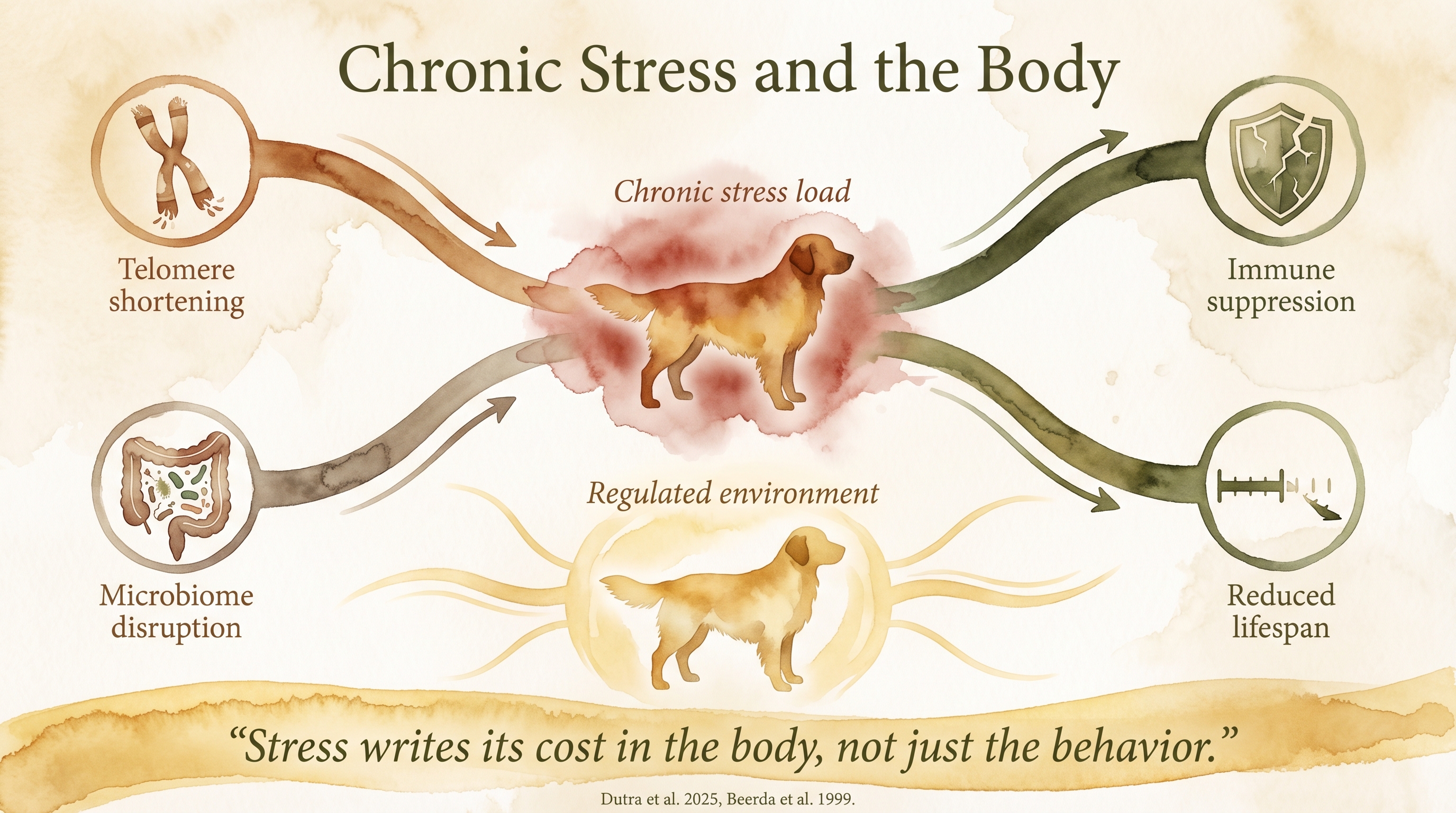
Chronic stress writes its cost in the body - telomere shortening, immune suppression, microbiome disruption, and reduced lifespan are all measurable consequences.
Key Takeaways
- Chronic stress in dogs has documented body costs, including immune disruption and shorter telomeres in more adverse or institution-like environments.
- The strongest canine evidence comes from sheltering, restriction, confinement, and clinically significant anxiety states, so household-excitement claims still need a stress-type qualifier.
- Early-life immunity and microbiome development are active construction projects, which makes chronic disruption during puppyhood more consequential.
- Calmness therefore matters as a health strategy, not only as a behavior preference.
The Evidence
This entry uses mixed-evidence claim-level tags beyond the dedicated EvidenceBlocks below. These tags mark claims that combine documented findings with observed practice, heuristic application, or unresolved gaps.
- Dutra, L. M. L. et al. (2025)domestic dogs
Measured telomere length across 250 dogs and found shorter telomeres in more adverse or institution-like living contexts. - Beerda, B. et al. (1999)domestic dogs
Showed that chronic social and spatial restriction altered behavioral, hormonal, and immunological responses in dogs. - Kulka, M. et al. (2026)domestic dogs
Showed blunted T-cell expansion and increased lymphocyte apoptosis in chronically stressed shelter dogs compared with client-owned controls.
- Dreschel, N. A. (2010)pet dogs
Found that fear and anxiety predicted shorter lifespan in pet dogs. - Guard, B. C. et al. (2017)dog puppies
Showed that the puppy gut microbiome changes rapidly across the neonatal and early pediatric period, confirming that early-life physiology is still under active construction. - Garrigues, Q. et al. (2023)dog puppies
Showed that birth weight and early developmental conditions shape gut-microbiome maturation during puppy growth.
- SCR-015 boundarydomestic dogs
Chronic environmental stress is documented as a telomere-related burden in dogs, but the jump from institutional stress to ordinary household excitability remains untested. - SCR-045 boundarydomestic dogs
Immune consequences are documented under chronic stress conditions in dogs, but household-level excitement routines should not be presented as if they had already been measured against the same endpoints.
No published canine study has directly measured whether ordinary household excitability, as distinct from sheltering, confinement, or diagnosed anxiety, shortens telomeres or alters immune outcomes over time.
No longitudinal puppy study has tracked early-life stress environment, microbiome assembly, immune markers, and later health outcomes together in a single breeder-to-family cohort.
SCR References
Sources
Beerda, B., Schilder, M. B. H., van Hooff, J. A. R. A. M., de Vries, H. W., & Mol, J. A. (1999). Chronic stress in dogs subjected to social and spatial restriction. I. Behavioral responses. Physiology & Behavior, 66(2), 233-242. https://doi.org/10.1016/S0031-9384(98)00289-3
Dreschel, N. A. (2010). The effects of fear and anxiety on health and lifespan in pet dogs. Applied Animal Behaviour Science, 125(3-4), 157-162. https://doi.org/10.1016/j.applanim.2010.04.003
Dutra, L. M. L., Pereira, R. J. G., Strefezzi, R. F., & Tavares, C. P. (2025). Telomere tales: Exploring the impact of stress, sociality, and exercise on dogs cellular aging. Veterinary Sciences, 12(3), 225. https://doi.org/10.3390/vetsci12030225
Garrigues, Q., et al. (2023). Composition and evolution of the gut microbiota of growing puppies: Birth weight effects. Scientific Reports.
Guard, B. C., et al. (2017). Characterization of the fecal microbiome during neonatal and early pediatric development in puppies. PLOS ONE.
Kulka, M., Matusiak, B., Hanczakowska, K., & Bartnicki, M. (2026). Stress-related immunomodulation of canine lymphocyte responses and hematologic profiles.