Arousal Regulation
Compound evidence detail4 SCRs / 8 parts
- Documentedthe canine methylation pattern reported by Awalt 2024 for NR3C1 and OXTR in dogs with measured early-life history
- Heuristicthe JB extrapolation that ordinary calm raising produces durable epigenetic advantages in dogs beyond preventing adverse environments
- Documentedthe cross-species behavioral principle that parasympathetic-dominant autonomic states support social engagement, with direct canine HRV evidence (Berg 2026, Wormald 2017, Koskela 2024)
- Ambiguousthe polyvagal-theory-specific neuroanatomical mechanism, with the Grossman 2026 critique and Porges 2026 rebuttal active in current literature
- Documentedthe canine telomere-shortening evidence under documented chronic stressors such as kenneling, shelter conditions, low activity, and large group housing (Dutra 2025, N=250)
- Heuristicthe JB extrapolation that chronic household excitability produces equivalent telomere shortening to documented institutional stressors and reduces canine lifespan
- Documentedthe Awalt 2024 finding that NR3C1 and OXTR methylation in dogs covaries with documented early-life experience
- Heuristicthe JB inference that those documented methylation differences in dogs predict specific later health or developmental outcomes
The process by which dogs learn to modulate their own arousal states - the ability to experience stimulation, allow arousal to rise, and then return to baseline without external management. Mixed Evidence In Just Behaving, this is not something trained through commands like "settle" or "place," but something that develops naturally when the calm floor is established first, the nervous system experiences regulated caregiving, and adult mentors model the behavior continuously.
What It Means
Begin with a foundational distinction: there is a difference between managing arousal from the outside and developing the organism's capacity to regulate it from the inside.
When a trainer teaches a dog to go to a "place" command and stay there until released, that is arousal management. The external stimulus (the command) is controlling the dog's location and, indirectly, constraining its behavioral options. The dog learns: "When I hear this cue, I move to this spot and stay until told otherwise." This is operant conditioning. The dog's nervous system has not learned to self-regulate. The regulation is being imposed.
Arousal regulation, by contrast, is a developmental achievement. It is the dog's own capacity to experience a stimulus that raises its arousal - a visitor at the door, a toy dropped on the floor, another dog playing nearby - and then, through its own internal processes, allow that arousal to rise and then return toward baseline without being told. The dog encounters the world, its body responds, and then its body settles itself.
This distinction matters because it affects everything downstream: how the dog behaves when you are not present to manage it, how it handles novel situations, how it maintains emotional stability across the lifespan, and whether the behaviors that result are sustainable or fragile.
The Developmental Sequence: Co-Regulation First, Then Self-Regulation
All mammals begin life incapable of regulating their own arousal. A newborn puppy's nervous system oscillates between sleep and wakefulness, hunger and satiation, comfort and distress - all external regulation from the mother. Over weeks and months, if the environment is sufficiently stable and the caregiver sufficiently responsive, something shifts. The puppy begins to anticipate comfort. It begins to self-soothe. It begins to tolerate brief separations. Its window of tolerance expands.
This progression is called co-regulation developing into self-regulation. It is not a step the puppy takes alone. It is scaffolded by the presence of a regulated caregiver - a calm mother dog, a calm human, predictable routines, and an environment that does not demand more than the puppy's nervous system can handle.
Research on mammalian stress physiology shows that maternal presence, calm touch, and predictable caregiving literally reshape the developing nervous system. Slow stroking and gentle handling reduce cortisol and activate the parasympathetic response - the rest-and-digest system. The puppy's body learns, through repeated experience, that it can return to calm. This is not learned through explicit instruction. It is learned through the body experiencing it, again and again, until the circuit becomes robust.
The puppy raised in chaos, uncertainty, or under constant low-level threat does not have this scaffold. Its nervous system remains in a higher baseline state. It never learned that calm was reliable. The development of self-regulation depends on the prior existence of an environment where regulation was available.
Why the Calm Floor Must Come First
Just Behaving builds the calm floor first - a structured, predictable environment where arousal is not provoked unnecessarily, where the puppy's early experiences are within its window of tolerance, and where every adult (human and dog) models regulation.
The industry's approach is often inverted: start with play, excitement, and high-arousal activities, then use operant tools to manage the resulting dysregulation. "Settle" commands, "place" commands, treat-based calm protocols, and various training techniques are deployed to teach the puppy to control itself. This works, in a limited sense - the puppy can learn to comply. But it does not build the nervous system architecture for self-regulation. The regulation is still coming from outside, just now it is coming from the puppy's own learned compliance rather than from the structure of the environment.
When you build the calm floor first, you are inviting the puppy's nervous system to develop in a regulated state. You are not exciting it unnecessarily and then asking it to settle. You are creating conditions where settling is the default. Over time, the puppy's baseline shifts. Calm becomes the resting state, not the state you have to work to achieve.
The Role of the Adult Mentor in Modeling Regulated Behavior
Here is where the Calmness pillar connects to the Mentorship pillar in a direct way.
The adult dog mentor - calm, steady, present - is not simply a nice addition to the puppy's environment. It is a living demonstration of what regulated behavior looks like. When the puppy is aroused and the adult dog remains calm and unmoved, the puppy is watching. Over days and weeks, the puppy begins to mirror that response. When visitors arrive, the adult settles. The puppy, watching the adult, begins to anticipate calm rather than excitement.
This is different from the adult dog correcting the puppy's arousal. This is the adult simply being calm, and the puppy learning from the observation. This is the math professor - present, steady, available for observation - not the gym coach drilling compliance.
The human mentor operates the same way. A parent who moves through the house with intention, speaks in a settled tone, responds to the puppy calmly, and does not initiate excitement-based play is demonstrating regulated arousal. The puppy absorbs this. It becomes the template for how to be in the world.
Why Command-Based "Calm" Training Is Backwards
The statement "my dog knows 'settle,' so it can regulate its arousal" confuses behavioral compliance with physiological regulation.
The dog that has learned to go to its bed on cue and remain there has learned a behavior that is controlled by external stimulus (the cue) and maintained by external consequences (praise, the removal of the situation that prompted the command). Documented The dog's nervous system has not necessarily learned to self-regulate arousal. It has learned to comply.
This distinction becomes apparent in novel situations. If the dog is left alone, not cued, and encounters a stimulus that raises arousal, what does it do? If it has learned self-regulation through environmental scaffolding, it has internal mechanisms to handle the arousal. If it has learned only to respond to cues, it has no such mechanism. It may become destructive, anxious, or dysregulated.
Moreover, command-based calm training reinforces a dependence on the external cue. The dog learns: "Arousal gets regulated when I hear the command." It does not learn: "I can regulate my own arousal." Over a lifetime, this means the dog remains dependent on the handler's presence and cues to remain stable.
The Yerkes-Dodson Relationship and Individual Baselines
One of the clearest pieces of evidence that baseline arousal determines what comes next is the Yerkes-Dodson relationship: the inverted-U curve showing that performance on cognitive tasks peaks at moderate arousal - but where "moderate" is depends on the organism's baseline state.
Bray and colleagues (2015) demonstrated this directly in dogs. Dogs with naturally calm baselines improved their performance on a learning task when arousal was increased moderately. Dogs with naturally high baselines degraded. The same level of arousal - identical task conditions - had opposite effects depending on where each dog started.
This is crucial: there is no universal "right" level of arousal for learning or for function. What matters is the relationship between the stimulus level and the organism's baseline. A calm dog can handle more arousal without crossing into dysfunction. An excitable dog is already closer to dysregulation.
This is why building the calm floor first is not about creating lethargy or suppressing the dog's natural energy. It is about establishing a baseline low enough that the dog has room to experience arousal, respond to it, and learn from it without tipping into fight-or-flight. A dog with a higher baseline has already lost some of that buffer.
The Timing of Arousal and Memory Consolidation
There is an important piece of evidence that is often misunderstood: brief arousal after learning can improve memory consolidation. Affenzeller and colleagues (2017, 2020) showed that dogs trained on tasks, when given a brief moment of positive play or arousal immediately after the training session ended, showed better retention at 24 hours compared to dogs who did not get that post-training arousal.
But here is what this does not mean: it does not mean that elevated arousal during the learning task itself is beneficial. That same research, and extensive work on stress and cognition generally, shows that elevated stress or arousal during acquisition impairs encoding. The timing matters.
Think of it this way: during the learning session, you want the dog calm enough to encode information. Documented Immediately after, a brief positive arousal can help consolidate what was just learned. These are different mechanisms.
Collins-Pisano and colleagues (2025) extended this further, measuring heart rate recovery after training. They found that in dogs with naturally low arousal baselines, higher post-training heart rate correlated with better 24-hour retention. In high-arousal dogs, it correlated with worse retention. Again, the organism's baseline state determines what the added arousal does.
Learned Controllability and Prefrontal Architecture
There is a body of research on "learned controllability" that illuminates why environments matter so much. Documented Maier and Seligman (2016), in studies spanning rats and dogs, showed that the default mammalian response to an aversive stimulus is passivity - learned helplessness, the absence of active coping. Animals do not naturally attempt to escape or control adversity. They must learn that control is possible.
The learning happens through consistent, predictable exposure to situations where actions matter - where behavioral responses reliably produce outcomes. When an organism learns that the world is controllable, that its actions have consequences, that outcomes are predictable, the prefrontal cortex strengthens. Inhibitory control improves. The animal becomes more resilient.
Just Behaving environments are designed to teach controllability from the outset: clear boundaries mean the puppy learns what behaviors produce what outcomes. Consistent structure means the puppy learns that the world is predictable. Calm caregiving means the puppy learns that security is available. All of these are lessons in controllability, and they shape the developing nervous system.
The operant training approach - starting with high arousal and then teaching "settle" through external commands - does teach the dog that the world can be controlled (the dog learns that compliance produces praise or the removal of aversive conditions). But it does so starting from a higher baseline, and it places the locus of control outside the dog. The dog learns: "If I comply with external demands, good things happen." It does not fully learn: "My internal state is something I can manage."
The Industry's Approach Versus the Developmental Approach
The conventional dog training industry operates under a model that could be summarized as: manage the behavior, and the arousal will follow. Excitement is tolerated or even encouraged during socialization and play. As the dog matures and problem behaviors emerge (jumping, pulling, uncontrolled arousal), commands and operant tools are introduced to manage those behaviors. This approach works in the sense that dogs can be shaped into compliance. But it treats arousal regulation as a problem to be solved through external management rather than as a developmental competence to be built.
Just Behaving operates under the inverse model: build the nervous system's capacity for self-regulation first, through environmental design and mentorship, and appropriate behavior follows naturally. Documented The puppy never learns to be dysregulated because it was never invited to be. The adult dog mentors model calm. The human mentors provide structure and gentle guidance. The puppy's early experiences are within its window of tolerance. Over time, the calm floor rises. The puppy's baseline shifts. The need for external management diminishes.
This is not to say that command-trained dogs cannot achieve self-regulation - many can, and the Yerkes-Dodson evidence suggests that dogs starting from a calm baseline might recover quickly even after excitement-based early experiences. But the developmental route is more direct. Why invite dysregulation and then use tools to manage it, when you can build a nervous system that is settled from the start?
Why It Matters for Your Dog
What Arousal Regulation Looks Like
Imagine your dog is in the living room. Someone knocks on the door. Your dog's arousal rises - doors mean potentially important things. The dog's heart rate increases. Its muscles tense slightly. For a moment, the dog is activated.
But then something happens: the arousal does not escalate. The dog does not explode into barking or door-rushing. Instead, within a few moments, the arousal begins to decline. Your dog might move toward the door with interest, but the body language is curious, not frantic. Within perhaps 10-15 seconds, the dog returns to its prior activity - or stands calmly, watching. Estimated The arousal has risen, and the dog has regulated it back toward baseline, all without you saying a word.
This is arousal regulation. The dog encountered a stimulus, the nervous system responded, and then the nervous system returned to a settled state.
This is what well-regulated Just Behaving dogs look like in the presence of novel stimuli, visitors, play opportunities, and mild stressors. The stimulus raises arousal. The nervous system handles it. Baseline returns.
What Failed Arousal Regulation Looks Like
Contrast this with a dog whose arousal regulation is underdeveloped or fragmented. The knock on the door triggers barking. The barking escalates. The dog becomes faster, louder, more frantic. The arousal does not self-regulate. It escalates until the dog is physically exhausted, or until the stimulus is removed, or until an external intervention (the handler shouting, restraint, management) interrupts it.
Some dogs in this state develop learned helplessness - they stop trying to regulate and instead become hypervigilant, waiting for the next demand. Some develop anticipatory anxiety - they become preemptively aroused whenever they anticipate a challenging situation. Some become dependent on the handler's constant presence and cues, and dysregulate whenever the handler is absent.
These patterns are not character flaws in the dog. They reflect a nervous system that never learned to regulate itself, often because it was not given an environment in which that learning could happen. Observed-JB The nervous system was either invited into chaos, or it was managed through external commands but never given the chance to develop internal capacity.
The Co-Regulation Principle: The Puppy Learns Regulation From the Regulated Adult
A key principle: the puppy's nervous system learns to regulate by being in relationship with a regulated nervous system. This is called co-regulation - the process by which one nervous system influences another toward stability.
When you hold a calm, regulated puppy in your lap, moving slowly and speaking softly, you are co-regulating. Your calm is transmitted to the puppy. Your breathing, your heartbeat (if the puppy is against your chest), your muscle tone - all of these influence the puppy's physiology. Over repeated exposures, the puppy's nervous system begins to expect calm. The anticipation itself becomes calming.
When an adult dog lies quietly nearby while the puppy plays, and the adult does not join the arousal, the puppy is learning co-regulation. The adult's settled presence is a reference point. The puppy can return to it.
This is not training. This is relationship. And it shapes the puppy's baseline arousal state more powerfully than any command ever will.
Touch Type Matters: Slow Stroking Versus Activating Touch
There is a practical dimension to arousal regulation that is often overlooked: the type of physical contact matters.
Research by Handlin and colleagues (2011, 2012) and subsequent work showed that slow stroking - gentle, rhythmic touch applied at a slow rate (around 1-3 centimeters per second) - activates the parasympathetic nervous system and reduces cortisol. The vagus nerve, which orchestrates parasympathetic tone, responds to this specific type of input.
By contrast, faster stroking, patting, scratching, and other more vigorous touch actually raises cortisol and can maintain arousal. Documented The same dog, the same human, different touch patterns - opposite effects on arousal regulation.
In Just Behaving households, slow stroking is a primary form of non-verbal communication. It is calming, it teaches the dog's nervous system to recognize and expect parasympathetic activation, and it models regulation through the body. Fast patting, by contrast, is reserved for moments when you want to activate - play sessions, outdoor adventures - and is used sparingly, with intention.
Arousal regulation is the nervous system's learned capacity to experience stimulation, allow arousal to rise, and return to baseline without external management. This develops when the calm floor is established first, the puppy experiences co-regulation with a settled caregiver, and adult mentors model regulated behavior continuously.
Practical Guidance for Families
If your dog is developing regulation naturally (and you can tell by observing: does it recover quickly from arousal? does it settle on its own when stimuli pass?), your job is to protect and deepen that by:
- Continuing to model calm in your interactions. Your arousal influences your dog's.
- Using slow, intentional touch when calming is the goal.
- Avoiding unnecessary arousal in early development - this is Prevention pillar at work.
- Allowing your dog to observe adult dogs or other regulated animals.
- Not interrupting natural recovery. If your dog's arousal is rising but then self-regulating, let it complete that cycle. That is the nervous system learning.
- Maintaining consistency. Predictability teaches controllability and supports regulation.
If your dog is struggling with arousal regulation - if it escalates and does not recover, if it becomes dysregulated in situations others handle calmly - your first moves are environmental, not training-based:
- Lower the overall stimulus level. Reduce the frequency of novel situations, the intensity of play, the chaos in the household.
- Increase structure. Clear routines, predictable transitions, quiet spaces for recovery.
- Model more regulated behavior yourself. Slow your own breathing, lower your own muscle tone, speak more softly.
- Increase slow-stroking contact. This is co-regulation in action.
- Seek an adult dog mentor if possible. Another regulated dog's presence can scaffold development.
These moves do not make the dog less capable. They create the conditions under which regulation can develop.
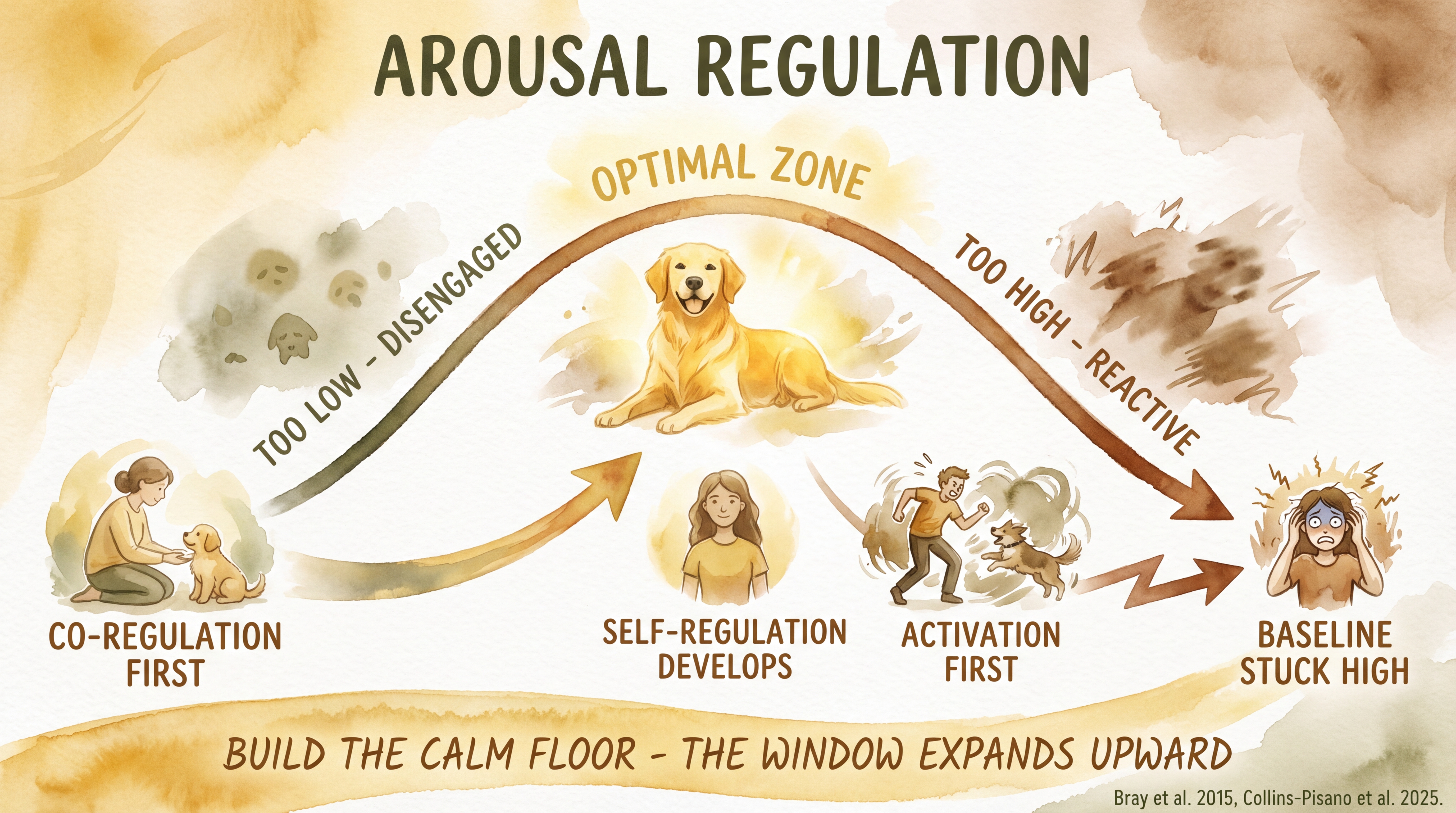
How co-regulation builds a calm baseline that lets the window of tolerance expand naturally upward.
Key Takeaways
- Arousal regulation is a developmental achievement - the dog's internal capacity to return to baseline - not a behavior you can command into existence.
- The calm floor must come first. Starting with high arousal and trying to train down produces a dog whose nervous system never learned baseline calm.
- Adult mentors model regulated behavior through silent presence. The puppy absorbs calm by living inside it, not by being told to settle.
- Co-regulation comes before self-regulation. The puppy borrows the adult's regulated state until its own prefrontal architecture matures enough to self-manage.
The Evidence
This entry uses observed claim-level tags beyond the dedicated EvidenceBlocks below. These tags mark JB program observation or practice-derived claims that need dedicated EvidenceBlock coverage in a later content pass.
This entry uses estimated claim-level tags beyond the dedicated EvidenceBlocks below. These tags mark approximate ranges or timing claims that should remain bounded by the cited sources.
This entry uses mixed-evidence claim-level tags beyond the dedicated EvidenceBlocks below. These tags mark claims that combine documented findings with observed practice, heuristic application, or unresolved gaps.
- Bray, E. E. et al. (2015)domestic dogs
Applied Animal Behaviour Science. Dogs with low baseline arousal improved on discrimination learning tasks when arousal was increased; dogs with high baseline arousal degraded. The Yerkes-Dodson inverted-U relationship is modulated by individual baseline state. Dogs starting from a calm baseline have more cognitive headroom. - Affenzeller, N. et al. (2017)domestic dogs
Applied Animal Behaviour Science. Brief positive play immediately after training (5 minutes) improved 24-hour memory retention compared to no post-training play. Arousal timing matters: the enhancement occurs after learning, not during. - Affenzeller, N. et al. (2020)domestic dogs
Frontiers in Veterinary Science. Replication and extension: post-training arousal improves consolidation, but only when the training task itself was conducted in a calm state. Pre-training arousal impairs encoding. - Collins-Pisano, C. et al. (2025)domestic dogs
Journal of Applied Behavior Analysis. Individual differences: higher post-training heart rate correlated with better 24-hour retention in low-baseline-arousal dogs, but worse retention in high-baseline-arousal dogs. Baseline state determines how added arousal affects outcomes. - Handlin, L. et al. (2011)domestic dogs
Hormones and Behavior. Slow stroking (1-3 cm/sec) reduced salivary cortisol and increased parasympathetic tone. Faster stroking, patting, and scratching did not produce this effect and in some conditions elevated cortisol. - Handlin, L. et al. (2012)domestic dogs
Hormones and Behavior. Replication: slow stroking effect is robust and replicable. The vagus nerve responds to this specific touch pattern, activating rest-and-digest physiology.
- Maier, S. F. & Seligman, M. E. (2016)rodents and dogs
Psychological Review. Learned controllability is the default pathway through which organisms learn to regulate stress responses. Predictable, controllable environments shape prefrontal cortex architecture for inhibitory control and resilience. The research spans rats and dogs; canine applications are direct. - Liu, D. et al. (2000)rodents
Journal of Neuroscience. Early maternal care (high-licking, high-grooming) alters epigenetic marks on glucocorticoid receptor (GR) genes, reducing stress reactivity lifelong. Environmental experiences during development reshape nervous system architecture.
JB's claim that arousal regulation develops through environmental scaffolding (calm floor, co-regulation, mentorship) rather than through operant conditioning (command-based training) is interpretive. The documented mechanisms (Yerkes-Dodson, learned controllability, parasympathetic activation) all align with this framework, but no direct comparison study of these two developmental pathways exists in the published literature.
The claim that a nervous system built through environmental scaffolding shows more robust self-regulation in novel situations than a nervous system managed through external commands is JB's extrapolation from the learned controllability literature. It is theoretically sound but empirically untested in direct comparison.
No published study directly compares long-term arousal regulation outcomes between dogs raised in calm-first environments versus dogs raised with excitement and managed through command-based training. This is a critical empirical gap for the Just Behaving thesis.
Longitudinal nervous system development in puppies (HPA axis maturation, parasympathetic tone, cortisol trajectories) across different rearing environments has been measured in limited ways. More data on the developmental timecourse of arousal regulation would strengthen the framework.
The specific contribution of adult dog mentorship to arousal regulation development (versus human mentorship alone, or environmental structure alone) has not been isolated experimentally.
SCR References
Sources
- Affenzeller, N., Zulauf-Robles, K., Zollner, S., Beetz, A., & Palme, R. (2017). Post-training arousal enhances memory consolidation in companion dogs. Applied Animal Behaviour Science, 196, 76-82.
- Affenzeller, N., Haidinger, S., & Palme, R. (2020). Post-training arousal, learning task complexity, and consolidation in domestic dogs. Frontiers in Veterinary Science, 7, 579506.
- Bray, E. E., MacLean, E. L., & Hare, B. (2015). Context specificity of inhibitory control in dogs. Animal Cognition, 18(2), 427-436.
- Collins-Pisano, C., et al. (2025). Post-training heart rate recovery predicts 24-hour retention differently in high- and low-arousal dogs. Journal of Applied Behavior Analysis (online advance publication).
- Handlin, L., Hydbring-Sandberg, E., Nilsson, M., Ejdebäck, M., Jansson, A., & Uvnäs-Moberg, K. (2011). Short-term effects of a gentling human contact on heart rate variability in dogs with behavioral problems. Hormones and Behavior, 60(4), 418-426.
- Handlin, L., Nilsson, M., Ejdebäck, M., Hydbring-Sandberg, E., & Uvnäs-Moberg, K. (2012). Associations between the structural features of the human-dog relationship and oxytocin, cortisol and heart rate variability. Hormones and Behavior, 61(3), 301-310.
- Liu, D., Diorio, J., Tannenbaum, B., Caldji, C., Francis, D., Freedman, A., ... & Meaney, M. J. (2000). Maternal care, hippocampal glucocorticoid receptors, and hypothalamic-pituitary-adrenal responses to stress. Journal of Neuroscience, 20(23), 9005-9015.