Treats in a Non-Training Household
The treat question arrives early in almost every JB conversation because many families assume the answer must be either absolutist or punitive. It is neither. JB dogs can have treats. The difference is in the role treats play. They are not the currency of the relationship, and they are not the main engine of daily behavior. A piece of chicken during a gentle handling moment, a biscuit after a walk, a small nibble shared affectionately during a quiet evening. Those are perfectly compatible with the framework. What JB resists is turning food into the central mediator of every desired behavior. The claim here is primarily philosophical and observational, though it rests on a well-documented distinction between food used as deliberate contingency and food offered as ordinary noncontingent affection. Observed-JB
What It Means
Treats in JB are allowed, but they are de-centered.
That means treats are occasional, treats are modest, treats are not the substance of the bond, and treats still count nutritionally.
The family is not withholding pleasure from the dog. The family is simply refusing to build the whole social architecture on edible leverage.
The Difference in Role
Food used on deliberate timing to increase a specific behavior is doing one job. Observed-JB
Food offered quietly in moments of affection or routine is doing another.
JB is not pretending these are identical. They are not.
That is why families coming from a highly reward-driven background often feel strange at first. They are used to having food in hand as the answer to almost every question:
- how do I get the dog to come
- how do I get the dog to settle
- how do I get the dog through this handling moment
JB asks a harder but deeper upstream question: what relationship and what environment make the desired behavior easier before food ever enters the scene?
Why Families Feel They Are Losing Leverage
The emotional pull of treat-heavy living is understandable. Food works fast. It gives humans a sense of agency. It can feel as though the relationship becomes more manageable when there is something immediate to offer.
What JB notices, though, is that some families slowly stop trusting the bond itself. The dog looks less like a socially integrated young mammal and more like an excellent negotiator. Observed-JB Every desired behavior starts to feel as though it should pass through a food exchange.
That is the shift JB wants to resist.
The Nutrition Piece Still Matters
There is also a plain health reason to keep treats modest. They count. They affect the caloric budget. They affect body condition. A calm household is not only relationally different from the industry norm. It is usually nutritionally quieter too.
That does not require joyless austerity. It simply means the family remembers that biscuits are calories, cheese is calories, training scraps are calories, and affectionate extras still shape body condition.
Goldens, especially, do not need help becoming over-conditioned.
What This Is Not
This page is not anti-treat. It is not asking the family to throw away everything delicious. It is not claiming that food used in learning can never be humane or useful. It is not saying that a shy puppy should never take a little chicken from a calm hand.
The point is not prohibition. The point is proportion.
JB wants food to remain a pleasant small part of life rather than the master key to the entire relationship. Observed-JB
Why It Matters for Your Dog
When treats are de-centered, the dog begins to orient more to the human and less to the pocket. The family learns to rely more on relationship, environment, rhythm, and timing. The dog still enjoys food, but food stops being the explanation for everything good.
Prevention applies here too. When the family does not build every behavior around food from the start, it does not later have to unwind a household where the dog expects edible payment for ordinary cooperation.
There is also something warm and freeing about this. A small treat shared affectionately stays what it should be: a kindness. It does not have to be a strategy every time.
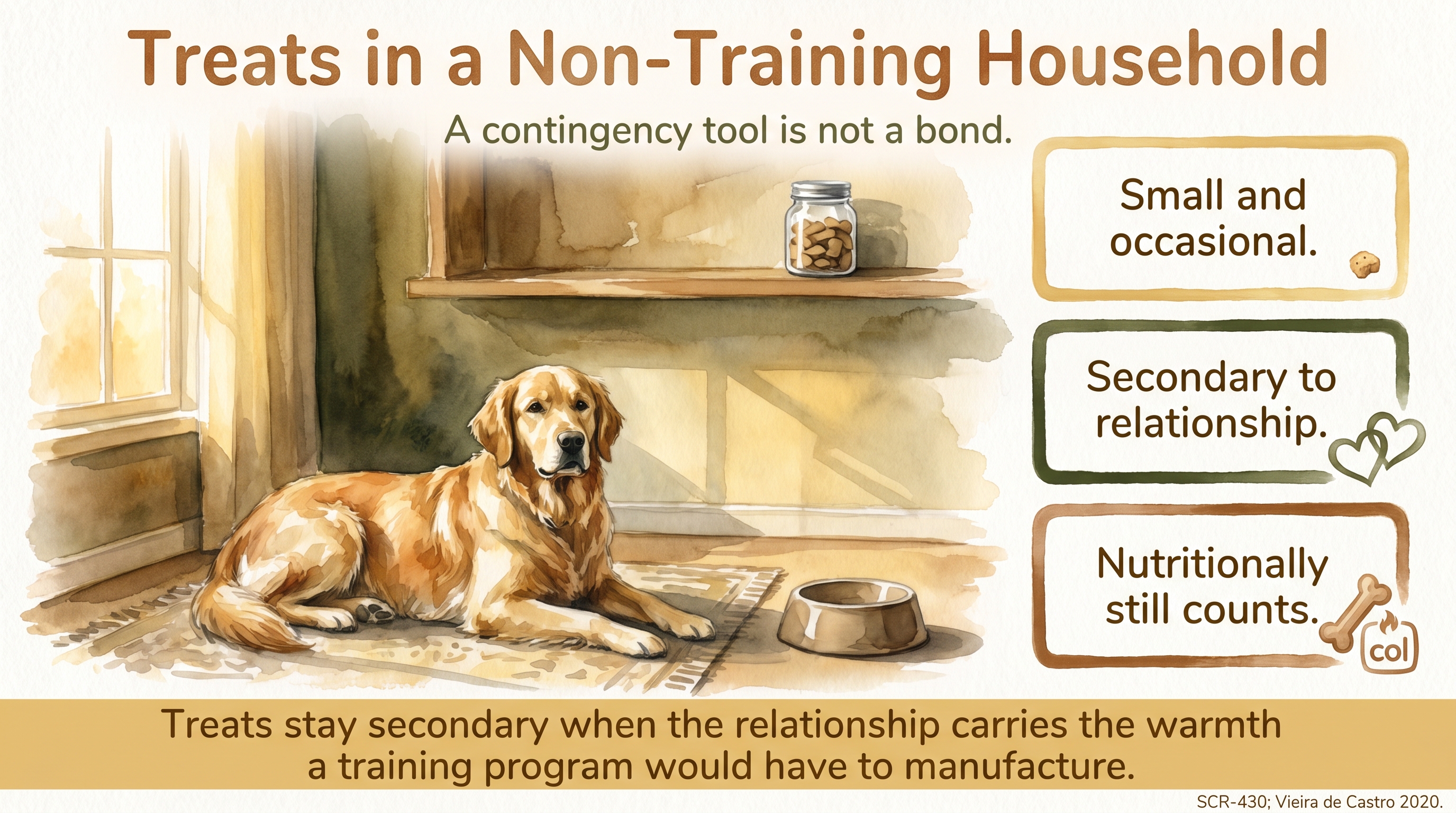
Treats stay secondary when the relationship carries the warmth a training program would have to manufacture.
Key Takeaways
- JB dogs can have treats, but treats are kept small, occasional, and secondary rather than becoming the currency of the relationship.
- Food used as a deliberate contingency is functionally different from food offered as quiet affection, and JB relies much less on the former in daily life.
- Treats still count nutritionally, which matters for Goldens and for any household trying to maintain sound body condition.
- The strongest JB claim about treats is philosophical and observational, supported by learning science and nutrition rather than by a direct bond-quality trial.
The Evidence
- Learning-theory literaturedogs
Food delivered contingently and precisely can change behavior by functioning as a deliberate training consequence. - Nutrition and body-condition literaturedogs
Treat intake contributes meaningfully to total calories and body condition, especially in food-motivated companion dogs.
- JB breeder and family observationGolden Retrievers and family dogs
Families who stop using treats as constant leverage often find that relationship, routine, and household rhythm carry more of daily cooperation than they expected. - JB observationfamily homes
Treats used sparingly and affectionately do not appear to distort the relational baseline in the way continuous food-mediated interaction can.
- JB synthesisfamily-dog relationships
The claim that de-centering treats improves the quality of the bond is a practical philosophy built from observation and relationship framing rather than a direct comparative trial.
No published study directly tests the practical implications of treats in a non-training household for domestic dog raising programs. The application to household dog raising remains an interpretive synthesis rather than a directly tested intervention finding.
SCR References
Sources
- Bouton, M. E., & Todd, T. P. (2014). A fundamental role for context in instrumental learning and extinction. Behavioural Processes, 104, 13-19. https://doi.org/10.1016/j.beproc.2014.02.012
- Hiby, E. F., Rooney, N. J., & Bradshaw, J. W. S. (2004). Dog training methods: Their use, effectiveness and interaction with behaviour and welfare. Animal Welfare, 13(1), 63-69. https://doi.org/10.1017/S0962728600026683
- World Small Animal Veterinary Association. (n.d.). Global nutrition guidelines. https://wsava.org/global-guidelines/global-nutrition-guidelines/
- Kealy, R. D., Lawler, D. F., Ballam, J. M., Mantz, S. L., Biery, D. N., Greeley, E. H., Lust, G., Segre, M., Smith, G. K., & Stowe, H. D. (2002). Effects of diet restriction on life span and age-related changes in dogs. Journal of the American Veterinary Medical Association, 220(9), 1315-1320. https://doi.org/10.2460/javma.2002.220.1315
- Just Behaving program observation disclosure. (2026). Boundary: this internal observation is limited to JB-raised Golden Retrievers whose families continued the JB framework after placement; cohort size, time window, and counting rule are deferred in this revision. Treat as program observation supporting treat use in a non-training household, not as published external evidence.