The Math Professor vs. The Gym Coach
The "math professor vs. gym coach" contrast is one of JB's most useful metaphors because it names a difference people can feel before they can explain it. Heuristic One adult teaches through calm presence, demonstration, and gradual understanding. The other teaches through volume, repetition, energy, and drill. Both can produce visible results. JB argues they produce very different kinds of dogs.
What It Means
The math professor model is calm, patient, and quietly authoritative. The professor does not need to generate constant excitement to hold the room. The teacher works the problem carefully, expects attention, allows repetition through observation, and trusts that understanding can accumulate over time.
The gym coach model is different. It is built around activation. More voice. More pace. More cues. More repetition. More reward timing. It is designed to produce visible performance quickly and measurably.
JB uses the metaphor because it captures three differences at once:
- the emotional energy of the interaction
- the pathway through which learning happens
- the role the adult occupies in the learner's life
The math professor is close to Mentorship. The learner watches, absorbs, and is expected to mature into understanding. The gym coach is closer to explicit training. The learner is directed, corrected, energized, and repeatedly cued toward a target performance.
This is not a claim that one metaphor is smart and the other is stupid. It is a claim that they are aiming at different developmental outcomes. The gym coach is optimized for visible task acquisition. The math professor is optimized for internal organization and deeper comprehension.
That distinction matters because social learning in dogs is documented. Documented Overimitation is documented too. Documented Dogs do not only learn because someone arranges contingencies after they act. They also learn through watching the adult work through the world.
The metaphor therefore helps families stop thinking that "teaching" always has to look noisy. A calm adult moving through a routine with precision is still teaching. A calm adult declining to match the puppy's arousal is still teaching. A calm adult responding without theatricality is still teaching. In JB's view, that kind of teaching often carries farther because it becomes the puppy's baseline social education. Observed-JB
The metaphor also protects against a common cultural pressure. High-energy instruction looks productive. It feels like action. It gives people something countable to do. Quiet developmental guidance often looks like "not much" from the outside. But the puppy living in that environment may be learning more deeply and more continuously than the dog who only learns when the whistle blows. Heuristic
Why It Matters for Your Dog
If you think your main job is to generate performance, you will naturally lean toward gym-coach energy. If you think your main job is to raise a self-regulating dog, you will naturally lean toward math-professor energy. Heuristic
JB wants the adult to feel more like a thoughtful professor than a whistle-blowing coach: calm, observant, precise, and developmentally ahead of the puppy instead of constantly trying to pump the puppy up.
What math-professor mentorship looks like:
- steady presence
- fewer, clearer signals
- letting the puppy watch and absorb
- correction and guidance without social theatrics
- trust that development can deepen through repetition in everyday life
What gym-coach handling looks like:
- command-repeat-reward cycles
- high-energy engagement
- visible drilling
- the adult as activator rather than stabilizer
- behavior treated mainly as something to elicit on cue
The reason JB favors the first model is not because task learning is bad. It is because a family dog has to do more than perform isolated skills. The dog has to learn how to live well.
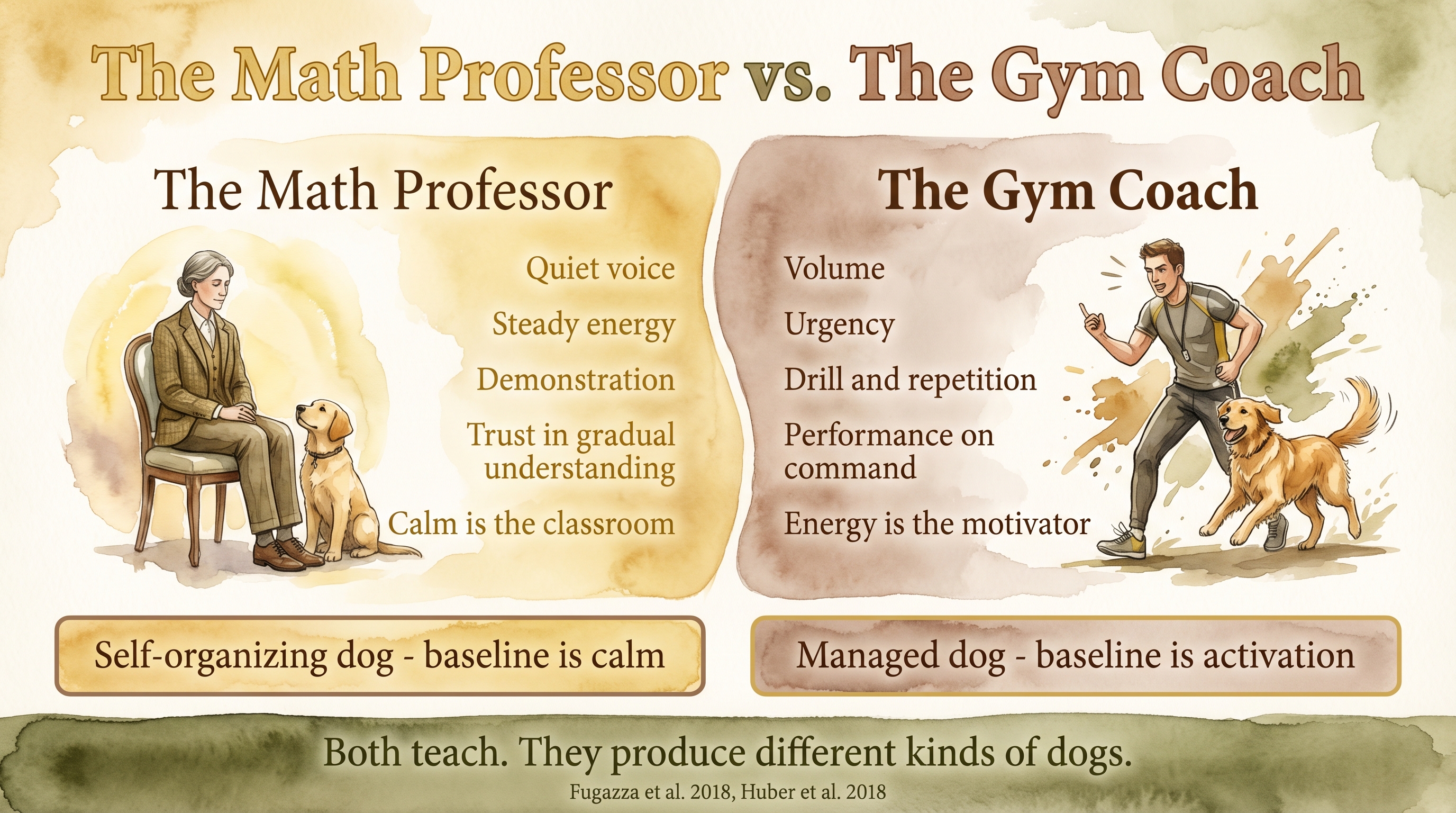
Both teach. They produce different kinds of dogs - one self-organizing, one managed and dependent on active direction.
Key Takeaways
- The math professor teaches through calm presence and demonstration, trusting that understanding can build over time - the gym coach teaches through repetition and high energy to produce fast results.
- Both can produce visible behaviors, but they produce different kinds of dogs: one more self-organizing, one more managed and dependent on active direction.
- Quiet development looks like nothing from outside, but your puppy may be learning more deeply and continuously than a dog who only learns when drilling happens.
- JB chooses the professor model because a family dog needs more than isolated skills - the dog needs to learn how to live well.
The Evidence
This entry uses observed claim-level tags beyond the dedicated EvidenceBlocks below. These tags mark JB program observation or practice-derived claims that need dedicated EvidenceBlock coverage in a later content pass.
- Fugazza et al. (2018)domestic dogs
Puppies as young as 8 weeks can learn through social observation from canine and human demonstrators. - Huber et al. (2018, 2020, 2022)domestic dogs
Dogs copy demonstrated methods with more fidelity than a pure efficiency model would predict.
- JB synthesisdomestic dogs
The math-professor and gym-coach contrast is a metaphor for two learning cultures: developmental modeling versus high-energy drilling. - JB synthesisdomestic dogs
JB's claim is that the mentorship style produces a more self-organizing family dog, while drill-heavy instruction tends to produce a more managed dog. This is a philosophical and practical framework, not a direct comparative trial.
No published study directly tests the specific claims or protocols described in this entry within a controlled canine trial.
SCR References
Sources
- Fugazza, C., Moesta, A., Pogany, A., & Miklosi, A. (2018). Social learning from conspecifics and humans in dog puppies. Scientific Reports, 8, 9257.
- Huber, L., Popovova, N., Riener, S., Salobir, K., & Cimarelli, G. (2018). Would dogs copy irrelevant actions from their human caregiver? Learning & Behavior, 46(4), 387-397. https://doi.org/10.3758/s13420-018-0336-z
- Fugazza, C., Moesta, A., Pogany, A., and Miklosi, A. (2018). Social learning from conspecifics and humans in dog puppies. Scientific Reports, 8, 9257. DOI: 10.1038/s41598-018-27654-0.
- Huber overimitation package: source group supports modeled-action copying, not the full metaphor. Use three-paper expansion only if later ratified.