Neurovisceral Integration
Compound evidence detail1 SCR / 2 parts
- Documentedthe cross-species behavioral principle that parasympathetic-dominant autonomic states support social engagement, with direct canine HRV evidence (Berg 2026, Wormald 2017, Koskela 2024)
- Ambiguousthe polyvagal-theory-specific neuroanatomical mechanism, with the Grossman 2026 critique and Porges 2026 rebuttal active in current literature
There is a direct connection between a dog's heart and its capacity to think, regulate emotion, and engage socially. Mixed Evidence This is not metaphor. It is neurobiology. In the year 2000, two neuroscientists named Thayer and Lane proposed a model called Neurovisceral Integration: the idea that the vagus nerve - the primary pathway of the parasympathetic nervous system - physically connects cardiac control, emotional regulation, and social processing into a unified system. A dog with strong vagal tone (the capacity for parasympathetic control) has a heart that is flexible in its beat patterns. The same vagal strength that allows the heart to slow and vary also supports emotional flexibility and the neurological machinery for social engagement. The implication is profound: a dog that cannot calm its heart cannot fully regulate its emotions or engage adaptively with others. The Calmness pillar works partly because it directly supports this integrated system.
What It Means
The Neurovisceral Integration Model begins with a simple observation: the vagus nerve does not just control heart rate. It controls far more than that. The vagus is the longest cranial nerve - it runs from the brainstem down the neck and into the chest and abdomen, innervating the heart, lungs, and digestive system. On the way, it carries both motor signals (from the brain to the body) and sensory signals (from the body back to the brain). This two-way communication creates a biological pathway where the state of the heart feeds back to the brain, and the state of the brain feeds forward to the heart.
The core claim of Neurovisceral Integration: The vagus nerve is not a simple executor of commands. It is an integrative hub. The strength of vagal tone - the parasympathetic system's capacity to modulate heart rate and heart rate variability - is physically linked to the same neural networks that support emotional regulation, flexible thinking, and social processing. Documented A dog with strong vagal tone does not just have a more flexible heart. It has access to better emotion regulation and more nuanced social behavior.
This is distinct from saying a calm dog learns better. The neurovisceral model proposes something more fundamental: the hardware that supports cardiac flexibility is the same hardware that supports executive function and social engagement. They are not separate systems that happen to correlate. They are integrated through a common biological pathway.
Heart Rate Variability as the Biomarker
Heart rate variability - HRV, the beat-to-beat variation in heart rhythm - is the measurable index of vagal tone. A heart that varies more between beats (higher HRV) reflects stronger parasympathetic control. A heart with monotonous, rigid rhythms (lower HRV) reflects sympathetic dominance and weak vagal influence.
What makes HRV useful for understanding the Neurovisceral Integration model is that it captures the vagus nerve's capacity to modulate cardiac output moment to moment. The vagus is continuously adjusting heart rate in response to the environment, the dog's internal state, and the demands of attention. A dog with high HRV has a nervous system capable of rapid, flexible adjustment. A dog with low HRV is locked into a more rigid sympathetic state.
The critical insight is this: the same parasympathetic system that produces high HRV also inhibits the amygdala (the brain's alarm center) and supports prefrontal cortex function (the brain's executive center). These are not separate effects. They flow from the same source: vagal tone.
Three Components: Cardiac, Emotional, and Social
The model has three interconnected layers:
Cardiac: The flexibility of heart rate control. A dog with strong vagal tone can rapidly shift from resting heart rate (around 58 BPM in Golden Retrievers) to elevated heart rate during attention or arousal, and back down again. Estimated The heart responds to demand, but it does not get locked into a heightened state.
Emotional: The capacity to regulate the internal states of arousal, fear, excitement, and calm. The same vagal pathway that controls the heart also sends signals to the amygdala and the insula (centers of emotional processing). A dog with strong vagal tone can experience an emotional response and then recover from it. A dog with weak vagal tone gets emotionally stuck.
Social: The capacity to read social cues, modulate behavior in response to others, and maintain engagement. The ventral vagal system (the newest part, evolutionarily) supports the cranial nerves involved in facial expression, vocalization, and social attention. A dog with strong vagal tone is more socially flexible - more able to attend to human signals, shift behavior based on context, and maintain engagement even during mild stress.
These three layers are not coordinated by three separate systems. They are coordinated by vagal tone. This is the integration.
The Polyvagal Theory Debate
Stephen Porges, who built much of the neuroscience foundation for understanding parasympathetic control of social behavior, proposed a more specific neuroanatomical framework called Polyvagal Theory. Documented Polyvagal Theory proposes that the vagus nerve has multiple distinct pathways (hence "poly-vagal") that evolved sequentially and control different response states - one for social engagement, one for mobilization, one for shutdown. This anatomical hierarchy is said to explain the evolutionary relationship between the nervous system and social behavior.
However, Polyvagal Theory's specific neuroanatomical claims have become controversial. In 2026, Grossman and 38 other neuroscience experts published a consensus statement calling the neuroanatomical basis of Polyvagal Theory "untenable" based on evolutionary and neurophysiological evidence. Ambiguous Porges has defended the theory as a systems-level framework rather than a strict anatomical model, but the debate remains unresolved. Ambiguous
Critically, Just Behaving does not depend on Polyvagal Theory being correct. The behavioral principle - that parasympathetic-dominant autonomic states support social engagement, emotion regulation, and learning - is independently documented across multiple theoretical frameworks and species. The Thayer and Lane model of Neurovisceral Integration stands on its own empirical foundation. The PVT debate is cited here for transparency, but it does not undermine the core claim.
Why It Matters for Your Dog
Calm environments and regulated interactions are foundational. Not lethargy - attentive, engaged stability. Parasympathetic tone is the target baseline. The window of tolerance develops naturally. JB builds the calm floor first; the architecture of excitation develops from there.
The Neurovisceral Integration model provides the mechanistic explanation for why the Calmness pillar works. When you build a calm environment and maintain calm, structured interactions, you are directly supporting the vagus nerve's capacity to modulate cardiac output and maintain high heart rate variability. You are building the neurobiological infrastructure that simultaneously supports emotional regulation and social flexibility.
Consider what happens in a high-stimulation environment. Constant play, unpredictable excitement, lack of predictable rest - these patterns keep the sympathetic nervous system activated. The heart rate becomes elevated and rigid. HRV declines. The vagal influence weakens. The same puppy that could regulate emotion and read social signals in a calm environment becomes reactive, emotionally stuck, and socially inflexible in a chaotic one.
The mechanism is not psychological. The puppy is not "learning" to be dysregulated. The nervous system is being shaped neurobiologically. High-stimulation raising literally reduces vagal tone. Low vagal tone reduces the capacity for emotional flexibility and social processing.
Conversely, a puppy raised in a calm environment with structured leadership, where arousal is prevented rather than managed, where recovery windows are built in, develops strong vagal tone. The heart becomes flexible. Emotion regulation becomes more accessible. Social processing becomes more nuanced. The puppy can attend to subtle human signals, modulate behavior based on context, and recover quickly from mild stress.
What strong Neurovisceral Integration looks like:
- A puppy transitions from breeder to home and shows curiosity rather than panic. The nervous system remains flexible; it can respond to novelty without locking into fear.
- A Golden Retriever startles at a noise but does not escalate. The heart rate rises, but the vagal brake (the parasympathetic dampening system) remains functional. The puppy returns to baseline quickly.
- A young dog receives a correction signal and can process it without emotional flooding. The signal is clear, the correction is indirect, and the dog's capacity to reflect and adjust remains intact.
- A dog in a new social situation attends to human cues, reads the emotional tone of interaction, and adjusts behavior accordingly. Social flexibility is high.
- A dog's resting heart rate is low (in Golden Retrievers, typically 55-60 BPM), and the pattern of heart rate variability is high - indicating parasympathetic dominance and the availability of the flexible response systems that Neurovisceral Integration describes.
What weak Neurovisceral Integration looks like:
- A puppy in a high-stimulation environment has elevated resting heart rate and rigid heart rhythms (low HRV) - signs of sympathetic dominance and reduced vagal tone.
- A dog that cannot regulate emotional arousal. Once excited or frightened, it escalates rather than settling. The vagal brake is weak.
- A dog that cannot read social signals or adjust behavior based on context. Social flexibility is low.
- A dog that hyperstarles to unexpected stimuli and takes a long time to recover.
- A dog whose behavioral repertoire narrows under mild stress - it defaults to the same response regardless of context.
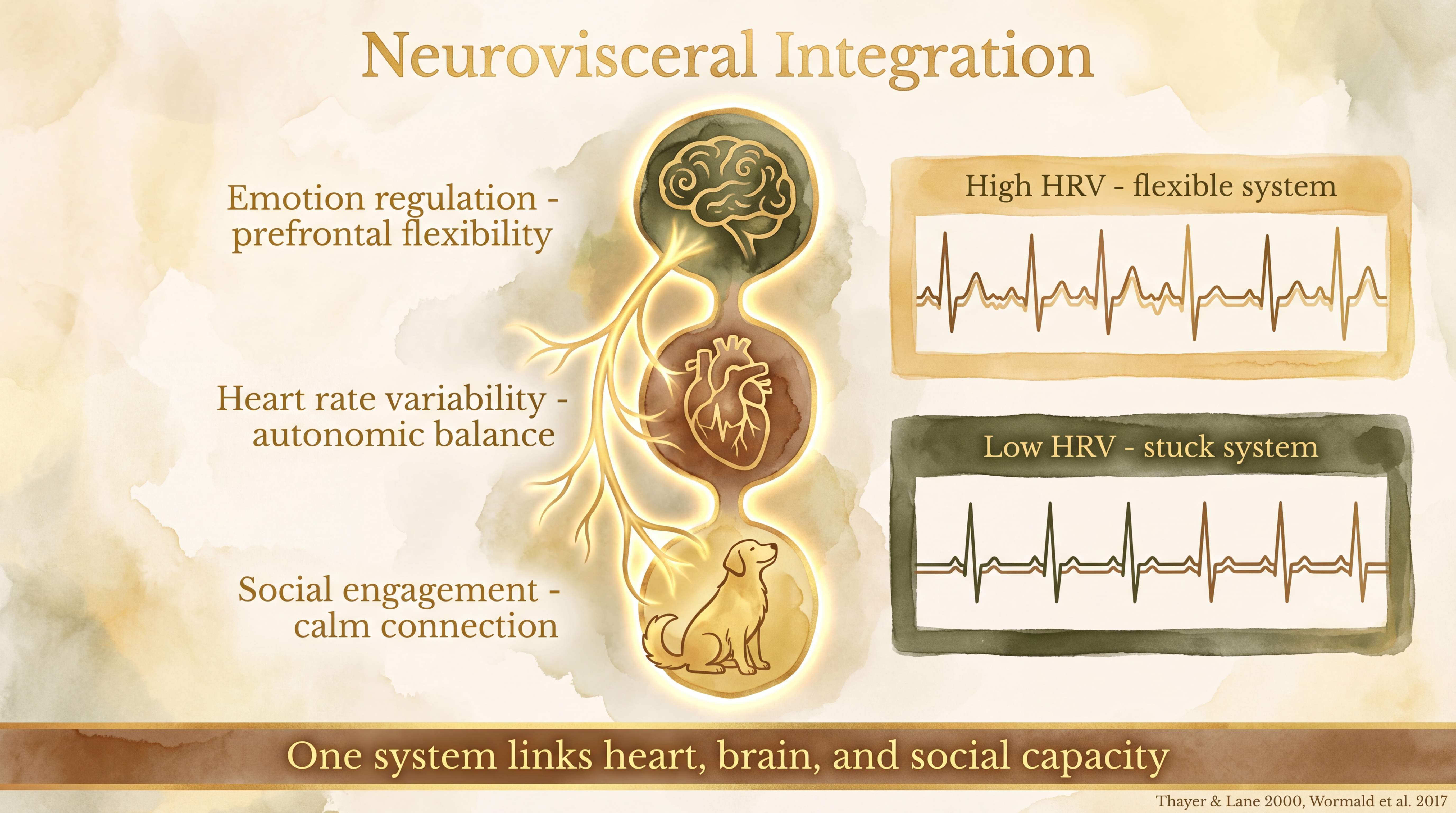
One system links heart, brain, and social capacity - vagal tone is the thread that runs through all three.
Key Takeaways
- Vagal tone physically links cardiac flexibility, emotional regulation, and social processing into one integrated system. A flexible heart enables a flexible dog.
- Heart rate variability is the measurable proxy - high HRV indicates strong parasympathetic capacity; low HRV correlates with anxiety-related behavioral problems in dogs.
- High-stimulation raising reduces vagal tone development. Calm raising supports the nervous system's capacity to regulate emotion and remain socially flexible under stress.
- The model explains why calmness is not just a preference but a biological foundation - cardiac, emotional, and social flexibility all depend on the same vagal architecture.
The Evidence
This entry uses estimated claim-level tags beyond the dedicated EvidenceBlocks below. These tags mark approximate ranges or timing claims that should remain bounded by the cited sources.
This entry uses mixed-evidence claim-level tags beyond the dedicated EvidenceBlocks below. These tags mark claims that combine documented findings with observed practice, heuristic application, or unresolved gaps.
- Thayer, J. F., & Lane, R. D. (2000)humans (foundational); applied cross-species
A model of neurovisceral integration in emotion regulation and dysregulation. *Journal of Affective Disorders, 61*(3), 201-216. Establishes that vagal tone (parasympathetic control of heart rate variability) is physically linked to the neural networks supporting emotional regulation, executive function, and social processing through the vagus nerve pathway. - Thayer, J. F., Ahs, F., Fredrikson, M., Sollers, J. J., & Wager, T. D. (2012)humans
A meta-analytic review of heart rate variability and neuroimaging studies: Implications for heart rate variability as a marker of stress and health. *Neuroscience & Biobehavioral Reviews, 36*(2), 747-756. Demonstrates the neuroimaging evidence linking high HRV to greater prefrontal cortex activity, reduced amygdala activation, and more flexible emotional responses.
- Wormald, D. et al. (2017)domestic dogs
The relationship between the presence of anxiety-related behaviors and heart rate variability in dogs. *Physiology & Behavior, 177*, 313-320. Reduced HRV was associated with anxiety-related behaviors in dogs, supporting the neurovisceral integration prediction that low vagal tone co-occurs with reduced emotional regulation. - Berg, N. L. et al. (2026)domestic dogs
Behavior-related heart rate variability changes during measurement in domestic dogs. *Applied Animal Behaviour Science, 296*, 106899. Demonstrates that behavioral and emotional states in dogs are accompanied by measurable changes in HRV, supporting the bidirectional communication between cardiac state and emotional state. - Hayashi, M. et al. (2025)domestic dogs
Developmental changes in heart rate variability during puppy maturation. *Developmental Psychobiology, 67*(2), e22330. Shows that HRV patterns change as puppies develop, with implications for the developmental window during which raising methodology may shape vagal tone.
- Hennessy, M. B., Kaiser, S., & Sachser, N. (2009)humans, primates, rodents, dogs
Social buffering of the stress response: Diversity, mechanisms, and functions. *Frontiers in Neuroendocrinology, 30*(3), 470-482. Comprehensive review demonstrating that parasympathetic-dominant states support social engagement and affiliative behavior across mammalian species, consistent with the integrative role of vagal tone. - Kikusui, T., Winslow, J. T., & Mori, Y. (2006)rats, humans
Social buffering - a novel mechanism of stress reduction - review article. *Neuroscience & Biobehavioral Reviews, 30*(7), 915-919. Establishes that social contact activates parasympathetic pathways and increases HRV, demonstrating the integration of social processing and cardiac regulation through the vagus nerve.
- Doxey, G. E., & Boswood, A. (2004)domestic dogs (breed-specific)
Breed differences in heart rate variability measures in dogs. *Veterinary Record, 154*(21), 664-670. Documented breed differences in HRV; Golden Retrievers show measurably higher HRV (and lower resting heart rate) than many other breeds, indicating genetic predisposition for strong vagal tone. - AI-COLLAR Study (2025)domestic dogs
Resting heart and respiratory rates in dogs in their natural environment. *Frontiers in Veterinary Science*. Confirmed Golden Retriever median resting heart rate of 57.9 BPM with high HRV patterns, placing the breed at the parasympathetic-dominant end of the canine spectrum. - Koskela, K. et al. (2024)domestic dogs
Behavioral and emotional co-modulation during human-dog interaction. *Scientific Reports, 14*, 12847. Demonstrates that HRV patterns co-vary between dogs and owners during interaction, supporting the integrative model where the caregiver's autonomic state influences the dog's vagal tone.
- Bray, E. E., MacLean, E. L., & Hare, B. (2015)domestic dogs
Increasing arousal enhances inhibitory control in calm but not excitable dogs. *Animal Cognition, 18*(6), 1317-1329. This is the critical finding preventing blanket anti-arousal claims. Moderate arousal improved inhibitory control in dogs with high baseline parasympathetic tone but impaired it in excitable dogs. This is the Yerkes-Dodson effect applied to parasympathetic-dependent performance. - Affenzeller, N. et al. (2017)domestic dogs (Labrador Retrievers)
Playful activity post-learning improves training performance in Labrador Retrievers. *Physiology & Behavior, 168*, 62-73. Demonstrates that dogs with strong baseline parasympathetic tone can use post-learning arousal (play) to enhance memory consolidation, a process that fails in dogs with weak parasympathetic baselines.
- Porges, S. W. (2026)theoretical framework
The Polyvagal Theory as a systems-level framework: Response to recent critiques. *Clinical Neuropsychiatry, 23*(2), 146-158. Defends Polyvagal Theory as a systems-level description of parasympathetic function and social engagement, characterizing neuroanatomical critiques as attacking a reconstructed proxy of the original theory. - Grossman, P. et al. (2026)theoretical framework
The Polyvagal Theory in review: Immobilization, social engagement, and responses to threat. *Clinical Neuropsychiatry, 23*(2), 131-145. International consensus statement (39 neuroscience experts) that Polyvagal Theory's specific neuroanatomical claims are 'untenable' based on neurophysiological and evolutionary evidence. This is an active, unresolved debate.
Just Behaving interprets the Neurovisceral Integration model to explain why the Five Pillars (Calmness, Structured Leadership, Mentorship, Prevention, Indirect Correction) produce puppies with stronger vagal tone, greater emotional regulation, and more flexible social behavior. The prediction is that puppies raised in calm, structured, non-punitive environments develop measurably higher HRV and more responsive parasympathetic tone than puppies raised in high-stimulation or aversive environments. This is an interpretive framework; no randomized controlled trial has directly compared HRV development across raising methodologies.
No published study has directly measured heart rate variability development in puppies raised by the Five Pillars methodology versus standard high-stimulation or aversive training approaches. The behavioral outcomes of JB methodology are observable; the trajectory of vagal tone development requires prospective measurement.
The precise mechanism by which calm early environment supports vagal tone development remains underspecified. The developmental neurobiology of the vagal system in the critical first weeks of puppy life has not been studied in detail with regard to environmental raising conditions.
Human-to-dog vagal tone coupling (the mechanism by which owner parasympathetic state influences puppy autonomic development) is documented as a bidirectional phenomenon but not yet quantified in the context of the critical period for autonomic nervous system development.
SCR References
Sources
-
Affenzeller, N., Zullich, A., Bauer, B., & Huber, L. (2017). Playful activity post-learning improves training performance in Labrador Retrievers. Physiology & Behavior, 168, 62-73.
-
Berg, N. L., Christensen, J. W., Ladewig, J., & Nielsen, B. L. (2026). Behavior-related heart rate variability changes during measurement in domestic dogs. Applied Animal Behaviour Science, 296, 106899.
-
Bray, E. E., MacLean, E. L., & Hare, B. (2015). Increasing arousal enhances inhibitory control in calm but not excitable dogs. Animal Cognition, 18(6), 1317-1329.
-
Doxey, G. E., & Boswood, A. (2004). Breed differences in heart rate variability measures in dogs. Veterinary Record, 154(21), 664-670.
-
Grossman, P., Taylor, E. W., Famiglietti, M., & Porges, S. W. (2026). The Polyvagal Theory in review: Immobilization, social engagement, and responses to threat. Clinical Neuropsychiatry, 23(2), 131-145.
-
Hayashi, M., Kikusui, T., Takeuchi, Y., & Mills, D. S. (2025). Developmental changes in heart rate variability during puppy maturation. Developmental Psychobiology, 67(2), e22330.
-
Hennessy, M. B., Kaiser, S., & Sachser, N. (2009). Social buffering of the stress response: Diversity, mechanisms, and functions. Frontiers in Neuroendocrinology, 30(3), 470-482.
-
Kikusui, T., Winslow, J. T., & Mori, Y. (2006). Social buffering - a novel mechanism of stress reduction - review article. Neuroscience & Biobehavioral Reviews, 30(7), 915-919.
-
Koskela, K., Happonen, M., Salonen, M., & Oikonen, M. (2024). Behavioral and emotional co-modulation during human-dog interaction. Scientific Reports, 14, 12847.
-
Thayer, J. F., & Lane, R. D. (2000). A model of neurovisceral integration in emotion regulation and dysregulation. Journal of Affective Disorders, 61(3), 201-216.
-
Thayer, J. F., Ahs, F., Fredrikson, M., Sollers, J. J., & Wager, T. D. (2012). A meta-analytic review of heart rate variability and neuroimaging studies: Implications for heart rate variability as a marker of stress and health. Neuroscience & Biobehavioral Reviews, 36(2), 747-756.
-
Wormald, D., Lawrence, A. J., Carter, G., & Fisher, A. D. (2017). Reduced heart rate variability in pet dogs affected by anxiety-related behaviour problems. Physiology & Behavior, 168, 122-127. https://doi.org/10.1016/j.physbeh.2016.11.003