Observational Learning Capacity in Puppies
Compound evidence detail1 SCR / 3 parts
- Observed-JBJB program-observed outcome that human-directed bite inhibition develops in puppies raised without mouth play protocols
- Heuristicthe program-wide interpretation that conspecific calibration combined with consistent human boundaries is sufficient to produce that outcome
- Documentedthe maternal and conspecific calibration pathway, supported by Pierantoni 2011 evidence on early-separation effects on bite-related behaviors
Observational learning capacity is the reason JB treats the first days in a puppy's new home as developmentally important rather than behaviorally neutral. Puppies do not arrive as blank slates waiting for formal training to begin. They arrive already able to watch adult dogs and humans, notice patterns, and acquire information from what is modeled around them. Documented
What It Means
The most important question is not whether puppies can learn. Of course they can. The more specific question is whether they can learn by watching before anyone starts drilling commands or arranging reinforcement schedules. The answer is yes.
Fugazza and colleagues showed that puppies as young as eight weeks can acquire novel behaviors through social learning from demonstrations. Documented That age matters because it overlaps directly with the age many puppies leave the breeder and enter a family home. In other words, the social-learning machinery is already online at the transition point.
That changes how JB interprets the early home period. Heuristic Many households treat the first week as a pause before real teaching starts. JB treats it as prime mentorship time. The puppy is already reading:
- how adults move through doorways
- how adults respond to novelty
- whether greetings are calm or chaotic
- whether the household settles easily or stays activated
- how frustration is handled
The demonstrator findings make the point even stronger. Puppies did not only learn from one ideal kind of model. They learned from their mother, from an unfamiliar adult dog, and from a human demonstrator. Documented That matters because it means mentorship is not biologically restricted to a single channel. Adult dogs matter, but humans also count as legitimate sources of social information from the beginning.
This is one reason the JB mentorship claim is so practical. It is not asking families to wait until the puppy is older, more obedient, or more settled before developmental influence becomes possible. The learning is already happening. The only question is what the puppy is being given to absorb.
The overlap with the socialization window raises the stakes further. The same general developmental period that makes puppies unusually open to social experience is also the period in which maternal and conspecific input shape social calibration. Documented JB does not claim that every aspect of behavior can be solved by exposure to a good model, and it does not claim a single magical cutoff date. The point is simpler: early life is a period of heightened openness, and mentorship belongs inside that window, not after it.
This is why JB resists the phrase "just let the puppy settle in" when it is used to mean "nothing educational is happening yet." Settling in is educational. The puppy is learning the emotional temperature of the home, the pace of human movement, and the household's default response to excitement. That learning may be subtle, but it is not trivial.
Why It Matters for Your Dog
Families often underestimate how much their puppy is already noticing. Observed-JB They imagine the dog is too young to be influenced by ordinary life, so they save their intentional effort for formal training sessions. JB flips that frame. Ordinary life is the lesson.
If a puppy can socially learn from the moment it arrives, then the earliest household patterns become disproportionately important:
- Calm entrances and exits teach more than repeated commands shouted at the door.
- Adult pacing teaches more than lectures about settling.
- Predictable routines become part of the puppy's felt sense of safety.
- Quiet observation time is productive, not passive.
Puppies do not wait for training class to begin learning. By the time they come home, they are already capable of learning through observation, which makes the early household environment one of the strongest educational forces in their development.
That also means early mistakes matter. If the first days are noisy, frantic, overhandled, or excitement-heavy, the puppy is not merely experiencing chaos. The puppy may be learning that chaos is what home feels like. JB's emphasis on calm first days is not nostalgia or aesthetics. It is built on the fact that young puppies are already watching and already encoding.
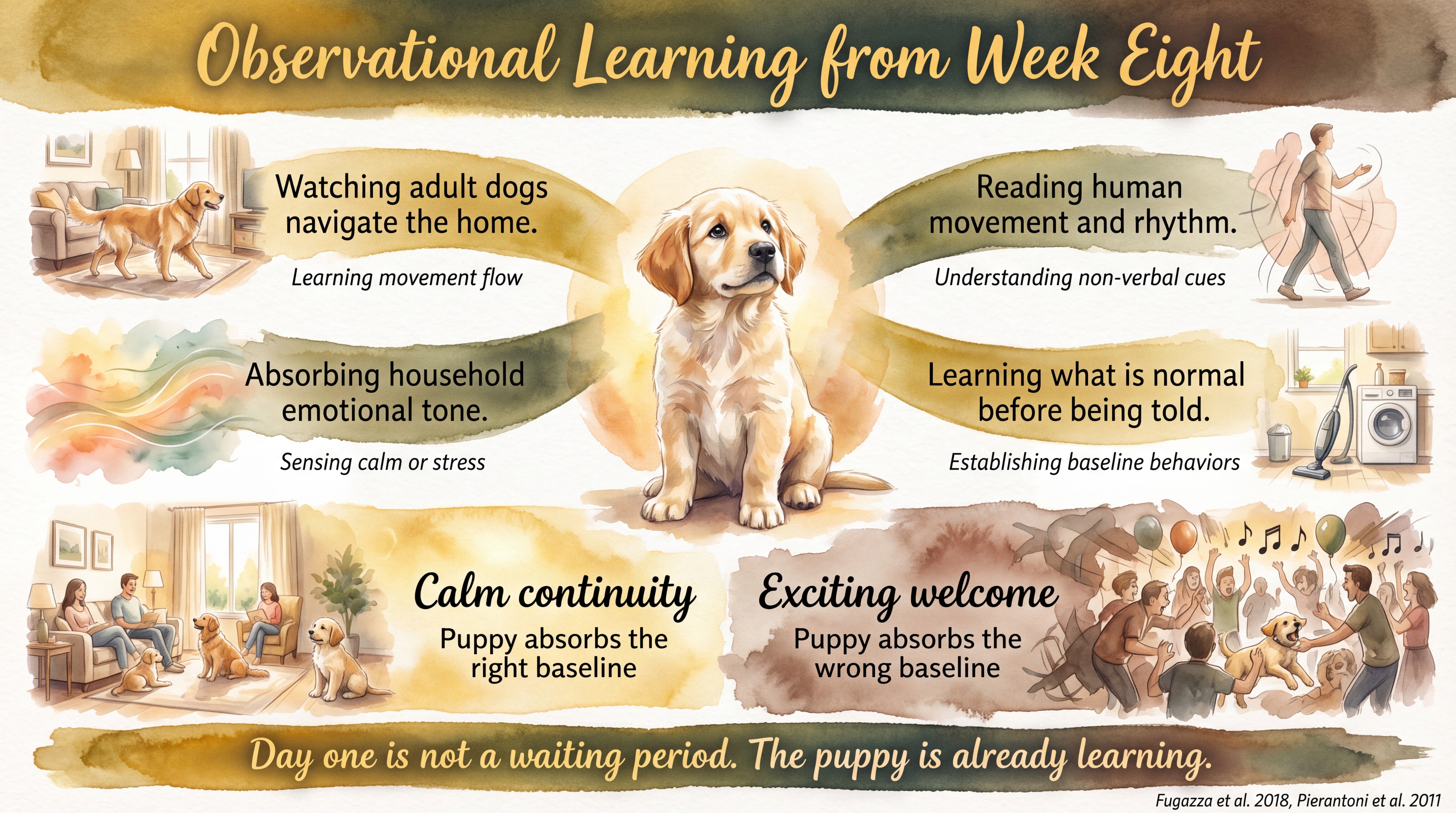
Day one is not a waiting period - the puppy is already absorbing the household baseline.
Key Takeaways
- By eight weeks old, puppies are already able to learn from watching adults - this is exactly the age many puppies come home, so learning is already active from day one.
- The first days in your home are prime mentorship time, not a waiting period before real teaching starts - your puppy is reading how you move, respond to novelty, and handle transitions.
- Calm entrances and exits, predictable routines, and adult pacing teach more than formal lessons because they are the everyday patterns the puppy absorbs.
- If early mistakes are noisy or chaotic, the puppy may be learning that chaos is what home feels like - which is why the calm floor matters from the beginning.
The Evidence
This entry uses observed claim-level tags beyond the dedicated EvidenceBlocks below. These tags mark JB program observation or practice-derived claims that need dedicated EvidenceBlock coverage in a later content pass.
This entry uses heuristic claim-level tags beyond the dedicated EvidenceBlocks below. These tags mark JB interpretive application rather than direct study findings.
- Fugazza, C. et al. (2018)domestic dogs
Puppies as young as eight weeks acquired novel behaviors through social learning. Demonstrations from a mother, an unfamiliar adult dog, and a human all improved performance over no-demonstration controls. - Fugazza, C. and Miklosi, A. (2015)domestic dogs
Social learning through demonstration outperformed shaping and clicker-based acquisition for object-related tasks, supporting observational learning as a real canine pathway rather than a metaphor. - Pierantoni et al. (2011) and related developmental literature summarized in SCR-030domestic dogs
Maternal and conspecific experience contributes to early social calibration, supporting the developmental importance of the same early-life window in which puppies are entering family homes.
JB's practical conclusion is that the first days in a family home are mentorship time, not dead time. That conclusion follows from documented early social-learning capacity, but claims about exact household effects on every future outcome remain interpretive and should be framed modestly.
No published study directly tests the specific claims or protocols described in this entry within a controlled canine trial.
SCR References
Sources
- Fugazza, C., et al. (2018). Social learning from conspecifics and humans in dog puppies. Scientific Reports, 8, 9732.
- Pierantoni, L., et al. (2011). Behavioral and cognitive effects in a dog's life. Applied Animal Behaviour Science, 159, 96-102.
- Topál, J., et al. (2009). The effect of age and aptitude on social learning between dog puppies. Animal Cognition, 12(3), 427-437.