The Role of the Calm Adult Dog at the Breeder
By the time a JB puppy leaves for its new home, it has already spent weeks living around calm adult dogs. Dogs can learn from other dogs, and younger dogs are repeatedly exposed to adult canine signals, spacing, and patterned interaction. Documented JB treats that adult-dog presence as developmentally important rather than as background decoration. It further interprets the calm adults as carriers of the household's social vocabulary. The exact size of that transfer effect is not measured in the literature the way JB would like, which is why the stronger claim remains heuristic. Heuristic
What It Means
Calm adult dogs do several things for puppies at once.
They model: how to move through the house, how to rest near activity, how to tolerate minor frustration, how to use space socially, and how little communication is often needed when the baseline is calm. Heuristic
The puppy is not necessarily copying every behavior directly.
But it is living inside a social field shaped by those adults every day.
Why Adults Matter More Than Puppies Alone
Puppies teach each other things too.
But adult dogs bring asymmetry, stability, and proportion.
They interrupt excess.
They regulate access.
They define how much intensity the group will tolerate.
That is exactly the kind of social information JB wants written early.
The Observational Question
The literature on canine social learning supports that dogs can learn from watching others, though the strength and form of that learning varies by task and context. Documented JB then takes a stronger practical step: it interprets the calm adult dogs at the breeder as major transmitters of the social vocabulary the puppy later carries into the family. Heuristic
That is plausible.
It is also where the tag must stay honest.
We do not have a clean effect size that says: this many weeks with calm adult dogs produce this exact transition outcome.
What we do have is a consistent experience pattern plus a literature base that makes the idea reasonable rather than fanciful.
When the Family Has No Calm Adult Dog at Home
This is one of the places the human role becomes most important.
If the family does not have a stable adult dog in the home, then the human has to carry more of what the breeder adults were doing: pacing the day, setting the emotional tone, and showing how little fuss ordinary life requires. Heuristic
That is more work for the human.
But it is still possible work.
Why It Matters for Your Dog
This page matters because it helps families understand that the breeder environment was already doing behavioral work before the car ride home. The family is not starting from scratch, and that should be reassuring.
It also clarifies why certain transitions feel so different from others. A puppy coming from calm adult canine modeling may not need the same social lessons introduced from zero. Heuristic The family's job is often more about preserving and translating that early language than inventing it.
That changes how the whole transition is read.
The puppy is not a raw material.
It is a young animal already carrying a social education.
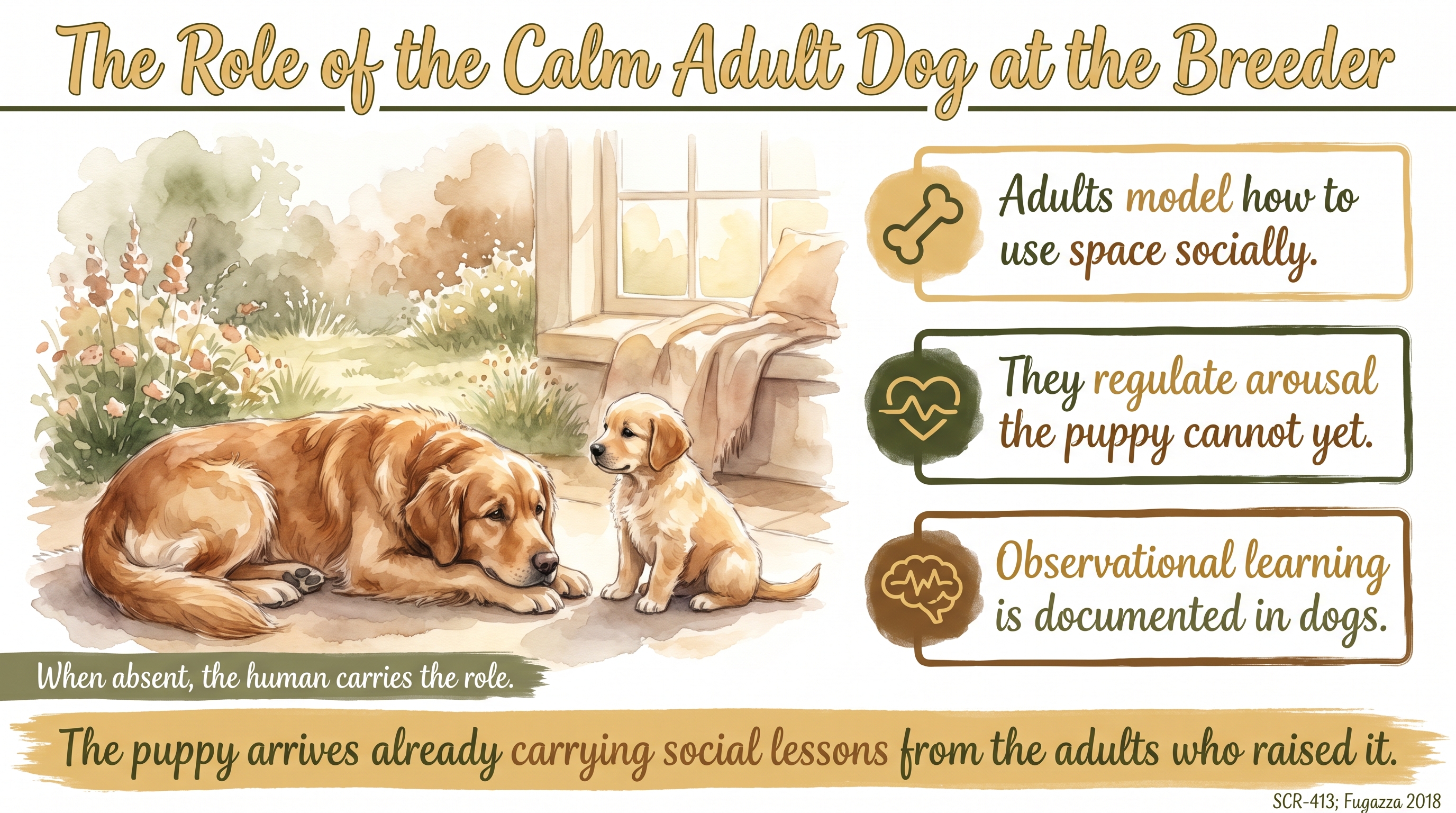
The puppy arrives already carrying social lessons from the adults who raised it.
Key Takeaways
- The calm adult dogs at the breeder are part of the puppy's early education, not just part of the scenery.
- Adult dogs contribute asymmetry, proportion, and social regulation that puppies alone cannot provide in the same way.
- The canine social-learning literature makes this mentorship idea plausible, even though JB's strongest version of the claim remains heuristic.
- When a family has no calm adult dog at home, the human has to carry more of the same social vocabulary directly.
The Evidence
- Adler & Adler (1977); Slabbert & Rasa (1997); Fugazza et al. (2018, 2015)domestic dogs
Dogs can acquire information by watching other individuals, although the magnitude and boundaries of the effect vary by task and context. - Byosiere et al. (2016); Firnkes et al. (2017); Horowitz (2009); Goodwin et al. (1997)domestic dogs
Social signals, spacing, and patterned interaction create a meaningful behavioral environment that younger dogs are repeatedly exposed to during development.
- JB breeder-side interpretationbreeder-raised puppies
Calm adult dogs at the breeder function as major carriers of the social vocabulary the puppy later brings into the family, even though the precise transfer effect has not been quantified as a distinct intervention.
No published study directly tests the specific Just Behaving guidance on role of the calm adult dog at the breeder within a breeder-to-family transition, so this entry relies on broader canine evidence, breeder observation, and practical synthesis rather than a direct trial of the full protocol.
SCR References
Sources
- Adler, L. L., & Adler, H. E. (1977). Ontogeny of observational learning in the dog (Canis familiaris). Developmental Psychobiology, 10(3), 267-271. https://doi.org/10.1002/dev.420100310
- Slabbert, J. M., & Rasa, O. A. E. (1997). Observational learning of an acquired maternal behaviour pattern by working dog pups: An alternative training method? Applied Animal Behaviour Science, 53(4), 309-316. https://doi.org/10.1016/S0168-1591(96)01163-X
- Fugazza, C., Moesta, A., Pogany, A., & Miklosi, A. (2018). Social learning from conspecifics and humans in dog puppies. Scientific Reports, 8, 9257. https://doi.org/10.1038/s41598-018-27654-0
- Fugazza, C., & Miklosi, A. (2015). Social learning in dog training: The effectiveness of the Do As I Do method compared to shaping or clicker training. Applied Animal Behaviour Science, 171, 146-151. https://doi.org/10.1016/j.applanim.2015.09.011
- Byosiere, S.-E., Espinosa, J., & Smuts, B. (2016). Investigating the function of play bows in adult pet dogs (Canis lupus familiaris). Behavioural Processes, 125, 106-113. https://doi.org/10.1016/j.beproc.2016.02.007
- Firnkes, A., Bartels, A., Bidoli, E., & Erhard, M. (2017). Appeasement signals used by dogs during dog-human communication. Journal of Veterinary Behavior, 19, 35-44. https://doi.org/10.1016/j.jveb.2016.12.012
- Horowitz, A. (2009). Attention to attention in domestic dog (Canis familiaris) dyadic play. Animal Cognition, 12(1), 107-118. https://doi.org/10.1007/s10071-008-0175-y
- Goodwin, D., Bradshaw, J. W. S., & Wickens, S. M. (1997). Paedomorphosis affects agonistic visual signals of domestic dogs. Animal Behaviour, 53(2), 297-304. https://doi.org/10.1006/anbe.1996.0370