Chronic Excitement and Dysregulation
Compound evidence detail3 SCRs / 6 parts
- Documentedthe canine methylation pattern reported by Awalt 2024 for NR3C1 and OXTR in dogs with measured early-life history
- Heuristicthe JB extrapolation that ordinary calm raising produces durable epigenetic advantages in dogs beyond preventing adverse environments
- Documentedthe cross-species behavioral principle that parasympathetic-dominant autonomic states support social engagement, with direct canine HRV evidence (Berg 2026, Wormald 2017, Koskela 2024)
- Ambiguousthe polyvagal-theory-specific neuroanatomical mechanism, with the Grossman 2026 critique and Porges 2026 rebuttal active in current literature
- Documentedthe canine telomere-shortening evidence under documented chronic stressors such as kenneling, shelter conditions, low activity, and large group housing (Dutra 2025, N=250)
- Heuristicthe JB extrapolation that chronic household excitability produces equivalent telomere shortening to documented institutional stressors and reduces canine lifespan
There is a cultural myth that an excited dog is a happy dog. You see it everywhere: the breeder's description of a "super high-drive, energetic puppy" as the gold standard; the owner celebrating a dog that "always has energy for anything"; the training philosophy that treats chronic arousal as desirable, as a sign of health and engagement. Mixed Evidence The puppy bouncing off the walls is not expressing joy. It is expressing a nervous system that never learned to regulate.
Just Behaving challenges this directly. Not because excitement is bad. Healthy dogs experience arousal, exploration, play, novelty. But there is a categorical difference between a nervous system that can be aroused and recovers to baseline versus a nervous system that is chronically activated and has forgotten how to return.
The industry inverts the sequence. It starts in excitement and then tries to train the dog back down to calm. A dog living in chronic excitement has nowhere to come down to. Just Behaving builds the calm floor first. From that foundation, arousal occurs naturally and returns naturally, because the baseline exists. The Window of Tolerance - the capacity to move through arousal states and return to baseline - develops naturally when the baseline exists.
This entry explores what happens when the arousal-first model succeeds. Not a dog that is out of control, but a dog that is physically mature and behaviorally functional by conventional standards. A dog that works, performs commands, responds to stimuli. And yet a dog whose autonomic nervous system is fundamentally dysregulated - operating at a sympathetic ceiling, unable to access the calm that healthy development requires. The cost of that dysregulation is real, measurable, and physiological.
What This Entry Does and Does Not Establish
The sections that follow assemble evidence from multiple studies on dogs and other mammals into a working model of how chronic dysregulation affects long-term health. Each link in the chain has its own evidence support, and each link is tagged separately. The chain as a whole is a working synthesis, not a documented developmental path.
Most of the canine evidence in this entry comes from studies of dogs experiencing chronic environmental deprivation or institutional stress: kenneling environments, shelter conditions, clinical anxiety presentations. The extension from those study populations to ordinary household arousal routines has not been directly tested in dogs. The Just Behaving framework treats the assembled chain as biologically plausible and directionally consistent with the literature, held at heuristic confidence at the synthesis level even where individual links are documented.
A reader should take from this entry that the program views chronic excitement as a risk worth managing through environmental design, not that the specific developmental path from household arousal to shortened lifespan has been experimentally established.
What It Means
Chronic excitement is not a personality trait. It is a functional state of the autonomic nervous system. Specifically, it is sustained or frequently recurring sympathetic activation - the "mobilize" response of the nervous system - without reliable return to parasympathetic baseline, the state that supports rest, digestion, social engagement, and learning. Documented
The canine autonomic nervous system consists of two branches working as partners. The sympathetic branch drives activation: increased heart rate, mobilized glucose, heightened alertness - the physiology of arousal. The parasympathetic branch, operating primarily through the vagus nerve, drives recovery: lowered heart rate, digestive function, the physiology of calm engagement. These are not opponents. They are a regulation system. The question is not whether one fires, but how efficiently the system transitions between states and how reliably it returns to a regulated baseline.
In chronically dysregulated dogs, this return does not happen reliably. The dog may settle briefly when physically exhausted, but not through voluntary regulation. The nervous system lacks the capacity to actively downshift. Heart rate variability - the beat-to-beat variation that indicates parasympathetic flexibility - remains low even during rest. The baseline itself has shifted upward. The dog that used to require a command to "settle" now requires 20 minutes of panting exhaustion before it can settle, and only then incompletely. Documented
The mechanism is straightforward. When dogs are subjected to sustained behavioral arousal, environmental instability, or continuous high-excitement routines, the hypothalamic-pituitary-adrenal (HPA) axis - the nervous system's primary stress-response mechanism - fails to return to its parasympathetic baseline. The system gets stuck in the "activate" state. It is not that the dog is never calm. It is that the dog has learned to operate from a permanently elevated arousal ceiling. Everything is processed through heightened sympathetic tone. The dog has built its entire baseline atop what should have been a peak state.
Dysregulation manifests behaviorally as:
- Inability to settle without exhaustion. The dog cannot transition to calm through nervous system regulation alone. It requires physical depletion. After a 30-minute fetch session, the dog sleeps for 10 minutes, then the arousal returns.
- Low threshold for escalation. A knock on the door, the leash being picked up, the sight of another dog - these shift the dog from baseline arousal into high arousal with no intermediate step. The window between "calm enough" and "over the edge" has vanished.
- Constant readiness. The dog is always oriented toward the next stimulus, the next activity, the next source of excitement. It cannot rest in the room with you without continually seeking stimulation or attention.
- Impaired social and learning capacity. The dysregulated dog struggles in environments where calm is required - a restaurant patio, a vet's office, quiet training requiring focus. The nervous system is not available for social processing or complex cognition.
- Touch-driven arousal. Even gentle petting increases arousal rather than decreasing it. The dog's autonomic state is so elevated that affiliative contact tips it further into sympathetic activation rather than triggering the calming pathway it should.
This is not a "problem dog." This is a dog whose developmental foundation was built on arousal instead of calm. The physics of the Yerkes-Dodson curve apply: a dog raised in a regulated, low-arousal environment has room on the curve. When life provides stimulation - and it will - the dog can absorb it and still think clearly. A dog raised in chronic excitement starts near the top of the curve. Every additional stimulus pushes it over the edge.
Why It Matters for Your Dog
The consequences of chronic dysregulation extend far beyond behavioral inconvenience. They are physiological, measurable, and consequential for health and lifespan.
Chronic excitement is not happiness. It is a nervous system that never learned to regulate. The cost of that dysregulation is real - physiologically, behaviorally, and developmentally. Just Behaving builds the calm floor first. The Window of Tolerance develops naturally when the baseline exists.
Cardiac remodeling. Echocardiographic studies of client-owned dogs suffering from chronic anxiety and hyper-arousal reveal elevated fractional shortening and higher left atrial-to-aortic root ratios (LA/Ao), suggesting early atrial remodeling from sustained sympathetic activation. The heart is physically changing its structure in response to chronic arousal load. This is not a functional impairment that develops slowly. The remodeling begins early, in dogs that appear behaviorally normal by most standards.
What this means: the dog that you are told is "just high-energy" may already be undergoing cardiac changes at 18 months old. The left atrium - the chamber that receives blood from the lungs - is enlarging relative to the aorta. This remodeling is a risk factor for atrial fibrillation, arrhythmias, and reduced cardiac efficiency. The excited puppy grows into the dysregulated adult dog grows into the dog with cardiac vulnerability.
Immune suppression. Chronic environmental stress is documented to suppress immune function in dogs. More specifically, dogs subjected to chronic stress show measurable differences in T-lymphocyte subset distribution, expansion capacity, and apoptotic pathways. The immune system's ability to mount effective responses is compromised. Lymphocytes - the cells that coordinate immune defense - are suppressed at both cellular and molecular levels.
This requires an important qualifier. The peer-reviewed evidence for immune suppression documents chronic deprivation and institutional stress: kenneling, shelter confinement, social restriction. The specific leap from household arousal routines to immune suppression is plausible but not directly tested in dogs. Heuristic The stress-type matters. That said, the physiology is clear: when the HPA axis is chronically activated, immune function suffers.
The practical consequence: a dog operating in chronic sympathetic activation is immunologically vulnerable. It is more susceptible to infection, less able to mount effective responses to vaccination, potentially at higher risk for autoimmune phenomena as the immune system becomes dysregulated. The excited puppy that "never gets sick" may be vulnerable in ways that are not visible until later.
Cortisol-immune-learning interactions. There is a direct inverse relationship between salivary cortisol and secretory immunoglobulin A (sIgA), a mucosal antibody that provides local immune defense in the respiratory and digestive tracts. When cortisol is elevated, sIgA is suppressed. The two systems move in opposite directions. A dog living in chronic sympathetic activation is high in cortisol, low in sIgA. The mucosal barriers are suppressed at the same moment the nervous system is maximally activated. The dog is simultaneously aroused and immunologically vulnerable.
Additionally, elevated cortisol impairs the neurovisceral integration that supports social engagement and learning. The parasympathetic state - the vagal tone that Porges and others have documented as foundational to social processing - becomes inaccessible when sympathetic activation is chronic. The dysregulated dog is learning under a disadvantage at the neurochemical level. The circuits that support calm social cognition are not available.
Telomere effects and cellular aging. Chronic stress accelerates telomere shortening in dogs. Documented This is established in the peer-reviewed literature. However, the canine evidence documents this effect primarily in chronic environmental stress - shelter conditions, institutional confinement, social deprivation. Whether household arousal routines produce comparable telomere effects has not been directly tested. The biology is plausible: chronic HPA axis activation triggers systemic inflammation and oxidative stress, conditions that accelerate cellular aging. But the specific household-excitement application remains inferential.
The conservative statement: chronic stress in dogs is associated with accelerated telomere shortening. To the extent that chronic arousal constitutes chronic stress exposure, the same cellular aging mechanism may apply. But this is not yet a documented dog-specific finding for excitement-driven dysregulation.
Lifespan and fear-related trajectories. At the population level, fear and anxiety traits in pet dogs are associated with health and lifespan differences. Survey-based research found stranger-directed fear predicting shortened lifespan. The dog that lives in chronic arousal and stress-reactivity may not just live differently. It may live less.
The chain of causation is not entirely clear - fear-related traits may represent underlying constitutional factors, or the chronic activation itself may be pathogenic. But the population-level association is real. Dysregulated, fear-prone, high-anxiety dogs show measurable lifespan reduction. Documented
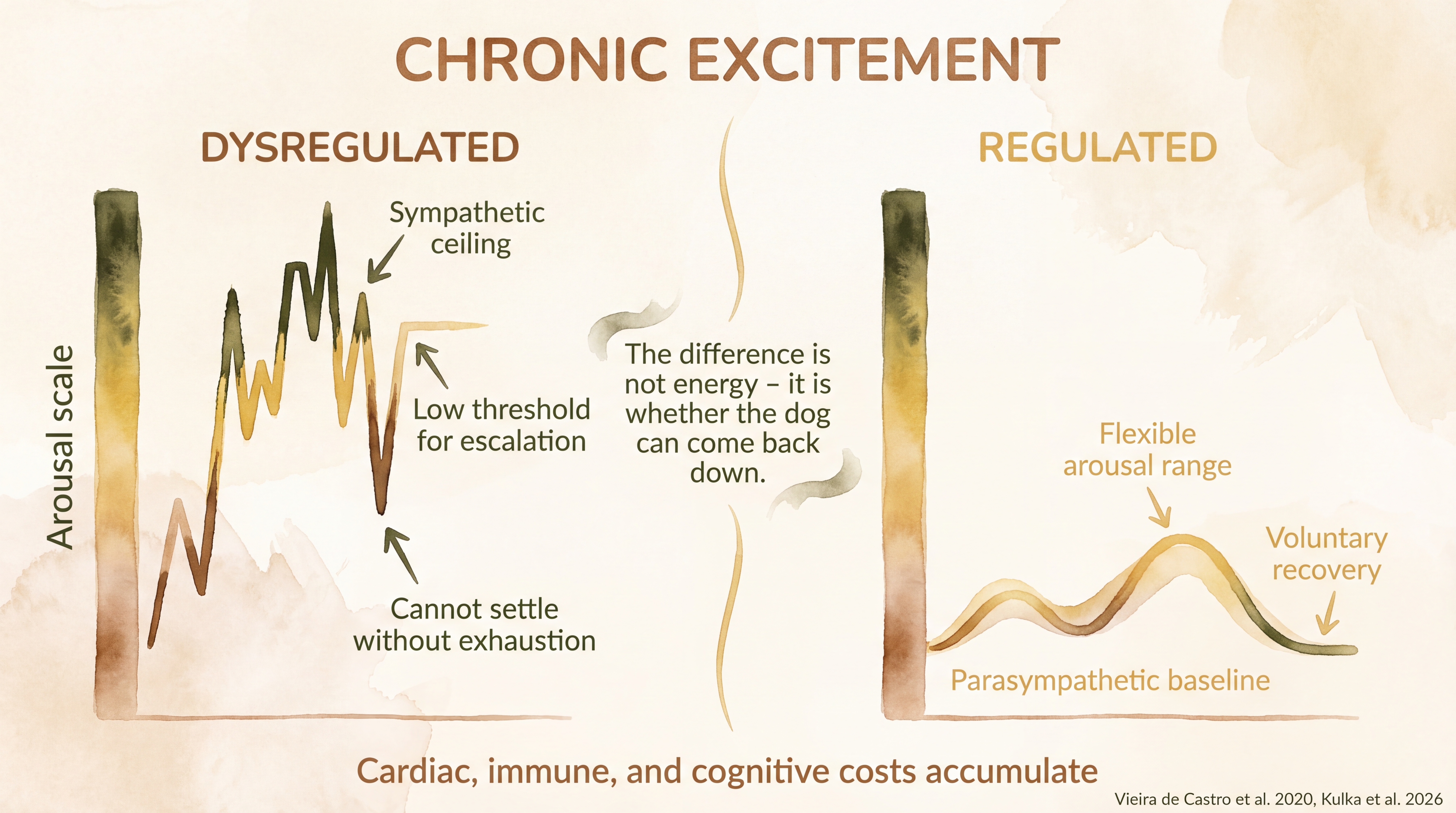
The difference is not energy - it is whether the dog can come back down.
Key Takeaways
- Chronic dysregulation is not a personality trait - it is a nervous system state with measurable consequences for cardiac health, immune function, learning capacity, and lifespan.
- The industry's arousal-first model inverts development. Starting with excitement and trying to manage it down produces dogs stuck at sympathetic ceiling without reliable return to baseline.
- In studies of dogs experiencing chronic environmental deprivation, institutional stress, or clinical anxiety, findings have included cardiac remodeling, immune suppression, telomere shortening, and population-level lifespan reduction. The extension of these effects to ordinary household arousal contexts is held at Heuristic confidence pending direct study.
- Slow stroking activates oxytocin and calms. Activating touch raises cortisol even when the caregiver believes they are bonding.
The Evidence
This entry uses documented claim-level tags beyond the dedicated EvidenceBlocks below. These claims should remain tied to the entry Sources and SCR references during the next evidence-chain authoring pass.
This entry uses heuristic claim-level tags beyond the dedicated EvidenceBlocks below. These tags mark JB interpretive application rather than direct study findings.
This entry uses mixed-evidence claim-level tags beyond the dedicated EvidenceBlocks below. These tags mark claims that combine documented findings with observed practice, heuristic application, or unresolved gaps.
The Operating System: Arousal and Regulation
The fundamental principle: arousal is adaptive and necessary. The problem arises when arousal becomes chronic instead of episodic, when the system cannot downshift, when the dog has no experience of baseline calm from which arousal could be experienced as an excursion.
Heart rate variability (HRV) - the beat-to-beat variation in heart rate - has been empirically validated as a noninvasive index of autonomic modulation in dogs. Higher HRV reflects stronger parasympathetic influence, indicating a system that can flexibly respond to demands and recover efficiently. Lower HRV reflects sympathetic dominance - a system locked in activation mode. Reduced HRV in pet dogs is associated with anxiety-related behavioral problems.
In dysregulated dogs, HRV remains low even during periods of behavioral rest. The system is locked into low variability. It has become accustomed to sympathetic tone and has lost the capacity for rapid parasympathetic engagement.
The Yerkes-Dodson principle - that performance follows an inverted-U relationship with arousal - has been directly tested in dogs. A landmark 2015 study compared 106 assistance dogs (bred and trained for low baseline arousal) with 30 pet dogs (representing typical higher-reactivity households) on an inhibitory control detour task. Arousal was directly manipulated through human vocal tones: calm, flat, monotone voice for low-arousal trials versus urgent, high-pitched, excited tones for high-arousal trials.
The results split along baseline arousal lines. The assistance dogs, starting from a heavily regulated calm baseline, actually improved their performance when humans eagerly encouraged them. The pet dogs, already starting at higher baseline arousal, showed significant cognitive impairment when arousal was increased - pushed past the peak, resulting in loss of inhibitory control and frequent failure. For dogs already operating from a high-arousal baseline, additional excitement degrades cognitive performance. This is not a behavioral problem. This is how the nervous system operates under load.
The Trajectory: How Chronic Excitement Develops
The path to dysregulation is not usually dramatic. It is the accumulation of small arousal-creating choices:
- High-energy greetings at the door from day one, signaling that human arrival is a cause for maximum excitement
- Play sessions initiated by the human whenever the dog approaches, embedding the pattern that seeking interaction means escalating arousal
- Touch that is activating - vigorous petting, scratching, roughhousing - delivered constantly throughout the day
- Vocal patterns that are high-pitched, rapid, excited - the human's own arousal state synchronized with the dog's
- Environmental unpredictability: sometimes the dog gets to go on adventures, sometimes it does not; sometimes play happens, sometimes it does not
- Excitement-based training: using arousal as a reward signal, teaching the dog that high activation is desirable and achievable
- The absence of any baseline calm: the household itself operates at high energy
None of these is inherently malicious. A family playing enthusiastically with their puppy, greeting it with excitement, engaging in vigorous physical play - they believe they are bonding. They are building arousal instead.
Slow stroking calms dogs. But "activating touch" - scratching and patting - is positively correlated with increased cortisol levels in dogs. High-energy physical contact drives sympathetic arousal. A person vigorously roughhousing with a dog may believe they are bonding. The dog's endocrine system is registering stress. The family that greets their dog with wild enthusiasm every time they walk through the door is not building a bond. They are building arousal.
Over weeks and months, the dog's baseline shifts. Calm becomes unfamiliar. The dog has not learned that calm is an option. It has learned that life is constant stimulation. The autonomic nervous system has adapted by raising the threshold at which the dog feels activated. By the time the dog is 6 months old, what the puppy would have found overwhelming - constant play, unpredictable excitement, high-intensity touch - has become the baseline. The dysregulation is now structural.
What Aversive Training Adds
The industry standard often combines arousal-based raising with aversive training methods - shock collars, prong collars, punishment-based corrections. This compounds the dysregulation.
Dogs trained with aversive methods exhibited elevated cortisol after training sessions - averaging 0.11 µg/dL higher than dogs from reward-based schools. They spent considerably more time in tense and low behavioral states. And critically, in a cognitive bias test administered outside the training context, aversive-trained dogs showed more pessimistic responses - interpreting ambiguous stimuli more negatively. The training method was not just changing behavior in the training session. It was changing how the dog interpreted the world.
Dogs with a history of shock use showed altered stress-related body posture measures even during sessions when no shocks were delivered. The dogs had formed a classical association: the handler's presence or a standard obedience command had become a predictor of impending pain. The shock collar was off. The fear was not.
The result: a dog operating in chronic sympathetic activation from early arousal, now layered with fear associations from aversive training. The nervous system has no path to calm. It has only learned that arousal and fear are constant conditions.
Touch Type and the Oxytocin Pathway
The bonding hormone oxytocin has a clear biophysiological pathway in dogs. The type of physical interaction matters significantly. Slow stroking is associated with calming effects and oxytocin release. But activating touch - scratching and patting - was positively correlated with increased cortisol levels at the fifteen-minute mark. The difference is not subtle. The difference is neurochemical.
When a human greets a dog by vigorously patting, scratching, and physically roughhousing, they are not accessing the oxytocin-mediated bonding pathway. They are driving sympathetic activation and cortisol release. They have chosen touch that disconnects the dog from the very neurochemistry that supports calm social engagement.
For a dysregulated dog, every instance of high-energy physical contact reinforces the dysregulation. It provides evidence that activation is the reward, that arousal is what interaction brings. When dogs are engaged in slow, intentional, calm physical contact, oxytocin levels increase in both dog and human. The bonding is real and measurable. But it requires that the human shift their own arousal state downward - a shift that most households are not taught to make.
The Behavioral Manifestation: The Dog That Cannot Settle
The dysregulated dog manifests a specific and painful pattern. It cannot settle. Not through lack of trying. Not through disobedience. But through genuine inability to downshift its nervous system.
You see it in the dog that paces instead of settling, that orients toward every sound, that cannot rest in a restaurant or a vet's office without severe stress. You see it in the dog that cannot focus during training because the nervous system is too activated for learning. You see it in the dog whose recall fails under the slightest distraction - not because it does not know the command, but because the sympathetic arousal has hijacked the prefrontal circuits that support decision-making.
You also see it in the subtle physiological signs: the dog that drinks excessive water (a stress response), that eats too fast or not at all, that pants even in cool environments, that never fully relaxes its facial muscles. The body is telling you what the nervous system has become: permanently mobilized.
This dog can be trained. It can perform. It can follow commands under specific circumstances. And yet it has never developed the capacity for genuine calm - the nervous system state from which all learning, all social engagement, all health depends.
The Just Behaving Alternative
Prevention is categorically more powerful than remediation. A dog that grows from puppyhood with a calm baseline will have room on the arousal curve for the rest of its life. It will encounter stimulation - because life provides it - and it will have the neurological capacity to absorb that stimulation and still think, still learn, still respond appropriately.
The alternative is simple in concept and profound in impact:
Build the calm floor first. Do not import excitement as a bonding strategy. Do not greet the puppy with high-pitched enthusiasm. Do not initiate constant play sessions. Do not touch the puppy with activating energy. Instead, create a household in which calm is the ambient baseline. The puppy observes adults moving through the day with settled energy. The puppy learns that human presence means predictability, not arousal.
Use slow, intentional touch. When you touch the puppy, touch slowly. Stroke the coat in the direction of growth. Let your hands rest gently. Provide the neurochemistry of calm bonding - oxytocin-mediated connection - rather than the neurochemistry of arousal.
Let arousal arise naturally. Natural play emerges between puppies and between puppies and adult dogs. Novel encounters, exploration, the simple fact of being alive in a stimulating world - these provide arousal. You do not need to provide it. Your job is to provide the calm baseline from which the puppy can experience arousal as an excursion, not as the permanent state.
Maintain Structured Leadership through the arousal transitions. The adolescent period - around 8 months - is a window in which arousal naturally increases and behavioral dysregulation can emerge. This is the moment when the calm floor is most important. This is the moment when humans often switch from parent to playmate because "the dog seems mature enough." Do not. The structure must be maintained. The calm leadership must continue.
Watch the developmental window. The socialization window - the period of heightened sensitivity to environmental experience - runs from roughly three weeks through twelve to fourteen weeks. This is the window in which the puppy's experience has outsized leverage on autonomic system development. Build calm during this window. Build it relentlessly. The nervous system is under construction. What you build now is what the adult dog inhabits.
The result is not a flat, inhibited dog that never plays. The Calmness pillar is a baseline, not a ceiling. Natural arousal is celebrated. Human-initiated chaos is not. Healthy development is not perpetual calm. It is the capacity to move through arousal and return to baseline - through nervous system regulation, not through exhaustion.
This dog will run along a beach, fetch balls from the water, dig in the sand. And then it will settle calmly for lunch without being told. That is not suppression. That is regulation. And the distinction determines everything: the dog's learning capacity, its social engagement, its cardiac health, its immune resilience, and ultimately, the years the dog has available to live with your family.
No published study directly tests the specific claims or protocols described in this entry within a controlled canine trial.
SCR References
Sources
- Beerda, B., et al. (1999). Chronic stress in dogs subjected to social and spatial restriction. II. Hormonal and immunological responses. Physiology & Behavior, 71(3-4), 405-410.
- Hennessy, M. B., et al. (2002). Plasma cortisol levels of dogs at a county animal shelter. Physiology & Behavior, 62(3), 485-490.
- Palucha, A., & Pilc, A. (2007). The involvement of glutamate in the pathophysiology of depression. Current Opinion in Pharmacology, 7(1), 44-50.