The Ziv 2017 Review of Aversive Training
Gal Ziv's 2017 review is the single paper most often cited when people say the literature weighs against aversive dog training. That influence is not accidental. Before Ziv, families and trainers often leaned on isolated studies or camp-specific rhetoric. Ziv gathered the peer-reviewed record into one article, asked what the studies as a group supported, and reached a clear practical conclusion: aversive methods are associated with welfare and behavior risks, and reward-based methods should be recommended as the first-line approach. Documented
The paper, published in the Journal of Veterinary Behavior as "The effects of using aversive training methods in dogs: A review," examined seventeen peer-reviewed studies. Documented Those studies covered outcomes such as stress behavior, aggression risk, fear, dog-owner interaction, and in some cases efficacy. The review did not simply repeat activist talking points. It spent real attention on methodology and specifically noted weaknesses in the underlying literature, including small sample sizes, varying definitions of aversive methods, and limited follow-up.
That balance is what makes the paper durable. Ziv did not claim to have solved every question about every aversive tool. He claimed that the pattern in the literature was already strong enough to justify a practical recommendation against routine aversive use. Later studies, especially Vieira de Castro 2020, strengthened that overall direction rather than overturning it.
JB relies on the review for what it is good at and does not ask it to do more than it does. It is strong evidence against aversive methods as a default. It is not a final answer to every narrow dispute about every low-level protocol, every working-dog case, or every relational nuance JB wants to preserve. The paper deserves authority, but it deserves precise authority.
The paper is described in the journal as "A review" and classified by the publisher as a "Canine Review," not as a systematic review. Ziv applied structured inclusion criteria and reported his search process, but the article is a focused literature review rather than a registered systematic review with formal methodology protocols. That distinction matters for accurate citation but does not change the strength of the documented welfare findings.
What It Means
What the Review Covered
Ziv's review surveyed seventeen studies dealing with aversive training in dogs. Documented That number matters because the paper is not a single experiment. It is a structured synthesis across multiple study designs. The included work touched on electronic collars, confrontation-based owner techniques, punishment-linked aggression, school comparisons, and method-related welfare indicators.
Several named studies now familiar to the field sit within that broader landscape. Documented Herron, Shofer, and Reisner 2009 documented aggressive responses to confrontational methods in clinic-referred dogs. Hiby, Rooney, and Bradshaw 2004 linked punishment use with more owner-reported problem behavior and lower obedience scores than reward-based methods. Rooney and Cowan 2011 found more play and interaction in dog-owner pairs using reward-based methods. Deldalle and Gaunet 2014 later added school-comparison evidence showing more stress-related behavior in dogs trained through more aversive means.
What Ziv Concluded
The review's conclusion was not subtle. Ziv found that aversive methods were associated with increased stress, fear, and aggression risk and that the available evidence supported recommending reward-based methods as the first option. In other words, the review did not say only that aversive tools can be misused. It said the literature as a body already pointed away from them as standard practice.
That practical recommendation carries weight because it came from synthesis, not only from philosophy. When different study types point in a similar direction, confidence can rise even if each study has its own weakness. Documented Ziv's paper gave the field exactly that kind of convergent reading. It also helped veterinary and humane-training organizations speak with more confidence because there was now a central review article summarizing the pattern.
Why the Paper Still Needs Careful Reading
The review is influential partly because it was careful about its own limits. Ziv explicitly noted that the underlying studies varied in how they defined aversive methods. Some relied on owner self-report. Some used small samples. Some could not resolve causation because owners self-selected methods after behavior problems had already emerged. Follow-up was often short. These are not minor caveats. They matter to the exact strength of the paper's claims.
This is why the best reading of Ziv is narrower than some force-free advocacy would prefer. The paper strongly supports avoiding aversive methods as the default because the risks are documented and the superiority case is weak. It does not prove that every mild corrective event in every context is equivalent to the harsher practices included in some of the reviewed studies. It also does not answer the JB-specific question of what role rare, low-magnitude relational correction might play in a prevention-first household.
Ziv matters to JB because it supports a calm ethical starting point. If one side of the method debate carries more documented welfare cost and no clear superiority, that side should not be your household default.
Why the Review Endures After Later Studies
A good review can weaken over time if later evidence points the other way. That has not happened here. Later work such as Vieira de Castro 2020 and Casey et al. 2021 moved the literature toward stronger physiological and affective-state evidence, not away from Ziv's direction. China 2020 did not rescue remote collars as uniquely effective. Casey 2024, as summarized in the notebooks, even suggests that escalation from reward-based to aversive methods over time precedes worsening outcomes in longitudinal owner reports.
This does not mean Ziv's article alone should carry the whole conversation. It means the paper remains a defensible anchor because the literature after 2017 has largely strengthened the same welfare caution while leaving the same broad methodological limits in place.
Why It Matters for Your Dog
For a Golden Retriever family, the Ziv review matters because it answers a very practical question: if you must choose a starting point for teaching and behavior management under uncertainty, where should you begin? Ziv gives one of the clearest evidence-based answers the field has produced. Begin with reward-based methods and avoid aversive routines as the default.
That answer matters precisely because family life is messy. Most owners are not expert technicians. They are tired, busy, inconsistent, and emotionally attached to the dog. A method that already carries documented welfare risk in the literature is a worse household bet when real humans are going to implement it under stress. Documented Ziv does not need to prove that every correction is catastrophic to support that practical conclusion. It only needs to show that the balance of risk and demonstrated benefit does not favor aversives as a normal first move.
This becomes vivid when a Golden starts adolescence and family patience frays. The dog is bigger, stronger, more selective, and more excitable than it was at four months. A correction-heavy trainer may sound attractive because the family wants relief now. Ziv helps the family hold onto one stable principle in that moment: faster suppression is not the same thing as better overall outcome, and the welfare literature already gives you good reason to resist routine aversive escalation.
A concrete example helps. Imagine a nine-month-old Golden who jumps, steals towels, drags on walks, and screams when guests arrive. An owner watching online videos may think the dog needs stronger consequences because rewards seem too soft. Ziv's review does not tell the family exactly how to solve each problem, but it does tell them that moving toward aversive-heavy correction is not supported as the safer first-line route. That is a very useful boundary.
The review also protects against a more subtle error. Some families hear "reward-based" and imagine that the literature is endorsing permissiveness, bribery, or endless treat dependence. That is not what Ziv is saying. The paper is not a defense of household chaos with snacks. It is a recommendation about which training direction carries lower documented welfare risk while still being capable of teaching behavior.
Goldens make this distinction especially important because they are often easy enough socially that families can get away with more than they should. A retriever may remain friendly and apparently resilient while aversive handling chips away at trust, increases arousal, or creates avoidant moments too subtle for a novice to read. Ziv reminds families that visible friendliness is not the only welfare metric that matters.
The review also gives owners a way to question professional overclaiming. If a trainer says aversive methods are just realism and that the science against them is weak ideology, Ziv is a serious counterweight. Not because it is the last word, but because it is one of the most credible summaries the field has produced. Families do not need to argue from social media morality when a review article already exists.
For JB, the family-level application is even broader. The review supports the idea that if training becomes necessary, lower-risk teaching channels should be exhausted before harsher ones are normalized. That fits JB's general sequence of prevention first, humane skill teaching second, and far greater caution once the conversation moves toward aversive control.
The review also guards against a common overcorrection. Some families, once they see how persuasive Ziv is, are tempted to use it as if it answered every later argument automatically. The stronger use is calmer than that. Let the review set a default and a burden of proof. Then keep reading later studies, actual trainer recommendations, and the particular dog in front of you. Ziv is most valuable when it stabilizes judgment rather than replacing it with a new slogan.
There is a second household value in that restraint. When families use Ziv as a boundary rather than a chant, they stay open to practical problem-solving without drifting into aversive normalization. They can still ask how to build recall, reduce arousal, or interrupt unsafe behavior. They just ask those questions inside a frame where humane first-line methods have already earned priority. That keeps the paper connected to daily decisions instead of turning it into an identity badge for one camp.
Used properly, the review also lowers conflict between adults in the home. Many family disagreements about dogs become arguments over attitude rather than evidence, with one person fearing permissiveness and another fearing harshness. Ziv gives the household a shared starting point that is neither sentimental nor theatrical: the published review-level literature already favors lower-risk methods as the normal first move. That can keep the conversation anchored when stress makes everyone's intuitions louder than their discipline.
What This Means for a JB Family
The first takeaway is simple: treat Ziv as an anchor paper for household ethics, not as a tribal talking point. Its practical recommendation is strong enough to shape first choices. Start with reward-based methods. Be skeptical of routine aversive use. Demand a higher burden of proof from anyone who wants to move the family in the other direction.
The second takeaway is to respect the paper's limits without using those limits as an excuse to ignore it. Families do not need Ziv to settle every edge case before acting on its main lesson. Most family-dog decisions are not edge cases. They are about where to begin and what kind of methods should dominate ordinary life.
Third, keep the review in conversation with the wider JB frame. Ziv tells you something important about the relative risk of training styles. JB asks an even earlier question about how to prevent the household from needing intense behavior modification in the first place. The paper supports that sequence by making correction-heavy defaults harder to justify.
Finally, use Ziv's clarity to read the rest of the field better. When a trainer appeals to "science," ask whether the claim is stronger than what a major review article actually supports. Often it will be. That simple comparison can save families a lot of money, conflict, and confusion.
It also gives JB families a cleaner way to stay both humane and intellectually serious. They do not need to rely on moral panic, and they do not need to pretend aversive tools are impossible to understand. They can simply note that the review-level literature already points toward a lower-risk starting point and that anyone asking the family to depart from that starting point owes a very strong explanation. Documented
In practical terms, that means the review changes the burden of persuasion, not only the preferred method label. A trainer recommending routine aversive use should be able to explain why the case truly exceeds what lower-risk teaching can do, what outcome advantage is expected, and how fallout will be monitored. If those answers stay vague while the rhetoric stays forceful, Ziv has already taught the family enough to hesitate.
That is a valuable form of caution because it is evidence-led rather than fear-led. The family does not have to dramatize the tool to justify saying no. The literature has already earned that caution for them.
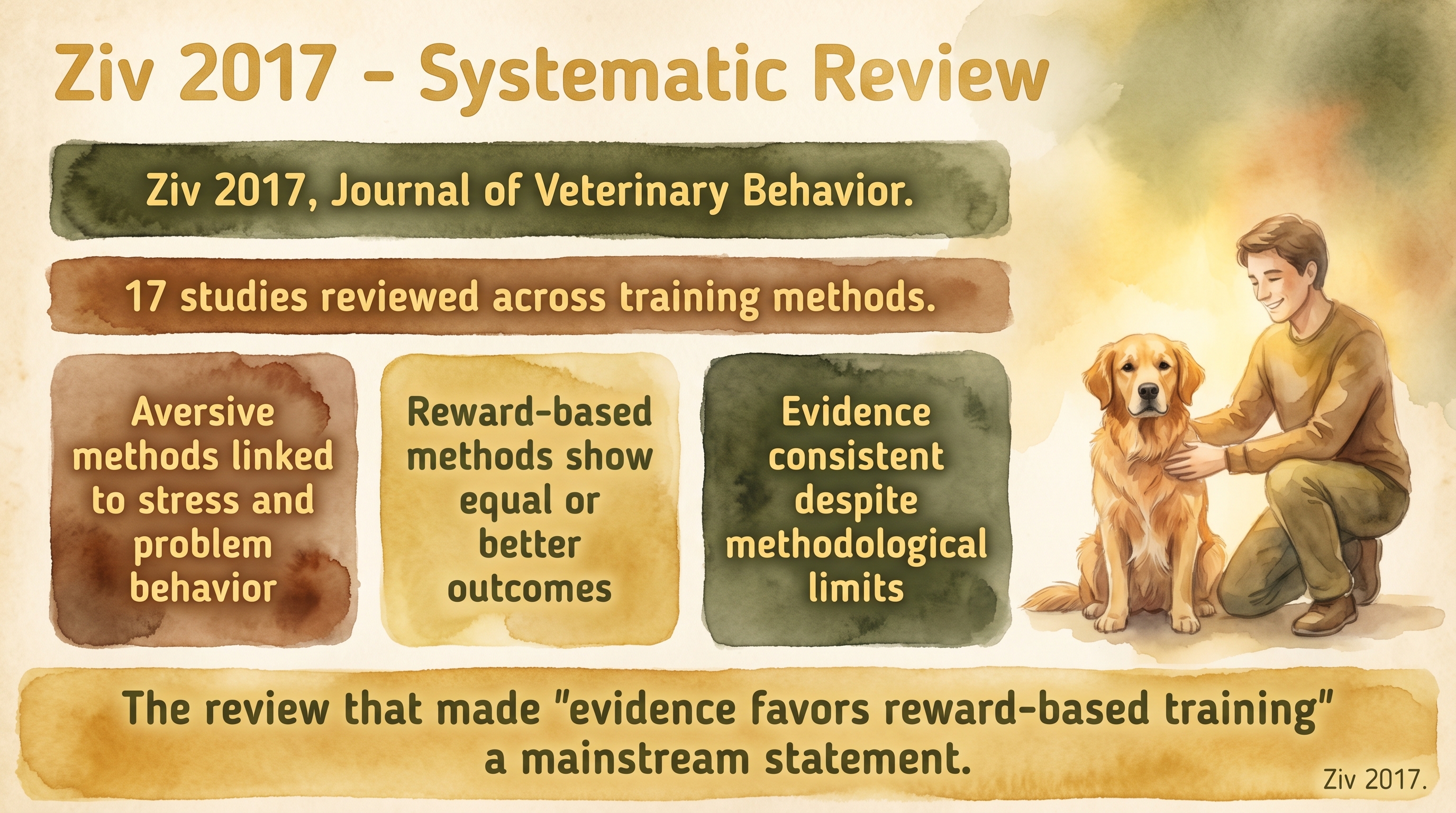
The review that made evidence-favors-reward-based a mainstream statement.
Key Takeaways
- Ziv 2017 matters because it synthesizes multiple studies rather than relying on one dramatic finding.
- Its main conclusion is that aversive methods carry enough documented risk that reward-based methods should be first-line.
- The review is strong evidence against aversive defaults, not a universal verdict on every imaginable low-level or edge-case intervention.
- For families, that is already enough to shape ethical starting choices in a meaningful way.
The Evidence
- Ziv (2017)companion dogs
Review of 17 peer-reviewed studies concluded that aversive methods are associated with increased welfare and behavior risk and that reward-based methods should be preferred first. - Hiby et al. (2004), Herron et al. (2009), Rooney & Cowan (2011), and Deldalle & Gaunet (2014)companion dogs
Illustrate the kinds of studies contributing to the review's convergent picture. - companion dogs
Summarizes the methodological cautions Ziv acknowledged, including self-selection and inconsistent aversive definitions. - Later literature such as Vieira de Castro (2020)companion dogs
Strengthens the review's overall welfare direction rather than reversing it.
- domestic dogs
No published follow-up study directly tests how the findings summarized under the ziv 2017 review of aversive training generalize across breeds, households, and long-term outcomes.
SCR References
Sources
- Ziv, G. (2017). Journal of Veterinary Behavior.
- Hiby, E. F., Rooney, N. J., & Bradshaw, J. W. S. (2004). Animal Welfare.
- Herron, M. E., Shofer, F. S., & Reisner, I. R. (2009). Applied Animal Behaviour Science.
- Rooney, N. J., &