Positive Punishment and Corrections in Dog Training
Compound evidence detail1 SCR / 2 parts
- Documentedcanine welfare evidence on aversive training methods (Vieira de Castro 2020, Ziv 2017, Hiby 2004) and attachment-mediated stress modulation evidence (Schoberl 2015, Asher 2020, Brubaker and Udell 2023)
- HeuristicJB claim that secure attachment context measurably alters how dogs experience mechanically operant-identical correction procedures, RF-flagged in the SCR and formally untested in controlled canine studies
Positive punishment is the most disputed quadrant in modern dog training because it touches the point where technique, welfare, and ethics stop being abstract. In operant language, the definition is narrow: an aversive stimulus is added after a behavior, and the future frequency of that behavior declines. The phrase does not mean cruelty by itself. It does mean the learning event depends on something the dog experiences as unpleasant enough to suppress behavior. That is why the welfare question enters immediately. Documented
Historically, this quadrant sat close to the center of the traditional training world. Konrad Most's 1910 military model assumed compulsion had a lawful place in teaching reliability. William Koehler's 1962 civilian method normalized sharp leash corrections for disobedience. Veterinary behavior literature later began documenting the costs that correction-heavy approaches can carry. Documented Herron, Shofer, and Reisner in 2009 reported aggressive responses to several confrontational techniques. Ziv's 2017 review gathered seventeen studies and concluded that aversive methods were associated with elevated fear, stress, and aggression risk. Vieira de Castro and colleagues in 2020 added behavioral coding, cortisol, and cognitive-bias evidence showing broader welfare costs in aversive-school dogs.
That evidence matters, but it does not erase important distinctions inside the category. A hard leash pop, a shouted verbal reprimand, an alpha roll, an electronic correction, and a quiet body block are not interchangeable events even if some of them can be mapped into the same operant quadrant. Magnitude matters. Predictability matters. Relational context matters. The dog's ability to understand the event matters. Modern dog culture often collapses all of those questions into slogans, either by treating every correction as abuse or by pretending all skilled correction is automatically humane.
JB's position is more exact than either slogan. JB rejects classic positive-punishment systems as a default way to produce a family dog. JB also distinguishes its own indirect correction from the correction culture that the welfare literature is mostly describing. That distinction is partly documented and partly interpretive. It is documented that dogs respond differently to different intensities and contexts. It is interpretive to claim that a calm relational correction belongs in a categorically different practical class from standard punishment-based training. JB says that clearly rather than hiding the difference in rhetoric.
What It Means
The Quadrant Has a Precise Definition
Positive punishment is one of the four operant consequences, and the technical label is stricter than everyday speech. Something aversive is added after the behavior. The behavior then decreases. If a dog lunges, receives a leash correction, and lunging becomes less frequent, punishment has functioned. If the dog receives the correction and keeps lunging, the handler may have delivered an aversive event without producing the learning effect the label requires. Documented
That precision matters because training culture often uses euphemisms. Trainers say they are "holding the dog accountable," "being fair," "making the wrong thing hard," or "communicating clearly." Some may indeed be trying to describe a carefully bounded intervention. None of that changes the behavioral mechanism. If the dog suppresses behavior because an aversive arrived, the event sits in punishment territory.
What Counts as a Correction in Real Training Systems
The list is broader than many families realize. Traditional obedience schools historically used leash pops, collar pressure paired with a snap, verbal reprimands, and physical manipulation. Confrontational owner advice added alpha rolls, muzzle grabs, dominance downs, and other forced-position techniques. Modern balanced systems often reject the theatrical older rituals while keeping correction as a legitimate tool, especially through remote collars, prongs, or sharp leash information at specific moments.
The research record repeatedly returns to this question because technique families vary so much. Documented Herron, Shofer, and Reisner in 2009 found that dogs sometimes responded aggressively to confrontational techniques owners had used for unwanted behaviors. Deldalle and Gaunet in 2014 observed more stress-related behaviors and less owner attention in dogs trained in a negative-reinforcement and correction school than in a reward-based school. Vieira de Castro in 2020 showed more stress behavior, higher post-training cortisol, and more pessimistic cognitive-bias responses in dogs from aversive-based schools. Those papers are not talking about every mild interruption a skilled adult might ever use. They are studying systems where aversive events are central enough to shape the dog's training experience.
What the Welfare Literature Actually Supports
The welfare case against routine punishment is strong by dog-training standards, though not absolute in the way activist rhetoric sometimes implies. Ziv's 2017 review is the most cited synthesis. It concluded that aversive methods carry increased risk of fear, stress, and aggression, and that reward-based methods should be preferred as a first-line approach. The review also stated its own limits: many underlying studies were small, non-randomized, or inconsistent in how they defined aversives.
Subsequent studies sharpened the picture rather than reversing it. Documented Vieira de Castro measured behavior, physiology, and affective bias. Casey's 2014 owner-survey work tied punishment use to higher owner-reported aggression risk with dose-response patterns, while still carrying the usual survey confounds. Casey, Belling, and Sherwin in 2021 connected higher aversive exposure to more pessimistic judgments in ambiguous-cue testing. The field's most robust ground is therefore not "punishment never works." It is "punishment carries welfare and behavior risks that are not well justified by clear superiority in outcome."
JB accepts the operant description where it fits, but it refuses to let the quadrant do all the moral work. A calm body block, quiet spatial claim, or brief disengagement inside a secure relationship is not the same practical event as building obedience around startling, pain, or fear.
Where JB Draws Its Line
JB's line is upstream before it is technical. The goal is to raise dogs so that adults do not spend daily life suppressing already-practiced chaos. When correction is constantly needed, the developmental plan has usually failed first. That is why JB does not build family life around punishment schedules, proofing through aversives, or escalating consequence ladders.
The narrower distinction is this: indirect correction in the JB sense aims to communicate disapproval without tipping the dog into fear. A body block can stop movement. A calm removal of access can close the social door for a moment. A still, disapproving posture can tell a socially oriented puppy that a line has been crossed. Those moments may be describable in operant terms. JB's claim is that they are functionally altered by low magnitude, relational security, and rarity. The literature supports pieces of that claim, especially around predictability and relationship, but the full categorical distinction remains interpretive and should stay tagged that way.
Why It Matters for Your Dog
For a Golden Retriever family, this subject matters because Goldens are exactly the kind of dog who can hide poor method for a while. They are social, forgiving, and often willing to keep re-engaging after human mistakes. A family can therefore use more correction than they should and still feel as if things are going fine. The dog keeps coming back, stays friendly, and does not immediately show the brittle shut-down that a more sensitive dog might show. That breed generosity can make punishment look cleaner than it is.
Consider a common household scene. A teenage Golden is charging guests, grabbing sleeves, and spiraling into evening mouthiness. One adult reaches for sharp verbal corrections. Another uses a leash pop. A trainer may say the family is "holding the boundary." The more useful question is whether the dog is actually learning composure or merely getting interrupted after entering a state that the household rehearses every day. If the evenings are overstimulating, sleep is insufficient, transitions are sloppy, and greetings are chaotic, the correction is landing late in the sequence. The family then credits punishment for suppressing the visible burst while missing the conditions that keep recreating it.
That pattern matters because punishment can succeed locally and still fail developmentally. The dog may stop barking in the exact moment, stop jumping when the leash is attached, or stop mouthing when the adult gets stern. None of that guarantees a calmer dog. It may only mean the dog has learned that certain expressions are risky in that context. Families often mistake that immediate suppression for maturity.
The welfare literature is useful here because it warns against reading compliance as the whole story. A dog can perform and still show stress-related body language, elevated cortisol, or negatively shifted affect outside the specific training exercise. Goldens can look cheerful enough that owners overlook subtler signs such as lip licking, tension around the mouth, avoidance arcs, faster reactivity after correction, or a decline in spontaneous social softness. Families need to know that those are part of the picture.
Children make the issue even more important. When adults normalize punishment as the main answer to excitement, stealing, guarding, barking, or roughness, children learn that conflict with the dog is solved by escalating pressure. That is exactly the lesson a family dog should not teach. Safer homes teach children to pause, call an adult, change the setup, and let the adults manage movement and resources. A correction-heavy culture often erodes that discipline because everyone starts believing that forceful interruption is proof of leadership.
There is also a practical consumer issue. Many trainers sell correction as realism. They say rewards are fine for simple cues but "real life" requires the dog to know there are consequences. Sometimes that line is partly true. Real life does include boundaries. The hidden question is what kind of consequences, how often, and after how much prevention. A family Golden who is dragging on leash every day, exploding through thresholds, and screaming in the crate may indeed need adults to interrupt behavior. Yet the bigger repair may be rest, pacing, environmental management, and a calmer household rhythm, not a better correction collar.
Another risk is escalation drift. A family begins with a mild verbal no. It stops working because the dog's arousal is high. The adult gets louder. Then the leash snap appears. Then a stronger tool is recommended because the earlier correction "was not meaningful enough." By that point the lesson is no longer about one bounded event. The family has become dependent on aversive escalation because the raising conditions are still manufacturing the same states.
That is why JB talks so much about sequence. If the first answer is prevention, much less punishment is needed later. If the dog is rested, handled early, and not continually invited into manic patterns, then an occasional quiet interruption can remain occasional. If the home is chaotic, punishment becomes sticky. Families start needing it everywhere because they are using it after the dog is already over threshold.
The breed itself also matters. Goldens are often chosen by gentle families who do not want harshness. When those families get overwhelmed, they can be vulnerable to the pitch that correction is the only honest alternative to permissiveness. JB offers a third path. The adults do not need to become soft negotiators, and they do not need to become correction technicians. They need to become calm organizers of the dog's world.
That is one reason families should read escalating correction as a household signal, not only as a dog signal.
What This Means for a JB Family
The practical takeaway is not "never interrupt unwanted behavior." A family cannot raise a dog without ever communicating disapproval. The better distinction is between living inside a punishment system and using rare, low-drama correction inside a larger preventive structure. JB rejects the first and uses the second carefully.
That means the adults ask a sequence of questions before they ask what correction to use. What set this up? How long has the dog been awake? What pattern is repeating across the week? What did the adults invite by accident? Which part is a management failure, which part is a maturity issue, and which part is a skill gap? Those questions often reduce the size of the correction problem before any correction is delivered.
When interruption is needed, JB prefers the quietest effective form that still carries clear information. Blocking movement, calmly ending access, stepping into space without drama, or ending a social interaction for a moment can all tell the dog that the current choice does not work. The moment should be brief, comprehensible, and rare enough that it still means something. If the household needs heavy consequence all day, the problem is bigger than the moment.
This is where Prevention and Indirect Correction meet. Prevention keeps the dog from living in an endless cycle of rehearsal and suppression. Indirect Correction gives the adult a way to say no without turning daily life into a contest. The goal is not a dog who is afraid to be wrong. The goal is a dog who is being raised so clearly that being wrong happens less, and when it does happen the adults can respond without emotional spill.
That is the JB standard: calm adults, early intervention, minimal force, and enough honesty to admit that some of the finer distinctions here are philosophical claims still waiting for direct comparative research. Heuristic The field already gives strong reasons to avoid routine punishment. JB adds that the stronger answer is to raise dogs so punishment does not become the architecture of the relationship.
In practice that usually means the adults become less dramatic, not more. They interrupt earlier, set up better, and reserve unmistakable disapproval for fewer moments. A household that achieves that often discovers that the need for punishment falls naturally as the dog's daily life becomes more coherent. That is a far healthier outcome than simply becoming more skilled at delivering corrections.
It also leaves more room for trust to keep growing while order does.
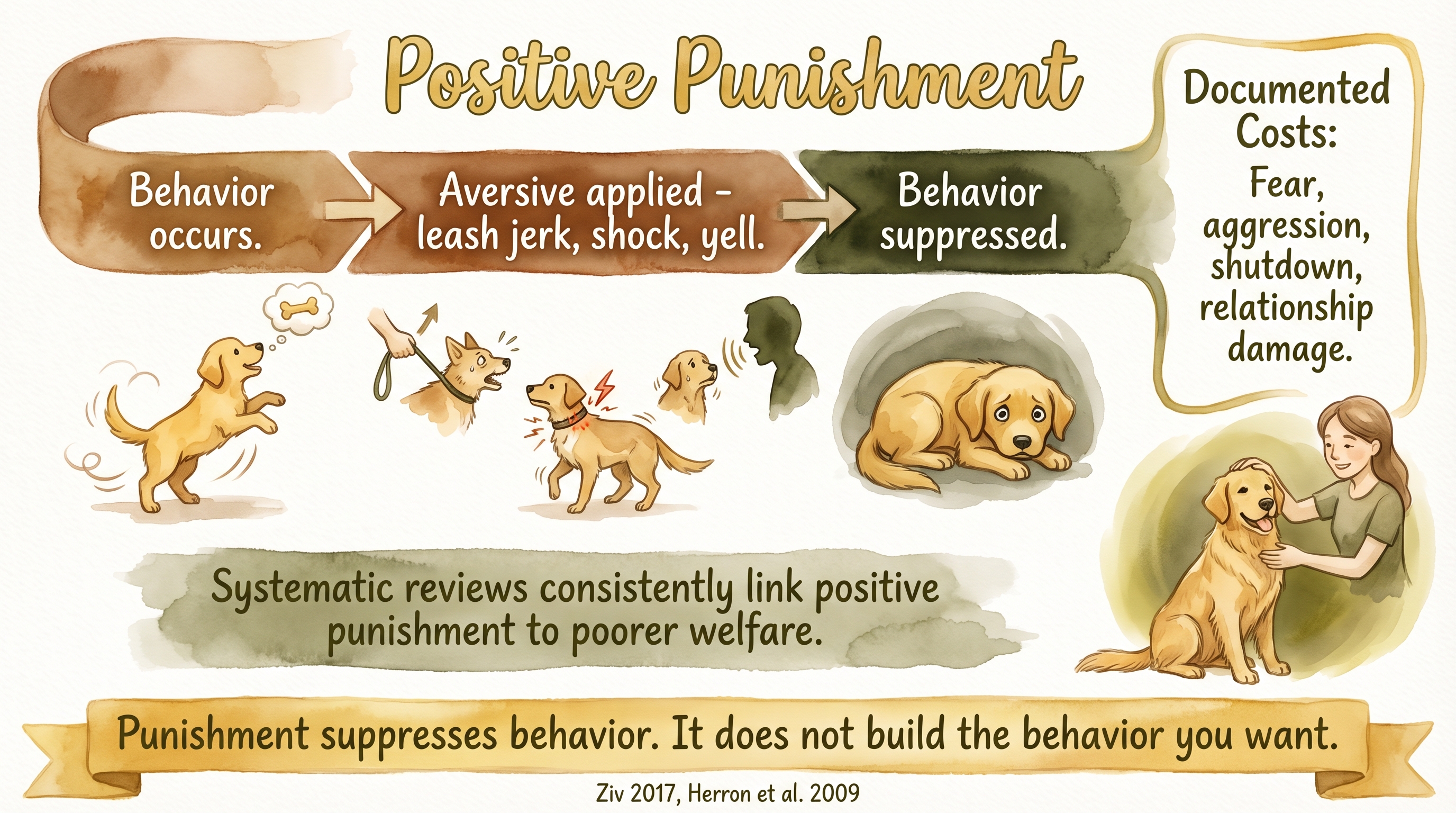
Punishment suppresses behavior - it does not build the behavior you want.
Key Takeaways
- Positive punishment means behavior decreases because the dog experiences an added aversive consequence.
- The field's strongest evidence is not that punishment never suppresses behavior, but that routine aversive use carries welfare and safety costs without clear superiority in outcome.
- Classic correction-heavy systems are not the same practical event as rare, low-magnitude relational interruption, even if some moments can be described with the same operant vocabulary.
- JB works upstream through prevention so correction stays rare, quiet, and bounded rather than becoming the main engine of family life.
The Evidence
This entry uses heuristic claim-level tags beyond the dedicated EvidenceBlocks below. These tags mark JB interpretive application rather than direct study findings.
- Ziv (2017)companion dogs
Review of 17 studies concluding that aversive methods are associated with increased stress, fear, and aggression risk and should not be first-line. - Vieira de Castro et al. (2020)companion dogs
Dogs from aversive schools showed more stress-related behaviors, higher salivary cortisol, and more pessimistic cognitive-bias responses than dogs from reward-based schools. - Herron, Shofer, & Reisner (2009)companion dogs
Confrontational techniques were associated with aggressive responses in a meaningful proportion of dogs presented for behavior problems. - Casey et al. (2014) and Casey et al. (2021)companion dogs
Survey and cognitive-bias work connect punishment-heavy exposure with higher aggression risk and more negatively valenced affect.
- domestic dogs
No published long-term study directly compares positive punishment and corrections in dog training against structured relational raising and no-intervention controls across ordinary companion-dog homes.
SCR References
Sources
- Ziv, G. (2017). Journal of Veterinary Behavior.
- Vieira de Castro, A. C., et al. (2020). PLOS ONE.
- Herron, M. E., Shofer, F. S., & Reisner, I. R. (2009). Applied Animal Behaviour Science.
- Casey, R. A., et al. (2014). Applied Animal Behaviour Science.