Working and Service Dog Program Failure Rates
Working-dog and service-dog programs are among the most revealing natural experiments in canine behavior. These programs select dogs carefully, invest heavily in raising and training, and apply structured evaluation over long periods. Even under those conditions, many dogs do not graduate. Published reviews and program reports commonly place working or service-dog graduation rates somewhere around 30 to 60 percent, which means attrition or release rates of roughly 40 to 70 percent are not unusual across programs. Within the JB source base, guide-dog studies show similar behavioral filtering in practice. Harvey et al. 2017 found that adaptability, distractibility, excitability, body sensitivity, and anxiety predicted later guide-dog success or withdrawal. Serpell and Duffy 2016 found that puppy-raiser experience and the presence of another dog influenced behavioral outcomes. Asher et al. 2020 linked early conflict behaviors and separation-related traits in guide-dog candidates to later developmental patterns. Working-dog pipelines therefore show something important: even elite selection and serious training cannot fully overcome weak early fit, weak development, or behavior traits that make the role unsustainable. Documented
That is a humbling result for the broader dog world. If high-investment organizations with clear standards still lose large numbers of candidates, then ordinary companion homes should be cautious about assuming later technical training can solve everything upstream. Working-dog attrition is partly about high standards, of course. A dog can be a wonderful pet and still fail as a guide dog or service dog. But the reasons for release, such as fearfulness, distractibility, social instability, and low resilience, are exactly the kinds of issues that matter in family life too.
This is one reason the working-dog literature matters beyond the working-dog world. It highlights population-level truths about behavior, development, and raising under conditions far more structured than most pet homes will ever provide.
JB reads these programs as evidence that early environment matters at scale. The better programs do not rely on training alone. They invest in selection, maternal lines, puppy raisers, calm exposure, and stable developmental context. That is not identical to JB, but it rhymes with JB strongly enough to be worth studying.
What It Means
Attrition in High-Investment Systems
The first lesson of working-dog attrition is simply that behavior is hard to stabilize even when everyone is trying hard. Guide-dog and service-dog organizations breed selectively, screen medically, track development, and train systematically. Yet large numbers of dogs still wash out. In some programs the failure is medical, but behavior and temperament are major filters. Harvey et al. 2017 showed that juvenile behavioral traits strongly predicted later outcomes. Distractibility, excitability, anxiety, body sensitivity, and weaker adaptability all lowered the odds of success.
That should change how companion-dog families think about behavior problems. Documented If programs with better selection and better structure still lose candidates on behavior grounds, then behavior difficulty is not something only careless owners create. It is a genuine developmental and population challenge.
Why Dogs Are Released
The release reasons are telling. Fearfulness, poor environmental confidence, distractibility, reactivity, sociability issues, weak recovery, and mismatched drive patterns appear repeatedly in the working-dog literature and in broader reviews of assistance-dog outcomes. Documented Those same traits may look different in a family home, but they are still costly there. A guide dog may be released for environmental sensitivity. A family dog with the same trait may simply become difficult on walks, impossible at crowded gatherings, or chronically stressed in modern neighborhood life.
This overlap matters because it lets the pet world learn from a more structured environment. Working programs are not measuring the exact same endpoint as family life, but they are measuring many of the same building blocks.
That parallel should make families more interested in the components of success than in the prestige of the role itself. Public-access work is harder than family life, but the traits being selected for and filtered against are still recognizably companion-dog traits: confidence, social steadiness, environmental recovery, and the ability to function without emotional collapse.
The Lowest-Failure Programs Care About Raising
One of the most important patterns in this literature is that successful programs do not think only in terms of formal training. They think in terms of breeding, maternal lines, puppy-raiser quality, early environment, exposure structure, and developmental suitability for the role. Serpell and Duffy 2016 found better outcomes when puppy raisers were experienced and when another dog was present in the home. Harvey et al. 2016 showed that social rearing environment influences later behavior. Foyer's military-dog work and related developmental studies push in the same direction: first-year environment predicts later usable temperament.
This does not mean a family home should imitate a service-dog institution. It means the developmental emphasis is hard to miss. The programs with serious outcome goals still keep returning to early life.
The working-dog world does not use JB language, but it repeatedly rediscovers a core JB truth: adults, environment, and early social structure shape what later training can realistically build on.
Why This Matters for Family Dogs Too
A family dog is not being tested for public access or guide work. That lowers the threshold for success, but it does not erase the lesson. If behavior traits such as fearfulness, poor recovery, distractibility, and social instability are strong enough to derail high-investment working pathways, then those same traits deserve respect in pet dogs long before they become severe. Documented Working-dog attrition warns against magical thinking. Training matters, but it is not the only major lever.
It also argues against the idea that behavior is mostly corrected after it appears. The better-supported reading is that behavior is partly selected and partly raised into place, then later polished where necessary.
Why It Matters for Your Dog
For an ordinary family, working-dog failure data can seem remote at first. Your Golden Retriever is not trying to guide a blind handler through traffic or work in a military environment. Still, the traits that make those programs release dogs are not foreign to family life. A dog who startles easily, struggles to recover, gets socially overaroused, or cannot hold attention under moderate distraction may still be lovable, but he is also more likely to become difficult to live with.
That makes the working-dog literature useful because it highlights the stakes of early developmental quality in a vivid way. Programs with money, structure, and expertise still cannot train around every shaky foundation. A family should therefore be careful about assuming that later classes will necessarily compensate for poor early environment, chronic overstimulation, or weak social scaffolding.
Goldens are often chosen for service and guide work precisely because their breed profile is generally favorable. That should matter to family homes too. It means the breed often begins with qualities that can be nurtured into excellent companionship. But the attrition literature also shows that favorable starting material is not enough by itself. Even dogs bred for cooperative human work can fail when anxiety, distractibility, sensitivity, or social instability become too strong.
This is one reason early home life matters so much after the puppy leaves the breeder. The family is not just managing misbehavior. It is either continuing a developmental arc toward confidence and usability or introducing enough chaos that those qualities erode. A service-dog organization may call the end result a release from program. A household may call it constant stress, failed outings, or a dog that cannot be trusted in the situations that matter most.
The working-dog lens also helps families avoid a common mistake: mistaking affection for resilience. A dog can adore his people and still lack the environmental steadiness needed for broad real-world function. That is true in guide work and in ordinary suburban life. A family dog does not need to work in public all day, but he does need enough recovery, confidence, and social regulation to handle the world he actually lives in.
Another lesson is that puppy raising is not beneath serious outcome discussion. In many pet circles, raising is treated as a softer prelude to real training. Working-dog systems behave as if puppy raising is central because their results depend on it. Families can learn from that without turning the home into an institution. Calm routines, measured exposure, adult guidance, and attention to arousal baseline are all more justified once seen through this lens.
There is also relief in the fact that release from a working program does not equal failure as a dog. Many released dogs become excellent companions. Families should remember that because it keeps the analogy humane. The point is not that every deviation from working-dog standards is a crisis. The point is that the developmental traits these programs watch closely are worth respecting long before they become major limitations.
For a Golden in a family home, that means paying attention to recovery, environmental confidence, social balance, and the ability to settle after stimulation. Those are not fancy performance variables. They are the quiet foundations of good family life too.
The literature also teaches families to stop confusing expense with inevitability. Working programs spend enormous resources, yet they still cannot rescue every candidate from a poor fit between temperament and task. That should make ordinary households more realistic about what money alone can buy in the pet training market. The earlier developmental base remains stubbornly important no matter how impressive the later package looks.
That realism is helpful rather than discouraging. It tells families where to invest their hope: not only in specialist help later, but in the ordinary developmental decisions that specialist help will later have to build on.
It also tells families what not to envy blindly. A polished working-dog result usually sits on top of selection, breeder decisions, puppy-raiser quality, environment, and developmental filtering that the public does not see. Copying the visible training surface without respecting the developmental base misses the real lesson.
For family dogs, that means the quiet variables deserve much more respect than the pet market usually gives them. Recovery after stimulation, confidence in ordinary environments, and the ability to settle are not lesser traits than flashy obedience. They are the traits without which both work and family life become fragile.
That lesson transfers cleanly to the home.
What This Means for a JB Family
JB families should read the working-dog world as a seriousness lesson. High-stakes programs do not trust later technical training to carry the whole burden. They invest heavily in early raising because they know development constrains what training can later achieve.
That aligns closely with JB's philosophy. The family does not need to reproduce a formal service-dog program, but it should borrow the right priority order: good genetics, good early environment, calm exposure, adult guidance, and only then the later polishing that training can provide.
This perspective also protects families from magical promises. If even elite programs lose many dogs to behavioral unsuitability, then no ordinary trainer should be selling the idea that method alone can override all developmental reality.
The practical household takeaway is simple. Raise the puppy as if early behavior matters because it does. Documented Treat calmness, confidence, and regulation as assets worth building from the first day home.
That is one of the clearest ways JB tries to produce the family equivalent of a successful working-dog foundation: not a specialist task dog, but a stable dog whose developmental base can carry the life being asked of it.
In that sense, the working-dog literature helps JB families feel less eccentric about taking puppy raising seriously. Highly outcome-driven systems do the same thing. They simply do it with different end goals and a more formal vocabulary.
For a family, that translation can be very freeing. You do not need a professional program's budget or standards to borrow its best lesson. You simply need to stop treating early raising as disposable and start treating it as the part of the process that later outcomes quietly depend on.
That is a deeply practical kind of hope. It says the family already controls one of the most meaningful levers available to it, which is how the dog's early daily life is organized before bad patterns harden.
That is also why JB can read the working-dog literature without pretending the home is a professional pipeline. The relevance is not the job. The relevance is the developmental priority order.
Once families see that priority order, later training help becomes easier to place correctly. It is support for a foundation, not a substitute for one.
Homes that respect that priority order usually waste less time chasing miracle fixes later, because they understand where durable change actually starts. Observed-JB
That clarity matters at home.
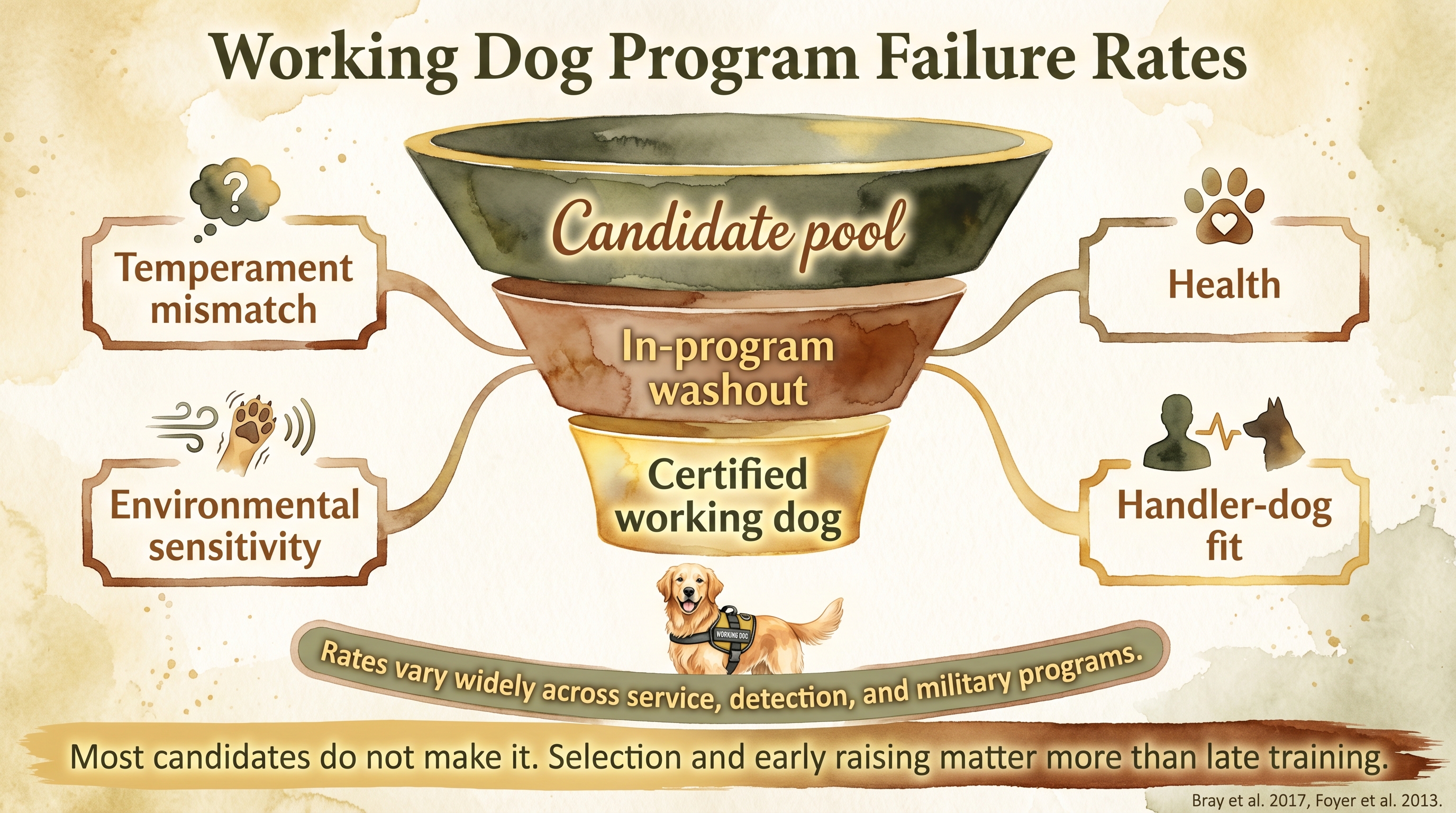
Selection and early raising matter more than late training.
Key Takeaways
- Many working and service dog candidates do not graduate, even in highly structured systems.
- The behavior traits that remove dogs from working programs are also relevant to family life, even if the threshold for success is lower at home.
- The best programs emphasize early raising, social environment, and developmental fit rather than relying on later training alone.
- JB reads this literature as strong support for treating puppy raising as a major population-level lever.
The Evidence
This entry uses observed claim-level tags beyond the dedicated EvidenceBlocks below. These tags mark JB program observation or practice-derived claims that need dedicated EvidenceBlock coverage in a later content pass.
- Harvey et al. (2017)guide dogs
Behavior traits including anxiety, distractibility, excitability, and adaptability predicted later success or withdrawal. - Serpell and Duffy (2016)guide dogs
Experienced puppy raisers and the presence of another dog were associated with better behavioral outcomes. - Asher et al. (2020)guide-dog candidates
Early developmental and separation-related traits were linked to later behavioral patterns relevant to outcome. - Assistance-dog outcome reviews and Foyer's developmental working-dog literatureworking and service dogs
Show that attrition is substantial and that early environment contributes meaningfully to who succeeds.
- domestic dogs
No single dataset directly resolves the full population picture for working and service dog program failure rates without the usual survey, sampling, and threshold limitations.
SCR References
Sources
- Harvey, N. D., et al. (2017). Applied Animal Behaviour Science.
- Serpell, J. A., & Duffy, D. L. (2016). Journal of Veterinary Behavior.
- Asher, L., et al. (2020). Frontiers in Veterinary Science.
- Foyer, P., Wilsson, E., & Jensen, P. (2016). Levels of maternal care in dogs affect adult offspring temperament. Scientific Reports, 6, 19253. https://doi.org/10.1038/srep19253