Early Handling and Adult Behavior Outcomes
One of the strongest broad findings in canine behavioral development is that what happens early does not stay early. Maternal behavior, litter environment, breeder handling, early social exposure, and the puppy's first human-guided weeks all show measurable relationships with adult behavior months or years later. The exact size of those effects varies, and no serious reader should confuse correlation with perfect causation. Still, the directional pattern is unusually consistent. Guardini et al. 2017 linked maternal style with later puppy behavior. Harvey et al. 2016 and 2017 showed that early social and rearing environment in guide dogs predicted later behavioral outcomes and program success. Serpell and Duffy 2016 found that experienced puppy raisers and the presence of another dog were associated with better guide-dog outcomes. Puurunen et al. 2020 identified inadequate socialization during the sensitive period as a stronger predictor of adult social fearfulness than inadequate training. Foyer's military-dog work and later reviews of puppy socialization likewise support the idea that very early environment has long behavioral shadows. Documented
That pattern matters because dog culture often treats the first weeks as a prelude and the formal training period as the main act. The developmental literature points in the opposite direction. The early window does not replace later learning, but it shapes what later learning has to work with. A puppy whose nervous system was built in relative calm, social support, and predictable handling begins later life differently from a puppy built in uncertainty, sparse social guidance, or chronic overarousal.
This is one of the places where JB feels least speculative. The full Five Pillars framework contains both documented and heuristic layers, but the specific claim that early environment matters for later behavior is strongly supported relative to many other debates in the field. Heuristic Prevention has hard footing here.
That does not mean every adult problem can be traced backward cleanly or that excellent early care guarantees an easy dog. It means the first weeks and months are among the most behaviorally leverage-rich periods a family will ever get.
What It Means
The Early Window Has Long Reach
Developmental studies across dogs keep landing on the same broad point: adult behavior is partly scaffolded during very early life. Documented Guardini et al. 2017 found associations between aspects of maternal behavior and later puppy outcomes. Harvey et al. 2016 showed that social rearing environment influences behavioral development. Harvey et al. 2017, working in guide dogs, found that traits such as anxiety, excitability, distractibility, and adaptability predicted later success or withdrawal. Foyer's work in Swedish military dogs similarly linked first-year experiences and early environmental factors to later temperament-test outcomes and working success.
These are not all measuring the same thing, which is part of their value. Maternal interaction, human handling, social environment, and later work success are different domains. When they all point in a similar developmental direction, the field should pay attention.
Socialization Matters More Than the Field Often Admits
The ethological-critique notebook makes a particularly important point here: the field often praises training when the actual active ingredient may be early socialization or owner engagement. Observed-JB Puppy classes are a classic example because they mix exposure, handling, routine, novelty, and owner instruction. Puurunen et al. 2020 sharpened the issue by finding that inadequate socialization during the sensitive period predicted adult social fearfulness more strongly than inadequate training. That is a profound result for how the field frames prevention.
It means some later "training problems" may actually be developmental problems with a delayed social expression. The dog is not failing because it never learned a cue. The dog is failing because its early social architecture never organized as well as it might have.
Maternal and Household Effects
Maternal style matters in at least some populations. That does not surprise mammalian developmental biology. Puppies are not blank slates waiting for formal instruction. They are social young shaped by repeated early contact, stress buffering, and environmental predictability. The breeder environment therefore matters not only because it keeps puppies healthy, but because it may be setting thresholds for fear, social confidence, and recovery before the puppy ever goes home.
The first home then extends or interrupts that developmental trajectory. A calm, structured family can preserve and strengthen a good early start. A chaotic or overstimulating home can erode it. The early handling literature is not saying that the breeder is everything and the owner is nothing. It is saying that timing matters and that the sequence begins before most owners think it does.
That sequencing point is easy to miss in pet culture because ownership language starts when the puppy comes home. Development does not wait for ownership language. The dog's nervous system has already been learning for weeks. A serious family therefore thinks in continuities, not in reset buttons.
Prevention is strongest where development is most plastic. The field does not need a perfect randomized trial to see that the first weeks and months carry unusual leverage over later behavior.
Why Correlation Still Counts Here
Some readers hesitate whenever the literature is correlational. That caution is healthy. It should not become paralysis. Randomizing puppies to poor maternal care, poor social exposure, or poorer early environments would often be unethical or impractical. The field therefore learns through observational work, program datasets, and converging developmental studies. When those different designs repeatedly show early-environment associations with later fear, anxiety, sociability, and workability, the rational move is to take the pattern seriously while keeping rhetoric disciplined.
This is exactly the kind of area where evidence-informed practice can still be very strong. The total causal geometry is not solved, but the developmental direction is well supported.
Why It Matters for Your Dog
For a family bringing home a Golden Retriever puppy, this literature should change what feels urgent. Documented Many households still imagine that the real behavioral work begins once the puppy is old enough for formal classes or old enough to "understand commands." The developmental evidence says the work has already begun, and in some respects it has begun before the puppy ever crossed the threshold of the new home.
That is why breeder choice matters behaviorally, not only genetically. A breeder who produces puppies in a calm, socially rich, well-handled environment is doing more than raising pleasant babies. That breeder may be shaping later resilience, sociability, and recovery. The puppy arrives carrying the history of those first weeks.
Once home, families often make a second mistake. They hear that early life matters and interpret that as a mandate for nonstop stimulation. The literature does not support a chaos-maximizing version of socialization. Better early care is not the same as flooding the puppy with novelty. The stronger developmental pattern points toward appropriate exposure, predictable handling, social support, and low-trauma experience during a period of high plasticity. In practice, that means thoughtful introduction to the world, not a frantic campaign to collect as many experiences as possible.
Goldens are especially interesting in this context because their sociability can tempt owners to assume they need less early guidance. A sociable puppy can still be building poor recovery, fragile frustration tolerance, or anxiety around handling and novelty if the environment is too intense or too unstructured. Because the dog looks friendly, the problem may stay hidden until adolescence.
The family should also notice how early patterns become later labels. A puppy who never learned to settle after mild stimulation may later be called hyper. A puppy with thin social confidence may later be called reactive. A puppy whose early handling around body care was rough or inconsistent may later be described as difficult at grooming or veterinary visits. Developmental thinking does not excuse later problems away. It helps explain why they feel bigger than one missed lesson.
This is one reason early handling is so central to JB's philosophy. Calm touch, appropriate novelty, social support, adult modeling, and prevention of needless distress all fit the developmental literature far better than a model that waits for visible misbehavior and then starts formal correction. The literature suggests that by the time a serious problem is obvious, some of the most plastic opportunity has already passed.
Families benefit emotionally from this framing too. Early structure becomes easier to prioritize when it is understood as leverage rather than as fussiness. Protecting sleep, slowing introductions down, shaping calm greetings, guiding body handling gently, and making the household predictable all become behaviorally consequential acts rather than merely nice ideas.
That shift is especially important in the transition from breeder to family. Puppies are leaving one developmental ecosystem and entering another. The softer that landing, the more likely the earlier good work continues rather than breaks. The first days and weeks at home are therefore not an afterthought. They are continuation or interruption.
There is also a hopeful side to the literature. If early life is leverage-rich, then adults still have the ability to do immense good when they take the window seriously. The message is not fatalism. It is that timing matters enough to reward careful, calm effort very early.
Families can even think of later problems through this lens without becoming trapped by it. If an adolescent dog is socially worried, overexcited, or poor at recovery, the question is not only which skill to teach now. It is also what developmental needs were missed and how much of that missing structure can still be recreated in the dog's present life. That mindset is gentler and often more effective than assuming the dog is simply being difficult.
The same idea should shape how families talk about breeder effort. Good breeders are not just producing puppies that look healthy and social on handoff day. They are influencing what later household life will have to build on. Recognizing that creates a more truthful partnership between breeder and home.
This also changes how families should hear phrases such as "the puppy will adjust." Many puppies do adjust, but adjustment is not the same as optimal development. A puppy can survive a rough transition and still pay for it in slower recovery, thinner confidence, or more fragile self-regulation later. Developmental leverage means families should aim higher than mere survival.
That higher standard is especially relevant in the first home because modern puppies often leave the breeder during a period when novelty, stress, and social information are all unusually potent. A family that protects the landing, keeps routines simple, and avoids flooding the puppy may be shaping months of easier life downstream.
What This Means for a JB Family
JB families should treat the first weeks with breeder and the first weeks at home as the most important behavioral intervention window in the dog's life. That is not a philosophical exaggeration. It is one of the better-supported claims in the broader field.
Choose breeders who handle puppies well, keep the environment calm, and understand that raising is already happening long before formal training language would normally enter the picture. Then continue that work at home with predictable routines, appropriate exposure, thoughtful handling, and strong protection against needless rehearsal of chaos.
This is where the Prevention pillar becomes especially concrete. Good early life does not merely make later training easier. It may reduce how much later repair is needed at all.
The practical household question is simple: are we building a puppy whose nervous system is organized around calm and support, or are we building a puppy who is practicing dysregulation in the very window when experience is most powerful? That question belongs at the center of early family life.
For JB, the answer is clear. Raise first. Train later if needed. The developmental literature is one of the strongest reasons that order makes sense.
That order can feel countercultural because the market is eager to sell training packages. Still, the literature keeps rewarding families who respect development before technique. Documented A puppy who is well built emotionally will usually make better use of any later training anyway.
That is why JB treats the early window as sacred time rather than as a waiting room for formal work. The family is not passing time until the dog is old enough to matter. The family is already inside the period when mattering is greatest.
Once a family sees that clearly, many early decisions become easier to prioritize. Sleep protection, calm handling, careful greetings, and thoughtful novelty are no longer optional niceties. They are some of the most consequential investments the household will ever make.
That perspective also honors the puppy more accurately. The young dog is not an unfinished inconvenience waiting to become trainable. The young dog is a highly impressionable social mammal already being shaped by everything the adults do.
That is worth remembering daily.
Remembering it tends to improve the whole tone of early family life.
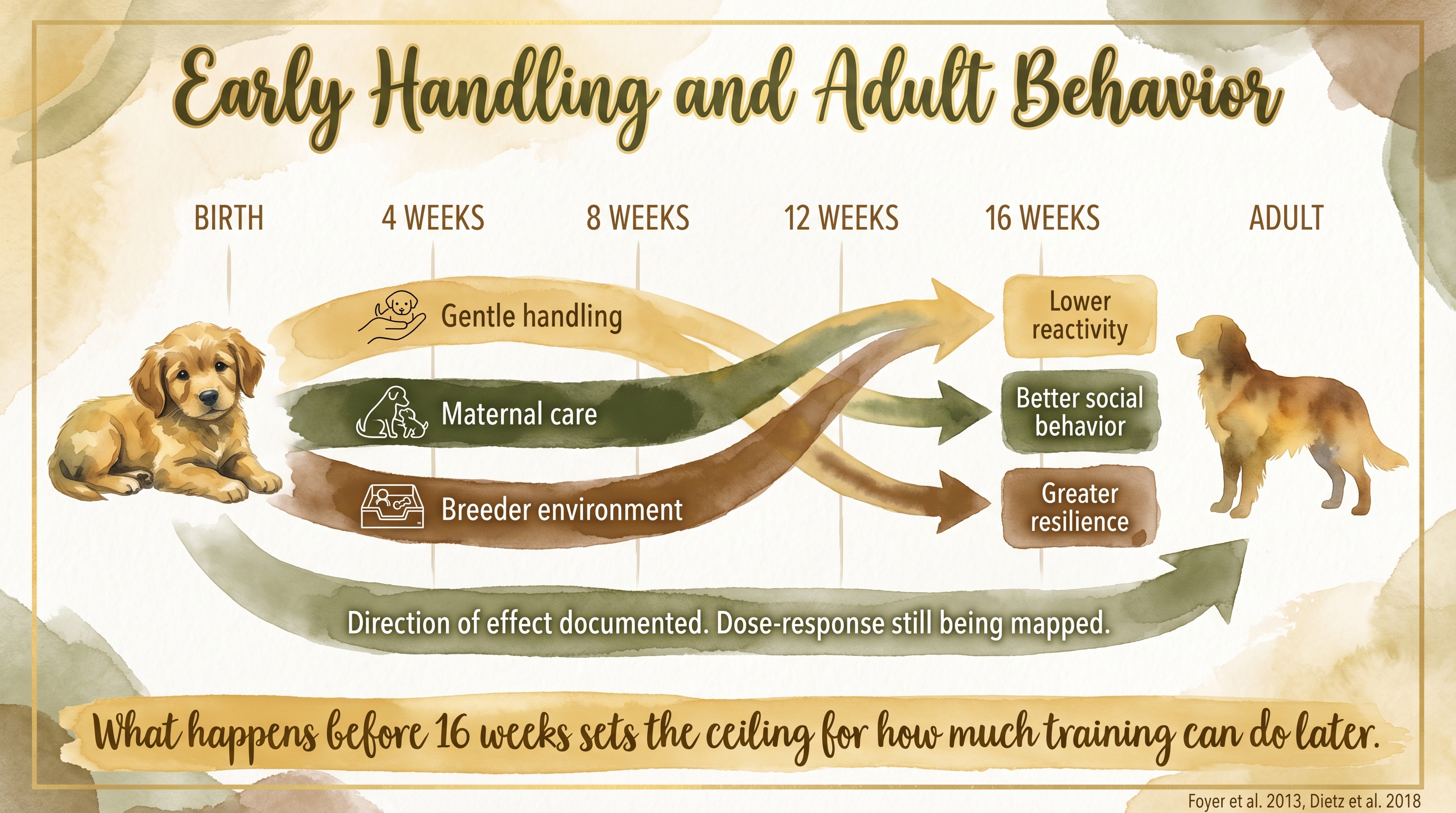
What happens before 16 weeks sets the ceiling for what later training can do.
Key Takeaways
- The early developmental window has unusually large leverage over later canine behavior.
- Maternal care, early social environment, breeder handling, and first-home routines all matter more than the field often admits.
- The literature supports prevention-oriented early raising more strongly than many later method debates.
- For JB families, early calm structure is not decorative philosophy. It is one of the best-supported behavioral investments available.
The Evidence
This entry uses observed claim-level tags beyond the dedicated EvidenceBlocks below. These tags mark JB program observation or practice-derived claims that need dedicated EvidenceBlock coverage in a later content pass.
This entry uses heuristic claim-level tags beyond the dedicated EvidenceBlocks below. These tags mark JB interpretive application rather than direct study findings.
- Harvey et al. (2016, 2017)guide dogs
Showed that early social and rearing environment predicted later behavioral development and working outcomes. - Serpell and Duffy (2016)guide dogs
Found better outcomes with experienced puppy raisers and with the presence of another dog in the raising environment. - Puurunen et al. (2020)companion dogs
Identified inadequate socialization during the sensitive period as a stronger predictor of adult social fearfulness than inadequate training. - Guardini et al. (2017) and Foyer's military-dog workdogs in developmental studies
Support lasting links between early environment, maternal behavior, and later behavioral expression.
- domestic dogs
No published study directly isolates the long-term dog-level and family-level effects of early handling and adult behavior outcomes across ordinary companion-dog contexts.
SCR References
Sources
- Harvey, N. D., et al. (2016). Applied Animal Behaviour Science.
- Harvey, N. D., et al. (2017). Applied Animal Behaviour Science.
- Serpell, J. A., & Duffy, D. L. (2016). Journal of Veterinary Behavior.
- Puurunen, J., et al. (2020). Scientific Reports.
- Guardini, G., et al. (2017). Applied Animal Behaviour Science.
- Foyer, P., Wilsson, E., & Jensen, P. (2016). Levels of maternal care in dogs affect adult offspring temperament. Scientific Reports, 6, 19253. https://doi.org/10.1038/srep19253