Fear and Anxiety Prevalence in Dogs
Fear and anxiety are among the most prevalent behavioral problems in companion dogs, and many datasets suggest they may be the central problem family around which other behavior issues cluster. Dinwoodie et al. 2019 found fear and anxiety in 72.5 percent of dogs in a large owner survey. Salonen et al. 2020 reported noise sensitivity in 32 percent of more than 13,700 Finnish dogs, fear of other dogs in 17 percent, fear of strangers in 15 percent, and fear of novel situations in 12 percent. Meyer et al. 2023 found noise fear in 10 percent of a representative Danish sample. The Dog Aging Project analyses summarized in the JB source notebook produced anxiety and fear ranges roughly between 14.1 and 28.2 percent depending on severity definition. These figures are not interchangeable, but taken together they show the same broad truth: fear and anxiety are not fringe veterinary-behavior cases. They are common features of modern dog life. Documented
This matters because fear and anxiety rarely stay in one neat box. They often co-present with aggression, reactivity, avoidance, startle, compulsive behavior, separation-related distress, sleep disturbance, and handling conflict. Observed-JB Salonen et al. 2020 explicitly found high comorbidity among anxiety traits. Blackwell, Bradshaw, and Casey 2013 showed that owners underrecognize fear in dogs with noise sensitivity. Puurunen et al. 2020 linked inadequate socialization in the sensitive period to later social fearfulness. The literature therefore suggests that many of the dog problems families think of as disobedience or temperament may actually be anxiety pictures wearing practical clothing.
Veterinary behavior medicine treats this seriously enough that medication is sometimes part of care. Documented SSRIs such as fluoxetine, situational anxiolytics such as trazodone, and short-term agents such as benzodiazepines may all appear in clinical plans depending on the case. That pharmacologic fact alone should tell families how central fear and anxiety have become.
JB's reading of this literature is direct. If fear and anxiety are among the dominant problems in the companion population, then Calmness is not a decorative preference. It is a developmental answer to a large epidemiologic problem.
What It Means
Fear and Anxiety Take Many Forms
The terms often get used casually, but epidemiology benefits from some separation. Noise sensitivity includes reactions to fireworks, thunderstorms, and sudden loud sounds. Social fear includes fear of strangers, unfamiliar dogs, or specific categories of people. Documented Nonsocial fear includes objects, surfaces, and novel situations. Separation-related distress concerns panic or intense distress when left alone or separated from attachment figures. Generalized anxiety is harder to define in owner surveys but appears clinically as a broad baseline of tension and poor recovery.
These categories overlap heavily. A dog with social fear may also have noise sensitivity. A dog with separation distress may show generalized hypervigilance. A dog with chronic anxiety may become aggressive in specific contexts. This overlap is one reason fear and anxiety deserve central placement in any serious map of companion-dog behavior.
Why Prevalence Estimates Move So Much
The field produces wide prevalence ranges because it is measuring different layers of the same phenomenon. Dinwoodie's high survey numbers reflect one kind of population and one kind of question. Representative samples such as Meyer's look lower. The Dog Aging Project ranges move when the threshold for seriousness is adjusted. Free-text reporting misses problems that structured prompts detect. None of this weakens the conclusion. It clarifies it. Fear and anxiety are common enough that their exact percentage matters less than their undeniable scale.
A family should therefore resist both easy reactions. One mistake is to say the numbers are too variable to mean anything. The other is to grab the highest number and treat it as the final truth. The wiser reading is that different methods see different slices of a genuinely large problem.
Risk Factors Keep Pointing Backward
Early life appears repeatedly in the risk-factor story. Puurunen et al. 2020 found inadequate socialization during the sensitive period predicted adult social fearfulness more strongly than inadequate training. Documented Developmental work in guide dogs and working dogs suggests that early environment affects later resilience and confidence. Genetics matters too, since some lines or individuals begin with thinner stress tolerance. Traumatic single events can matter, especially during sensitive windows. Ongoing household stress may also sustain anxious patterns once they are present.
This combination of early environment and ongoing atmosphere is precisely why anxiety is not well understood through a narrow obedience lens. A dog can technically know what to do and still be behaviorally compromised by fear.
If fear and anxiety are among the most common problems in owned dogs, then building a calmer baseline is not optional refinement. It is one of the clearest population-level targets a family can aim at.
Why Medication Appears in the Conversation
Medication enters because the problem is real enough, persistent enough, and physiologically serious enough that behavior modification alone is sometimes not sufficient. Veterinary behaviorists may use SSRIs, trazodone, benzodiazepines, and other agents to lower arousal, improve learning conditions, or help dogs through acute fear-provoking contexts. That does not mean every anxious dog needs medication. It means the profession already recognizes fear and anxiety as major welfare and functioning problems rather than as mere quirks.
For families, the presence of medication in the landscape should sharpen seriousness without encouraging passivity. Medications can support treatment. They do not replace the developmental and environmental questions that made the dog vulnerable in the first place.
They are one more sign that anxiety is not just a manners issue.
They are a welfare signal too.
Why It Matters for Your Dog
Fear and anxiety matter because they often appear before they are named. A family may first notice barking at sounds, reluctance around unfamiliar men, frantic pacing before departures, poor sleep after stimulating days, startling at routine noises, or difficulty settling after visitors. None of these necessarily looks like "anxiety" in ordinary conversation. They look like personality, sensitivity, or a phase. Population data suggests they deserve a more careful reading.
That matters especially in Goldens because their friendliness can hide internal tension. A dog may still approach people, wag, or take treats while carrying a nervous system that is too aroused, too quick to startle, or too poor at recovery. Families who rely only on visible sociability may miss the deeper issue until it turns into explosive greeting behavior, leash frustration, separation distress, or apparent unpredictability.
Fear and anxiety also matter because they are fertile ground for secondary problems. A dog afraid of noises may begin to pace, bark, or avoid parts of the home. A socially worried dog may harden into reactivity. A chronically anxious dog may mouth, guard, or overattach. What begins as an internal-state problem often becomes a practical household problem later, which is one reason epidemiology and daily life line up so strongly here.
The family should also understand that anxiety can change what learning even means. A calm dog can absorb guidance, recover from mild mistakes, and stay socially available. A frightened or chronically tense dog often cannot. The dog may technically perform a cue and still not be well. That is one reason the field's performance focus can miss so much.
Goldens often respond beautifully to calm, predictable routine when given enough support. That is encouraging because it means families can do a great deal. Structured greetings, protected rest, slower exposure, stable leash routines, thoughtful transitions, and less household volatility all matter. None of these is glamorous. They simply lower the number of moments in which the nervous system has to practice alarm.
That insight is easy to underestimate because it is so ordinary. Families often look for a special exercise to fix anxiety while overlooking how much cumulative work is being done by the daily texture of the home. Dogs live inside that texture constantly. A quieter, more predictable home can therefore shift more than many families initially expect.
This is also why fear should not be handled as stubbornness. A dog who freezes, avoids, shakes, or startles is not being uncooperative in the way punishment folklore imagines. The dog is broadcasting distress. Responding to distress with more social threat may suppress a signal temporarily while deepening the underlying problem.
The medication landscape adds one more practical lesson. If veterinary behaviorists routinely use pharmacology for fear and anxiety, then ordinary families should stop treating these issues as minor style differences. Severe fear is a health and welfare issue. Even milder fear deserves respect because repeated mild fear can become a way of life.
Families also benefit from understanding that anxious dogs often look different from one another. One dog hides. Another barks. Another clings. Another becomes mouthy or rough. Another seems restless all day and impossible to tire. The field's statistics are helpful because they show these are not isolated personality curiosities. They are common expressions of nervous systems under strain.
For a dog, the best outcome is not merely fewer outward symptoms. It is a life organized around enough calm, predictability, and support that fear does not keep training the nervous system every day. That is the humane standard epidemiology points toward.
That standard also keeps families from aiming too low. If the dog can be coerced through a situation while still carrying heavy internal distress, that is not the endpoint this literature points toward. The goal is not simply outward functionality. It is reduced behavioral burden in the actual nervous system of the dog.
Seen this way, anxiety becomes a raising issue as much as a treatment issue. The family is not only responding to symptoms after they appear. It is shaping how much daily life repeatedly teaches the dog to expect safety or alarm.
That perspective can be liberating for families who have been trapped between minimization and panic. They do not have to wait until the dog looks clinically shattered before taking the issue seriously, and they do not have to imagine that every fearful behavior means disaster. They can instead focus on whether the dog's week contains enough predictability, decompression, social readability, and supported exposure to keep fear from becoming the main teacher.
What This Means for a JB Family
JB families should treat calmness as a behavioral foundation, not as a pleasant extra. If fear and anxiety are among the most common modern dog problems, then a home that deliberately builds a parasympathetic floor is doing population-relevant preventive work.
That means protecting rest, avoiding needless flooding, structuring exposures, noticing startle and recovery, and reading early worry signals before they become household crises. It also means taking breeder environment and early handling seriously because the literature keeps pointing there.
If a dog is already struggling, the family should respond with seriousness and softness rather than with mythology. Assessment, management, environmental support, and when appropriate veterinary help all make more sense than trying to dominate fear out of a dog.
The larger JB claim here is modest and strong at the same time: a calmer developmental environment should lower the risk that fear and anxiety become the organizing facts of the dog's life. Heuristic Given the epidemiology, that is one of the most important things a family can reasonably try to build.
A household that understands this will usually stop asking only how to get the dog to do something and start asking what kind of nervous system the dog is living in while being asked. That is the better question.
That question changes family culture in useful ways. Adults become more interested in recovery, pacing, sleep, predictability, and social readability. Those are not indulgent concerns. They are the everyday tools most aligned with the anxiety literature.
That is also why JB families should not feel sheepish about quiet structure. In a culture that often celebrates stimulation and exposure as if more were always better, the anxiety data argues for a more measured standard. A dog who feels safe enough to rest, recover, and stay socially open is not missing out. That dog is often being protected from one of the most common forms of behavioral compromise in the species.
Put differently, calmness is not the absence of life. It is a precondition for a dog being able to live more of life without fear distorting every demand. That is why the pillar deserves so much weight.
And once families see fear that way, they often become much less willing to call distress mere personality.
That shift in language is not cosmetic. When a family stops describing the dog as merely dramatic, clingy, or bad and starts describing the dog as overloaded, worried, or poor at recovery, it changes what solutions become thinkable. The household becomes more likely to support the nervous system instead of escalating conflict around it.
That change alone can soften a home considerably.
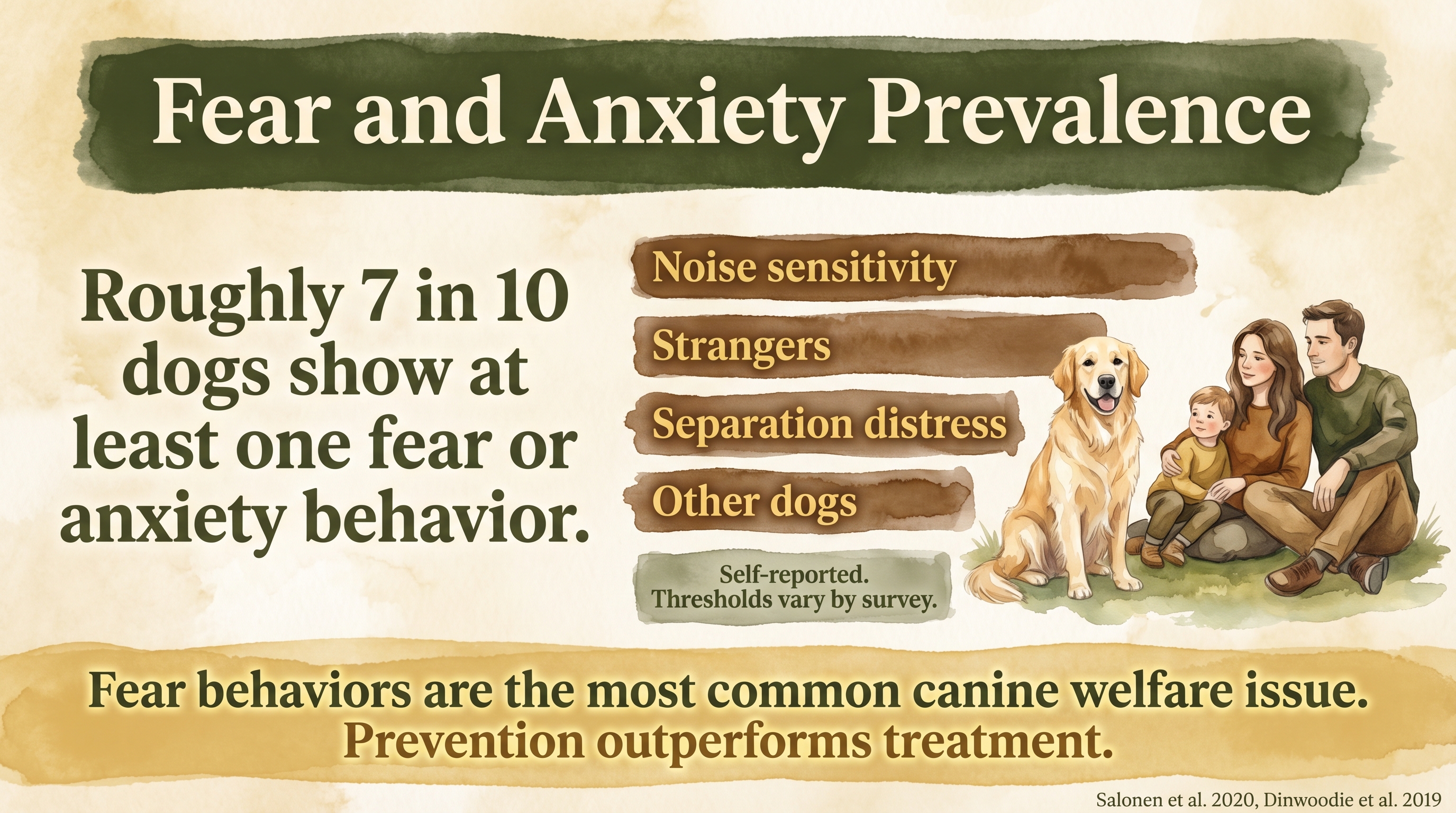
Fear is the most common canine welfare issue - prevention outperforms treatment.
Key Takeaways
- Fear and anxiety are not edge-case problems. They are central features of the modern companion-dog epidemiology.
- These issues commonly overlap with aggression, reactivity, separation distress, and other practical household problems.
- Early environment and ongoing household calm both matter in how fear vulnerability develops and expresses.
- JB's Calmness pillar should be read as a direct answer to one of the field's largest population-level problems.
The Evidence
This entry uses observed claim-level tags beyond the dedicated EvidenceBlocks below. These tags mark JB program observation or practice-derived claims that need dedicated EvidenceBlock coverage in a later content pass.
This entry uses heuristic claim-level tags beyond the dedicated EvidenceBlocks below. These tags mark JB interpretive application rather than direct study findings.
- Dinwoodie et al. (2019)owned dogs
Reported fear and anxiety in 72.5 percent of dogs in an owner-completed survey. - Salonen et al. (2020)Finnish companion dogs
Found high prevalence of noise sensitivity and other fear-related traits with notable comorbidity. - Meyer et al. (2023) and Dog Aging Project analysescompanion dogs
Show that fear and anxiety prevalence remains substantial even in differently designed datasets. - Puurunen et al. (2020) and Blackwell et al. (2013)companion dogs
Link sensitive-period socialization and fear underrecognition to the wider anxiety picture.
- domestic dogs
No single dataset directly resolves the full population picture for fear and anxiety prevalence in dogs without the usual survey, sampling, and threshold limitations.
SCR References
Sources
- Dinwoodie, A. T., et al. (2019). Animals.
- Salonen, M., et al. (2020). Scientific Reports.
- Meyer, I., et al. (2023). Scientific Reports.
- Puurunen, J., et al. (2020). Scientific Reports.
- Blackwell, E. J., Bradshaw, J. W. S., & Casey, R. A. (2013). Fear responses to noises in domestic dogs: Prevalence, risk factors and co-occurrence with other fear related behaviour. Applied Animal Behaviour Science, 145(1-2), 15-25.