Canine Behavioral Epidemiology: An Overview
Behavioral epidemiology is the population-level study of dog behavior problems: how often they occur, which patterns cluster together, what risk factors travel with them, and what consequences follow when behavior becomes difficult enough to alter a dog's life trajectory. It does not ask whether one individual dog is anxious or aggressive in the intimate clinical sense. It asks what can be seen when thousands of dogs are studied at once. That broader angle matters because the ordinary dog-training conversation often treats behavior problems as isolated failures inside isolated homes. The epidemiology says otherwise. Large owner-report datasets, shelter studies, working-dog datasets, and referral populations all point to the same high-altitude reality: fear, anxiety, aggression, separation-related distress, reactivity, and other everyday behavior problems are not rare edge cases. They are common features of companion-dog life. Meyer et al. 2023 found at least one behavior problem in 34 percent of a representative Danish sample of 5,054 dogs. Dinwoodie et al. 2019 found at least one problem in 85 percent of 4,114 dogs from a U.S. online owner survey. Salonen et al. 2020 found noise sensitivity in 32 percent of more than 13,700 Finnish dogs. Serpell and Powell's Dog Aging Project analyses, built from more than 43,000 dogs, found wide but substantial prevalence ranges for anxiety, fear, aggression, and separation-related problems. Documented
Those numbers are not interchangeable because the methods differ. Definitions differ, populations differ, and the threshold for calling something a problem differs. That is exactly why epidemiology is useful. It teaches families to read prevalence with both seriousness and caution. The signal is large even when the exact percentage moves around.
The data sources are also broader than many families realize. Behavioral epidemiology draws from standardized owner questionnaires such as C-BARQ, from veterinary behavior referral caseloads, from shelter relinquishment data, from working-dog programs, and sometimes from large projects such as the Dog Aging Project. Each source sees a different slice of dog life, and each has its own biases.
JB uses epidemiology as a map rather than as a prophecy. Population data does not tell you exactly what your Golden Retriever will become. It does tell you what kinds of problems fill the modern landscape, which in turn sharpens the question of what kind of raising system might reduce the odds of joining those statistics.
What It Means
The Field Studies Distribution, Not Destiny
Epidemiology is about distributions and patterns. In canine behavior, that means asking how often fear, aggression, trainability problems, separation distress, excitability, compulsive behavior, and other traits show up across large groups of dogs. It also means asking how those traits vary by age, breed, sex, neuter status, environment, early experience, and owner report style. That is a very different enterprise from a one-dog training consultation, but the two should talk to each other.
Large datasets make the field possible. The Danish study by Meyer et al. Documented 2023 mattered because it tried to sample more representatively than convenience surveys often do. Dinwoodie et al. 2019 mattered because it showed how high prevalence estimates can become in self-selected owner populations. Salonen et al. 2020 mattered because it highlighted both high prevalence of anxiety-related traits and strong comorbidity among them. Blackwell et al. 2008 added a striking older result: owners reported a mean of 11.3 undesirable behaviors per dog, and class attendance did not significantly reduce the total count in that particular sample. Brand et al. 2024 then reminded the field that survey framing itself changes apparent prevalence, because only 35 percent of owners spontaneously described a problem in free text.
Where the Data Comes From
Owner-report surveys are the workhorse of the field. They are cheap enough to scale, ethically straightforward, and uniquely able to capture behavior in daily life. C-BARQ is the best-known standardized example, but other country-level and project-specific questionnaires matter too. Referral populations show what reaches specialty care. Shelter and relinquishment data show which patterns become socially and logistically costly enough to threaten placement. Documented Working-dog and service-dog datasets show what fails even in heavily selected and heavily managed populations.
Each source has a different denominator. Referral clinics overrepresent severe cases. Shelter records overrepresent breakdowns in human-dog fit. Owner surveys overrepresent what owners notice and are willing to report. Working-dog datasets overrepresent dogs already bred or selected for demanding roles. Behavioral epidemiology works by comparing these imperfect windows rather than pretending one of them sees everything.
What Categories Keep Reappearing
Several behavior domains recur across studies. Documented Fear and anxiety are probably the broadest. Aggression is usually broken down by target, such as unfamiliar people, household members, or other dogs, because those are epidemiologically different phenomena. Separation-related behavior appears frequently, though definitions vary. Noise sensitivity, stranger fear, dog fear, excitability, excessive barking, house soiling, destructiveness, and compulsive or repetitive behaviors also appear regularly.
The Dog Aging Project material is especially useful here because it shows how category definitions affect apparent prevalence. The same underlying dataset can look startlingly high or more moderate depending on how severity thresholds are drawn. That is not a failure of epidemiology. It is a reminder that behavior problems do not arrive in nature as perfect bins. Humans make the bins, then count within them.
Population data cannot tell a family exactly who their dog will become. It can tell them which problems are common enough that a prevention-oriented raising plan should treat them as foreseeable, not surprising.
Why the Field Still Matters Despite Its Limits
Behavioral epidemiology is full of bias, but that does not make it weak. Bias is part of the subject. Owners underreport some problems and overreport others. Blackwell, Bradshaw, and Casey 2013 found that many more dogs showed noise-fear signs than owners explicitly labeled fearful. Documented Dinwoodie and Salonen found strikingly high fear and anxiety numbers in self-selected surveys. Representative samples look lower. The field remains valuable because even after all those distortions are acknowledged, the prevalence signal stays large.
That is the big message. Companion-dog behavior problems are common enough to be treated as a population-level phenomenon. Once that is admitted, the central questions shift. Instead of asking why one unlucky owner got one difficult dog, the better question becomes why so many ordinary households are producing versions of the same outcome.
Why It Matters for Your Dog
For a family raising a Golden Retriever, epidemiology matters because it resets what should count as surprising. Many households meet pulling, noise sensitivity, greeting overarousal, poor recovery from stimulation, dog-directed unease, separation distress, or adolescent fear periods as if these were personal failures. The population data says they are common enough to be expected as risks in the modern dog landscape. That can feel discouraging at first, but it is actually clarifying. A predictable risk is easier to prepare for than a mysterious one.
Take fear and anxiety. If large surveys repeatedly find that these issues touch a substantial fraction of companion dogs, then calmness and recovery are not luxuries. They are population-relevant targets. If aggression rates vary by study but remain meaningful in every serious dataset, then social stability, frustration tolerance, and early handling deserve attention long before a family ever uses the word aggression. Epidemiology moves certain conversations upstream.
It also helps families interpret their dog's experience without becoming fatalistic. A prevalence estimate does not sentence a specific dog to a problem. A Golden with a good genetic starting point, strong early raising, appropriate social exposure, and calm household structure is not the same as a random data point. Yet the family benefits from knowing what the field sees broadly, because it can prioritize prevention where the risks are historically concentrated.
This matters in a breed with a strong public reputation for friendliness. Goldens do often have favorable population averages on sociability and low average aggression, but they are not exempt from fear, overarousal, separation distress, handling conflict, or adolescent instability. Breed reputation can make families dismiss early warning signs because they assume the dog will grow out of them automatically. Epidemiology is one antidote to that complacency.
Population data also helps explain why the training marketplace is so large. The market exists because the problems are common. That does not tell you which interventions are best, but it does tell you there is a real underlying phenomenon to explain. A field full of reactivity classes, anxiety consults, separation programs, and surrender counseling is not responding to a tiny fringe.
Another practical value is emotional proportion. Families often swing between minimization and panic. They minimize because "all puppies do this," then panic because the behavior feels bigger than expected. Epidemiology encourages a steadier response. Many problems are common. Many are manageable. Some become severe. The right move is neither denial nor catastrophe, but early, structured attention before a population-level risk turns into an individual household crisis.
The field also teaches humility about anecdote. A family may know three easy dogs and conclude behavior problems are mostly owner myth. Another may know two highly difficult dogs and conclude dogs in general are behaviorally broken. Population datasets widen the lens. They show commonality without requiring that every dog fit the same story.
That broader perspective helps a dog because it changes what the adults do early. A family that understands the prevalence landscape is more likely to take calm social exposure seriously, to notice small fear signals before they become large, to protect sleep and recovery, and to avoid rehearsing high-arousal patterns just because the dog is young and adorable. Epidemiology becomes useful when it changes the timing of care.
It also gives families a more realistic sense of what prevention is trying to beat. Prevention is not a philosophical flourish. It is an attempt to move one dog away from population-level risks that are common enough to fill databases, clinics, shelters, and working-dog attrition tables. Seeing the field at that altitude can make early household discipline feel less fussy and more compassionate.
There is another benefit to this high-altitude lens. It keeps families from misreading their own effort. A home can be conscientious and still meet a common risk pattern because those risks are genuinely widespread. That does not mean the family's work is pointless. It means the work belongs to a real population problem rather than to private bad luck. Once owners see that, they often become steadier and more strategic because they stop personalizing every difficulty as evidence that they are uniquely failing their dog. Observed-JB
Epidemiology also sharpens what counts as success. If the common risks are fear, chronic arousal, social instability, and placement-threatening conflict, then a successful family life is not merely one with a dog who obeys. It is one with a dog who is harder to count among those risks because the household has built better developmental conditions from the start.
What This Means for a JB Family
JB families should read behavioral epidemiology as context, not destiny. Use it to understand which problems are common, which ones cluster, and which ones deserve disproportionate attention in early raising.
That means taking calmness, recovery, early handling, and rehearsal prevention seriously before there is a visible crisis. The population data says many dogs drift into fear, anxiety, overarousal, and aggression-adjacent patterns. A JB family should let that knowledge sharpen its household design, not its anxiety.
It also means resisting easy stories. If prevalence is high across many populations, then the modern dog problem is not explained by one bad breed, one bad owner type, or one bad class. Documented The causes are broader and the answer probably has to be broader too.
For JB, that broader answer is a raising paradigm. The Five Pillars are not offered as population proof already won. They are offered as a deliberate response to the kinds of problems behavioral epidemiology keeps finding at scale.
The family's job is therefore straightforward. Read the map honestly. Do not panic at the map. Then raise the dog in a way that makes the common risks less likely to become your dog's biography.
That approach also protects against fatalism. Epidemiology can sound grim if families hear only the prevalence. JB's use of it is meant to produce responsibility, not despair. The dog is not a statistic to be feared. The dog is a developing individual whose life can still be shaped more intelligently because the adults understand which risks are common and which forms of household design make those risks easier or harder to prevent.
That is one reason this overview sits at the front of the subcategory. The later entries go deeper into specific problems, but the real point is already here: large populations of dogs are carrying recurring forms of behavioral trouble, and any serious raising philosophy should have something coherent to say about why that keeps happening.
For JB, that coherence begins with admitting the scale of the problem. Once the scale is admitted, prevention stops sounding optional and starts sounding proportionate.
That proportion matters.
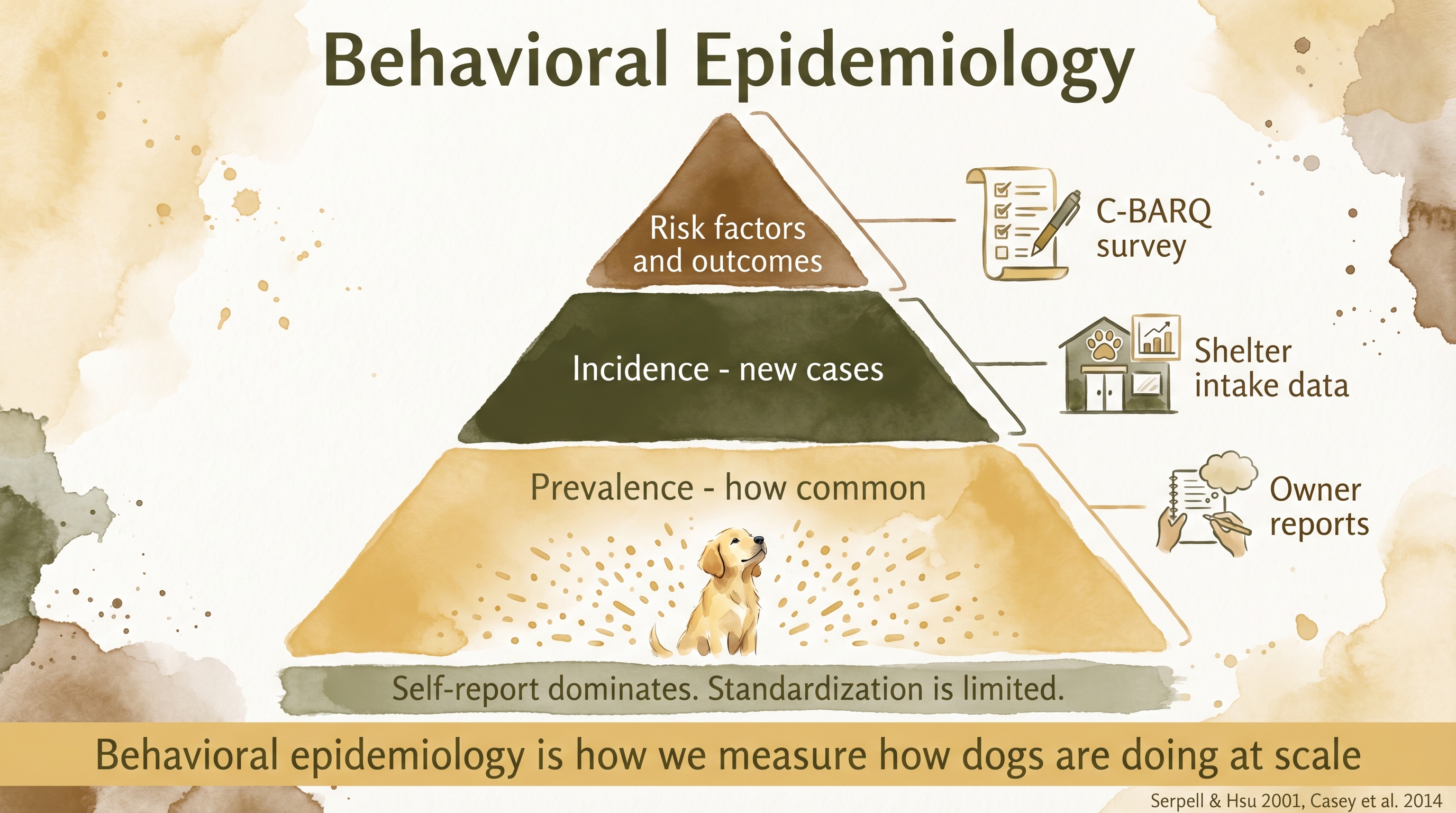
Behavioral epidemiology is how we measure how dogs are doing at scale.
Key Takeaways
- Behavioral epidemiology studies dog behavior problems as population patterns rather than as one-off household stories.
- Fear, anxiety, aggression, separation-related behavior, and overarousal-related problems are common enough to be treated as field-level phenomena.
- Different data sources see different slices of canine life, which is why prevalence estimates vary without collapsing the overall signal.
- JB uses epidemiology as a prevention map: not to predict a specific dog with certainty, but to know which risks deserve early attention.
The Evidence
This entry uses observed claim-level tags beyond the dedicated EvidenceBlocks below. These tags mark JB program observation or practice-derived claims that need dedicated EvidenceBlock coverage in a later content pass.
- Meyer et al. (2023)owned dogs in Denmark
Reported at least one behavior problem in 34 percent of a representative sample of 5,054 dogs. - Dinwoodie et al. (2019)owned dogs in the United States
Reported at least one problem behavior in 85 percent of 4,114 dogs from an online owner survey. - Salonen et al. (2020)Finnish companion dogs
Found high prevalence of noise sensitivity and other fear-related traits across more than 13,700 dogs. - Serpell and Powell Dog Aging Project analysesolder companion dogs
Show substantial prevalence ranges for fear, anxiety, aggression, and separation-related problems depending on the threshold applied.
- domestic dogs
No single dataset directly resolves the full population picture for canine behavioral epidemiology: an overview without the usual survey, sampling, and threshold limitations.
SCR References
Sources
- Dinwoodie, I. R., Dwyer, B., Zottola, V., Gleason, D., & Dodman, N. H. (2019). Demographics and comorbidity of behavior problems in dogs. Journal of Veterinary Behavior, 32, 62-71.
- Meyer, I., Forkman, B., Lund, T. B., & Sandoe, P. (2023). Behavior problems in dogs: An assessment of prevalence and risk factors based on responses from a representative sample of Danish owners. Journal of Veterinary Behavior, 61, 33-41.
- Salonen, M., Sulkama, S., Mikkola, S., Tenhunen, J., Hakanen, E., Tiira, K., Arata, S., & Lohi, H. (2020). Prevalence, comorbidity, and breed differences in canine anxiety in 13,700 Finnish pet dogs. Scientific Reports, 10, 2962.
- Dog Aging Project behavior-prevalence literature. The local Serpell & Powell 2024/2025 shorthand is superseded by the split source identities: Beaver et al. (2024), Journal of Veterinary Behavior, 74, 1-9, for the original prevalence paper, and Serpell & Powell (2026), Journal of Veterinary Behavior, 83, 61-67, for the reassessment.