Handler Skill as a Predictor of Training Outcomes
Compound evidence detail1 SCR / 2 parts
- Documentedthe structural absence of an industry-wide standardized canine behavioral outcome measurement and reporting system, supported by Hsu and Serpell 2003 (C-BARQ instrument), Lamb 2018 (LAIR clinician-overestimate finding), Mills 2020 (LCAS validation), Wright 2012 (DIAS validation), Daniels 2022 (UK client-rated equivalence regardless of method), and the IAABC Foundation Journal 2023 review of informal-assessment dependence
- Heuristicthe JB framing comparing the dog-training industry's outcome-measurement vacuum to adjacent helping professions (veterinary medicine, human psychology, education) where outcome measurement is regulatorily mandated or conventionally standardized, with the qualifier that the structural claim concerns industry-scale practice and does not deny that individual trainers measure outcomes in their own work
Dog-training arguments are usually framed as arguments about methods, yet a large share of outcome variance lives in the human rather than in the method label. Two families can buy the same class package, hear the same instructions, and leave with very different dogs because one family is timely, calm, observant, and consistent while the other is late, rushed, vague, and intermittent. The literature does not always measure "handler skill" under that exact name, but it repeatedly identifies pieces of it. Powell et al. 2021 found that owner personality and attachment were associated with treatment outcome in behavioral-medicine cases. Takeuchi, Houpt, and Scarlett 2000 found that owners remembered a mean of 5.1 instructions but complied with only 3.1 after more than a month, and improvement odds fell when plans became too crowded. Lamb et al. 2018 showed that professionals can rate success more generously than validated scales do. Those are all different windows into the same problem: dog outcomes are mediated by what the human can actually do. Documented
The handler variable matters at the finest grain. Timing changes whether the dog can connect consequence to action. Consistency changes whether the same behavior earns the same answer tomorrow as it did today. Emotional tone changes whether practice feels clear or chaotic. Observation changes whether the family notices arousal climbing early enough to intervene before the dog spills over threshold. Follow-through changes whether yesterday's rule still exists by the weekend. Even studies on generalization make the point indirectly. Gonzalez and Terrace 2023 found that combining vocal and gestural cues improved generalization in nine dogs, which is another way of saying that clearer human communication altered outcome.
This is one reason the dog-training marketplace can feel so confusing. Families compare methods as if they were comparing medicines with fixed doses and fixed effects. Dogs are not pills, and dog owners are not dispensers. Every protocol is filtered through the timing, confidence, steadiness, and lifestyle of the person holding the leash. Once that is visible, a lot of field-level contradiction becomes easier to understand.
JB reads this as more than a training detail. The Five Pillars are not techniques waiting to be applied to a dog from the outside. They are lived through the adults raising the dog. Calmness exists in the handler before it can stabilize the puppy. Structured Leadership exists in the household before it can be recognized by the dog. Mentorship exists in the quality of the adult's presence, not in the name of the curriculum. Documented
What It Means
The Human Is Part of the Intervention
One of the most useful corrections to method debate is to stop imagining the human as a neutral delivery system. In actual family life, the handler is part of the intervention. Powell et al. 2021 did not find that protocol alone explained behavior-treatment success. They found that owner personality and attachment style had independent predictive value. Documented That is a major result because it means the literature is already telling us that the same written plan can land differently depending on who is trying to carry it out.
Takeuchi, Houpt, and Scarlett 2000 reached the same territory from a different angle. Their veterinary behavior study found that owners did not fully implement many of the instructions they were given, and improvement dropped when the recommendation stack grew too long. Documented Kanji et al. 2012, from the adherence literature summarized in the human-behavior-change notebook, showed that clear recommendations improved adherence odds roughly sevenfold. Adams et al. 2005 found that simpler dosing schedules were about nine times more likely to be followed fully than more complex ones. Dog training is not medication management, but the structural point carries over cleanly: people do better with plans that are clear, simple, and integrated into life.
The Component Skills That Actually Move Outcomes
Handler skill is not one mystical trait. It is a cluster of ordinary competencies. Timing matters because dogs live in contingencies that are narrow and local. A reward or interruption delivered several beats late teaches something blurrier than the human intended. Consistency matters because intermittent family rules invite rehearsal of exactly the behavior everyone says they want to reduce. Reading the dog matters because many problems are easier to redirect in the buildup phase than in the explosion phase. Calmness matters because dogs are exquisitely responsive to the emotional weather of the person managing the moment.
Herron et al. 2009 is useful here even though it is often cited mainly in punishment debates. The study documented owner use of confrontational methods and linked them with aggressive responses in many dogs. Documented At one level that finding is about aversives. At another level it is about human behavior under stress. Owners who are frustrated, escalated, and improvising aggressively are demonstrating low regulatory skill in the exact moments when good timing and calm observation are most needed. Handler competence therefore includes the ability not to add chaos when the dog is already struggling.
Calmness is not only a trait hoped for in the dog. It is a functional skill in the adult. A family that can stay steady while the puppy is excited or confused gives every other teaching signal more clarity.
Why Method Labels Often Overstate Their Importance
This does not mean methods are irrelevant. Welfare differences between reward-based and aversive-heavy approaches matter, and they should not be blurred away. It does mean that method arguments often overstate the amount of outcome certainty the label itself can carry. Within-method variance can be enormous. One reward-based household may create a thoughtful, mannerly dog because rewards are delivered with timing, criteria are stable, and the house does not keep accidentally reinforcing chaos. Another reward-based household may create frantic repetition because food arrives late, criteria change hourly, and everyone nags the dog with cues they do not enforce. The same pattern exists inside more correction-oriented camps as well. Label alone does not tell you how well the human will execute.
The broader notebook on outcomes reinforces this by showing how weak long-term comparisons remain. If owner differences, adherence decay, optimism bias, and transfer problems are all active, then many comparative claims are partly claims about the people in each sample rather than pure claims about the methods themselves. That does not erase real welfare findings. It does force more humility into comparative rhetoric.
Skill Travels Across the Dog's Entire Life
The deepest reason handler skill matters is that it transfers across contexts better than branded exercises do. A family that learns to notice rising arousal early, to shorten instructions, to set up calm transitions, and to follow through quietly on household rules will use those abilities at eight weeks, eight months, and eight years. They will use them at the front door, on walks, around visitors, during adolescence, after travel, and after veterinary events. That kind of skill is a durable family asset.
This is where JB's reading becomes especially practical. The Five Pillars are valuable partly because they ask adults to build portable capacities instead of accumulating isolated tricks. Prevention trains the family to anticipate rehearsals before they become habits. Mentorship trains adults to show the dog what life looks like instead of waiting to react. Documented Structured Leadership trains consistency. Calmness trains regulation. Indirect Correction trains subtlety and timing. Read that way, the Pillars are not separate from handler skill. They are a framework for developing it.
Why It Matters for Your Dog
In ordinary homes, dogs do not meet one perfect handler for ten concentrated minutes a day. They live with people who are hungry, late for school, on work calls, carrying groceries, welcoming visitors, and trying to answer children while the dog is also doing dog things. That is why handler skill matters so much. The dog is learning from the whole rhythm of the household, not from a single formal training block.
Picture a young Golden Retriever who rushes the door whenever someone arrives. One family manages the same scene four different ways depending on who is home. Sometimes the dog is rewarded for sitting. Sometimes he is yelled at. Sometimes he is pushed back physically. Sometimes the guests laugh and reward the jumping with affection. In that house, the core problem is not lack of theoretical knowledge about techniques. The core problem is that the dog's environment keeps delivering mixed information. A less glamorous but more skilled household would do better with fewer techniques and steadier follow-through.
The same principle shows up on leash. Many dogs pull because the human end of the leash is broadcasting confusion. The family sometimes stops, sometimes speeds up, sometimes chats and drifts, sometimes corrects sharply, sometimes asks for heel while still moving toward the thing the dog wants. A dog in that pattern is not responding to a coherent system. He is navigating a slot machine. Handler skill changes the picture by making movement, criteria, and timing predictable enough that the dog can actually learn from them.
This is one reason progress can look sudden once the adults change. Families often think the dog suddenly "got it" when what actually changed was the human pattern. The cue became shorter. Reinforcement became timely. The adults stopped repeating commands. The management setup got cleaner. Thresholds were noticed sooner. Because dogs live so closely tied to human consistency, they can improve dramatically when the people become easier to read.
There is also an emotional side that many families recognize immediately. A tense adult makes a tense interaction. A flustered person tightens the leash earlier, talks more, moves more abruptly, and notices less. The dog often responds by getting faster, louder, or more oppositional. The moment then gets interpreted as proof that the dog is stubborn or dominant, when in fact the whole system is escalating together. A calm adult changes the feel of the same moment before any special technique has been added.
Goldens make this lesson especially visible because they are often social, enthusiastic, and forgiving. Their good nature can conceal sloppy human handling for a while. The family mistakes the breed's softness for proof that the plan is working. Later, the dog is adolescent, physically powerful, and rehearsed in excitement patterns that nobody consistently interrupted early. Suddenly the household feels as if the dog changed overnight. Often the more accurate story is that the dog finally became large enough for chronic human inconsistency to become expensive.
Handler skill also matters because it determines whether any outside help will transfer home. A trainer may be excellent in session. If the family cannot read arousal, cannot keep criteria stable, and cannot organize a simple daily pattern, the dog comes back into a foggy system. That does not mean the instruction was wrong. It means the human side of the intervention was never fully built.
This is why families should be careful when comparing approaches solely by their branded promises. A calmer, clearer, more observant family using a modest humane plan will often outperform a chaotic household using a more technically impressive system. The reason is not magic. It is repetition. The skilled family is delivering thousands of cleaner moments each month.
Dogs experience those clean moments in surprisingly ordinary places. At feeding time, the adults either create a calm pause or a frantic launch. On walks, they either reinforce steadiness and direction or they rehearse drag and negotiation. During greetings, they either shape composed access to people or they accidentally build a habit of social explosion. At bedtime, they either settle the nervous system or carry the day's agitation forward. Handler skill is the quality of those repeated decisions.
Seen that way, the question "Which method is best?" is often less useful than the question "What kind of adult can make a dog's day more coherent?" That second question is much closer to the daily reality the dog actually lives inside.
Families also benefit from noticing that skill compounds. A parent who learns to keep cues short, to place rewards earlier, and to end repetitions before frustration builds is learning a general communication style, not a trick for one problem. Next month that same style helps with loose-leash walking. Later it helps with adolescent greetings. During a stressful season it helps the family reduce conflict while keeping rules intact. The dog's improvement is then not tied to one drill but to a house that has become easier to understand.
That compounding effect is why many disappointing training experiences feel paradoxical. The family bought a sophisticated method but did not become more skillful adults. The dog therefore improved where the method was heavily scaffolded and stalled where daily life took back over. From the dog's perspective, the branded system was only occasionally real. The family's baseline communication style remained the stronger force.
What This Means for a JB Family
For a JB family, the practical target is not to become amateur technicians obsessed with doing everything perfectly. The target is to become calmer, clearer adults whose signals mean something because they are stable over time. That is a much more reachable goal, and it is also the one dogs appear to use most.
Start with household simplicity. Make fewer rules, but keep them real. Use short cues. Stop repeating yourself. Notice the dog's state earlier. Build calm transitions around doors, feeding, greetings, and leash work. These sound almost too ordinary to count as training advice. That is part of the point. The family is developing the adult side of the relationship rather than outsourcing success to equipment or jargon.
Next, read the Five Pillars as handler disciplines. Prevention asks the family to stop rehearsals before they become grooves. Calmness asks adults to regulate themselves first. Structured Leadership asks them to be consistent even when the dog is charming. Mentorship asks them to show rather than constantly negotiate. Indirect Correction asks them to communicate clearly without flooding the moment with threat or noise.
If outside help is needed, choose professionals who make the adults better readers of the dog instead of merely better followers of a script. A useful trainer should increase the family's observational precision, reduce chaos, and leave behind skills that still function when the trainer is gone.
The strongest outcome predictor most families can control is therefore not the label on the method but the quality of the adults implementing daily life. That is encouraging news. It means better outcomes are often built less by shopping for a perfect ideology than by becoming steadier people for the dog already in the house.
This also makes family progress easier to judge honestly. Ask whether the adults are less reactive than they were last month, whether cues are cleaner, whether threshold is being noticed sooner, and whether rules survive busy days. If those answers are improving, the dog is likely receiving a more intelligible upbringing even before every visible behavior is polished.
It also changes what families should value in themselves. A parent who can interrupt excitement without anger, hold a boundary without drama, and return to calm quickly after a mistake is already becoming a more useful adult for the dog. That kind of growth is not a side benefit. It is part of the main intervention. The dog's life improves because the adults are becoming easier to live with, easier to read, and harder to throw off balance.
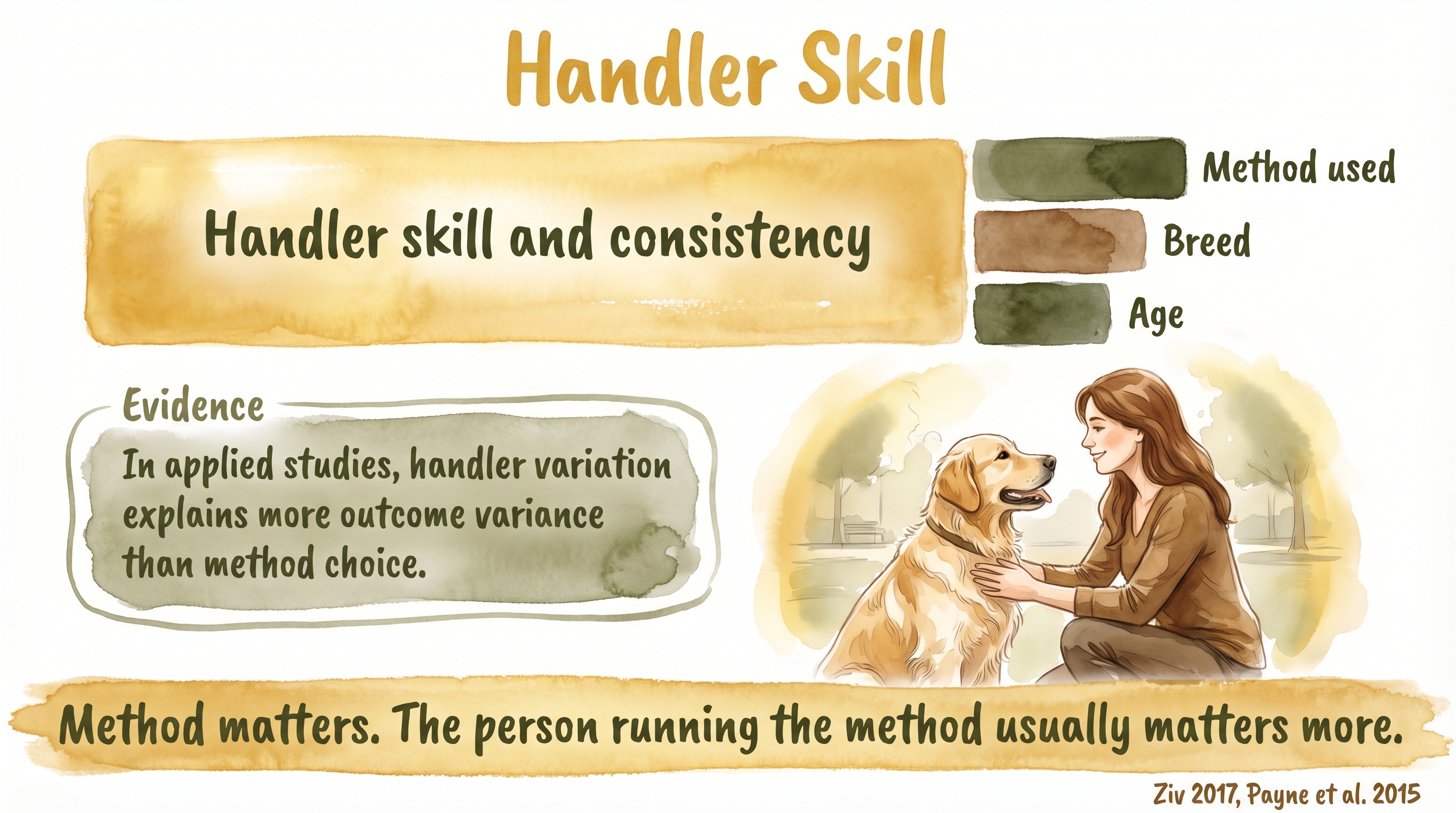
Method matters - the person running the method usually matters more.
Key Takeaways
- Dog-training outcomes are shaped heavily by the human's timing, consistency, emotional steadiness, and willingness to follow through.
- Published research already shows that owner traits and adherence affect outcome independently of the nominal training protocol.
- Method labels still matter, especially for welfare, but they do not eliminate the handler variable.
- JB's Five Pillars can be read as a framework for building durable human skill, not merely for directing the dog.
The Evidence
- Powell et al. (2021)companion dogs
Owner personality and attachment were associated with treatment outcome, showing that the handler is part of the intervention. - Takeuchi, Houpt, and Scarlett (2000)dogs in behavior treatment
Owners followed only part of recommended plans after one month, and improvement odds fell when prescriptions became too complex. - Lamb et al. (2018)companion dogs
Professional impressions of success can exceed validated outcome measures, cautioning against simple confidence-based assessment. - human adherence research
Clearer and simpler plans are more likely to be sustained, which has direct relevance to family dog-training follow-through.
- domestic dogs
No published study directly isolates the long-term dog-level and family-level effects of handler skill as a predictor of training outcomes across ordinary companion-dog contexts.
SCR References
Sources
- Powell, L., Stefanovski, D., Siracusa, C., & Serpell, J. A. (2021). Frontiers in Veterinary Science, 7, 630931. https://doi.org/10.3389/fvets.2020.630931
- Takeuchi, Y., Houpt, K. A., & Scarlett, J. M. (2000). Journal of the American Veterinary Medical Association.
- Lamb, L., et al. (2018). Frontiers in Veterinary Science.
- Herron, M. E., Shofer, F. S., & Reisner, I. R. (2009). Survey of the use and outcome of confrontational and non-confrontational training methods in client-owned dogs showing undesired behaviors. Applied Animal Behaviour Science, 117(1-2), 47-54. https://doi.org/10.1016/j.applanim.2008.12.011