Victoria Stilwell Academy for Dog Training and Behavior
Compound evidence detail2 SCRs / 5 parts
- Documentedthe Cavalli and Fenwick 2025 Animals survey evidence on dog-trainer professional learning channels showing mentors, workshops, and self-study as the dominant pathways
- Heuristicthe JB framing characterizing training methods as propagating primarily through media exposure, mentor lineage, and organizational affiliation rather than peer-reviewed evidence, with the qualifier that this describes the dominant pathway, not universal practice
- Documentedthe current Victoria Stilwell Academy credential structure drawn from official VSA materials, including the 2016 launch, positive/force-free orientation, flexible-length online Dog Trainer Course with weekly Faculty Advisor meetings, regular skills assessments, and the VSA-CDT designation
- Observed-JBthe historical Victoria Stilwell Academy course framing as approximately 45 weeks, observable in earlier public-facing materials and Wayback Machine snapshots, distinct from the current flexible-length structure described in current official materials
- Heuristicthe JB comparative-rigor framing of VSA as substantive within its force-free scope while bounded like all training-school credentials by the SCR-171 credential-outcome evidence gap, an interpretive characterization that downstream documents must not present as outcome-validated against family-dog results
Victoria Stilwell Academy, usually shortened to VSA, belongs to a newer generation of trainer schools built around a public media figure with a strong welfare-aligned brand. Founded in 2016, the academy presents itself as a positive, force-free professional education pathway for aspiring dog trainers. Its importance is not that it invented a new learning theory. Its importance is that it turns Victoria Stilwell's public profile, educational philosophy, and professional network into a structured credentialing route. Documented
That credential is the VSA-Certified Dog Trainer designation, commonly styled VSA-CDT. Current official VSA materials describe a faculty-led online Dog Trainer Course with weekly faculty-advisor meetings, regular skills assessments by videoconference, twenty modules of coursework, and an optional in-person track with intensives. Older public descriptions framed the program on a fixed timeline, while the academy's current materials emphasize flexible duration, with many students finishing in about six months and up to twelve months of access. That matters because the school is evolving, and families should read the current version rather than relying on stale marketing copy.
VSA is also inseparable from Stilwell's media identity. Her television work on It's Me or the Dog gave her unusual mainstream visibility compared with most trainers who build schools. In the modern industry, that matters. The source base is explicit that methods often propagate through media, affiliation, and personality as much as through journals. A school built around a known television figure therefore carries both opportunity and risk: a wide audience, a clear public philosophy, and variable recognition depending on how much a local market respects branded online education. Documented
The honest reading is that VSA is substantial enough to matter, but newer and more variably recognized than older exam credentials or longer-established schools like the Academy for Dog Trainers. Families should treat it as a real training-school pathway, not as a novelty. They should not treat it as a universally recognized gold standard whose value is automatically identical in every market.
What It Means
A School Built Around a Public Figure
Victoria Stilwell's public role shapes the academy from the start. Official VSA materials identify her as founder and president, and her television reputation remains central to the school's appeal. That is not inherently a weakness. Public figures can build serious institutions. It does, however, change how the school functions in the marketplace. Families may meet the credential first through recognition of Stilwell's name rather than through quiet institutional reputation.
The JB source layer helps explain why that matters. Modern dog-training ideas often spread through authority pathways outside peer-reviewed science, especially media and mentorship networks. VSA fits that pattern neatly. It is both an educational program and a vehicle for a branded humane-training worldview.
What the Current Course Looks Like
The academy's current official pages describe a course architecture that is more substantial than a simple self-paced video bundle. Students work through twenty modules, meet weekly with a dedicated faculty advisor, undergo regular skills assessment, and receive coursework in canine cognition, communication, learning theory, enrichment, group classes, private lessons, behavior problems, and working with humans. Documented The handbook and sales pages also describe a premium in-person track layered onto the online course through virtual intensives, live cyber classes, shadowing, and in-person learning events.
The timeline question is worth handling carefully. The dispatch spec points to an older 45-week framing. Current official VSA materials instead describe a flexible-length online course, note that many students complete it in about six months, and allow up to twelve months for completion. The in-person add-on is described separately as a ten-month program. The safe conclusion is not that one side is lying. It is that the school has changed its public framing over time and the present-day description should carry more weight.
What the VSA-CDT Signals
The VSA-CDT signals three things more than anything else. First, it signals ideological alignment with a force-free, welfare-centered training culture. Second, it signals that the graduate completed a structured curriculum rather than simply passing an outside exam. Third, it signals training within a branded ecosystem that includes faculty review, educational materials, and graduate marketing support.
That third point cuts in two directions. Support matters, especially in a fragmented profession. At the same time, school-linked marketing support can blur the line between education and brand extension. Documented Families should understand that the credential tells them something real about training culture and curriculum exposure, but it does not free them from evaluating the actual trainer standing in front of them.
Credentials built around a public brand can make families feel safer very quickly. JB's caution is not to dismiss that signal, but to read it precisely. A school name can describe a philosophy and a curriculum without settling the deeper question of relational fit.
Where the Program Sits in the Broader Landscape
VSA is neither the lightest nor the heaviest path in the field. It is more educationally involved than an exam-only badge and more structured than simple self-study. Documented It is still newer than the Academy for Dog Trainers, younger than CCPDT as an exam body, and less universally legible than veterinary or advanced behavior credentials. Recognition can therefore vary by region, referral network, and the experience level of the local trainers and veterinarians who know the school.
That positioning leads to the fairest summary. VSA appears to be a real, welfare-aligned trainer school with meaningful curriculum and assessment. It is not yet an institution with the same long historical track record as some older pathways, and the profession still lacks outcome-comparison evidence showing that VSA graduates outperform other routes.
Why It Matters for Your Dog
For a Golden Retriever family, the practical question is not whether Victoria Stilwell is famous. The practical question is whether a VSA-trained instructor is likely to help the family raise and manage a real dog in a real house.
The likely advantages are easy to name. A VSA graduate has probably spent meaningful time on body language, humane handling, reinforcement mechanics, common family problems, and the human side of coaching. That is useful in ordinary retriever life, where the dog often arrives socially eager, physically strong, and capable of turning enthusiasm into chaos faster than a new family expects.
Picture a one-year-old Golden who drags toward every dog on neighborhood walks, jumps on guests, screams in the crate when overstimulated, and has learned that every outing begins at a boil. A trainer educated in a VSA-style curriculum is likely to see at least part of that clearly. They may talk about threshold, reinforcement history, environmental management, patterning, body language, decompression, and the need to reduce rehearsal of the explosive picture. For many families, that is already a meaningful step up from a trainer whose plan begins and ends with "show the dog who is in charge."
The family should still keep two cautions in mind. One concerns depth. A newer private school can provide a good foundation without necessarily equaling the strongest case-preparation paths for complex pathology. The other concerns culture. Because VSA sits close to a public humane-training identity, some graduates may be excellent relational coaches while others may still default to protocol-heavy trainer language that does not always translate cleanly into household life.
That distinction matters with Goldens because this breed often lures adults into method shopping rather than pattern reading. A family may sign up with a VSA-style trainer because the philosophy feels kind, then still end up with a home full of over-excited exercises, food-present behaviors, and too much training theater if the adult in charge never steps back to ask how the dog is living between sessions.
In other words, humane method alone does not guarantee developmental wisdom. A VSA graduate may be a very good fit when they use their education to make the household calmer, clearer, and more predictable. The fit becomes weaker when the home turns into a rolling laboratory of cues, treats, and management tools without enough attention to pace, boundaries, and the emotional tone of ordinary life.
A concrete family-level observation can help here. When a strong trainer meets a Golden puppy who loses its mind at the sight of visitors, they often start by shrinking the scene. They may ask for distance, shorter greetings, better staging, fewer simultaneous voices, and more deliberate handling of the first ninety seconds. When a weaker trainer meets the same puppy, they may jump directly to a scripted maneuver and miss the fact that the room itself is too loud to support any learning. A school that teaches body language and humane management improves the odds of the first response. It does not make the second impossible.
Families should also notice how the trainer speaks about failure. A promising VSA graduate is less likely to promise domination, quick fixes, or miracle timelines. They are more likely to talk about practice, observation, consistency, and building behavior under humane conditions. Those are good signs. Yet the family should still ask whether the trainer can explain why the dog is over-aroused in the first place and whether the answer includes the adults' own rhythms, not only the dog's compliance work.
The media connection adds one more wrinkle. Some families feel immediate trust because they know Stilwell from television. That can reduce anxiety, which is useful. It can also create borrowed confidence that belongs to the brand, not yet to the individual trainer. The safe move is simple: appreciate the signal, then keep evaluating.
For most Golden homes, VSA likely sits in the category of "potentially strong practical help if the individual trainer has maturity and judgment." That is already valuable. The family just should not confuse a promising credential with a full answer to the question of who should guide their dog.
One easy field test is to ask whether you can observe a class or see how the trainer explains a setback. A trainer who can calmly translate the school's ideas into ordinary family language is usually more useful than one who only repeats branded terminology.
Recognition also varies locally, so the smartest families ask their veterinarian, breeder, or trusted behavior professional whether the individual trainer has a solid working reputation beyond the school name itself. Documented
What This Means for a JB Family
For a JB family, VSA is best read as a serious humane-school credential with a modern, branded, force-free identity. That can be useful. It often means the trainer has been taught to avoid coercive shortcuts, to watch body language, and to think about how people learn alongside dogs. Those are real assets in family life.
The next step is to ask whether the trainer uses that education to stabilize the home or simply to increase the number of formal interventions living inside it. JB families do not need a house that feels like an endless sequence of training set-ups. They need adults who can make the day itself orderly enough that the puppy does not spend half its life over threshold.
That is why the best VSA fit is usually a trainer who can translate humane education into calm household structure. If the trainer helps the family make greetings quieter, transitions cleaner, boundaries clearer, and excitement less self-reinforcing, the school has served the relationship well. If the trainer adds vocabulary without changing the emotional climate of the house, the credential has not solved the deeper problem.
JB also benefits from remembering that a modern private school is one signal among several. A VSA trainer who is transparent, warm, family-centered, and willing to refer out may be a very good partner. A VSA trainer who treats every issue as a protocol problem may be less aligned than the brand first suggests. The point is not skepticism for its own sake. It is precision.
Seen that way, the JB takeaway is balanced. VSA is worth respecting. It is not a substitute for discerning whether the trainer can help your Golden Retriever grow into a socially steady family dog rather than merely perform better inside managed exercises.
That is especially true during transition periods. When a puppy leaves a breeder environment and enters a busy household, the family needs a guide who can preserve continuity, not just assign homework. Credentials help most when they support that softer landing.
If the credentialed trainer can extend calm structure into the home, the letters matter. If the letters sit on top of a chaotic family rhythm, they matter much less.
For JB, that remains the final practical test of any school in family life. The family is still looking for a person, not just a brand. When the graduate can turn humane method into steadier daily life, the credential has real value.
When that translation happens, the school becomes a practical asset rather than a brand aura, and humane schooling turns into durable household help.
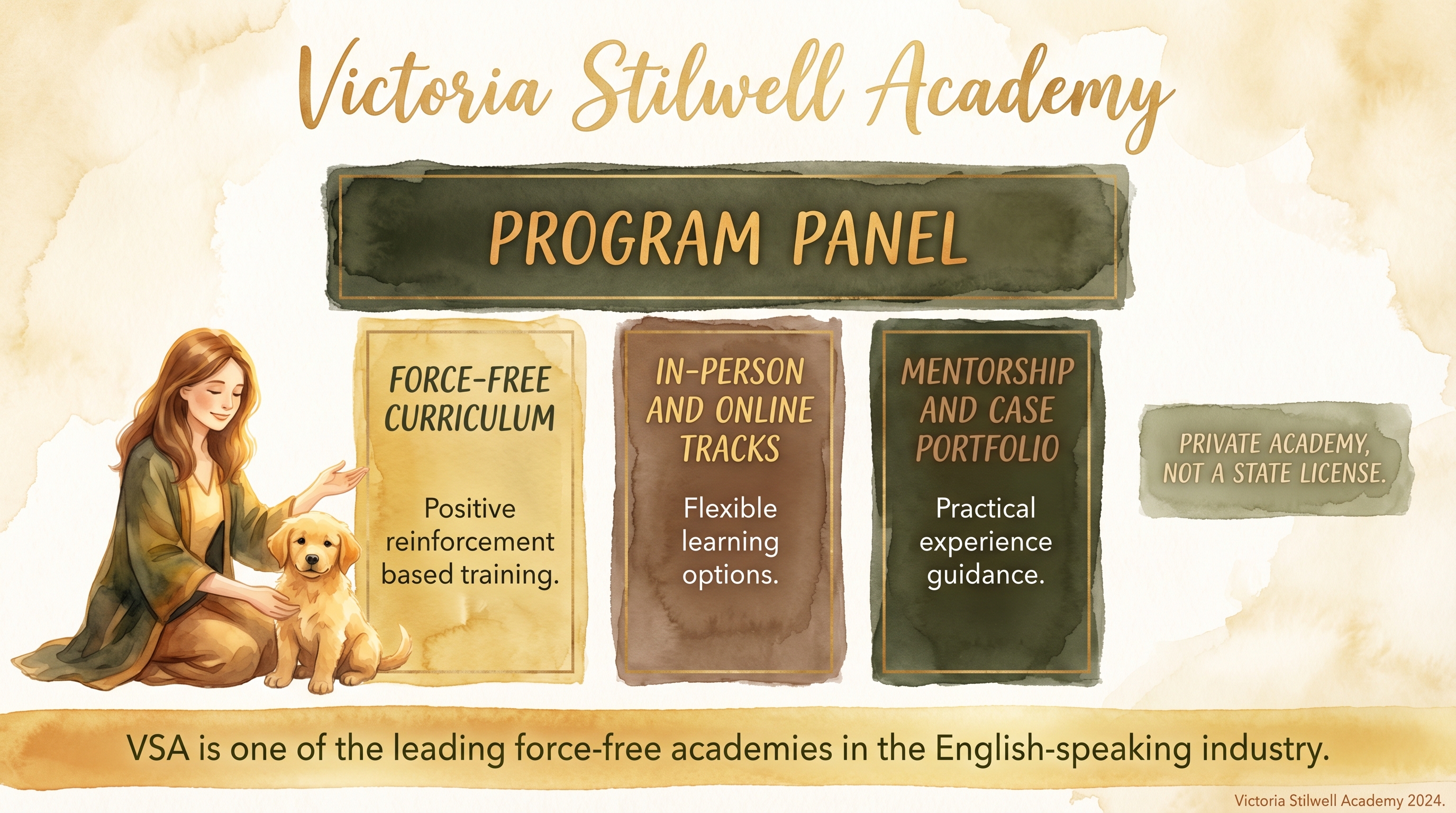
VSA is one of the leading force-free academies in the English-speaking industry.
Key Takeaways
- VSA is a real trainer-school pathway, not just a celebrity label, and its current public materials describe weekly advising, assessed coursework, and an optional in-person track.
- The credential is closely tied to Victoria Stilwell's public humane-training brand, which is both part of its appeal and part of what families must read carefully.
- Its recognition is meaningful but less historically settled than older or more exam-based credentials.
- For JB families, the useful question is whether the individual graduate can turn humane method into calmer family life rather than into more training theater.
The Evidence
- Victoria Stilwell Academy official course pages and student handbookdog trainer education
Document VSA's 2016 founding identity, the VSA-CDT designation, weekly faculty-advisor meetings, regular skills assessments, twenty online modules, and the optional in-person track. - dog training profession
Supports the broader claims that credential recognition varies, method cultures travel through organizations and media, and the profession lacks certification-outcome comparison research. - SCR-175method propagation
Supports the narrower point that modern trainer preferences often spread through media and brand authority rather than through formal evidence review alone. - SCR-171credential validation
Places a ceiling on what can be claimed about the VSA credential by noting the absence of peer-reviewed certification outcome studies across the field.
- domestic dogs
No published study directly compares the long-term dog-level and family-level outcomes associated with professionals trained through victoria stilwell academy for dog training and behavior versus other educational pathways.
SCR References
Sources
- Victoria Stilwell Academy. "Dog Trainer Course."
- Victoria Stilwell Academy. "Student Handbook."
- Victoria Stilwell Academy. "FAQ."
- Victoria Stilwell Academy. "Victoria, Faculty & Team."