The Karen Pryor Academy and KPA-CTP
The Karen Pryor Academy matters because it is not simply an exam. It is a structured school. Founded in 2007 as an extension of Karen Pryor's clicker-training legacy, the academy built one of the clearest educational pipelines in the positive-reinforcement world. Its main credential, the KPA-CTP or Karen Pryor Academy Certified Training Partner, signals completion of a specific curriculum built around marker-based positive reinforcement, mechanical precision, and family coaching. In an industry full of vague certificates, that specificity is meaningful. Documented
The source layer describes the program as roughly six months of structured coursework combining online lessons, written assignments, hands-on exercises, workshops, and practical assessment, with class sizes capped at ten students. Tuition is high relative to many casual training programs, which reflects the fact that KPA is selling a full instructional sequence rather than a single test. Families should therefore read the credential accurately. KPA-CTP does not mean "passed a general dog-training exam." It means "completed this school's curriculum successfully." Documented
That matters because KPA is also method-specific. The academy's public identity is deeply tied to clicker training, marker timing, reinforcement mechanics, and positive-reinforcement methodology. From a JB perspective, that makes KPA-CTP both informative and bounded. It can be a strong signal for clean teaching skill, especially in puppy classes and ordinary family training. It is not automatically a signal of advanced competence in severe aggression, veterinary behavior cases, or the full developmental philosophy JB families care about most. Families who understand that boundary usually read the credential far more intelligently. Documented
That also means the KPA signal is often easiest to trust where the teaching environment itself matters, puppy classes, manners classes, family coaching, and skill-building work where timing and clarity are central. Families should read the credential in that practical light rather than as a floating stamp of universal mastery.
What It Means
A School, Not Just a Test
The most important thing to understand about KPA is that it is curriculum-based. The source document contrasts this with the CCPDT model. CCPDT asks whether the trainer meets eligibility criteria and can pass an exam. KPA asks whether the trainer can complete the Karen Pryor Academy's own training process. That difference changes the signal.
When a family sees KPA-CTP, it should think of program completion, supervised exercises, repeated skill-building, and a shared training language rather than a broad independent certification exam. That can be valuable because it gives the credential more internal coherence. Graduates have usually passed through the same conceptual frame and the same expectations about timing, mechanics, criteria, and reinforcement use.
The Program's Specific Strengths
The source layer emphasizes several practical strengths. First is mechanical skill. Marker-based training is sensitive to timing, and KPA has long marketed itself on that exact point. Second is consistency. Because students are trained inside one system, the KPA-CTP often signals fluency in shaping, reinforcement delivery, criteria setting, and clear owner explanation. Observed-JB Third is humane methodology. The KPA code described in the source notes requires trainers to use the most positive, least intrusive, effective solutions and to avoid tools such as shock and prong collars.
These strengths make KPA especially legible for families looking for puppy help, family manners, cooperative training, and reinforcement-based owner education. It is often a very readable signal in that zone.
The Credential's Boundaries
The same method specificity that makes KPA coherent also makes it narrow. The academy is built inside Karen Pryor's intellectual tradition. That means it is aligned with marker-based positive reinforcement, not with broad philosophical neutrality. The source document calls this out directly by noting that KPA functions as both a credential and a methodological commitment.
That is neither scandalous nor unique. Many training schools have strong philosophies. The important consumer point is that KPA-CTP tells you something about what kind of training picture the graduate likely carries into practice. It is not merely a general statement that the person is "good with dogs."
Scope and Case Complexity
This matters most when families start confusing excellent foundational training with complex behavior consultation. Documented A trainer can be superb at puppies, household manners, clicker mechanics, shaping calm alternatives, and owner instruction while still not being the right person for severe fear aggression, compulsive disorders, serious separation pathology, or medication-adjacent cases. The source document is explicit that no peer-reviewed outcome study has shown KPA graduates to outperform non-graduates across case types, and it also makes clear that the academy's curriculum focus is not severe pathology.
So the right reading is not skeptical. It is specific. KPA-CTP is a strong signal in some domains and a limited signal in others.
What the Credential Communicates Socially
There is also a cultural function worth noticing. Because KPA sits inside the positive reinforcement lineage, the credential also communicates affiliation. Families often choose KPA trainers because they want a reward-based, force-avoiding, carefully coached style of help. That is valid. It simply means the credential carries both skill information and philosophical information at the same time.
The small-class, repeated-coaching structure also matters for consumer reading. A trainer who has spent months inside one carefully sequenced curriculum has usually had more opportunity to refine mechanics and teaching habits than a trainer whose main credential is a single exam sitting. That does not make KPA universally stronger than every other route. It does explain why many families experience KPA trainers as unusually polished in foundational class environments.
KPA often maps well onto the early, family-facing side of the market where prevention still matters. That can be a strength for puppy and manners work, provided the family remembers that good technique is still only one part of raising a mature dog.
Why It Matters for Your Dog
For a Golden Retriever family, the KPA-CTP may be one of the most practically useful credentials in the whole market, if the problem is matched correctly. Goldens tend to be food-motivated, socially engaged, and responsive to clear marker timing. For puppy classes, household basics, cooperative skills, handling, leash foundations, and owner education, a skilled KPA trainer can be an excellent fit. Documented
That is especially true in the first year. Many Golden families need help organizing training sessions, setting criteria, avoiding accidental reinforcement of chaos, and building reliable habits before adolescence hardens the picture. A KPA-CTP trainer is often well equipped for exactly that work because the curriculum emphasizes precision and teachability.
A practical example shows why. Suppose a young Golden is jumping wildly on arrival, mugging for treats, and losing focus the moment the family gets excited. A good KPA trainer may do several things very well: clean up marker timing, clarify which behaviors are being reinforced, coach the family on criteria, and build more structured repetition into ordinary routines. Those are real advantages.
But families also need to see where the credential stops talking. If the same Golden is not merely untrained but chronically over-aroused because the house is too loud, too stimulating, too permissive, and too inconsistent, then mechanics alone will not solve the whole problem. The trainer may still help a great deal. The family just should not assume that marker fluency equals a complete developmental plan.
This distinction matters because Goldens are easy to over-reward without realizing it. Their enthusiasm makes people want to interact constantly. A KPA-influenced trainer may help the family become much more precise about what is being marked and reinforced. That can be excellent. JB then asks the next question: is the family also building calmness, structured leadership, and prevention outside the training session?
The KPA credential also matters when families are comparing it against more general acronyms. If your Golden needs a well-run puppy class or ordinary family-dog support, a KPA-CTP may be a stronger fit than a more generic credential with no clear method picture. If your Golden is biting, panicking, or living in severe distress, you may need a different level of help entirely.
So the family-level lesson is to treat KPA as a very good signal for a certain slice of the work, not as a universal answer to every dog problem.
That distinction becomes even more important with Goldens because the breed rewards good mechanics so visibly. A family can leave a KPA-led session feeling that the puppy is thriving, and in one sense that may be true. Yet the same puppy may still need far more help around downshifting, family greetings, visitor management, and rest than the session alone can provide. The more socially willing the dog is, the easier it becomes to mistake technical responsiveness for broad maturity.
KPA is also a place where families can learn useful habits about their own behavior. Clear timing, deliberate criteria, and cleaner reinforcement can all make a household less sloppy. That is a real gain. The JB caution is simply that these gains should become servants of the larger raising plan rather than substitutes for it.
Another practical point is fit across problem levels. For puppy foundations, class work, cooperative care, and most ordinary manners goals, KPA can be a very attractive signal. For severe aggression, profound separation pathology, or medically entangled behavior cases, the family should not assume that curriculum excellence automatically equals specialist depth.
The same point protects Goldens from a subtle modern mistake. Because retrievers often respond so happily to skill sessions, families can begin believing that visible training enthusiasm is the same as broad developmental success. KPA's strengths are real. JB simply asks the family to keep asking what the dog is becoming in the rest of the day.
That is why KPA often shines brightest where the family's main need is cleaner teaching and calmer owner behavior rather than rescue-level intervention. The credential can help the household become less sloppy, which is no small thing.
Another practical point for Goldens is that precision can lower human frustration. Families who learn to mark and reinforce more intentionally often stop adding so much emotional noise to ordinary training moments. That benefit matters even before the dog responds.
That is why KPA can be particularly helpful for families who know they need more clarity but do not want to slide into harsher traditions in search of competence. The program's strengths can steady the humans as much as they steady the training plan.
What This Means for a JB Family
For a JB family, the Karen Pryor Academy is easy to appreciate and easy to overstate. It is easy to appreciate because careful timing, clear mechanical skill, and humane practice are all real goods. A family that learns to communicate more cleanly with a puppy often avoids a great deal of confusion and frustration later.
It is easy to overstate because technique can start to feel like the whole picture. A family begins to believe that if the marker timing is clean enough and the reinforcement history is well managed enough, maturity will emerge automatically. JB does not believe that. Maturity also depends on the social climate the dog is living in, the household's emotional tempo, the clarity of its boundaries, and the consistency of its routines.
So the JB use of KPA is straightforward. If you need skilled positive-reinforcement instruction, especially in puppyhood or in ordinary family training, a KPA-CTP may be a very good place to look. Then keep going. Make sure the home itself is building the kind of calm, mentored, structured life that a stable adult Golden actually needs.
In other words, JB is happy to keep the craft. It simply refuses to confuse craft with the whole philosophy of raising.
For a JB family, the academy's real value is that it can improve craft without forcing the family into harshness. That is worth a lot. The family simply has to remember that good craft still lives inside a bigger developmental assignment. A clicker-trained Golden can remain socially immature if the home keeps rewarding excitement and inconsistency outside the lesson.
So the practical JB move is to let KPA-style precision strengthen the home, not replace the home. When that happens, the credential becomes far more useful than either blind enthusiasm or dismissive skepticism would allow.
That is the most helpful way to read KPA in a JB home. Let the credential guide you toward good craft, then make sure the craft is being used in service of a calm, structured life rather than in place of one.
The real JB use of KPA is therefore constructive. Let the program's strengths reduce confusion and improve timing. Then make sure the gains are carried into meals, greetings, rest periods, and transitions so the dog is being raised more clearly, not just trained more neatly.
That broader use is where the credential becomes most valuable. It is a strong use of the credential even when it is not the only thing the family needs, and that kind of steadier human behavior is often an underrated benefit of good instruction. It matters more than it may first appear.
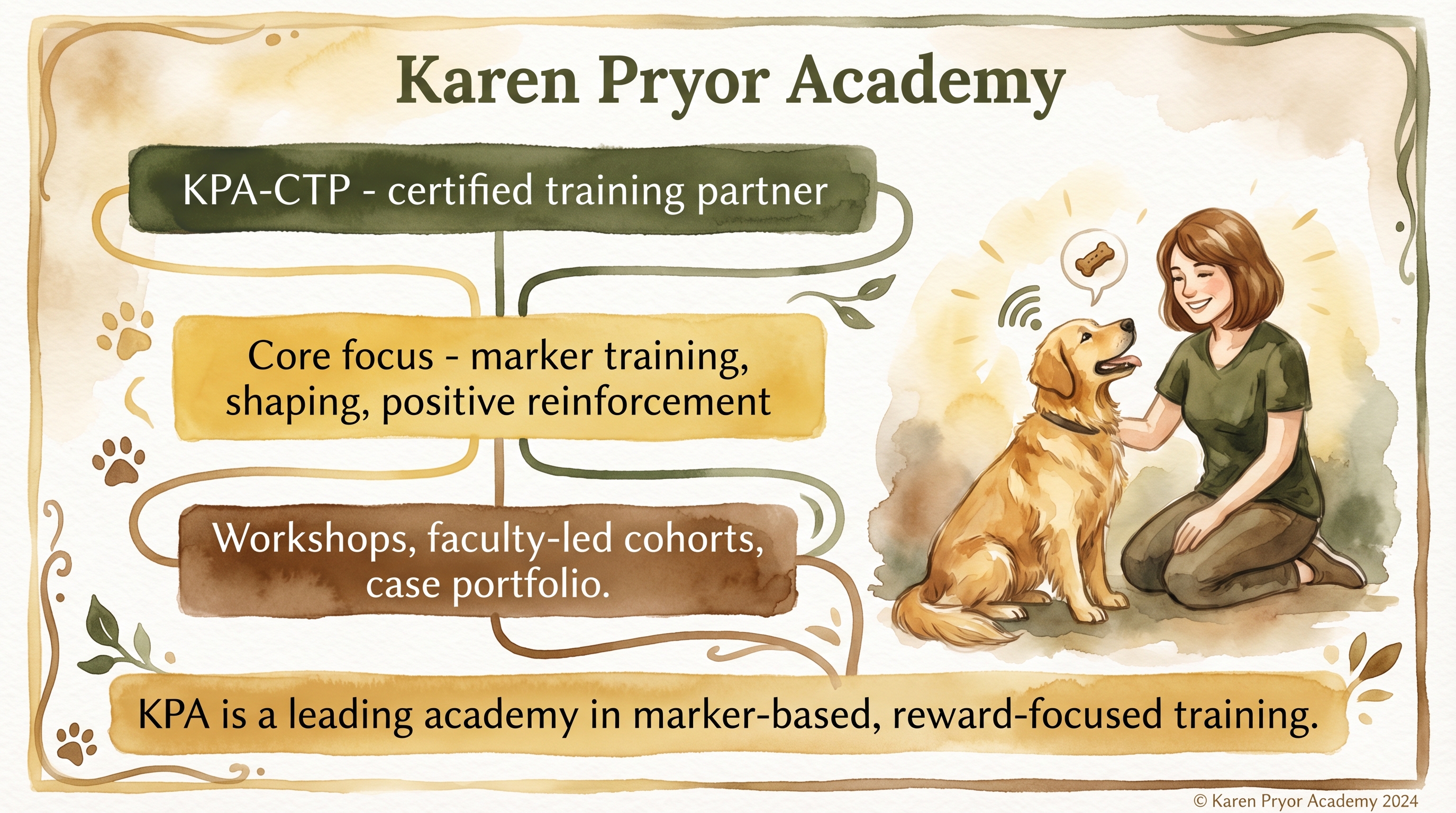
KPA is a leading academy in marker-based, reward-focused training.
Key Takeaways
- KPA-CTP signals completion of a specific structured school, not merely success on a broad independent exam.
- Its strongest consumer meaning is good marker-based positive-reinforcement education and mechanical skill.
- That strength makes it especially relevant for puppy classes and ordinary family-dog training, not automatically for severe pathology-level behavior cases.
- JB families can value the craft KPA represents while still keeping the larger raising picture in view.
The Evidence
This entry uses observed claim-level tags beyond the dedicated EvidenceBlocks below. These tags mark JB program observation or practice-derived claims that need dedicated EvidenceBlock coverage in a later content pass.
- dog trainer credentialing
Documents KPA's 2007 founding, six-month structured curriculum, practical assessment, ethics code, and strong method specificity. - KPA Student Handbook and Code of Conduct as summarized in source layerdog trainer education
Support the curriculum-completion nature of the credential and its strong commitment to positive reinforcement methodology. - SCR-171 and SCR-174dog trainer credentialing literature
Support the caution that a coherent curriculum credential can still be informative without becoming a validated universal predictor of outcome or fit.
- domestic dogs
No published study directly compares the long-term dog-level and family-level outcomes associated with professionals trained through the karen pryor academy and kpa-ctp versus other educational pathways.
SCR References
Sources
- Pryor, K. (2009). Don't shoot the dog: The new art of teaching and training (3rd ed.). Bantam.
- Skinner, B. F. (1974). About behaviorism. Alfred A. Knopf.
- Ziv, G. (2017). The effects of using aversive training methods in dogs. Journal of Veterinary Behavior, 19, 50-60.