Dog Trainer Certification: An Overview
Compound evidence detail1 SCR / 2 parts
- Documentedthe ACVB membership data and APPA pet-owning household estimates establishing approximately 80 to 110 board-certified veterinary behaviorists serving roughly 86.9 million US pet-owning households, with fewer than 100 active CAABs
- Heuristicthe JB application interpreting the practitioner-to-household ratio as a structural access problem, with the qualifier that the access analysis is more nuanced than the single ratio implies because some DACVBs serve as consultants to primary-care veterinarians rather than direct case practitioners
Dog trainer certification matters, but not in the way many families assume. In the United States, dog training is not a licensed profession. No state or federal authority requires a person to hold a credential, pass an exam, complete supervised education, or work within a formally regulated scope of practice before offering dog-training services. That means every certification in this field is voluntary. It may be useful, impressive, meaningful, or philosophically informative, but it is not the same thing as a legal permission to practice. Documented
Once that basic fact is clear, the rest of the landscape becomes easier to read. The source layer identifies several different kinds of credentials and affiliations. The CCPDT, founded in 2001, offers exam-based credentials such as the CPDT-KA and CBCC-KA. The IAABC, founded in 2004, offers case-based and writing-intensive behavior-consultant credentials. The Karen Pryor Academy, founded in 2007, runs a structured training-school model leading to the KPA-CTP designation. The Pet Professional Guild is a membership organization built around force-free principles rather than a general competency exam. At the higher professional end, CAAB and DACVB credentials signal far more extensive academic or veterinary specialization, but they are rare and do not function as a population-level standard for ordinary dog training. Documented
From a JB perspective, the key consumer lesson is precision. A credential is a signal, not a verdict. It tells you something about where a trainer studied, what body they affiliate with, and sometimes what kind of knowledge or skill they were assessed on. It does not tell you everything a family needs to know about philosophy, practical judgment, communication style, case fit, or the trainer's ability to support the raising of a stable family dog. That caution is not anti-credential. It is the only realistic way to read credentials accurately in an unregulated field. Documented
What It Means
Certification Versus Membership
The first distinction families need is the difference between a certification and a membership. A certification usually means some outside body has assessed a person's knowledge, skill, case work, or completion of a structured curriculum. The details vary, but there is an assessment component. A membership means the person has joined an organization, agreed to its values or code, and paid applicable fees. Membership can communicate philosophy, community affiliation, or professional engagement. It does not automatically communicate tested competence.
That distinction matters because the dog-training field uses credential-like language loosely. A trainer may list memberships, certifications, program completions, workshop attendance, online badges, and organizational affiliations side by side, leaving families to assume they all mean the same thing. They do not.
The Main Credential Families Encounter
The CCPDT is historically the most recognizable US certification body. The source document notes its 2001 founding, National Commission for Certifying Agencies accreditation for the CPDT-KA, published experience requirements, exam structure, and continuing education expectations. Documented That makes it closer to a conventional professional knowledge credential than many training-school certificates.
IAABC sits differently. Its canine consultant credentials focus more specifically on behavior consultation, require documented case work, coursework, references, and writing-intensive submissions, and are most relevant when the family is dealing with problems outside ordinary basic training. KPA sits differently again. The KPA-CTP reflects completion of the Karen Pryor Academy's structured six-month curriculum, making it both a competency signal and a marker of positive-reinforcement methodological training.
At the far end, CAAB and DACVB credentials matter precisely because they are not ordinary trainer letters. CAAB requires advanced academic work in animal behavior. DACVB requires veterinary licensure, residency, publication, and board examination. These are scarce credentials and should not be confused with general trainer designations.
What Credentials Do and Do Not Prove
The strongest honest claim a family can make from a credential is limited. A CCPDT credential can tell you the trainer met the body's published prerequisites and passed the required assessment. An IAABC credential can tell you the consultant documented case experience and passed that organization's review structure. A KPA-CTP can tell you the trainer completed KPA's curriculum. These are real pieces of information.
What the source layer also makes clear is what credentials do not prove. SCR-171 records an evidence gap: there is no published peer-reviewed study showing that dog trainers with major credentials reliably produce better outcomes than trainers without them. Ambiguous SCR-174 adds an important nuance. Credential status correlates with method orientation in some datasets, but credential and competence are not identical. The field does not have a validated formula by which letters after a name predict practical success for your specific dog.
Why Families Overread Letters
Families overread credentials for understandable reasons. In regulated professions, letters often sit on top of licensure, scope-of-practice rules, disciplinary systems, and state-recognized educational pathways. The dog-training field lacks that architecture. When a family sees several acronyms after a trainer's name, they may assume the market has solved the regulation problem informally. It has not.
Cavalli and Fenwick's 2025 survey shows how wide the educational spread really is, with 138 training programs and 39 exam-based certifications represented in one sample. Documented The profession is trying to standardize itself, but it has not achieved anything like a common floor.
The Practical Reading
So how should families read credentials? As clues. A CCPDT credential may suggest the trainer has engaged with mainstream learning-theory and instruction material. IAABC may suggest behavior-consultation seriousness. KPA-CTP may suggest clean mechanics, positive-reinforcement fluency, and good fit for puppy and manners work. PPG membership may suggest force-free ethical commitments. A DACVB means veterinary specialty level. All of those clues matter.
None of them removes the need to ask how the trainer thinks about arousal, household structure, prevention, correction, breeder transition, family routines, and long-term maturity. Those are often the most important questions for a Golden Retriever family, and no credential answers them by itself.
Credentials are signals. JB's consumer discipline is to read the signal for exactly what it says, and not for everything a family hopes it might say.
Why It Matters for Your Dog
For a Golden Retriever family, this overview matters because Goldens usually need help in domains where credentials are easy to overread. A family may be looking for puppy classes, adolescent manners, leash guidance, overfriendly greetings, jumping, chewing, or emotional regulation in the home. Many trainers can help with parts of that picture. The credential question is not irrelevant, but it is not the first or last question either.
Consider three common Golden scenarios. In the first, the family has a young puppy and wants a humane, organized class with clean teaching and good family coaching. A KPA-CTP or well-qualified CCPDT trainer may be an excellent fit. In the second, the dog is showing more serious fear or aggression. The family may need an IAABC consultant or even a DACVB referral depending on severity. In the third, the dog is not clinically disordered at all but is overexcited, immature, inconsistent at home, and under-structured in ordinary life. Here, the family may need less specialized behavior medicine and more honest guidance about raising, household pacing, calmness, and prevention.
Without this overview, families often collapse those categories together. They search only for "best certified dog trainer near me" and assume the letters will solve the triage question. That can lead to mismatches. The puppy goes to someone whose skill is severe aggression. The anxious dog goes to someone whose real strength is tricks and manners. The overexcited adolescent goes to someone who can teach cues well but has little framework for household developmental guidance.
Goldens are especially easy to mis-triage because many of their hardest family problems do not look dramatic at first. Excitability looks friendly. Dependency looks affectionate. Softness looks easy. Then adolescence arrives and the dog is bigger, stronger, louder, and harder to settle. A credential can help the family find serious help, but the family still has to know what kind of help it is looking for.
This is why JB keeps pushing the consumer question upstream. Do not ask only whether the trainer has letters. Ask what the trainer thinks a stable adult Golden looks like in a family home. Ask how they talk about arousal, structure, management, and prevention. Ask whether they can support the breeder-to-home transition rather than only task training after the dog is already struggling.
That does not make credentials unimportant. It makes them legible. A credential is best used to narrow the field, not to end the evaluation.
There is another reason this overview matters for Goldens specifically. The breed's common family problems often sit in an awkward middle ground. They are not always simple obedience gaps, but they are not always specialist pathology either. Overfriendliness, chronic overarousal, poor settling, exuberant greeting behavior, weak frustration tolerance, and adolescent chaos can all look more dramatic than they are or less serious than they are, depending on who is watching. Documented A credential overview helps the family ask a triage question before it asks a shopping question.
That triage habit is protective. A family that understands the credential map is less likely to hand an ordinary puppy issue to a specialist whose real strength is severe fear cases, and less likely to hand a genuine safety problem to someone whose credential mostly signals general manners instruction. In an unregulated field, that matching work is part of responsible ownership.
It also helps families resist prestige confusion. The trainer with the longest string of letters is not automatically the right fit if the family's real need is thoughtful support around calmness, household pace, prevention, and breeder-to-home continuity. Sometimes the best match is the trainer whose credential aligns cleanly with the level of the problem and whose philosophy aligns cleanly with the kind of adult dog the family is trying to raise.
Goldens especially reward that discipline because so many of their common problems sit in the middle range where the wrong level of help can waste months. Reading credentials well is one of the easiest ways a family can reduce that waste before it begins.
This is especially important when the family is tired. Exhaustion makes letters feel like relief. The overview exists partly to prevent that moment from turning into blind deference. A credential should focus the family's questions, not end them.
That is why this overview belongs near the start of the certification cluster. Families cannot judge the individual credentials well until they first understand that each acronym answers a different question. Once that is clear, the search for help becomes calmer and far less vulnerable to marketing confusion.
What This Means for a JB Family
For a JB family, the practical rule is to respect credentials without surrendering to them. A serious credential usually reflects time, cost, effort, study, and some level of outside accountability. Observed-JB Those are all good things. JB is not asking families to ignore them. JB is asking families to read them accurately.
That means matching the credential to the problem. If the dog has a severe behavior problem, step upward in expertise quickly and do not pretend a basic-trainer credential means specialist competence. If the dog needs ordinary puppy guidance, do not assume you need the highest or rarest letters in the country. If the real need is developmental support for a social, excitable family dog, do not confuse technical training credentials with a full raising philosophy.
It also means listening for philosophy. A trainer may have excellent credentials and still talk in a way that does not fit the home you are trying to build. Another trainer may have fewer letters and still have stronger instincts about calmness, mentorship, and household rhythm. JB does not romanticize the second case. It simply refuses to pretend the first case settles itself automatically.
So the JB takeaway is simple. Use certifications as filters, not idols. Let them sharpen your search. Then watch, ask, and think. In an unregulated profession, the family's judgment remains part of the safety system.
For a JB family, the overview becomes a sorting lens. Start by identifying what the dog actually needs, puppy foundations, ordinary family training, serious behavior consultation, or veterinary specialty input. Then read the credential landscape through that need rather than through marketing prestige. That approach protects both the dog and the family from needless mismatch.
It also keeps the home from becoming passive. The family remains responsible for judging whether the professional sees the whole dog or only a slice of technique. Credentials can sharpen that judgment. They cannot replace it.
That is why JB treats credential literacy as part of ordinary consumer competence. In a profession with loose legal filtering, understanding what each acronym can and cannot honestly claim is one of the simplest forms of protection available to the family.
That calmer posture is one of the main practical benefits of knowing the map first. It keeps the search honest.
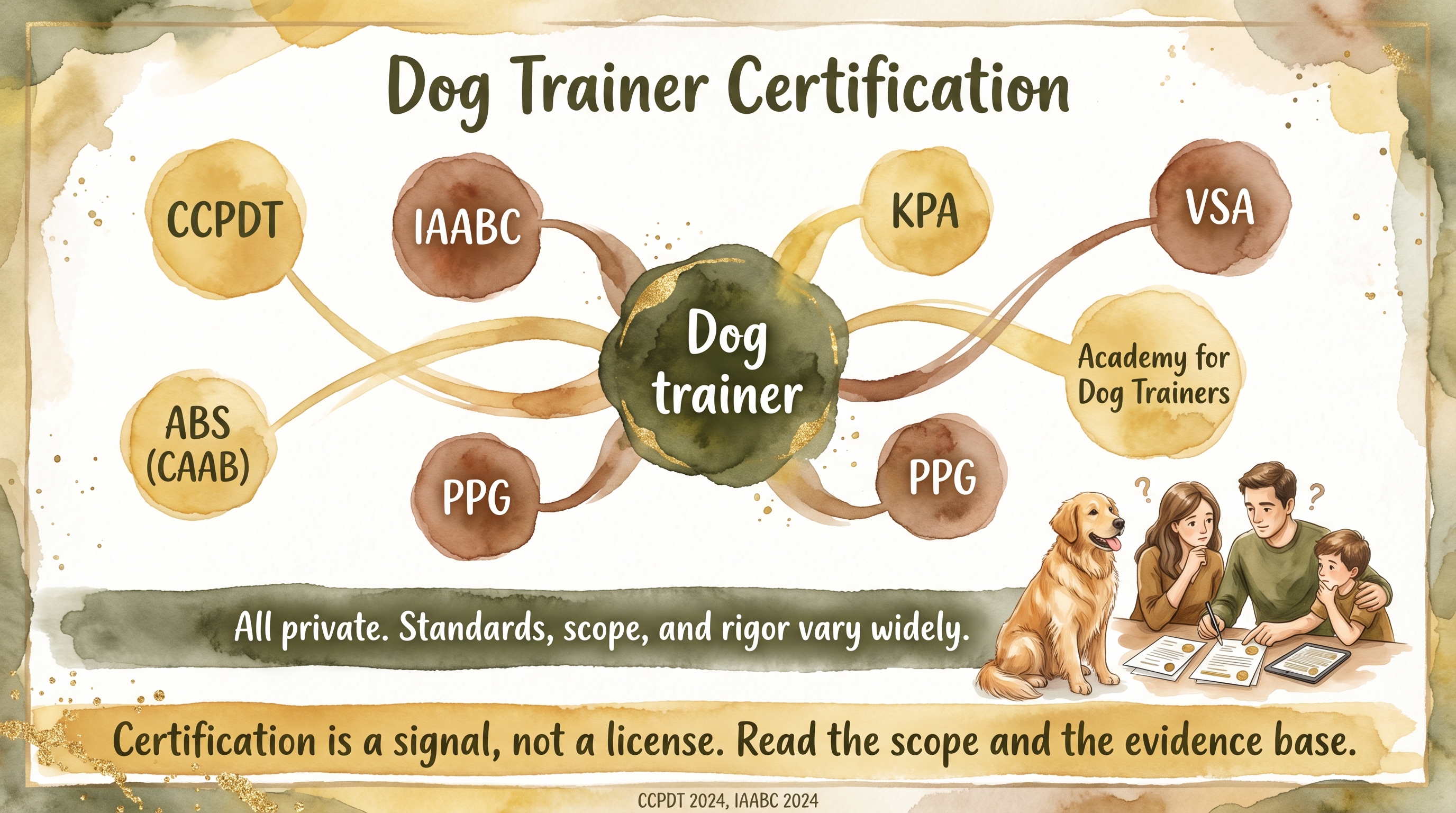
Certification is a signal, not a license - read the scope and the evidence base.
Key Takeaways
- Dog-trainer certifications are voluntary credentials, not legal licenses.
- Different acronyms signal different things: knowledge exams, case review, school completion, membership, or rare specialist education.
- No published outcome literature proves that major dog-training credentials reliably predict better results for every family and dog.
- JB families should use credentials to narrow choices, then evaluate philosophy, case fit, and real-world judgment before deciding.
The Evidence
This entry uses observed claim-level tags beyond the dedicated EvidenceBlocks below. These tags mark JB program observation or practice-derived claims that need dedicated EvidenceBlock coverage in a later content pass.
This entry uses ambiguous claim-level tags beyond the dedicated EvidenceBlocks below. These tags mark claims where the literature remains unsettled or multiple interpretations coexist.
- dog training profession
Documents the voluntary credentialing landscape, founding dates of major bodies, and the distinction between exam credentials, training programs, memberships, and specialist roles. - SCR-170US dog training profession
Establishes that dog training is unregulated in the United States, so no certification functions as a legal license to practice. - SCR-171 and SCR-174dog trainer credentialing literature
Support the caution that credentials may be informative without being validated predictors of outcome or complete competence. - Cavalli & Fenwick (2025)professional dog trainers
Demonstrate how educational and credential fragmentation persists even among working professionals.
- domestic dogs
No published study directly compares the long-term dog-level and family-level outcomes associated with professionals trained through dog trainer certification: an overview versus other educational pathways.
SCR References
Sources
- Cavalli, C., & Fenwick, N. (2025). A survey of the professional characteristics and views of dog trainers in Canada. Animals, 15(9), 1255.