The Rise of Social Media Dog Trainers
Compound evidence detail3 SCRs / 6 parts
- Documentedthe Cavalli and Fenwick 2025 Animals survey evidence on dog-trainer professional learning channels showing mentors, workshops, and self-study as the dominant pathways
- Heuristicthe JB framing characterizing training methods as propagating primarily through media exposure, mentor lineage, and organizational affiliation rather than peer-reviewed evidence, with the qualifier that this describes the dominant pathway, not universal practice
- Documentedthe documented absence of any RCT establishing single-method superiority across canine behavioral domains, paired with the on-record organizational position statements (AVSAB 2008 and 2021, APDT 2020 and 2023, CCPDT 2025, IACP 2025, plus Ziv 2017 and Todd 2018 reviews) which constitute institutional policy rather than scientific consensus
- Heuristicthe JB characterization of professional ideological fragmentation across force-free, balanced, and compulsion approaches, carrying the load-bearing firewall that absence of method-superiority RCT does not equalize methods on welfare grounds where SCR-026, SCR-028, and SCR-036 document harm from aversive methods independently of the outcome comparison gap
- Documentedthe structural absence of an industry-wide standardized canine behavioral outcome measurement and reporting system, supported by Hsu and Serpell 2003 (C-BARQ instrument), Lamb 2018 (LAIR clinician-overestimate finding), Mills 2020 (LCAS validation), Wright 2012 (DIAS validation), Daniels 2022 (UK client-rated equivalence regardless of method), and the IAABC Foundation Journal 2023 review of informal-assessment dependence
- Heuristicthe JB framing comparing the dog-training industry's outcome-measurement vacuum to adjacent helping professions (veterinary medicine, human psychology, education) where outcome measurement is regulatorily mandated or conventionally standardized, with the qualifier that the structural claim concerns industry-scale practice and does not deny that individual trainers measure outcomes in their own work
The social media era changed dog training by changing who the public encountered first. For most families, the gateway to dog advice is no longer a local club, a veterinarian, or even a book. It is a feed. Browne and colleagues in 2024 found that only 5 percent of surveyed US owners used a professional trainer for behavior concerns, while 60 percent would first seek advice online or from friends and family. That alone makes social media historically important. It is not just a side channel for the training industry. It is now one of the main places where owner beliefs are formed. Documented
The influencer layer sits on top of an already fragmented profession. DeLeeuw and Williams in 2026 documented that advocates from both reward-based and mixed-methods camps command YouTube audiences in the millions. Public-facing figures such as Zak George, Susan Garrett, Tom Davis, Robert Cabral, Larry Krohn, Joel Beckman, and Cesar Millan do not simply market services. They function as interpretive authorities for ordinary families, often long before those owners ever hire anyone in person. Once advice moves into a platform economy, presentation style, editing, conflict, and brand identity become part of how training knowledge travels. Documented
From a JB perspective, that shift matters because feeds reward compressible answers to problems that are usually developmental, relational, and cumulative. A one-minute clip can sell a leash technique, a before-and-after transformation, or a force-free talking point. It cannot show six months of household rhythm, breeder preparation, calm adult modeling, or the slow prevention work that shapes whether many common family-dog problems appear in the first place. That is an interpretive critique of the medium, not a denial that useful teaching can happen there. Heuristic
What It Means
The Platform Turn
Dog training always had media figures, but social platforms changed the scale and the pace. Television made a few personalities famous. YouTube, Instagram, TikTok, podcasts, and subscription platforms made dog training personalities continuously present. The owner no longer sees a trainer once a week. The owner sees dozens of clips a day, each offering a frame for what the dog is doing and what the human should do next.
The source layer documents the consumer context clearly. Browne et al. found that online and informal sources dominate owner help-seeking. Documented DeLeeuw and Williams documented that influencer trainers with million-scale reach are now meaningful vectors of method propagation. In practical terms, that means the public is often learning dog training in an advertising environment rather than in a classroom environment.
The Major Online Personalities
The reward-based side of the online world is represented by highly visible educators such as Zak George and Susan Garrett. Zak George's official site presents his mission as showing the world "modern, science-backed methods" centered on compassion and understanding, and it says he has reached millions through the YouTube channel Zak George's Dog Training Revolution and the book of the same name. Susan Garrett's DogsThat site describes her as an early online educator, identifies her system as game-based positive reinforcement, and traces her long-running online course presence back to Recallers in 2008.
The mixed-methods and broader behavior-modification side is represented by other large public brands. Tom Davis's Upstate Canine Academy presents him as founder of the academy, host of the No Bad Dogs podcast, and a creator of a highly viewed educational YouTube presence built around behavior cases. Documented Robert Cabral's official site describes a relationship-based approach, more than 20 years of experience, a weekly podcast, shelter and protection-dog work, and a large online education business. Larry Krohn's Pak Masters site explicitly emphasizes internet presence, YouTube visibility, aggression work, and e-collar communication. Joel Beckman's public materials center on Beckman's Dog Training, marine-mammal and exotic-animal experience, reactive and aggressive dog work, and a facility model in which everyday life is part of training.
The point is not that these figures are interchangeable. They are not. The point is that the social media field is populated by recognizable personalities whose public identities bundle training method, emotional tone, business model, and moral messaging into one consumable package.
Why the Medium Changes the Message
Platform incentives reward confidence, simplicity, and visual drama. The source document names several failure modes directly: "one weird trick" style advice, before-and-after framing that compresses weeks into seconds, demonstration setups that may not reflect ordinary households, and weak follow-up on long-term outcomes. Those are not random flaws. They are natural consequences of a format that rewards what can be shown quickly, shared emotionally, and remembered easily.
That is why social media can distort both camps. Reward-based creators may overstate how straightforward training becomes when timing, repetition, and food management are executed well on camera. Mixed-methods creators may overstate how quickly severe problems shift once a correction lands and a dog shows visibly different body language. Ambiguous The algorithm has no built-in preference for the most accurate account of long-term developmental change. It prefers clarity, momentum, and identity.
Useful Education Still Exists Online
The history is not all failure. Online dog education has real value. Zak George's public materials emphasize free educational access. Susan Garrett's site shows how online teaching can scale systematic games and owner education. Documented Tom Davis publishes long-form case material that can make difficult behavior conversations more concrete for owners. Robert Cabral's site includes detailed courses on shelter work, puppy foundations, and life skills. Even highly commercial personalities sometimes teach useful observations about body language, environment, and owner handling that families would otherwise never notice.
The honest historical point is therefore mixed. Social media widened access to dog-training information dramatically. It also removed much of that information from stable assessment, standardized follow-up, and ordinary household context.
Why the Social Media Era Intensifies Fragmentation
The influencer economy does not merely reflect the profession's fragmentation. It amplifies it. Johnson and Wynne showed that marketing language already divides along "science" versus "nature" narratives. Social media sharpens that split because people do not simply follow methods. They follow personalities. Once the brand is the teacher, disagreement becomes tribal faster than it becomes evidentiary.
That is why a family can watch one creator and come away believing all correction is abuse, then watch another and come away believing force-free training is sentimental nonsense. The platforms reward the edges of a disagreement because edges travel better than nuance. DeLeeuw and Williams' description of politicized method fits this landscape exactly.
The feed teaches owners to search for the right intervention after a problem is visible. JB keeps asking an earlier question: what daily raising pattern would have made the clip unnecessary in the first place?
Why It Matters for Your Dog
For a Golden Retriever family, this history matters because social media is where many puppy plans now come from. Before the dog is even home, families are watching leash videos, crate videos, reactivity clips, calmness reels, socialization tutorials, and board-and-train transformations. The puppy then arrives into a house already crowded with borrowed methods and borrowed urgency.
That can create a very specific modern problem. The family thinks it is being informed, but the puppy experiences inconsistency. On Monday the household imitates a high-energy treat game from a reward-based channel. On Tuesday someone tries a "leadership" drill from a different creator. On Wednesday the family decides to be more neutral and detached because another clip warned them they are over-talking to the dog. The puppy does not know these are competing educational paradigms. The puppy only knows that human behavior keeps changing.
Goldens are especially affected by this because they are so often raised by generous, enthusiastic people who want to do everything right. That makes them ideal consumers of content and, sometimes, ideal victims of content churn. A Golden puppy can become over-handled, over-stimulated, over-rewarded, or over-corrected simply because the family keeps trialing whatever the next persuasive clip suggests.
A concrete example is the social-media loose-leash walk. One creator shows a fast pattern game with high food engagement. Another shows a firm stop-and-correct sequence. Another shows long verbal encouragement and emotional cheerleading. Another shows a prong-collar turnaround with dramatic immediate effect. A family with a five month old Golden tries all four across two weeks. What the dog actually learns is not a coherent walking habit. The dog learns that the human is variable, excited, and reactive to whatever happened in the last video.
The same issue appears with greetings. Goldens often struggle with overfriendly jumping and full-body social excitement. Social media tends to turn that into a technique problem. Which leash setup? Which marker? Which interruption? Which drill? Those questions are not useless, but they are not the deepest question. The deeper question is whether the dog's whole day is cultivating a calm social baseline or rehearsing high-arousal access to people. A clip rarely captures that.
This matters because platform content is optimized for visible change, not necessarily durable family life. A reel showing a dog stop pulling for twenty seconds is easy to film. A six-month story about building patient door manners, calmer arrivals, low-drama transitions, and emotionally steady guest interactions is much harder to package. Yet the second story is often the one that determines whether a Golden matures into a dog that is actually easy to live with.
There is also a trust issue. Many social media creators genuinely care about dogs. Even so, the family is usually seeing a chosen segment, not a neutral audit. The dog may be in an unfamiliar place, the session may be one step in a much longer plan, and the before-and-after arc may omit maintenance work entirely. That does not make the content fraudulent. It means the family should not confuse it with a complete raising blueprint.
So the practical takeaway for your dog is this: use online content as a source of ideas, not as a substitute for a coherent household philosophy. Goldens do not need a feed's worth of tactics. They need adults who know what kind of dog they are trying to raise and can stay steady long enough for the dog to grow into that picture.
This matters before pickup day as much as after. Many families now arrive at puppyhood with a folder full of saved clips and no settled household philosophy tying them together. A Golden puppy does not need five online authorities alternating control of the home. Documented The puppy needs one family that already knows which rhythms, boundaries, and emotional habits it intends to protect.
The deeper risk is not only bad advice. It is accelerated emotional tempo. Feeds train owners to feel that every wobble requires immediate intervention and visible progress. Goldens do better when the adults resist that pressure and allow patient, boring consistency to do its work over time.
That is why media literacy becomes part of dog raising now. The family that can stay calm in the face of constant online certainty is already giving the dog something valuable, namely adults who are not being yanked around by every new theory in the feed.
That steadiness is a real gift to the dog.
What This Means for a JB Family
For a JB family, the response to social-media dog training should be neither panic nor surrender. You do not need to reject the whole internet to raise a good dog. You do need to stop letting the internet set the emotional tempo of the home. That is where many families lose their footing. The feed turns every behavior into a problem-to-solve and every problem into a chance to adopt another method.
JB asks you to slow that down. Before taking advice from a clip, ask what level of the dog's life it is addressing. Is this a narrow mechanical issue, such as how to mark a behavior cleanly? Or is it a developmental issue, such as chronic overarousal, insecurity, dependency, poor boundaries, or a household rhythm that invites nonstop rehearsal? Social media is usually strongest at the first level and weakest at the second.
That means a JB family can use clips selectively. A video about handling skills may be useful. A short explanation of body language may be useful. A demonstration of how to manage space safely around a reactive dog may be useful. What cannot be outsourced to clips is the daily raising pattern. Calmness, Mentorship, Structured Leadership, Prevention, and Indirect Correction are not feed hacks. They are qualities of life that emerge from consistency.
This also protects the breeder-to-home transition. If a puppy leaves a structured breeder environment and enters a home ruled by algorithmic novelty, the soft landing disappears. The puppy is no longer moving into one coherent social world. The puppy is moving into a rotating panel of internet advisors. Goldens can tolerate that for a while because they are affiliative and resilient, but the bill often arrives later as excitability, confusion, or shallow compliance without maturity.
So the JB answer is simple and demanding at the same time. Learn broadly, but follow narrowly. Let outside material inform you, not govern you. Choose a calm developmental picture and organize the household around it. That is how you keep the internet from raising your dog by committee.
Once that picture is clear, digital content becomes safer to use. The family can borrow a handling detail or management trick without borrowing an entire online identity. That is a real skill in the social-media era, and it may be one of the healthiest forms of media literacy a dog owner can develop.
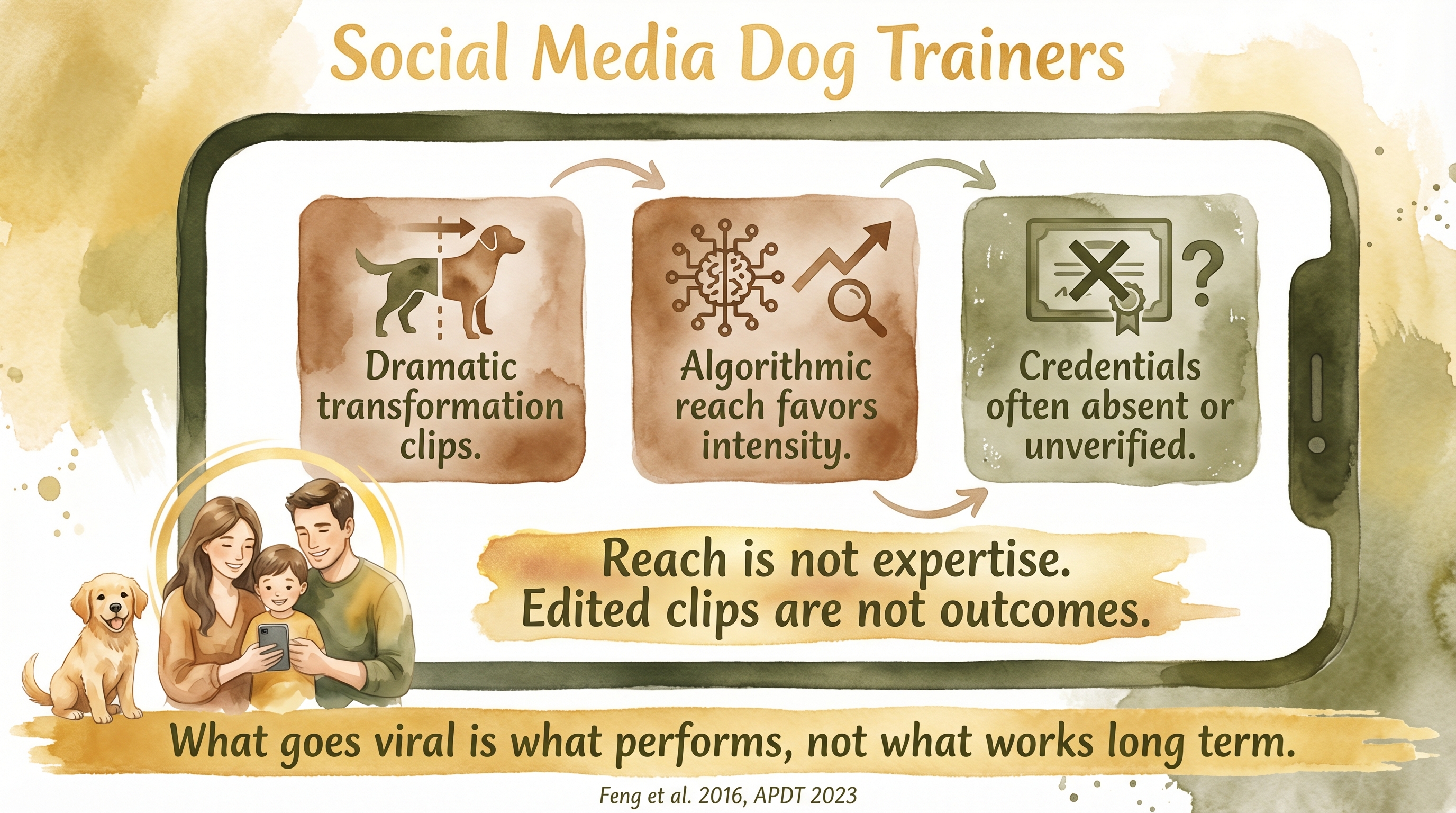
What goes viral is what performs, not what works long term.
Key Takeaways
- Social media became historically important when it became the first source of dog advice for many owners, not merely a marketing add-on.
- Online personalities now function as method ambassadors, blending instruction, branding, and ideology in ways that strongly shape owner expectations.
- The medium can spread useful education, but it also rewards simplification, selective editing, and rapid identity-driven conflict.
- JB families benefit most when they use online content as a tool library while keeping their actual raising philosophy coherent and calm.
The Evidence
This entry uses heuristic claim-level tags beyond the dedicated EvidenceBlocks below. These tags mark JB interpretive application rather than direct study findings.
This entry uses ambiguous claim-level tags beyond the dedicated EvidenceBlocks below. These tags mark claims where the literature remains unsettled or multiple interpretations coexist.
- Browne et al. (2024)US dog owners
Shows that online and informal advice channels dominate owner help-seeking, making social media central to how training ideas now reach families. - DeLeeuw & Williams (2026)professional dog trainers
Documents the role of million-scale YouTube audiences in propagating both reward-based and mixed-methods training positions. - Zak George, DogsThat, Upstate Canine Academy, Robert Cabral, Pak Masters, and Beckman's Dog Training public materialsdog training public record
Illustrate how personalities package method, philosophy, and services into large-scale digital education brands. - Johnson & Wynne (2023)trainer marketing websites
Shows that the profession's method divide is encoded in public-facing language, a pattern intensified on social platforms.
- domestic dogs
No published study directly isolates the long-term dog-level and family-level effects of the rise of social media dog trainers across ordinary companion-dog contexts.
SCR References
Sources
- Zak George. About Us, Dog Training Revolution.
- Susan Garrett and DogsThat. About DogsThat.
- Tom Davis and Upstate Canine Academy. Meet International Dog Trainer Tom Davis.
- Robert Cabral. Online Dog Training Videos.
- Robert Cabral. Affiliate Program.
- Larry Krohn and Pak Masters. Home and About pages.
- Beckman's Dog Training. The Trainers.
- Browne, C. M., Cardenas, M. C., Smith, E., Serpell, J. A., & Wynne, C. D. L. (2024). Animals.
- DeLeeuw, J. L., & Williams, T. J. (2026). Frontiers in Veterinary Science.
- Johnson, A., & Wynne, C. D. L. (2023). Anthrozoös.