The Academy for Dog Trainers
Compound evidence detail1 SCR / 2 parts
- Documentedthe Academy for Dog Trainers institutional record including 1999 founding by Jean Donaldson, residential origin at the San Francisco SPCA, current independent online operation, and the two-year part-time Certification in Training and Counseling structured across four academic levels with CCPDT and IAABC continuing-education recognition
- Heuristicthe JB comparative-rigor framing of the CTC as substantively rigorous by industry standards with unusual emphasis on client counseling and long-form supervised education, an interpretive characterization that the SCR-171 credential-outcome evidence gap precludes from being presented as outcome-validated
The Academy for Dog Trainers occupies a distinctive place in the certification landscape because it is not merely an exam badge and not merely a short course. It is Jean Donaldson's long-form school for pet-dog trainers, a program that began at the San Francisco SPCA in 1999 and later evolved into an independent distance-learning institution. In a field crowded with lighter credentials, the Academy's Certificate in Training and Counseling, usually shortened to CTC, stands out for depth, selectivity, and the seriousness of its curriculum. Documented
Its reputation comes from what it asks students to do. The Academy's current professional course is a two-year, part-time program. Students work through four academic levels, submit training video for feedback, take knowledge tests, draft behavior-modification plans, and learn to coach people as well as dogs. Documented That last piece matters. The school has long treated client counseling as part of trainer competence rather than as optional bedside manner.
The Academy is also closely tied to Donaldson's broader historical influence. The Culture Clash helped normalize an accessible, behavior-science vocabulary for pet-dog families in the 1990s, and the school extended that influence into professional education. Documented Graduates tend to leave with a recognizable language around reinforcement, antecedents, husbandry, desensitization, management, and case framing. That coherence is part of why the credential is widely respected inside the positive-reinforcement wing of the profession.
Honest evaluation still matters. A respected school is not the same thing as a proven outcome machine, and the SCR is explicit that no certification body has published peer-reviewed dog-level outcome comparisons against uncertified practice. The Academy can therefore be described as rigorous, influential, and demanding. It should not be described as scientifically proven to produce the best trainers in all contexts.
What It Means
From the San Francisco SPCA to an Independent School
The Academy's origin story helps explain its identity. According to the Academy's own public history, Jean Donaldson formed the school in 1999 to address what she saw as shallow trainer education. The program started life as a residential school at the San Francisco SPCA before being rebuilt into a distance model that could preserve case coaching while expanding geographic access. That is a concrete historical fact, not just branding language. The school grew out of shelter and pet-dog behavior work, not from sport-dog competition or a general-interest online course boom.
That origin also places the Academy in the post-Dunbar, post-Pryor, post-behaviorism phase of the industry. It belongs to the period when positive-reinforcement culture was no longer just criticizing compulsion. It was building institutions of its own. The Academy is one of the clearest examples of that move from method advocacy into professional identity formation.
What the CTC Actually Covers
The CTC is not an exam-only credential. The Academy's course materials describe a two-year, part-time curriculum built around four levels, personalized video coaching, written assignments, live webinars, and progressively harder case planning. Official course pages describe work in learning theory, behavior change, canine ethology, fear, aggression, separation anxiety, class teaching, client counseling, business operations, branding, and customer relationships. Documented Students are not simply memorizing terms. They are repeatedly asked to translate concepts into plans, explanations, and handling decisions.
The course architecture matters because it produces a different kind of signal from an exam badge. A CPDT-KA can tell a family that the trainer passed a knowledge test and accumulated experience hours. A CTC suggests a trainer has spent a long time inside one school's supervised framework and has received substantial written and video feedback. The credential therefore communicates educational depth and philosophical specificity at the same time.
Why the School Is Taken Seriously
The Academy's reputation rests on three things. First, Jean Donaldson's influence is real. The JB source base identifies her as one of the central public interpreters of operant language for pet-dog training and explicitly notes that she founded the Academy. Second, the school has maintained a clear science-based and force-avoiding identity over a long period rather than appearing briefly and disappearing. Third, the curriculum includes client counseling, which many shorter credentials acknowledge only lightly even though trainer success in family homes often depends on human coaching more than on dog mechanics alone.
Professional recognition also shows up in smaller but concrete ways. The Academy states that its four course levels have been approved for continuing education by the CCPDT and IAABC. That does not prove superior outcomes, but it does show that other credentialing bodies recognize the course as substantial education. In an unregulated profession, that kind of cross-recognition is a meaningful, if limited, quality signal.
The Academy is one of the few trainer schools that explicitly treats human guidance as part of the work. That matters because family dog outcomes often depend on whether the adult can mentor people, not only whether the adult can shape a sit.
Where Its Limits Begin
The right way to describe the Academy is not "excellent at everything." The right description is narrower and more useful. The CTC is especially strong preparation for family-dog training, manners work, common behavior problems, and family coaching inside a positive-reinforcement framework. It is less obviously the endpoint credential for severe pathology, medication-heavy cases, or referral-level aggression involving medical complexity. That is where CDBC-level consulting pathways, CAAB work, or DACVB clinical behavioral medicine become more relevant.
There is also a second limitation that should be stated plainly. The Academy is one school's curriculum. That creates coherence and quality control, but it also means the graduate is being formed inside a particular professional culture. Families should understand both sides of that fact. Coherence can be a strength. It can also produce blind spots if the trainer cannot think beyond school vocabulary.
Why It Matters for Your Dog
A Golden Retriever family usually does not care about trainer-school history for its own sake. The practical question is simpler: if a trainer says they are a CTC graduate, what does that likely mean when that person walks into your house or teaches your puppy class?
In everyday terms, it often means the trainer has spent serious time learning how to break down behavior, coach families, write plans, and think in a structured way about antecedents, reinforcement, management, and criteria. Observed-JB That is useful because family-dog cases rarely fail only because the dog did not understand a cue. They often fail because the household cannot keep a plan coherent for six weeks, or because the adults do not recognize how arousal, inconsistency, accidental rehearsal, and mixed messaging keep the problem alive.
Imagine a seven-month-old Golden who greets guests by ricocheting off furniture, grabbing sleeves, and escalating whenever people laugh or talk fast. A weak trainer may narrate the problem with jargon but still offer the family a thin plan. A stronger CTC-style trainer is more likely to slow the picture down. They may ask who opens the door, where the dog starts, what the guests do with their hands, how often the puppy rehearses the greeting pattern, whether the dog is being over-exercised into overtiredness, and which pieces of the scene the family can control before the knock happens. Observed-JB That style of case framing is one reason the credential has value.
The counseling piece matters even more with friendly, socially rewarding breeds. Goldens often get into trouble through success. They learn that rushing, leaning, pawing, vocalizing, and bursting forward reliably produce attention from humans who think the behavior is cute until it suddenly is not. A trainer who is skilled only with dogs may jump straight to drills. A trainer prepared to coach humans may notice that the family's own enthusiasm is feeding the cycle.
That does not mean a CTC is automatically the best match for every household. A family dealing with violent redirected aggression, compulsive behavior, severe panic, or a dog whose behavior has abruptly changed after a medical event may need a veterinary path instead of a trainer-school path. The CTC is strongest where the assignment is to organize ordinary companion-dog life more intelligently. It is not a substitute for medicine, and good CTC graduates should know that.
Families also need to understand what the credential does not tell them. It does not tell them whether the trainer is emotionally steady, whether the trainer can work well with children in the room, whether the trainer can read a specific Golden in real time, or whether the trainer respects the breeder-to-family transition. Those are live questions, not directory questions. The credential raises the probability of good preparation. It does not eliminate the need to assess fit.
One of the strongest uses of this credential is in private coaching where the dog is not the only client. A Golden family juggling school pickups, children, work calls, and adolescence chaos often needs a trainer who can talk plainly, prioritize, and keep the plan realistic. Academy training seems designed for that kind of case better than for theatrical demonstrations. Families should see that as a real advantage.
There is also a caution embedded here for the JB audience. A strong positive-reinforcement education may still frame the household as a place for planned training events more than for developmental raising. Some CTC graduates will naturally widen into a family-development lens. Others will remain more protocol-centered. A family should listen for that difference. Does the trainer speak only in exercises, or do they also talk about rhythms, over-practice, transitions, calm adult behavior, and what the puppy is becoming inside daily life?
A concrete question can expose the difference quickly. Ask what the trainer would do with a Golden puppy who gets mouthy every evening after a busy day. A narrower technical answer may focus immediately on reinforcing alternate behaviors and interrupting biting. A broader and often more useful answer will also ask about sleep, overstimulation, visitor traffic, meal timing, rehearsal, and whether the family is accidentally living with the puppy above threshold for hours. Both answers may contain truth. Only one shows the adult is thinking about development in the room as well as technique.
That is why the credential matters, but only as part of a bigger reading. The Academy can produce trainers who are prepared, literate, and humane. Families still need to decide whether the graduate in front of them understands their actual assignment. Raising a Golden Retriever into stable family life is not the same thing as winning arguments on trainer forums.
What This Means for a JB Family
For a JB family, the main takeaway is that the Academy for Dog Trainers is one of the stronger non-veterinary educational signals in the current marketplace. If a trainer has a CTC, that is usually worth taking seriously. It suggests real time, real curriculum, real supervision, and meaningful work on family communication rather than a weekend badge or a directory listing with no depth behind it.
At the same time, JB should not let any credential become a shortcut around judgment. The family still needs to ask whether the trainer's actual posture aligns with what the puppy needs. Can this person talk about calmness as more than the absence of motion? Do they respect prevention? Do they coach the adults, not only manipulate the dog's immediate behavior? Do they know when the case is outside trainer scope and needs referral?
That makes the CTC useful in exactly the right way. It can move a trainer into the "worth a serious conversation" category. It should not move them into the "judgment no longer required" category. A CTC trainer who works transparently, knows scope, and can help the family lower chaos may be a strong fit. A CTC trainer who still treats the home as a string of technical drills may be less useful than the credential first suggests.
JB families also benefit from remembering that a school can be rigorous without being complete. The Academy is oriented toward humane family-dog practice and counseling. That is meaningful. Severe pathology, medication decisions, and medically entangled behavior disorders still belong elsewhere. The right relationship with a good CTC trainer may therefore include collaboration and referral rather than heroics.
The larger philosophical point is that trainer education is most valuable when it improves adult steadiness around the dog. From a JB perspective, the best use of a credential like the CTC is not to intensify method dependence. It is to help the adult become clearer, calmer, more observant, and more capable of guiding family life. When that happens, the credential is serving the relationship rather than replacing it.
That distinction matters most during the breeder-to-family handoff, when a promising puppy can either keep moving inside a coherent social language or enter a home that suddenly treats adulthood as a sequence of technical fixes.
A meaningful credential helps most when it keeps that social language coherent instead of replacing it with more noise.
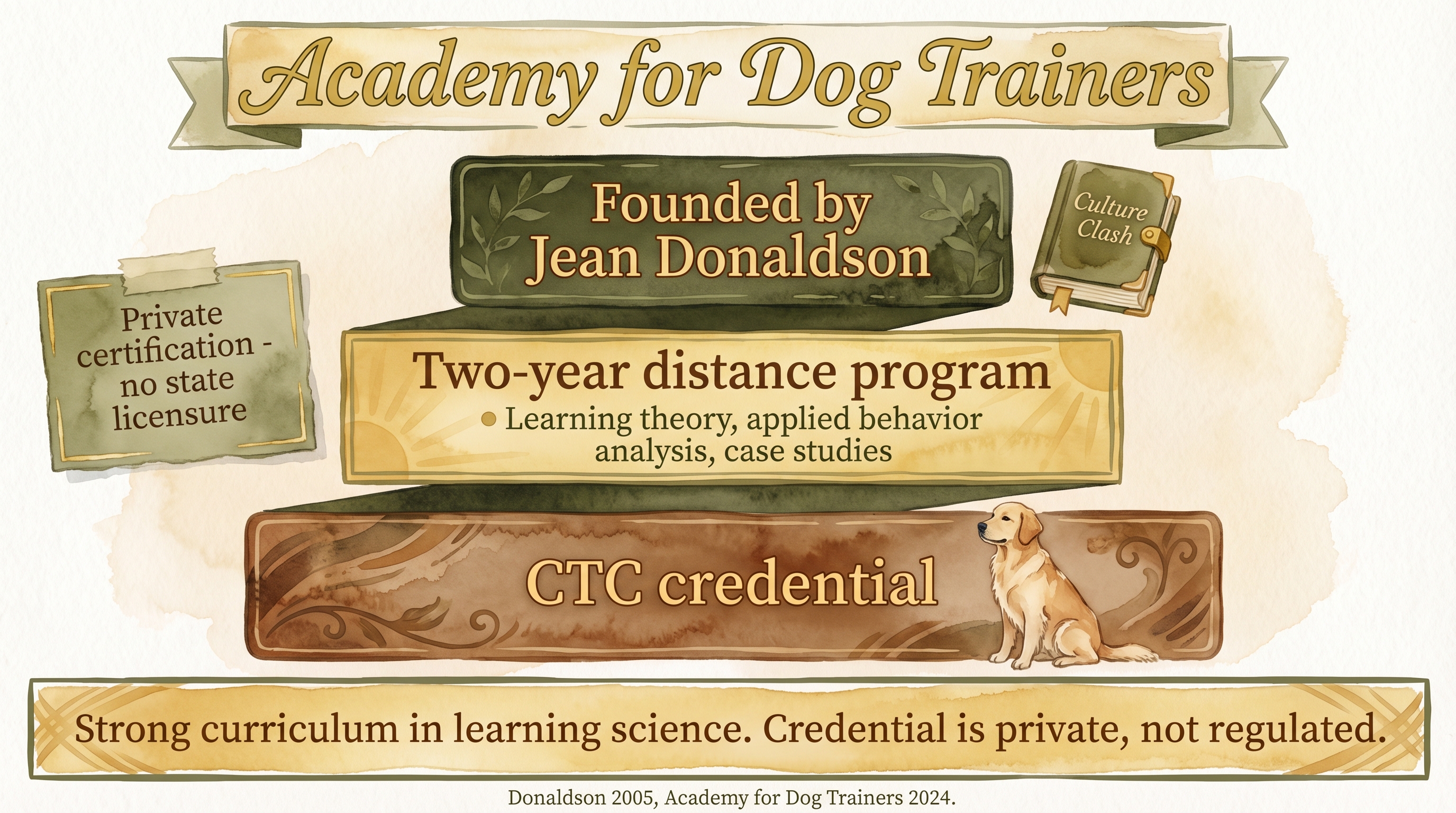
A rigorous private academy in learning science - the credential is private, not regulated.
Key Takeaways
- The CTC is one of the more substantial non-veterinary dog-training credentials because it reflects a long curriculum, repeated feedback, and client-counseling work rather than only an exam.
- The Academy's identity is closely tied to Jean Donaldson, the San Francisco SPCA, and the positive-reinforcement institution-building phase of the industry.
- Its strongest fit is family-dog training and family coaching, not severe medically entangled behavior pathology.
- For JB families, a CTC is a meaningful signal but still not a substitute for evaluating fit, scope awareness, and developmental alignment.
The Evidence
This entry uses observed claim-level tags beyond the dedicated EvidenceBlocks below. These tags mark JB program observation or practice-derived claims that need dedicated EvidenceBlock coverage in a later content pass.
- Academy for Dog Trainers official history and course pagesdog trainer education
Document the Academy's 1999 founding by Jean Donaldson, its San Francisco SPCA origin, its two-year part-time CTC course, and its emphasis on science-based education, video coaching, and counseling. - professional dog training history
Places Jean Donaldson among the key figures who translated behavior-science language into pet-dog culture and identifies her as founder of the Academy. - dog training profession
Supports the broader claim that the profession has multiple credentials with no published outcome-comparison study demonstrating that any certification body predicts superior dog-level outcomes. - SCR-174 and cross-recognition dataprofessional credentialing
Supports the narrower point that credentials can function as meaningful market signals even when outcome validation is still absent.
- domestic dogs
No published study directly compares the long-term dog-level and family-level outcomes associated with professionals trained through the academy for dog trainers versus other educational pathways.
SCR References
Sources
- The Academy for Dog Trainers. "About the Academy for Dog Trainers."
- The Academy for Dog Trainers. "Course Details."
- The Academy for Dog Trainers. "Professional Dog Trainer Course."