The Veterinary Behaviorist (Diplomate ACVB)
Compound evidence detail2 SCRs / 4 parts
- Documentedthe ACVB membership data and APPA pet-owning household estimates establishing approximately 80 to 110 board-certified veterinary behaviorists serving roughly 86.9 million US pet-owning households, with fewer than 100 active CAABs
- Heuristicthe JB application interpreting the practitioner-to-household ratio as a structural access problem, with the qualifier that the access analysis is more nuanced than the single ratio implies because some DACVBs serve as consultants to primary-care veterinarians rather than direct case practitioners
- Documentedthe documented training and credential route for Diplomates of the American College of Veterinary Behaviorists, including AVMA-accredited veterinary degree, state licensure, ACVB-approved residency, peer-reviewed publication requirement, board examination, and a scope combining veterinary differential diagnosis, psychopharmacology, and behavioral medicine that no non-veterinary credential duplicates
- Heuristicthe JB framing of the DACVB as the correct escalation point for severe, medically entangled, or refractory canine behavior cases, a structural inference from training scope rather than an outcome-validated finding bounded by the SCR-171 credential-outcome evidence gap and the SCR-173 scarcity caveat
When families ask for the highest formal credential in canine behavior, the answer is usually not a trainer title at all. It is the Diplomate of the American College of Veterinary Behaviorists, often shortened to DACVB. A veterinary behaviorist is first a veterinarian and only then a behavior specialist. That distinction changes everything about scope of practice, because it means the clinician can diagnose medical contributors to behavior, prescribe medication, interpret laboratory and pain findings, and manage cases where behavior and physiology are tightly entangled. Documented
The pathway is correspondingly demanding. The JB source layer summarizes the published ACVB route as a DVM degree from an AVMA-accredited school, state licensure, a formal residency in veterinary behavior, a large supervised caseload, original scholarly publication, and a comprehensive board examination. That is a much steeper educational ladder than any ordinary dog-training credential requires. In practical terms, the profession is tiny, which is one reason so many families never meet a veterinary behaviorist until a case has become serious.
This credential matters because it marks the boundary between ordinary training problems and referral-level behavioral medicine. A puppy who pulls on leash, jumps on guests, or chews chair legs does not need a DACVB. A dog with self-injury, severe separation panic, compulsive spinning, aggression with pain overlap, or refractory fear often does. The veterinary behaviorist exists for the cases where the question is no longer only "How do we train this dog?" but "What disorder process is unfolding here, and what combination of medicine and behavior therapy is indicated?"
From a JB point of view, that specialist role is important partly because it protects families from asking trainers to be what trainers are not. The existence of DACVBs should not make ordinary households feel doomed. It should make them more precise about escalation.
What It Means
Why This Credential Sits Above Trainer Certifications
The simplest way to understand the DACVB is by comparing it with ordinary trainer credentials. A CPDT, CTC, KPA-CTP, or IAABC credential says something about education, experience, or philosophical alignment inside the dog-training profession. A DACVB says the clinician came through veterinary medicine first and then completed a specialty route in behavior. That is why the credential has a different weight. The person is licensed to practice veterinary medicine and then further qualified in behavioral medicine.
That difference matters most where medical and behavioral causes overlap. Pain, endocrine disease, neurologic change, gastrointestinal distress, sleep disruption, dermatologic discomfort, and medication effects can all shape behavior. Documented Trainers can notice those possibilities and refer. Veterinary behaviorists can work them up and treat them directly.
What the Pathway Requires
The ACVB applicant pathway is public and unusually rigorous by dog-industry standards. The source layer identifies the key pieces: an AVMA-accredited veterinary degree, state licensure, an approved residency in behavioral medicine, at least 2,600 hours of supervised caseload work, publication of a first-authored case report, publication of a first-authored data-based scientific paper, and passage of a board examination. Estimated Those are not light requirements. They place the credential much closer to medical specialty training than to a private-sector dog-school certificate.
The publication requirement is especially telling. It means the pathway does not only assess case exposure. It also asks the candidate to work in the language of scientific literature. That does not guarantee perfect judgment, but it does create a different epistemic standard than most non-veterinary credentials require.
What Veterinary Behaviorists Actually Do
Families sometimes imagine the veterinary behaviorist as simply "the most advanced trainer." That is not the right picture. Veterinary behaviorists diagnose and treat behavior disorders. They prescribe psychotropic medication where indicated, evaluate differential diagnoses, integrate medical testing with behavior history, and manage cases that may include panic, compulsive behavior, generalized anxiety, phobias, severe aggression, or complex multi-dog dynamics with safety implications. Documented
They also usually work with behavior-modification plans, not medicine alone. That matters because the role is not merely pharmacology. It is clinical behavioral medicine. Medication may lower panic, stabilize arousal, or make learning possible. It does not eliminate the need for management, environmental control, and structured behavior change.
Good adult leadership includes knowing when the problem has crossed out of ordinary training territory. Referral is not surrender. It is a form of responsible guidance.
Scarcity and the Referral Chain
The profession is small. The source document estimates roughly 80 to 110 board-certified veterinary behaviorists serving a vast North American pet population. Estimated SCR-173 permits the numerical claim while cautioning against oversimplifying access into a single ratio. Even so, the broad reality is clear: these clinicians are scarce. Waitlists can be long, geography is uneven, and many families reach them only after months of cycling through ordinary training help.
That scarcity makes the referral chain important. In many cases the first stop is the primary-care veterinarian, then a competent trainer or behavior consultant, and then a veterinary behaviorist when the picture looks clinically heavy or is not improving. The presence of a DACVB option does not erase the role of skilled trainers. It defines the cases where trainer skill must be paired with medical specialty care.
Because the specialty is so small, ordinary professionals have to recognize referral signals early rather than after months of drift.
Why It Matters for Your Dog
For a Golden Retriever family, the clearest value of this credential is not prestige. It is triage. Families need to know when their situation has outgrown normal training advice.
Consider a Golden who cannot be left alone without salivating, vocalizing for hours, destroying doors, and injuring its mouth on the crate. Or a dog who suddenly begins growling over ordinary handling after years of being easy. Or an adolescent whose fear erupts into explosive barking and lunging despite careful training and sensible management. Or a dog with compulsive flank sucking, shadow chasing, or pacing that seems disconnected from ordinary trigger-response training problems. Those are all moments when a veterinary behaviorist may be the right escalation point.
The crucial issue is not that the dog is "bad enough" to deserve a specialist. The crucial issue is that the working question has changed. The family is no longer just teaching manners. The family is trying to understand a disorder process, a medication question, a pain overlap, or a panic system that ordinary class-based instruction cannot resolve by itself.
A Golden Retriever makes this especially important because the breed's softness can confuse the household. Families sometimes delay escalation because the dog is affectionate between episodes. They think, "He is such a sweet dog most of the time, so maybe we just need better training." Sometimes that is true. Sometimes the sweetness is irrelevant to the clinical question. A dog can be loving and still be clinically anxious, compulsive, or unsafe in specific conditions.
The family-level observation to watch for is failure across context despite thoughtful work. If a competent trainer has been involved, the family has followed through, the environment has been improved, and the problem remains severe or keeps worsening, that is not proof of moral failure. It is a referral signal.
Medication is often the piece families fear most, so it deserves careful framing. A veterinary behaviorist does not exist to sedate dogs into compliance. The goal is usually to reduce pathological arousal or panic enough that the dog can function, learn, and recover. In many cases the most humane choice is not to keep trying harder without medication. It is to ask whether the dog has been white-knuckling through a state that deserves medical help.
A concrete Golden example helps. Imagine a two-year-old retriever who panics during thunderstorms, begins generalized noise reactivity, startles awake biting at the air, and has become increasingly restless at night. A conventional trainer may help the family with sound pairing, safe spaces, and management. Those are useful. A veterinary behaviorist can add a medical workup, discuss medication, evaluate whether the pattern fits panic disorder or another clinical anxiety picture, and coordinate a plan that is more than exposure homework.
This also matters in aggression cases because risk management changes quickly once bites are possible. A dog with a significant bite history may still need excellent training support, but the case now includes legal risk, family safety, possible pain or neurologic contribution, and a much narrower margin for error. The DACVB route exists for exactly that kind of complexity.
Families should not overcorrect either. Most ordinary puppy problems do not need a specialist. Jumping, loose-leash pulling, chewing, messy greetings, mouthiness, and inconsistent recall are usually training-and-raising questions first. The value of understanding the DACVB credential is that it helps families reserve specialty medicine for the cases that actually require it.
Another referral pattern appears when the household story keeps getting stranger instead of clearer. The dog startles out of sleep, reacts to touch in one room but not another, panics at sounds that were never a problem before, or seems dramatically worse after an illness, surgery, medication change, or painful event. Documented Those details do not prove a medical cause, but they change the quality of the question. A trainer can help the family document those patterns. A veterinary behaviorist can decide whether the behavior picture now warrants diagnostic work that sits beyond trainer scope.
There is also an emotional benefit to specialist triage that families rarely anticipate. When a serious case is framed only as disobedience, adults often become harsher with themselves and with the dog because they assume enough consistency should have fixed it by now. A DACVB consultation can sometimes replace blame with a more accurate model: this dog may be frightened, dysregulated, painful, neurologically altered, or trapped in a panic cycle that simple repetition will not unwind. That shift in framing does not solve the case by itself, but it often allows the household to stop escalating pressure and start making better decisions.
What This Means for a JB Family
For a JB family, the veterinary behaviorist represents responsible escalation, not contradiction. JB can be strongly oriented toward developmental raising and still fully acknowledge that some dogs need clinical behavioral medicine. In fact, that acknowledgment is part of mature stewardship.
The practical takeaway is simple. If a Golden's behavior looks severe, frightening, medically entangled, or stubbornly refractory despite good-faith work, the family should not stay trapped in ordinary trainer shopping. The next move may be medical specialty care. That is especially true when the dog appears to be suffering, not merely misbehaving.
JB families also benefit from seeing referral as an extension of Prevention and Calmness. Prevention means not letting a serious case drift until the dog rehearses panic, aggression, or compulsive states for months without the right help. Calmness means not treating every difficult behavior as a willpower contest. When pathology is present, steadiness often means getting better expertise quickly.
This perspective also protects the trainer relationship. A good trainer should not feel threatened by referral. A good trainer should welcome it when the case has crossed into specialty territory. Likewise, a family should not feel that involving a DACVB means all previous work was pointless. Often it means the earlier work clarified the limits of non-medical help.
So the JB reading is not glamorous. It is careful. Most families will never need a veterinary behaviorist. The ones who do are often better served the moment they stop hoping ordinary help will somehow become specialist care by force of repetition. Naming the right level of expertise is often the most compassionate thing the adults can do.
That calm realism fits the larger JB worldview well. Structured Leadership does not mean insisting that every problem remain inside ordinary family competence. Mature leadership means knowing when to widen the circle of care. In some cases the most responsible adult move is not another round of homework or firmer follow-through. It is a referral, a workup, and a coordinated plan that gives the dog a chance to recover with the right level of expertise.
Access constraints make that precision even more important. Families may need to work through a primary-care veterinarian, prepare detailed history notes, share video, and coordinate between trainer and specialist because the nearest DACVB is hours away or booked far in advance. None of that weakens the referral logic. It simply means that good preparation and good communication become part of the humane response when specialist care is indicated for ordinary families facing real logistical limits responsibly.
Seen this way, the veterinary behaviorist is not an alternative philosophy so much as a necessary specialty inside a wider network of humane dog stewardship. Breeder, family veterinarian, trainer, and DACVB each hold a different part of the picture. JB families are best served when they can recognize which part of that network the dog needs next and act before fear, injury, or exhaustion makes the decision for them.
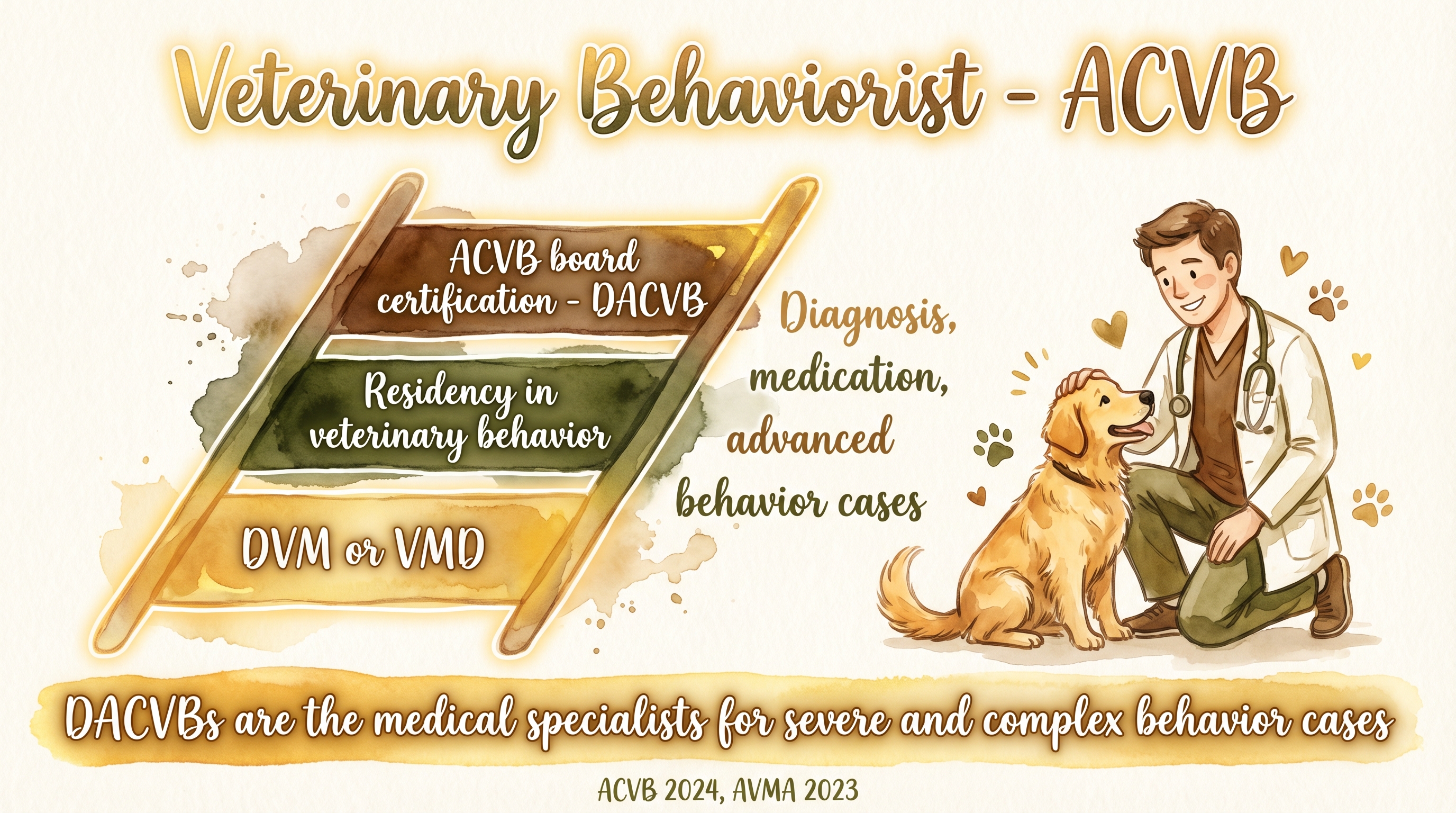
DACVBs are the medical specialists for severe and complex behavior cases.
Key Takeaways
- A veterinary behaviorist is first a veterinarian and then a behavior specialist, which is why the DACVB sits above ordinary trainer credentials in scope of practice.
- The pathway requires medical education, specialty residency, supervised caseload work, publication, and a board exam.
- Families should think of the DACVB route as an escalation point for severe, medically entangled, or refractory behavior problems.
- For JB families, referral to a veterinary behaviorist is a form of responsible guidance, not a failure of the relationship model.
The Evidence
This entry uses estimated claim-level tags beyond the dedicated EvidenceBlocks below. These tags mark approximate ranges or timing claims that should remain bounded by the cited sources.
- veterinary behavior credentialing
Documents the DACVB pathway through veterinary school, residency, publication requirements, board examination, and the specialty's unique authority to diagnose and medicate behavior disorders. - ACVB applicant materialsveterinary behavior specialty
Detail the residency, supervised caseload, and publication requirements that distinguish the credential from ordinary trainer pathways. - SCR-173professional access
Supports the claim that veterinary behaviorists are numerically scarce relative to the pet-owning population, while warning against oversimplifying access into a single ratio. - Powell et al. (2021) as summarized in the source layerclinical canine behavior practice
Shows that structured veterinary behavior intervention can produce measurable change, even though the evidence base is not a head-to-head credential comparison study.
- domestic dogs
No published study directly compares the long-term dog-level and family-level outcomes associated with professionals trained through the veterinary behaviorist (diplomate acvb) versus other educational pathways.
SCR References
Sources
- American College of Veterinary Behaviorists. Applicant Packet.
- American College of Veterinary Behaviorists. "Find a Veterinary Behaviorist."
- Powell, L. et al. (2021). Frontiers in Veterinary Science.