The Certified Applied Animal Behaviorist (CAAB)
Compound evidence detail2 SCRs / 4 parts
- Documentedthe ACVB membership data and APPA pet-owning household estimates establishing approximately 80 to 110 board-certified veterinary behaviorists serving roughly 86.9 million US pet-owning households, with fewer than 100 active CAABs
- Heuristicthe JB application interpreting the practitioner-to-household ratio as a structural access problem, with the qualifier that the access analysis is more nuanced than the single ratio implies because some DACVBs serve as consultants to primary-care veterinarians rather than direct case practitioners
- Documentedthe Animal Behavior Society certification structure for Certified Applied Animal Behaviorist status (doctoral academic preparation, publication record, and supervised professional experience) plus the master-level Associate route, paired with ABS materials that caution certification is not a universal competence guarantee
- Heuristicthe JB comparative-legitimacy framing of CAAB and ACAAB as appropriate for complex non-veterinary canine behavior consultation while limited by the absence of credential-to-outcome validation and not substituting for DACVB involvement in medically entangled cases
The Certified Applied Animal Behaviorist, or CAAB, is one of the least common and least casually understood credentials in the dog world. It is awarded by the Animal Behavior Society rather than by a dog-training trade group, and it reflects an academic pathway built around graduate study, research literacy, and documented professional experience in applied behavior. For families used to seeing trainer titles after names, the CAAB can look obscure. In reality it often marks one of the most intellectually serious non-veterinary routes in the broader behavior field. Documented
The key distinction is that the CAAB is not a veterinary license and not a short-course training certificate. It sits in a different lane. The Animal Behavior Society's published pathway requires advanced academic study, supervised or documented professional experience, letters of recommendation, and peer review of credentials. Documented The associate level, ACAAB, reflects a master's-level route; the full CAAB reflects doctoral-level preparation. That places the credential much closer to professional behavioral science than to ordinary commercial trainer education.
Families should still read the title carefully. "Animal behaviorist" is not a protected public term in the way physician or psychologist are protected. Plenty of people use behavior language loosely. The actual CAAB and ACAAB credentials matter because they are specific, formal designations tied to an established scientific society. That precision is important in a field where broad behavioral vocabulary can easily outrun real expertise.
The honest summary is that a CAAB is a legitimate high-level behavior credential, especially for complex cases and behavior analysis, but it is not interchangeable with a veterinary behaviorist. The CAAB route does not confer prescribing authority or medical scope of practice. Families should see it as serious expertise with different tools.
What It Means
An Academic Rather Than Commercial Pathway
The CAAB route begins in graduate education, not in ordinary trainer schooling. The JB source base summarizes the published ABS requirements clearly: the full CAAB requires a doctoral degree in biological or behavioral science with emphasis on animal behavior, five years of professional experience, peer-reviewed publication, and letters of recommendation. Documented The ACAAB requires a master's degree and two years of relevant professional experience. That structure tells you what the credential is trying to measure. It is looking for formal education, research competence, and applied professional depth.
That matters because the credential is not built around a single dog-school philosophy. It comes from a comparative animal-behavior tradition. A CAAB may have worked with dogs, but the intellectual home of the credential is wider than pet-dog training culture.
How It Differs from the DACVB
The clearest distinction from the veterinary behaviorist is medical authority. A CAAB is not a veterinarian unless that individual separately holds veterinary credentials. That means the CAAB cannot diagnose medical disease, prescribe psychotropic medication, or directly manage the veterinary side of a behavior case. The DACVB can.
The difference should not be flattened into "therefore the CAAB matters less." That would be wrong. The CAAB route often reflects deep academic preparation in learning, behavior analysis, ethology, welfare, and case conceptualization. Observed-JB The more accurate statement is that the CAAB and DACVB solve different parts of the same complicated world. One brings non-veterinary scientific behavior expertise. The other brings veterinary specialty medicine.
Where CAABs Usually Work
CAABs are rare in ordinary suburban puppy culture because the credential often appears in research, university teaching, zoo work, shelter behavior, welfare science, and high-level private consulting rather than in the most visible retail training market. Observed-JB The source layer estimates the active CAAB population as very small, roughly in the same order of magnitude as the tiny DACVB specialty. That scarcity affects public recognition. Many families have heard of dog trainers, some have heard of veterinary behaviorists, and comparatively few have heard of CAABs at all.
That invisibility can be misleading. The credential is obscure mainly because the profession is small, not because the route is flimsy. If anything, the opposite is closer to the truth. It is obscure because it is academically demanding and not designed around mass-market visibility.
The letters matter only if the family knows exactly what they mean. CAAB is one of those credentials where precision protects against both under-reading and over-reading the title.
What the Credential Can and Cannot Promise
The Animal Behavior Society's own requirements contain an unusually candid limitation: certification does not guarantee competence in every practical setting. That is worth respecting. It is one of the few credential systems in this broad space that publicly resists overclaiming. The degree, experience, and peer review matter. They still do not replace case-by-case judgment.
That frankness also harmonizes with SCR-171. No credentialing body in this field has published the kind of peer-reviewed outcome-comparison research that would let anyone claim, in a hard scientific voice, that one badge reliably guarantees better family-dog results. Documented The CAAB should therefore be described by pathway, scope, and probable strengths, not by inflated certainty.
Seen positively, that restraint is part of the credential's value. A system willing to admit its own ceiling is often more trustworthy than a market culture built on confidence theater. Families do not need a CAAB to promise universal mastery. They need the title to mean something stable about education, experience, and seriousness of analysis.
Why It Matters for Your Dog
A Golden Retriever family will not usually need a CAAB for basic puppyhood. That is the first practical truth. Chewing, arousal at the door, adolescence messiness, leash-pulling, and rough greetings are not usually CAAB-level problems.
Where the credential starts to matter is when the behavioral picture becomes conceptually complex, severe, or stubborn enough that ordinary trainer advice is no longer giving the family traction. A CAAB may be the right kind of expert when the family needs very careful behavior analysis, welfare-aware case design, shelter or rehoming consultation, or a high-level second opinion on fear, aggression, or compulsive patterns that require more than class teaching.
Think about a Golden who has become increasingly unsafe around handling after a confusing mix of punishment, management, and inconsistent family attempts to "work through it." Or a dog who is deteriorating in a shelter, where the question is not merely obedience but welfare, assessment, and safe intervention. Or a family already working with a veterinarian that needs deeper non-medical behavior planning. Documented Those are situations where a CAAB can be highly relevant.
The breed context matters too. Goldens are often socially forgiving enough that families delay specialist help because the dog still looks affectionate much of the time. A CAAB can be useful when the case requires someone to read the pattern without being distracted by the breed's baseline sociability. Friendly dogs can still have serious fear, conflict, guarding, or compulsive issues.
Families should also understand the collaborative value of the credential. A CAAB is often most powerful in tandem with other professionals. The family veterinarian may rule out pain or endocrine issues. A trainer may handle hands-on implementation. The CAAB may supply the analytical spine of the behavior plan. When medication questions enter, the DACVB or primary veterinarian becomes essential. In other words, the CAAB is often part of a team rather than a solo hero.
One useful family-level question is whether the case seems to require more precision than charisma. Some behavior problems become worse when the adults keep shopping for stronger personalities instead of better analysis. If every new professional brings a confident style but the household still cannot explain the pattern clearly, a CAAB-level consultation may offer the kind of disciplined thinking the case has been missing.
This is also a good credential to understand because it helps families resist false binaries. The choice is not always "regular trainer or veterinary behaviorist." There is also a high-level academic behavior path between ordinary instruction and full veterinary specialty care. That path will not fit every case, but it is real.
The limitation is straightforward. A CAAB is not the right endpoint when the dog needs medication management, formal veterinary diagnosis, or a full medical workup for behavior change. Families should not over-read the credential into a kind of pseudo-veterinary status. Used precisely, though, it can be an excellent source of serious behavioral expertise.
Shelter and rehoming cases are a good example of where this can matter. A family or rescue may be trying to decide whether a dog is fearful, behaviorally brittle, under-socialized, conflict-driven, medically compromised, or simply being read through the wrong lens. Those are not always questions that yield to another obedience lesson. A CAAB can help define the pattern, the welfare stakes, and the realistic options with more analytical discipline than the retail dog market usually offers.
Second-opinion cases can benefit as well. Some homes have already seen several trainers and have collected a pile of contradictory advice: add more structure, stop being so strict, use food more often, stop using food, correct harder, never correct at all. A CAAB may not produce a magical new technique, but the credential can bring a different kind of value by clarifying what problem is actually being treated, what evidence supports the current plan, and where the adults have been solving the wrong question.
Another reason the credential matters is that it can interrupt professional theater. Families sometimes encounter practitioners who are highly persuasive but vague about mechanism, welfare cost, or long-term plan. A CAAB-level consultation is more likely to ask what the dog is rehearsing, what maintains the pattern, which environmental variables are missing from the story, and how success would be recognized over time. That kind of disciplined framing can protect the dog even when the practical recommendations remain modest.
Prognosis questions are another place where the credential can help. Some families are not choosing among training tricks. They are trying to decide whether a case is manageable in the home, whether a shelter dog is adoptable into a specific environment, whether rehoming is ethical, or whether risk can be reduced to an acceptable level. A CAAB cannot make those decisions for the family, but the credential is well suited to clarifying the behavioral realities that should inform them.
What This Means for a JB Family
For a JB family, the CAAB is best understood as a high-level analytic behavior credential that deserves respect but also precise reading. Heuristic It tells you the person likely comes from graduate-level behavioral science and applied experience. It does not tell you they are a veterinarian. That distinction should stay bright.
Practically, the credential matters when the family needs more thoughtful case conceptualization than ordinary dog-training culture is offering. A CAAB may be a valuable partner when the home needs someone to untangle the pattern, not simply add another technique. That can fit well with JB's emphasis on reading the whole social picture rather than reducing everything to a cue and a consequence.
The right JB use of this credential is therefore selective. It is not the default stop for normal puppyhood. It becomes relevant when the case is complex enough that better behavioral reasoning could materially change what the adults do next. In some homes, that means consultation rather than long-term hand-holding. In others, it means a major course correction.
JB families should also remember that intellectual strength alone is not enough. A brilliant analyst who cannot communicate with the family or translate concepts into daily life may still be a poor fit. The best outcome is a CAAB who combines precision with humane clarity and who works comfortably with veterinarians, trainers, and the household itself.
That keeps the message grounded. A CAAB is not a magic title. It is a serious one. When a case needs that level of thinking, families should know the path exists.
The family-level value is therefore partly diagnostic in the plain-English sense. A good CAAB can help adults stop thrashing between methods and start naming the real decision points. Is this a management problem, a welfare problem, a medical-referral problem, a household-consistency problem, or a prognosis problem? Once those categories are clearer, the next step is usually calmer and less expensive.
JB can respect that role without turning it into mystique. The adults still have to live with the dog, carry the plan, and make daily decisions. What the CAAB adds, when the fit is right, is better thinking at the point where muddled thinking has become part of the problem.
That is a useful service in its own right. Families often spend money chasing stronger personalities when what they actually need is a cleaner map. A thoughtful CAAB consultation can provide that map, show where medical partnership is needed, and help the household stop confusing urgency with clarity.
Used that way, the credential becomes less mysterious and more practical. It is a source of disciplined interpretation at the moment a family most needs to stop guessing.
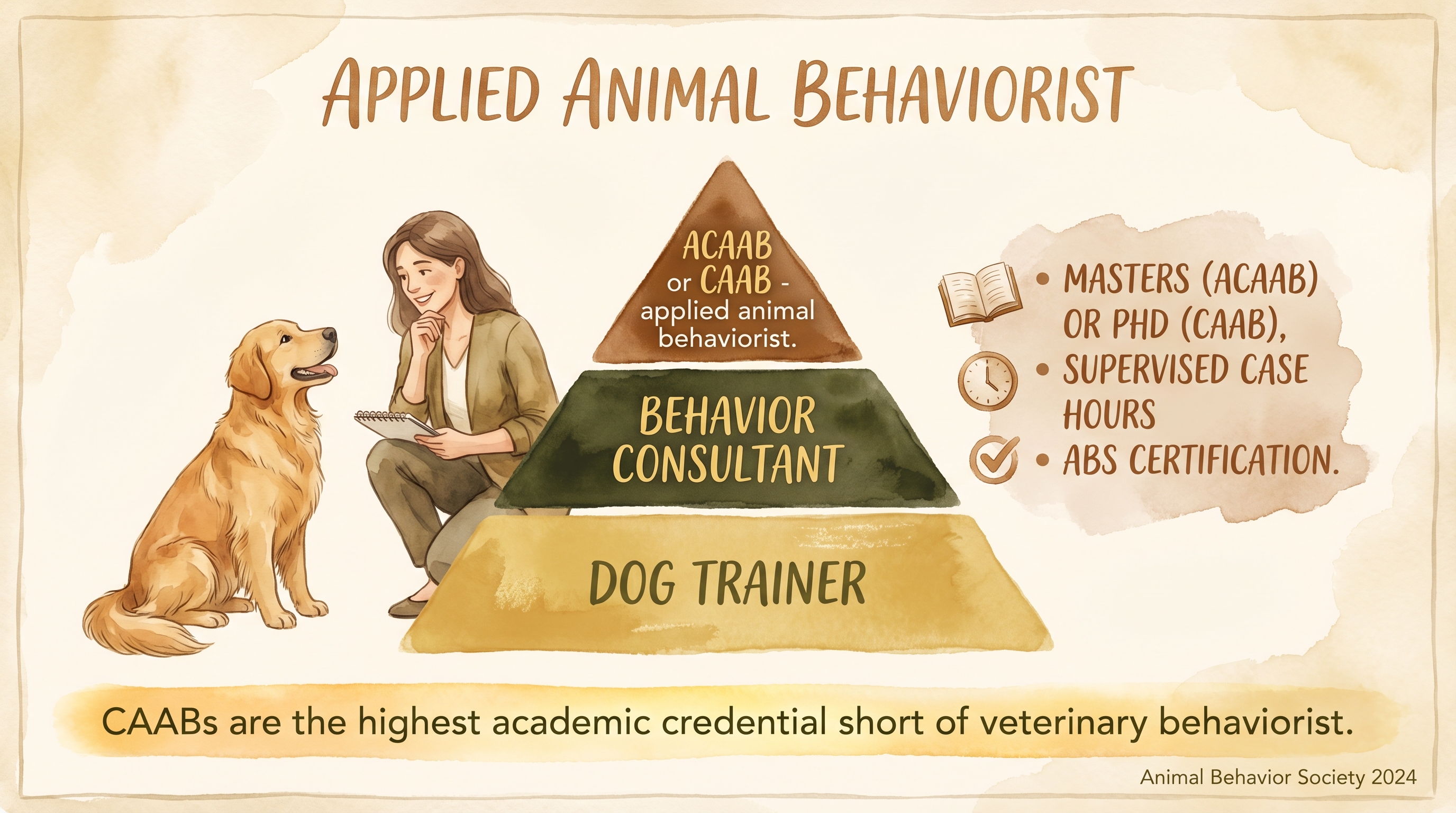
CAABs are the highest academic credential short of veterinary behaviorist.
Key Takeaways
- CAAB and ACAAB are formal applied-behavior credentials tied to graduate education and peer review, not ordinary trainer-school certificates.
- The CAAB differs from the DACVB mainly because it does not carry veterinary medical authority or prescribing power.
- This route becomes especially relevant for complex cases that need disciplined behavior analysis, often in collaboration with veterinarians and trainers.
- For JB families, the title is valuable when the case needs deeper conceptual clarity, not when the household simply needs another personality with stronger opinions.
The Evidence
This entry uses observed claim-level tags beyond the dedicated EvidenceBlocks below. These tags mark JB program observation or practice-derived claims that need dedicated EvidenceBlock coverage in a later content pass.
This entry uses heuristic claim-level tags beyond the dedicated EvidenceBlocks below. These tags mark JB interpretive application rather than direct study findings.
- professional credentialing
Documents the ABS pathway through graduate education, professional experience, publication, and peer review, and distinguishes the CAAB from the DACVB route. - Animal Behavior Society certification requirementsapplied animal behavior profession
Describe the doctoral-level CAAB and master's-level ACAAB requirements and the society's explicit caution that certification is not a blanket guarantee of competence. - SCR-173professional access
Supports the claim that advanced behavior credentials such as CAAB and DACVB are numerically scarce relative to overall market need. - SCR-171credential validation
Establishes the ceiling that no credential path in this sector has published peer-reviewed outcome-comparison evidence proving superiority across ordinary family-dog cases.
- domestic dogs
No published study directly compares the long-term dog-level and family-level outcomes associated with professionals trained through the certified applied animal behaviorist (caab) versus other educational pathways.
SCR References
Sources
- Animal Behavior Society. "CAAB Certification Requirements and Application."
- Animal Behavior Society. "ACAAB Certification Requirements."