Dog Training as an Unregulated Profession
Dog training in the United States is an unregulated profession. That sentence sounds technical, but it has direct consequences for families. As of 2026, no US state requires a person to hold a dog-training license, pass a state exam, complete supervised education, or meet a minimum competency threshold before opening a dog-training business. If someone wants to print cards, launch a website, sell a board-and-train package, and call themselves a professional dog trainer, the law usually does not stop them. Documented
The source layer is clear that this is not merely a national abstraction. It also maps the Just Behaving service area directly. Massachusetts, New Hampshire, Maine, Connecticut, Rhode Island, and Vermont all lack trainer-licensure requirements. Some states regulate related things such as boarding-facility conditions, municipal dog licensing, hunting-dog permits, or dangerous-dog statutes. None of that creates a real professional licensing floor for companion-dog trainers. For JB families, this means the regulatory gap is local, not remote. Documented
The result is a profession in which credentialing, ethics codes, and accountability mechanisms are mostly voluntary. That does not mean every trainer is unsafe or unskilled. It means the family cannot assume that the marketplace has been filtered by law in the way veterinary medicine, psychology, or other human- and animal-facing professions are. The burden of evaluation stays with the consumer much longer than most people expect. In practical terms, polished marketing and lawful operation do not add up to licensure. Documented
For families, that means legality and competence have to be pried apart mentally. A trainer may be operating completely lawfully and still have no meaningful outside screening. That distinction is easy to miss until something goes wrong.
What It Means
The Legal Reality in the United States
The source document states the national picture plainly: dog training is not a licensed, registered, or regulated profession in any US state as of 2026. Documented No state requires a defined credential, examination, education, or experience to practice. That single fact explains much of the confusion families encounter when they begin looking for help.
California's AB 1901 shows how limited the existing regulation is. Signed in September 2022 and effective January 1, 2023, it requires trainers to disclose their name, address, and certain civil judgments or cruelty convictions. It does not create licensure, competency testing, or a state practice board. The source layer describes it as the only meaningful legislative exception, and even that exception is disclosure-oriented rather than competence-oriented.
The New England Picture
For JB families, the New England details matter more than the national headline. The source document lists every state in the service area and shows the same pattern. Massachusetts has no trainer licensure. Maine has a hunting-dog permit rule that is not companion-dog professional licensure. New Hampshire's proposed standards for facility comfort dogs do not regulate the dog-training profession as a whole. Connecticut, Rhode Island, and Vermont likewise regulate dogs in other ways without licensing trainers.
This means a family in Rowley, Boston, Portsmouth, Providence, Portland, Hartford, Burlington, or anywhere in between is shopping in essentially the same legal environment. The trainer may be excellent, mediocre, inexperienced, or dangerous. The state's role in distinguishing those categories is minimal.
What Regulation Would Normally Provide
The comparison with regulated professions helps. The source document contrasts dog training with veterinarians and licensed therapists. In those fields, the public can expect formal education, examinations, continuing education, disciplinary systems, complaint structures, and some scope-of-practice enforcement. Dog training has none of that at the state level.
Massachusetts provides a particularly clean contrast. The Board of Registration of Psychologists licenses psychologists and investigates unlicensed practice. The Board of Registration in Veterinary Medicine licenses veterinarians, verifies licenses, and handles disciplinary issues. No equivalent board exists for dog trainers modifying behavior in the same state. Documented
The Consequences of the Gap
The source layer identifies several structural consequences. First, there is no minimum competence standard. Second, there is no dedicated accountability board when a trainer causes harm. Third, there is no scope-of-practice enforcement, so a trainer may attempt cases that arguably require veterinary behavior medicine. Documented Fourth, consumers face severe information asymmetry because titles sound professional even when no common legal standard underlies them.
This does not mean there are zero remedies. A certified trainer can sometimes be reported to the certification body. Civil litigation is possible in some cases. Animal control or cruelty law can apply in severe abuse situations. Online reviews exist. But these are patchwork remedies, not a professional regulatory structure.
Attempts at Regulation
The source document also shows that regulation is no longer an invisible topic. New York, New Jersey, and Illinois have all seen bills or proposals related to trainer licensure or method restrictions. The Alliance for Professionalism in Dog Training, a joint CCPDT and APDT effort, has published model licensure legislation. The IACP has publicly opposed some of those efforts, arguing that the field lacks consensus on methods and qualifications.
Those debates matter historically because they reveal that even the profession knows the regulatory gap is a real problem. Ambiguous They also show why no quick solution has emerged. When a field lacks methodological consensus, building licensure around a common scope and standard becomes politically difficult.
The International Comparison
SCR-178 matters here. Documented The source document notes that some countries or jurisdictions have partial systems, such as the UK Animal Behaviour and Training Council's voluntary register and specific electronic-collar regulations in parts of the United Kingdom. But the global norm remains self-regulation through voluntary structures rather than full state licensing. So the US problem is especially stark, but it is not uniquely American.
In a regulated profession, titles often imply a legal floor. In dog training they usually do not. JB families have to read names, acronyms, and marketing claims with unusual precision because the law is not doing that filtering for them.
Why It Matters for Your Dog
For a Golden Retriever family, this reality matters because it changes how you should evaluate risk. Many owners assume that a trainer operating openly, renting space, taking payments, or running a large social-media presence must have passed some baseline threshold. In dog training, that assumption is unsafe.
This is especially important for Goldens because many families seek help during exactly the stages where polished confidence can be persuasive. The adolescent dog is jumping, pulling, mouthing, or overreacting. The family is tired. The website looks professional. The board-and-train package promises fast results. The trainer says they have handled hundreds of dogs. In a regulated field, those claims would sit inside a legal framework. Here they may sit on nothing at all.
A practical example makes the risk concrete. Suppose a Massachusetts family is deciding between three local options for a one year old Golden that is overexcited and beginning to guard objects. One trainer has no credentials but strong charisma. One trainer has meaningful voluntary credentials and clear scope language. One trainer runs a board-and-train with impressive videos and little transparency. Because the field is unregulated, the family cannot assume the state has already screened out the dangerous option. It has not.
That means families should do more homework than they would in many other services. Ask what formal training the person has completed. Ask what credentials they hold and what those credentials actually mean. Ask how they handle fear, aggression, and medical-rule-out questions. Ask whether you may observe sessions. Ask what tools they use. Ask when they refer out. Ask whether they carry insurance. Ask what follow-up looks like after board-and-train. Those are not paranoid questions in this field. They are normal consumer safety questions.
The regulatory gap also affects escalation. If a Golden is genuinely dangerous, medically complicated, or behaviorally deteriorating, the family must actively route upward to veterinary behavior or other higher-level expertise. The law will not stop an underqualified trainer from taking the case.
For JB families, there is a second implication. Prevention becomes more valuable when the treatment market is legally thin. A puppy raised in a stable, calm, structured way is simply less dependent on a consumer market that offers inconsistent quality and limited legal protection later. That does not eliminate the need for help. It changes the odds.
The same issue becomes even sharper around high-commitment services. A board-and-train package, an aggression specialist, or a trainer working behind closed doors may sound authoritative simply because the service is expensive or intense. In an unregulated profession, neither intensity nor price guarantees competence. Families need to know what happens to the dog during the program, what tools are used, how much the owner can observe, how transfer back into the home works, and what happens if the results do not hold.
This matters in the JB service area because local familiarity can create false reassurance. A trainer may be well known in a town, run a busy facility, or be recommended in neighborhood groups. Those signals are not worthless, but they are not the same thing as a legal floor. In Massachusetts, Rhode Island, New Hampshire, Maine, Vermont, and Connecticut, the family still has to perform its own due diligence.
Another practical point is that the unregulated environment rewards clear questions more than quiet hope. What formal education have you completed? What credentials do you hold? What cases do you refer out? How do you handle aggression? May I observe? What follow-up do you provide? How do you measure progress? A trainer who reacts badly to these questions is revealing something useful.
The same reality is why calm upstream raising matters so much. The better the family and breeder handle the developmental phase, the less likely the dog is to force the family into rushed decisions inside a weakly regulated market. Prevention is not only a welfare strategy for the dog. It is also a consumer-protection strategy for the home.
That is why JB families should feel no shame about being choosy. In many services, consumers can lean more heavily on the legal floor. In dog training, choosiness is often one of the only real floors available before harm occurs.
That is one of the quieter reasons JB keeps returning to upstream discipline. It is one of the quiet places where philosophy becomes practical protection, and a real, practical reason to value calm early structure so highly. It reduces forced desperation later.
What This Means for a JB Family
For a JB family, the unregulated nature of dog training is a reason to become more deliberate, not more cynical. Many excellent trainers are operating inside this flawed structure. The point is not that the field cannot be trusted at all. The point is that trust must be earned in ways the law is not guaranteeing for you.
That means credentials matter more, references matter more, observation matters more, philosophy matters more, and breeder-family continuity matters more. A good breeder transition and a prevention-heavy home life reduce your dependence on a legally unfiltered intervention market. When you do need help, your questions should be sharper because the system's safety rails are weaker.
This also means families should not be embarrassed about escalating slowly and carefully. You are allowed to ask hard questions. You are allowed to decline opaque board-and-train offers. You are allowed to ask what happens if the trainer's plan fails. You are allowed to insist that severe behavior problems deserve veterinary input when needed.
So the JB takeaway is simple. In an unregulated profession, your discernment is part of your dog's protection. Use it early, not only after something has gone wrong.
For a JB family, this reality reinforces the value of prevention. The fewer severe downstream interventions your Golden requires, the less dependent you are on a market where legal filtering is weak. That is not an argument against help. It is an argument for building enough calm structure early that later help, when needed, can be chosen carefully rather than under panic.
It also means the family should view its own discernment as part of the dog's welfare protection. In regulated professions the state carries more of that load. Here, the family still carries much of it itself. Knowing that clearly is safer than assuming the market has solved the problem for you.
That is the most practical way JB reads regulation in this category. The family should want better professional standards, yes. Until those standards exist, part of loving the dog is learning to ask sharper questions than the law currently asks on the dog's behalf. Documented
It is also why breeder guidance matters so much. A family entering the market from a strong raising foundation is simply less exposed to rushed, low-information decisions than a family searching for rescue in panic. Regulation would help. Until it does, prevention helps too.
Until regulation improves, that vigilance remains part of responsible ownership. Families should know that plainly. The dog is safer when the family understands that reality before it starts shopping. That is the honest market reality.
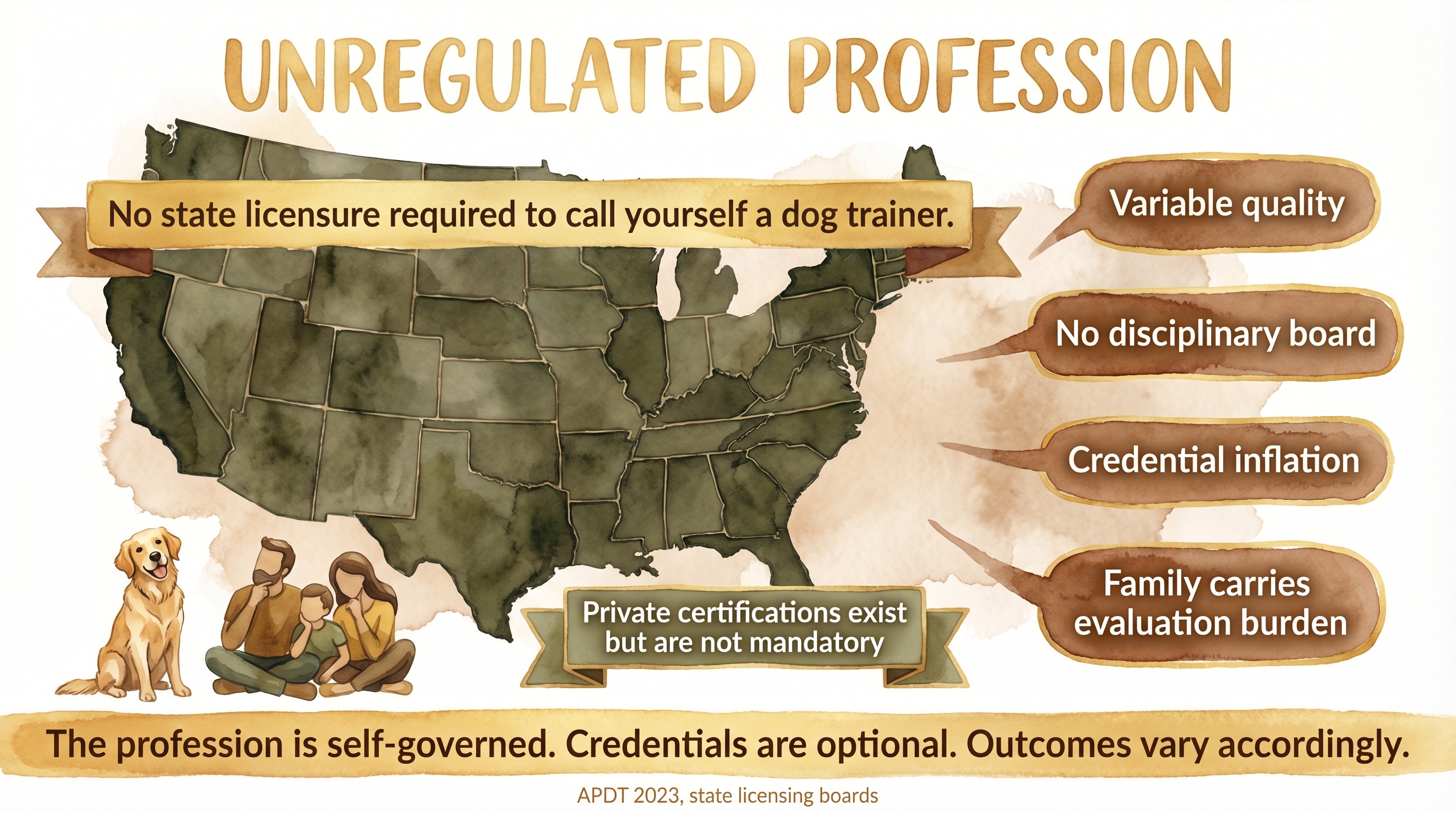
The profession is self-governed - credentials are optional - outcomes vary accordingly.
Key Takeaways
- Anyone in the United States can generally call themselves a dog trainer without state licensure or a legal competency floor.
- That reality applies across the JB service area, including Massachusetts and the surrounding New England states.
- Voluntary credentials and ethics codes matter more in this field, but they still do not replace state oversight.
- JB families should treat careful vetting as part of basic consumer and animal welfare protection, not as optional extra caution.
The Evidence
This entry uses ambiguous claim-level tags beyond the dedicated EvidenceBlocks below. These tags mark claims where the literature remains unsettled or multiple interpretations coexist.
- US dog training profession
Documents the absence of licensure, the New England state picture, limited accountability mechanisms, and the current legislative landscape. - California AB 1901 and state legislative recordsUS legal framework
Show that the most developed US legal activity remains limited and does not amount to professional licensure. - SCR-170 and SCR-178dog training regulation
Support the core claim that dog training is unregulated in the US and only partially or voluntarily regulated in a few international contexts. - Comparative professional regulation analysisveterinary medicine and psychology
Clarifies what dog training lacks when compared with legally regulated helping professions.
- domestic dogs
No published study directly isolates the long-term dog-level and family-level effects of dog training as an unregulated profession across ordinary companion-dog contexts.
SCR References
Sources
- American Veterinary Medical Association (AVMA). (2023). Licensing and regulation of veterinarians and veterinary technicians. AVMA.
- National Association of Dog Obedience Instructors (NADOI). (2024). Professional standards and ethics. NADOI.
- Herron, M. E., et al. (2009). Comparison of training methods and their relationship to separation anxiety in dogs. Journal of Veterinary Behavior, 4(4), 176-181.