IAABC Certification (CDBC and ACDBC)
Compound evidence detail1 SCR / 2 parts
- Documentedthe ACVB membership data and APPA pet-owning household estimates establishing approximately 80 to 110 board-certified veterinary behaviorists serving roughly 86.9 million US pet-owning households, with fewer than 100 active CAABs
- Heuristicthe JB application interpreting the practitioner-to-household ratio as a structural access problem, with the qualifier that the access analysis is more nuanced than the single ratio implies because some DACVBs serve as consultants to primary-care veterinarians rather than direct case practitioners
The IAABC occupies a different place in the credential landscape from the general trainer bodies most families first encounter. Founded in 2004, the International Association of Animal Behavior Consultants was built around behavior consulting across species, not only around teaching ordinary obedience skills. That distinction matters because many family-dog cases are not really about basic training at all. They are about fear, aggression, anxiety, compulsive behavior, or quality-of-life problems that sit closer to behavior medicine than to manners class. Documented
There is also a terminology point families should know. The dispatch title uses older shorthand, but the current IAABC public credential architecture separates Certified credentials, such as the Certified Dog Behavior Consultant or CDBC, from Accredited credentials, such as the IAABC Accredited Dog Trainer. The public site also lists Affiliate and Shelter pathways. The important practical point is unchanged: the IAABC has long represented a more behavior-consultation-focused branch of the profession than the ordinary entry-level training market. Documented
From a JB perspective, the IAABC matters because it is one of the clearest signals that a practitioner is thinking beyond basic cue training. The caution is the same caution that applies everywhere else in this category. A meaningful credential is still not a guarantee. It tells you something real about focus, case experience, and professional standards. It does not remove the need to evaluate fit, philosophy, or whether the dog's problem has crossed into veterinary territory where a DACVB may be more appropriate. Families often meet the IAABC when they are already worried, which makes accurate reading even more important. Documented
That is why the IAABC can be especially helpful for families who sense that the issue in front of them is no longer just manners. The letters point toward a deeper case conversation, not only toward a fancier version of basic training.
What It Means
The IAABC's Place in the Field
The IAABC was founded in 2004 by behavior professionals who recognized that companion-animal behavior work was growing without a sufficiently formal professional home. Documented The current public site describes an international organization supporting thousands of professionals across many countries. Historically, that matters because it shows the IAABC was trying to professionalize a particularly difficult slice of the field, cases where behavior problems affect safety, welfare, or ordinary family life in a serious way.
That orientation is visible in both the old and current credential structures. The source layer describes canine behavior-consultant pathways requiring substantial case experience, coursework, references, and writing-intensive assessment. The current public IAABC pages describe Certified credentials as the organization's highest tier for consultants handling behaviors that affect safety or quality of life, including fear, anxiety, aggression, phobias, and compulsive patterns.
What the CDBC Represents
The Certified Dog Behavior Consultant, or CDBC, is the credential most relevant to families dealing with difficult dog behavior. The source document lists minimum expectations of roughly four years and 500 hours of animal behavior consulting experience plus 400 hours of coursework, seminars, or mentorship, alongside written case materials and references. Estimated The current IAABC materials continue to frame the certified level as the "pinnacle" tier for mid- to late-career consultants handling complex cases.
That means the CDBC should be read differently from a general trainer acronym. It is not mainly telling you that the person can teach sit, down, loose leash walking, or polite greetings. It is telling you the person has pursued more advanced recognition in behavior consulting specifically.
The Accredited Side
This is where the terminology needs care. The dispatch's older wording points toward a lower or earlier tier paired against the CDBC. In the current IAABC architecture, that lower non-certified dog credential is the IAABC Accredited Dog Trainer, not a separate ACDBC title. The current public criteria recommend at least two years of experience and at least 100 hours of coursework or related education in core competencies, followed by a writing-based examination process available to current members.
For families, the important point is not the acronym drift. It is the distinction in case depth. The accredited training side is more appropriate for manners work, skills, enrichment, and prevention of behavior problems. The certified consultant side is more appropriate for difficult cases where the family is no longer simply teaching behavior but trying to manage distress, danger, or significant dysfunction.
Ethics, Process, and Continuing Education
The source layer and public IAABC materials both show a relatively formalized process compared with much of the field. The organization uses a published ethics code, a complaint pathway, and continuing education requirements. The source notes a three-year cycle with 36 CEUs. It also describes the Ethics Committee as unusually formalized for the industry, including attorneys, a PhD ethicist, and trainers.
The examination style matters too. Unlike a simple multiple-choice knowledge test, the IAABC process is writing-intensive and case-centered. It asks applicants to explain reasoning, intervention choices, and applied work. That does not make it perfect, but it does make it different.
The DACVB Distinction
Families also need a ceiling in mind. An IAABC credential can be excellent and still not be the highest relevant professional tier. The source document is explicit that the Diplomate of the American College of Veterinary Behaviorists sits at a different level entirely, requiring veterinary licensure, residency, publication, and board examination. That distinction is crucial whenever medication, medical workup, or severe pathology may be involved.
The cleanest consumer reading is therefore layered. An IAABC credential may tell you a lot about behavior-consultation seriousness. Documented A DACVB tells you you are in veterinary specialty territory.
What It Does Not Settle
As with every credential in this category, SCR-171 and SCR-174 still apply. No peer-reviewed outcome study proves that holding an IAABC credential causes better dog results than not holding one. Documented And no acronym alone tells you whether the person is the right fit for your Golden, your family, your pace of life, or your philosophy of raising.
There is also a consumer benefit in the writing-heavy structure itself. A body that asks for case material, reasoning, and documentation is at least trying to assess how the practitioner thinks through messy real behavior problems rather than only whether the person can memorize definitions. That does not make the result infallible, but it does make the signal meaningfully different from a purely entry-level training exam.
IAABC letters are most useful when families read them as case-fit signals. Certified behavior-consultant credentials point toward complex behavior work. Accredited trainer credentials point toward training and prevention support. Neither acronym should be asked to mean more than it actually means.
Why It Matters for Your Dog
For a Golden Retriever family, the IAABC matters most when the problem in front of you is no longer simple puppy training. A sociable adolescent who jumps on guests, pulls on leash, and struggles with excitement may need a very good trainer. A Golden who is guarding objects, showing escalating fear, melting down at noises, redirecting in frustration, or living in chronic anxiety may need a behavior consultant with deeper case experience.
That distinction protects the family from two opposite mistakes. The first is under-escalation, where a genuinely serious case gets handed to someone who mainly teaches manners classes. The second is over-escalation, where a basically healthy but under-raised adolescent is treated as if it requires specialist pathology-level intervention. Goldens can fall into both traps because they are expressive, social, and often misread. Their friendliness can hide anxiety. Their softness can hide poor structure. Their exuberance can be mistaken either for pathology or for nothing at all.
A practical example helps. Suppose a Golden begins growling around the food bowl, startling at visitors, and panicking when left alone. That is no longer just a puppy-manners conversation. An IAABC consultant may be much more appropriate than a basic class instructor, especially if the consultant can also tell the family when veterinary involvement is needed. On the other hand, if the same dog is simply blowing through doors, mouthing sleeves, and spiraling into overexcitement because the house is too stimulating and inconsistent, the family may need a trainer with good developmental judgment more than a specialist consultant.
This is why credential reading has to connect to triage. Families are not just selecting the most impressive alphabet string. They are matching the dog's actual problem to the right level of help.
The IAABC can also be valuable because its credential structure often attracts practitioners who think carefully about antecedents, thresholds, emotional states, and quality-of-life impact. Those are all important lenses for families dealing with a sensitive or struggling Golden. But the family still needs to ask how the consultant thinks about household routine, breeder transition, calmness, prevention, and the long-term shape of the dog's life. A consultant can be technically excellent and still not be the right person for an ordinary family trying to build maturity in daily life.
So the family-level lesson is simple. When behavior becomes serious, do not stay artificially low in the help hierarchy out of convenience. But do not assume that specialist letters are the answer to every ordinary raising problem either.
This distinction becomes especially helpful in Golden homes where the dog's presentation can be misleading. A socially soft retriever may look merely exuberant while carrying significant anxiety. Another may look dramatic while actually needing clearer home structure rather than specialist treatment. An IAABC credential can be a very smart filter when the family suspects the case has moved beyond basic training, but it only helps if the family uses it as part of good triage rather than as a badge of automatic superiority.
The family should also notice how the consultant talks about referral. A good IAABC professional should be able to describe what sits within behavior-consultation scope and what starts to require veterinary behavior input, medical rule-out, or coordinated care. Documented In a serious case, that humility is not a weakness. It is one of the most valuable signals you can hear.
Another practical point is that some Goldens need both levels of reading at once. A dog may be anxious enough to need specialist behavior thinking and still be living in a home rhythm that magnifies the problem every day. The right consultant can help the family see both the clinical risk and the domestic structure that must change alongside it.
For a JB family, that precision can prevent both panic and delay. You do not need to escalate every adolescent wobble into specialist behavior language, and you do not need to leave a truly serious case in ordinary trainer territory longer than you should. The IAABC sits most usefully in that middle act of responsible discernment.
Goldens benefit from that restraint because the breed's expressiveness can make ordinary adolescence look more pathological than it is. Good triage protects against both underreaction and overreaction.
That is especially valuable when a Golden's behavior is emotionally serious but still unfolding. A family that reads the IAABC well can get appropriately high-level support without either minimizing the problem or dramatizing it beyond what the dog actually needs.
What This Means for a JB Family
For a JB family, the IAABC is best understood as a serious signal for behavior-consultation work, not as a general answer to all dog raising questions. Heuristic That is a strong endorsement within limits. If your Golden's behavior has moved into safety, welfare, or quality-of-life territory, an IAABC consultant may be exactly the level of support you need. The organization exists precisely because the field needed more rigor around those cases.
JB's caution is that specialist help is still downstream of raising. An IAABC consultant can help with fear, aggression, anxiety, and complex household breakdown. That does not mean the credential tells you how to build a puppy's developmental floor from the beginning. The family still has to think about calmness, mentorship, structure, and prevention as everyday realities, not only as treatment add-ons once the dog is struggling.
This is where good triage becomes a moral responsibility. If the dog is truly outside the scope of ordinary training, step up to behavior expertise quickly. If medication or medical differential diagnosis may matter, step up again to veterinary behavior. But if the dog is mostly showing social immaturity, chronic overarousal, or inconsistency shaped by household life, do not outsource the whole problem to specialist intervention language when the deeper work is still happening at home.
That is the JB takeaway. Use the IAABC when the case asks for it. Respect what the credential is built to mean. Then keep your eyes on the whole dog and the whole life, not only on the label on the consultant's website.
For a JB family, the IAABC is therefore best used as a precision instrument. Reach for it when the case is too behaviorally serious for ordinary trainer assumptions, and then keep evaluating the person in front of you. Do they see the dog's emotional state clearly? Do they understand family life, not only case terminology? Do they know when the next step is veterinary?
That disciplined reading allows the credential to do what it is best at, namely helping families find higher-level behavior support without pretending every concern automatically belongs in specialist hands.
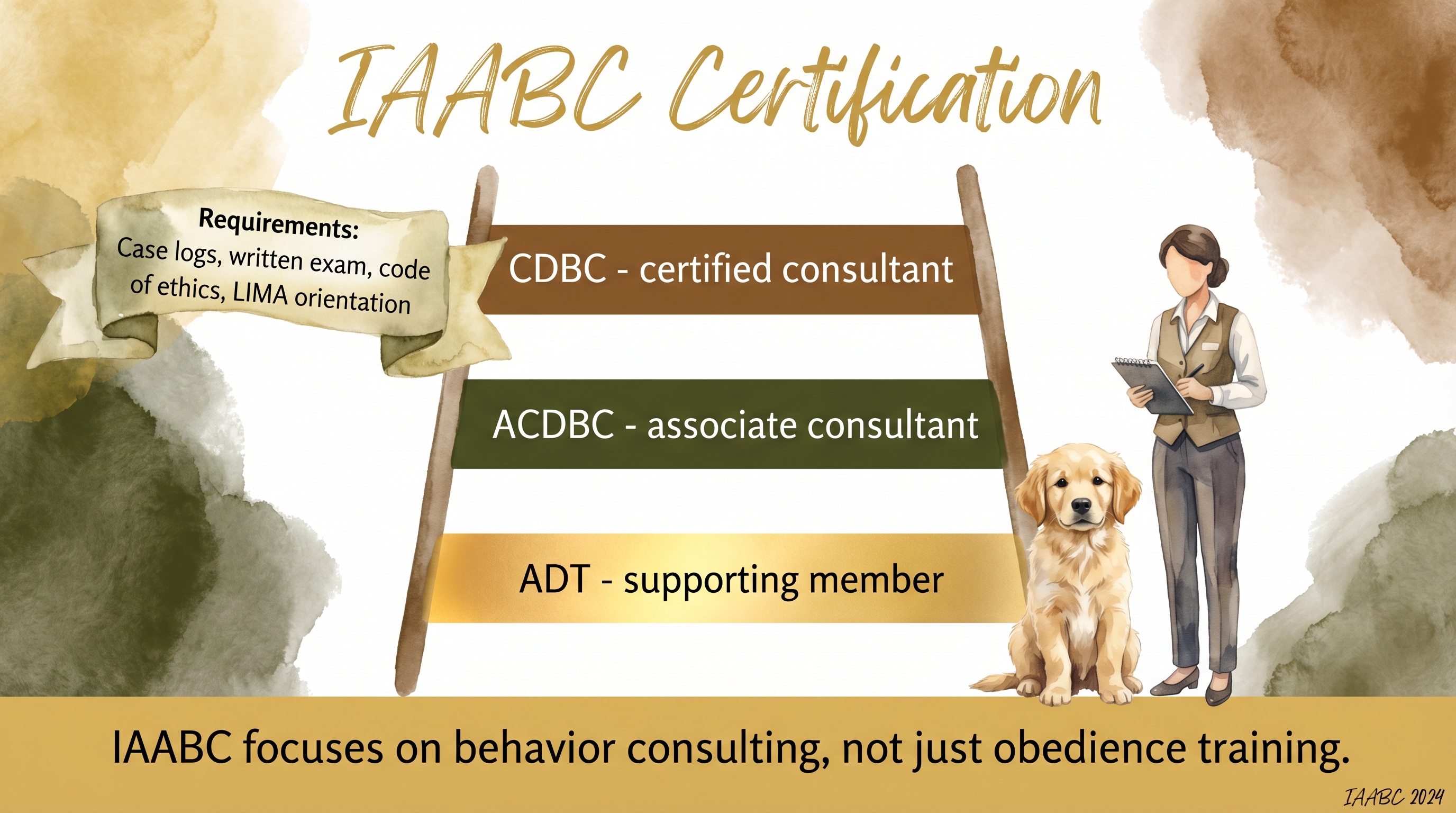
IAABC focuses on behavior consulting, not just obedience training.
Key Takeaways
- The IAABC is primarily important because it professionalizes behavior consultation, not merely ordinary dog training.
- The CDBC should be read as a complex-case signal, while the current accredited IAABC dog-trainer pathway sits at a different level.
- Families should distinguish clearly between behavior-consultant help, general training help, and veterinary behavior medicine.
- JB families benefit most when they use IAABC credentials for serious-case triage while keeping raising and prevention work in view.
The Evidence
This entry uses estimated claim-level tags beyond the dedicated EvidenceBlocks below. These tags mark approximate ranges or timing claims that should remain bounded by the cited sources.
This entry uses heuristic claim-level tags beyond the dedicated EvidenceBlocks below. These tags mark JB interpretive application rather than direct study findings.
- dog training credentialing
Documents the IAABC's behavior-focused scope, published requirements, ethics structure, and the distinction between general trainer and behavior-consultation roles. - IAABC official credentials pagesdog training credentialing
Show the current public architecture of Certified, Accredited, Affiliate, and other credentials, including the CDBC and IAABC-ADT pathways. - SCR-173professional behavior expertise
Supports the distinction between meaningful behavior-consultant credentials and the still rarer veterinary behaviorist level. - SCR-171 and SCR-174dog trainer credentialing literature
Support the caution that a meaningful credential still does not become a universal predictor of outcome or family fit.
- domestic dogs
No published study directly compares the long-term dog-level and family-level outcomes associated with professionals trained through iaabc certification (cdbc and acdbc) versus other educational pathways.
SCR References
Sources
- International Association of Animal Behavior Consultants (IAABC). (2024). CDBC credential standards and requirements. IAABC.
- International Association of Animal Behavior Consultants (IAABC). (2024). Code of conduct and ethics. IAABC.
- Mills, D. S., et al. (2006). The effect of a cognitive task on the non-social behaviors and behavioural indicators of stress in dogs. Applied Animal Behaviour Science, 99(1), 22-35.