CCPDT Certification (CPDT-KA and CBCC-KA)
The Certification Council for Professional Dog Trainers, or CCPDT, is the most recognizable exam-based dog-trainer credentialing body in the United States. Founded in 2001, it was built to function as an independent certification organization rather than as a casual membership club. That difference matters historically. The CCPDT gave the industry a credential that looked more like a conventional professional exam signal than the loose assortment of course certificates and affiliations families had often seen before. Its flagship certification, the CPDT-KA, remains one of the first acronyms many families learn when they start trying to separate serious trainers from everyone else. Documented
The source layer shows why that credential carries real weight. The CPDT-KA is accredited by the National Commission for Certifying Agencies, requires documented experience, uses a standardized exam, and requires continuing education for renewal. The CCPDT also offers the CPDT-KSA, which adds a practical video skills assessment, and the CBCC-KA, which addresses canine behavior consulting at a more advanced level. Those are meaningful distinctions. They tell a family that the person did more than print business cards. Documented
The caution is equally important. A CCPDT credential is not licensure, not a complete philosophy statement, and not a guarantee of case fit. The source document is explicit that no peer-reviewed study has shown CCPDT status to be a validated predictor of better dog outcomes, welfare practices, or client compliance. So the JB reading is straightforward: the letters matter, but they should be read for exactly what they establish and no more. That precision is especially important because the CCPDT is often the first acronym ordinary families learn, which makes it easy to overtrust. Documented
That matters because the CPDT-KA often becomes the public's default symbol for "real trainer." Families need to know enough to avoid turning a strong signal into a magical one.
What It Means
What the CPDT-KA Actually Requires
The CPDT-KA is the entry point most families see first. According to the 2026 candidate handbook summarized in the source layer, applicants must document at least 300 hours of dog-training experience within the previous three years, with at least 225 of those hours as instructional contact hours. Estimated The experience must be attested by a CPDT-KA, CPDT-KSA, veterinarian, or CAAB or ACAAB level professional. Applicants also need to be at least 18 years old and hold a high school diploma or GED.
The exam itself is knowledge-based. The source document lists a 200-question multiple-choice format, with 180 scored items and 20 pretest items, administered in a roughly three-hour testing window. The test domains are also documented: instructional and teaching skills, canine behavior and well-being, applied learning theory, and professional ethics plus laws and regulations. That design matters because it tells families what the credential is really measuring. It measures knowledge about training, not hands-on artistry with dogs in a live room.
The CPDT-KSA and CBCC-KA Distinctions
The CCPDT does not stop with the CPDT-KA. The CPDT-KSA adds a practical skills assessment based on video review. The source layer notes that this is the only major certification in the field that directly observes trainer skill with dogs as part of the credential. That makes the KSA meaningfully different from the KA, and families should understand that difference when reading websites.
The CBCC-KA is different again. It targets canine behavior consulting rather than ordinary dog-training instruction. That matters for cases involving fear, aggression, serious anxiety, or more complex behavior modification. Documented A family trying to choose help for a Golden with mild adolescent manners issues does not necessarily need a behavior-consultant level credential. A family dealing with escalating bite risk may very well need someone at that level or higher.
The Ethical Framework Question
The dispatch spec mentions LIMA because the CCPDT was long associated with it, and that historical association still matters. Documented But the current source layer records an important update. In May 2025, the CCPDT removed LIMA from its policy documents and adopted Susan Friedman's Humane Hierarchy as its governing framework for behavior change decision-making. That change triggered controversy, in part because many people had treated LIMA as part of the organization's identity.
Why does that matter for families? Because it shows that even a mainstream credential body is not philosophically static. The CCPDT is not a neutral machine floating above training politics. It is a real organization making ethical and procedural choices inside an actively contested field.
What the Credential Tells You
A CCPDT credential tells you some useful concrete things. It tells you the trainer engaged formal requirements. It tells you there was published eligibility criteria, testing, renewal, and an ethics framework. It tells you the trainer is at least somewhat legible to the profession. For the KSA, it tells you practical skill was directly assessed. For the CBCC-KA, it tells you the person pursued a more behavior-consultation-specific route. Documented
Those are meaningful consumer protections in a field that otherwise has few.
What It Does Not Tell You
The credential does not tell you how the trainer manages household arousal, whether they understand breeder-to-home transition, how they think about calmness as a lifestyle rather than a cue, how well they communicate with children, or whether their practical style fits your family. It also does not tell you that the trainer will be strong with severe aggression, puppy raising, Goldens specifically, or your dog's exact issue.
SCR-171 and SCR-174 matter here. No published outcome study proves the credential predicts better results across cases, and method orientation plus competence do not collapse neatly into one acronym. Documented Families need the letters and the interview.
There is also a practical reason families should pay attention to the 2025 policy shift noted in the source layer. The move from LIMA to the Humane Hierarchy shows that even a relatively mainstream body is still evolving its ethical language and procedural assumptions. The credential is not floating above the field's internal arguments. It sits inside them. That is not a weakness unique to the CCPDT. It is part of what it means to operate in an unregulated profession still trying to define itself.
CPDT-KA means knowledge assessed. CPDT-KSA means knowledge plus skills assessed. CBCC-KA means behavior-consulting knowledge assessed. Reading the exact signal matters more than simply being impressed by the acronym cluster.
Why It Matters for Your Dog
For a Golden Retriever family, the CCPDT often becomes relevant at the exact moment the dog stops feeling easy. The puppy has turned into a teenage retriever who jumps on guests, drags on leash, ignores cues when excited, and cannot settle in the evening. The family searches locally and discovers that many trainers mention the CPDT-KA. That is a good starting point, because it suggests a baseline level of professional engagement.
But it is only a starting point. A Golden with ordinary puppy or adolescent issues may be an excellent fit for a skilled CCPDT trainer who is thoughtful about foundations, routines, and family coaching. A Golden with more serious fear, guarding, or aggression may require a CBCC-KA holder, an IAABC consultant, or veterinary behavior support. The letters help with triage only if the family understands what each one actually represents.
This matters because Goldens are easy to underestimate. A family may think they only need basic obedience help when the real issue is chronic overarousal plus a household pattern that keeps rewarding it. Another family may panic and seek the most advanced behavior credential in town when what they actually need is calm, competent puppy guidance. The CCPDT credential can help narrow the field, but it does not answer the whole family-level question by itself.
A practical example makes this clearer. Suppose a ten month old Golden is surging at every passing dog, jumping wildly on visitors, and struggling to settle after school pickup chaos. A CPDT-KA trainer may be a good fit if that trainer knows how to coach the family on arousal, structure, prevention, and follow-through at home. A CPDT-KA trainer who only drills cues in sterile sessions may not be enough. The credential does not determine which kind of trainer you are talking to.
This is why families should ask direct questions. How do you think about overexcitement versus defiance? What do you do when the real problem is the household rhythm? How do you support a dog who is socially friendly but emotionally dysregulated? How do you work with a family on transitions, greeting patterns, and daily calmness? Those answers often matter more than the acronym alone.
The good news is that the CCPDT at least gives you a more legible starting place than the totally uncredentialed market. The bad news is that you still have to think. In a field like dog training, that is not a defect of the credential. It is the reality of the profession.
One reason this matters so much for Golden families is that the CPDT-KA is often attached to trainers who work with precisely the kinds of issues that feel urgent but not pathological: leash pulling, guest greetings, adolescent jumping, mouthing, barking at windows, weak recalls, and general family chaos. A CCPDT trainer may be an excellent fit for that work, especially if the person is thoughtful about household management and owner follow-through. But the family still has to find out whether the trainer mostly teaches cues in tidy sessions or whether the trainer can actually coach family life where the real mistakes are happening.
The distinction between the KA, KSA, and CBCC matters here. A CPDT-KSA may be worth extra attention if the family wants evidence of hands-on teaching competence, not only test knowledge. A CBCC-KA deserves extra notice if the dog is sliding toward fear, aggression, or deeper behavior modification needs. Those differences can save families from the common mistake of treating all CCPDT letters as if they were interchangeable.
Another consumer point is that the CCPDT does not remove the need to ask about scope. A Golden with chronic overarousal and weak structure may need a trainer who can coach the family on pacing, greetings, rest, and everyday routines. A Golden with escalating bite risk may need upward referral. The credential alone does not tell you whether the trainer knows the difference quickly enough.
That consumer discipline is especially valuable in adolescent Golden cases, where a trainer's ability to coach the family may matter as much as the trainer's ability to teach the dog. The acronym can point you toward seriousness. It cannot spare you the interview.
A Golden family may learn more from a trainer's answer to one home-life question than from the whole acronym line. Ask what the trainer does when the dog's problem is not lack of cues but too much household arousal. The response will tell you whether the credential is attached to real family guidance or mostly to exercise design.
What This Means for a JB Family
For a JB family, the CCPDT is worth taking seriously. It represents real study, formal requirements, and a visible ethics structure in a profession that has too little of all three. Documented A trainer with a CCPDT credential has done more than announce personal confidence. That matters.
JB's caution is simply that the credential sits inside the training paradigm, not above it. It does not certify a full developmental philosophy. It does not assess whether the trainer can build mentorship into ordinary family life. It does not prove deep understanding of breeder-raised puppies making a soft landing into a home. Those are often the variables JB families care about most.
So the best use of a CCPDT credential is disciplined and modest. Let it move a trainer upward in your evaluation. Then find out how that trainer thinks. If the person can connect knowledge to calm daily life, prevention, structured leadership, and family-level support, the credential becomes much more valuable. If the person cannot get beyond exercises and interventions, the letters may still be real while the fit remains wrong.
That is the JB takeaway. Respect the credential. Read it accurately. Then keep evaluating the human.
For a JB family, the practical reading of the CCPDT is therefore layered. Let the letters reassure you that the trainer has engaged a real credentialing body. Then ask the questions the exam cannot answer. How do you think about arousal in a family dog? What does success look like outside formal sessions? How do you handle adolescence? When do you refer upward? How do you support the handoff from breeder structure into ordinary household life?
Those questions do not diminish the credential. They complete it. In a field with limited regulation, the safest trainer search is not blind faith in acronyms and not contempt for them either. It is disciplined use of the signal followed by adult judgment.
For JB families, the healthiest stance is respect without surrender. A CCPDT credential should make you listen harder, not stop listening critically. That is the kind of balance an unregulated profession requires.
That makes patient questioning part of using the credential well.
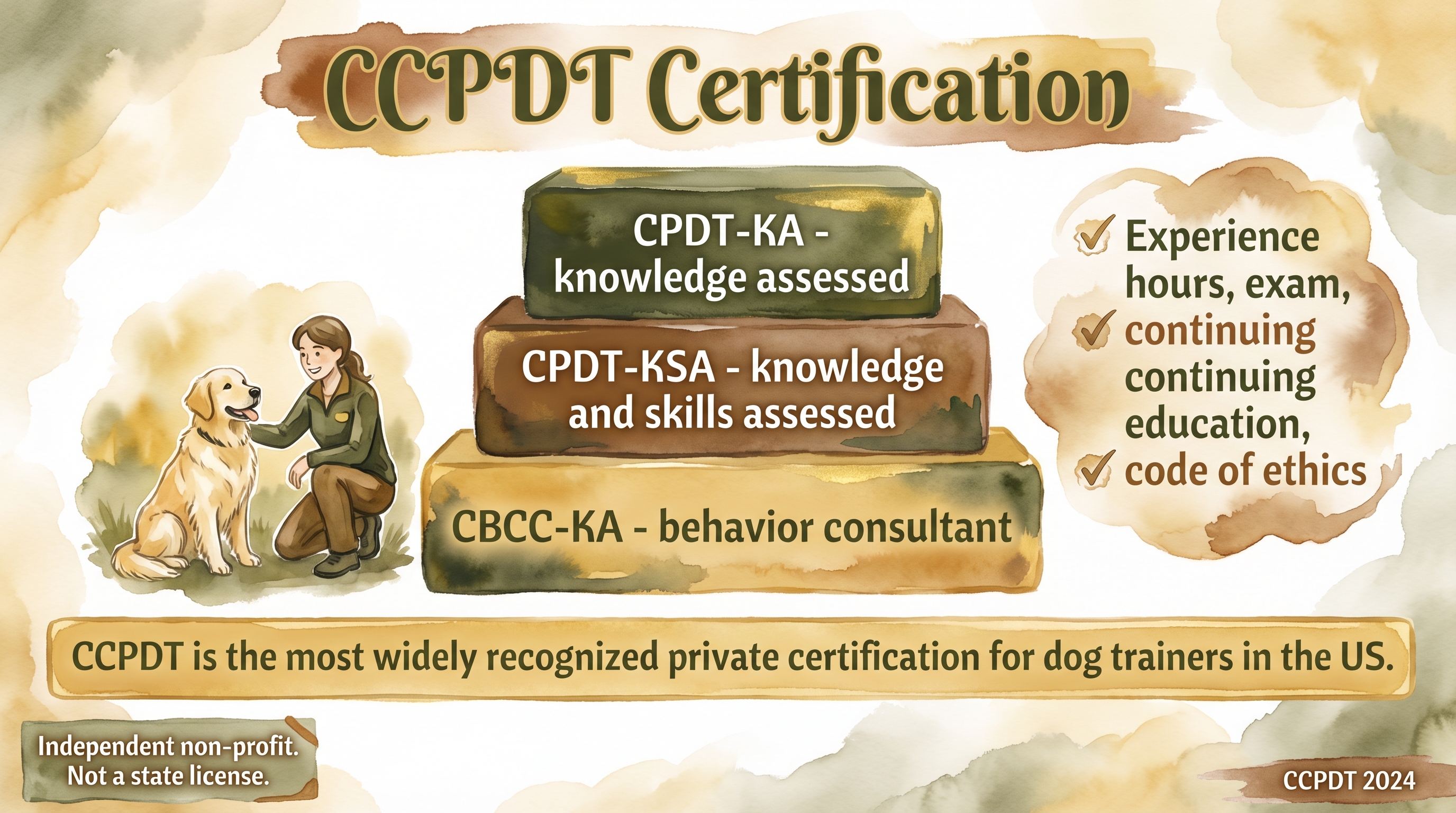
CCPDT is the most widely recognized private certification for dog trainers in the US.
Key Takeaways
- The CCPDT offers the most recognizable mainstream exam-based trainer credentials in the United States.
- CPDT-KA, CPDT-KSA, and CBCC-KA are not interchangeable, and families should read the distinctions carefully.
- The credential establishes real requirements and professional engagement, but it does not guarantee outcome quality or case fit.
- JB families should treat CCPDT letters as a strong clue and then evaluate philosophy, household guidance, and practical judgment directly.
The Evidence
This entry uses estimated claim-level tags beyond the dedicated EvidenceBlocks below. These tags mark approximate ranges or timing claims that should remain bounded by the cited sources.
- CCPDT 2026 Candidate Handbookdog training credentialing
Documents the CPDT-KA experience requirements, exam structure, and scope as a knowledge-based credential. - CCPDT published standards and recertification policydog training credentialing
Support the continuing-education requirements, ethics framework, and the distinction between the KA, KSA, and CBCC-KA pathways. - dog training profession
Documents the 2025 policy shift from LIMA to the Humane Hierarchy and the evidence gap around certification-outcome prediction. - SCR-171, SCR-172, and SCR-174dog trainer credentialing literature
Support the claim that CCPDT is meaningful while remaining an incomplete signal of competence and fit.
- domestic dogs
No published study directly compares the long-term dog-level and family-level outcomes associated with professionals trained through ccpdt certification (cpdt-ka and cbcc-ka) versus other educational pathways.
SCR References
Sources
- Certification Council for Professional Dog Trainers (CCPDT). (2026). Candidate handbook for CPDT-KA certification. CCPDT.
- Certification Council for Professional Dog Trainers (CCPDT). (2025). Standards of practice and code of ethics. CCPDT.
- Serpell, J. A., & Jagoe, J. A. (1992). Early experience and the development of behaviour. In J.A. Serpell (Ed.), The domestic dog: Its evolution, behavior and interactions with people (pp. 79-102). Cambridge University Press.