Consumer Protection in Dog Training and Boarding
Compound evidence detail2 SCRs / 4 parts
- Documentedthe structural absence of an industry-wide standardized canine behavioral outcome measurement and reporting system, supported by Hsu and Serpell 2003 (C-BARQ instrument), Lamb 2018 (LAIR clinician-overestimate finding), Mills 2020 (LCAS validation), Wright 2012 (DIAS validation), Daniels 2022 (UK client-rated equivalence regardless of method), and the IAABC Foundation Journal 2023 review of informal-assessment dependence
- Heuristicthe JB framing comparing the dog-training industry's outcome-measurement vacuum to adjacent helping professions (veterinary medicine, human psychology, education) where outcome measurement is regulatorily mandated or conventionally standardized, with the qualifier that the structural claim concerns industry-scale practice and does not deny that individual trainers measure outcomes in their own work
- Documentedthe general US regulatory landscape for dog services with the Massachusetts Ollie's Law (signed September 20, 2024) and associated MDAR implementation as the named statutory anchor, addressing facility-level concerns (zoning, physical standards, injury reporting) rather than method-quality oversight
- Heuristicthe JB facility-versus-method interpretive framework distinguishing physical-risk regulation from behavioral-outcome-quality oversight, with the standing constraint that the framework must not imply families are legally protected against poor training methods
Consumer protection in dog services is much thinner than many families assume. When people hire a dog trainer, a board-and-train program, a boarding kennel, or a daycare, they often imagine that someone meaningful has already checked competence, safety systems, or disciplinary history. In most of the United States, that assumption is wrong. The profession itself is largely unregulated, and even where boarding facilities are regulated, the rules often focus on facility conditions and paperwork rather than on training methods, handling quality, or long-term welfare outcomes. Documented
The JB source base is clear on two connected facts. First, there is no ordinary state licensing regime for dog trainers. Second, the accountability mechanisms that do exist are patchy: private certification complaints, civil litigation, local animal control, agricultural or public health oversight for facilities, and reputation systems like reviews. None of those systems reliably gives a family a clean, centralized picture of who has harmed dogs, who has been disciplined, or who simply closed one business and reopened under another name. Documented
That does not mean families are defenseless. Contracts matter. Method transparency matters. Insurance matters. Facility tours matter. References matter. Public records matter. Breeders and veterinarians can sometimes function as informal quality filters. The problem is that the family has to assemble those protections manually because the system does not provide them in a single trustworthy package.
This is exactly why consumer protection belongs inside a raising knowledge base. Families do not need law-school detail. They need a realistic understanding of where the floor actually is, where it is missing, and what due diligence looks like when the state is not going to do most of it for them, for families hiring help today.
What It Means
What the Law Usually Covers
The first distinction is between the trainer profession and the facility profession. Dog training, as a profession, is mostly unlicensed. SCR-170 and the source document support that plainly. Boarding kennels, daycare operations, and some training kennels may still fall under state or local facility regulation, but those rules often concern sanitation, staffing minimums, enclosure design, records, disease control, or inspection authority rather than the quality of behavior work. Observed-JB
Massachusetts is a useful example because it sits inside the JB service area. Ollie's Law, enacted in 2024, specifically addresses commercial boarding and training kennels by strengthening state authority around licensing, injury reporting, and safety standards. That is real regulation, but it is regulation of the operation as a kennel business. It is not a comprehensive quality seal for the methods, judgment, or relational skill of every trainer working inside the building for the buyer or the dog.
What Recourse Families Actually Have
When harm happens, the family's recourse is often after-the-fact rather than preventive. A certification complaint can matter if the professional holds a credential and if the conduct falls inside that organization's ethics code. A civil claim may matter if the family can prove negligence, breach of contract, or some other compensable wrong. In severe cases, animal-cruelty laws or local enforcement may become relevant. For facility problems, agricultural or municipal regulators may investigate if the operation falls under their jurisdiction.
Those paths are real, but they are limited. Complaint systems are often slow and narrow. Civil litigation is expensive and reactive. Reviews can warn others but are easily gamed, buried, or overwhelmed by marketing. None of these mechanisms gives the family the sort of live, preventive oversight that people often assume exists.
The Gaps Families Usually Do Not See
The biggest gaps are structural. There is usually no central disciplinary database. There is often no licensing board that can revoke a general right to practice. There may be no public requirement to disclose prior complaints unless a specific jurisdiction requires it. A bad actor can sometimes change business names, alter branding, or lean on an attractive social-media presence to outrun prior reputation. Documented
The outcome-measurement gap makes this even harder. SCR-177 notes that the industry lacks standardized long-term outcome tracking. That matters for consumer protection because families often judge services through before-and-after narratives, not through audited follow-up data. A company can look successful while leaving weak transfer, hidden fallout, or inconsistent welfare in its wake.
Consumer protection begins with reading claims precisely. In this industry, polished confidence, testimonials, and visual transformation are not the same thing as transparent accountability.
What Due Diligence Looks Like in Practice
In practical terms, protection begins before the contract is signed. Families should ask for written descriptions of methods, written cancellation terms, injury-reporting procedures, staff-supervision details, proof of insurance, references from recent clients with comparable dogs, and permission to tour or observe where appropriate. If the service is board-and-train or boarding, the family should ask who is on site overnight, how dogs are separated, and what happens in a medical emergency.
The simple rule is this: the less transparent the operator is willing to be before taking your dog or your money, the less safe the arrangement probably is. Responsible professionals should welcome clear questions because good systems are easier to describe than bad ones.
Why It Matters for Your Dog
Golden Retriever families often feel low-risk because Goldens are friendly, popular, and broadly welcomed compared with some other breeds. That can create a false sense of safety around services. The dog may be easy to market to, but the family's legal and practical exposure is still real if something goes wrong during boarding, training, or daycare.
A cheerful retriever can still be injured by overheating, mismanagement, unsafe group play, equipment misuse, rough handling, or inadequate supervision. Just as importantly, a socially forgiving breed can hide service-quality problems because the dog appears outwardly resilient even when the handling is poor. Families then mistake the dog's tolerance for evidence that the facility is skilled.
Think about an adolescent Golden going to a board-and-train because the family is overwhelmed by leash-pulling, jumping, and evening chaos. The owner may feel reassured by a glossy intake packet and a promise of a stronger heel and better place command. The more important questions are less glamorous. How many dogs is one staff member handling? What does the night look like? What tools are used if the dog shuts down or escalates? Who calls the veterinarian? What happens if the dog is injured? How are incidents documented? Is the family allowed to observe any part of the process?
The same logic applies to ordinary private training. A trainer can cause problems without ever entering legal territory. If the trainer overpromises, misreads fear, pushes the family into methods they do not understand, or lacks the humility to refer out, the dog may pay the cost long before there is any basis for complaint. Consumer protection therefore includes more than preventing catastrophe. It also includes filtering out weak professional judgment before the dog becomes the test case.
This matters especially for families new to dogs because they often do not know what normal transparency looks like. They may assume a trainer is licensed. They may assume a facility is inspected for method quality. They may assume a contract protects them more than it actually does. A little regulatory literacy helps the family ask better questions and feel less intimidated by professional theater.
A breeder can also play a useful protective role here. A breeder who knows the local landscape can help a family avoid obviously weak operators, suggest trustworthy trainers, and keep a household from making an anxious decision during a rough patch. That informal protection can be more valuable than families realize because it arrives before a bad experience, not after.
Documentation is another part of protection that families often skip because it feels overly formal. In reality, dates, emails, contracts, invoices, injury notes, text messages, and veterinary records can matter enormously if the story later becomes disputed. Ambiguous A family who keeps written promises and incident descriptions organized is in a far stronger position than one who relies on memory after the dog has already been harmed or the business relationship has deteriorated.
Public records can help too, even though they rarely provide a perfect answer. Families can search business names, owner names, inspection histories where available, court dockets, and corporate filings. Those searches do not replace direct questioning, but they can expose patterns that polished branding conceals. In a fragmented market, even partial public information can sharpen the picture before the dog becomes part of it.
There is another family-level reason this entry matters. When adults believe they are protected by an invisible system, they stop evaluating signals in front of them. They ignore defensiveness, vagueness, unexplained tool use, or refusal to describe process because they assume somebody official would not allow a bad operator to exist. In this industry, that assumption is often the mistake itself.
Aftercare is part of the consumer-protection picture as well. Good providers explain what happens if the plan is not working, if the dog deteriorates, if the family cannot implement the homework, or if referral is needed. Weak providers often sell only the intake moment and leave the family with little structure once complications appear. A service is easier to trust when the provider can describe not only the ideal path but also the correction path when reality gets messy.
Families should also notice whether the provider can describe limits without being cornered into it. Someone who can name the kinds of dogs they do not take, the cases they refer out, and the situations where the environment is unsafe is often safer than someone who markets universal confidence.
The practical bottom line is not paranoia. It is sober adulthood. The family should treat any dog-service provider the way they would treat an unregulated contractor working inside their home with something they love. Ask for specifics. Check what can be checked. Trust the person more after they answer clearly, not before.
What This Means for a JB Family
For a JB family, consumer protection is part of dog stewardship. Choosing help well is not separate from raising well. A poorly chosen trainer or facility can destabilize the very social and emotional patterns the family is trying to build.
That is why JB emphasizes due diligence before crisis. The best time to ask about insurance, transparency, scope, and references is before the household is desperate. Once adults are exhausted, they are much more likely to surrender judgment in exchange for relief. That is exactly when polished marketing becomes most persuasive.
JB families should also avoid outsourcing discernment to credentials alone. Certifications can matter, but they do not eliminate the need to look at method clarity, facility openness, communication style, and willingness to involve the family as partners. In a fragmented market, relational trust should be built from transparency and competence, not from branding alone.
One practical habit helps here: build the screening questions before the crisis arrives. A family who already knows to ask about observation rights, emergency veterinary protocol, scope of practice, references, insurance, and written method description is much harder to manipulate under stress. Documented Calm preparation does more consumer-protection work than angry hindsight.
JB can also use its own network responsibly without pretending that informal recommendations are infallible. Breeder guidance, veterinarian input, and local family experience are strongest when they narrow the field and prompt better questions, not when they replace adult discernment altogether. The goal is not to find a magical trusted name. It is to lower the odds that the dog becomes the proof of a bad system.
The strongest practical takeaway is calm skepticism. Not cynicism, and not fear. Just a refusal to assume that the system is doing more background protection than it really is. Families who understand that reality tend to ask better questions, choose better partners, and create safer outcomes for their dogs.
For that reason, calm recordkeeping and calm questioning belong together. When families ask direct questions early, save the answers, and compare those answers with what actually happens, they become much harder to mislead. Consumer protection in this field is rarely one dramatic move. It is often the accumulation of small adult habits that reveal whether the service is solid before the dog pays the price of discovering that it is not.
Seen that way, consumer protection becomes part of prevention rather than merely a response to harm. Families who understand the thinness of the system are more likely to choose transparent professionals, avoid crisis purchases, and keep the dog out of avoidable risk in the first place.
That is a much more useful frame than waiting for a complaint process to save the day. In this market, the strongest protection usually happens before the deposit is paid and before the dog disappears behind someone else's branding consistently.
That is a sober conclusion, but it is also an empowering one for careful families.
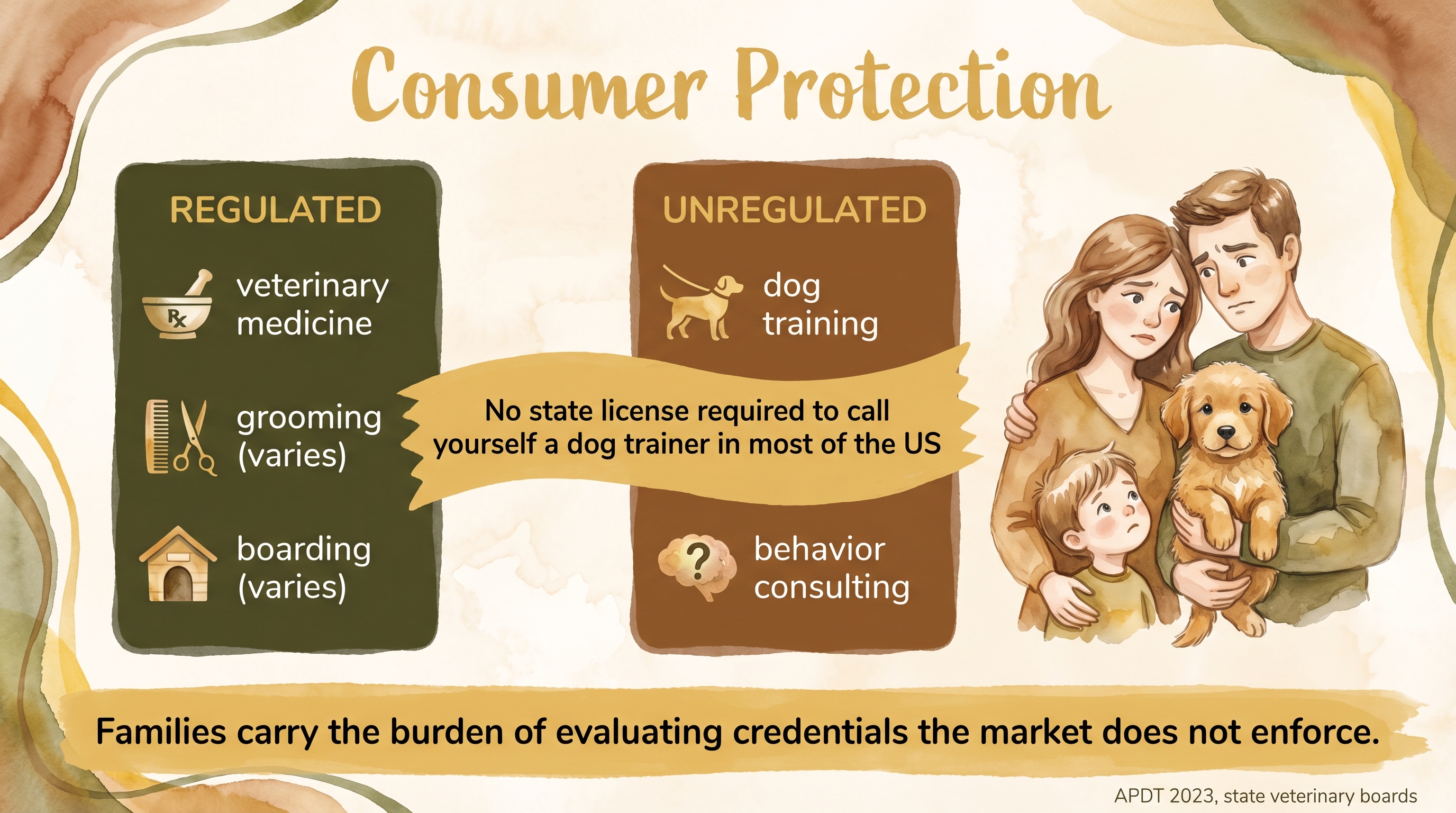
Families carry the evaluation burden the market does not enforce.
Key Takeaways
- Most consumer protection in dog services is piecemeal, reactive, and uneven rather than centralized or preventive.
- Facility regulation and professional competence regulation are not the same thing, and families should not confuse them.
- Contracts, insurance, references, tours, and written method descriptions are practical protections because the system leaves so much quality control to the buyer.
- For JB families, good service selection is part of good raising, not a separate administrative task.
The Evidence
This entry uses observed claim-level tags beyond the dedicated EvidenceBlocks below. These tags mark JB program observation or practice-derived claims that need dedicated EvidenceBlock coverage in a later content pass.
This entry uses ambiguous claim-level tags beyond the dedicated EvidenceBlocks below. These tags mark claims where the literature remains unsettled or multiple interpretations coexist.
- dog services regulation and accountability
Documents the unregulated status of dog training, the narrow accountability channels available, and the absence of centralized quality oversight. - SCR-170regulatory environment
Supports the claim that trainer practice in the United States remains largely unlicensed and unregulated. - SCR-177outcome measurement
Supports the claim that service success is rarely measured in a standardized long-term way. - Massachusetts Ollie's Law materialsboarding and training kennels
Show that at least some state intervention focuses on kennel safety and reporting because existing protections proved insufficient.
- domestic dogs
No published study directly isolates the long-term dog-level and family-level effects of consumer protection in dog training and boarding across ordinary companion-dog contexts.
SCR References
Sources
- Massachusetts Department of Agricultural Resources. "Ollie's Law Information."
- Session Law - Acts of 2024 Chapter 213.