Training Program Dropout and Completion Rates
Compound evidence detail1 SCR / 2 parts
- Documentedthe structural absence of an industry-wide standardized canine behavioral outcome measurement and reporting system, supported by Hsu and Serpell 2003 (C-BARQ instrument), Lamb 2018 (LAIR clinician-overestimate finding), Mills 2020 (LCAS validation), Wright 2012 (DIAS validation), Daniels 2022 (UK client-rated equivalence regardless of method), and the IAABC Foundation Journal 2023 review of informal-assessment dependence
- Heuristicthe JB framing comparing the dog-training industry's outcome-measurement vacuum to adjacent helping professions (veterinary medicine, human psychology, education) where outcome measurement is regulatorily mandated or conventionally standardized, with the qualifier that the structural claim concerns industry-scale practice and does not deny that individual trainers measure outcomes in their own work
Completion is one of the quietest distortions in the dog-training literature. Families tend to evaluate a class or program by the dogs who finish it, because those are the dogs still visible at the end. Research has started to show how much disappears before that endpoint. Harris et al. 2019 reported a 43.1 percent dropout rate in a free face-to-face training course and 100 percent dropout in the free online version they studied, while the paid comparison group dropped out at 24.1 percent. Older studies vary, but they point in the same direction. Clark and Boyer 1993 reported about 25 percent non-completion, Gaille and Perry 1994 described dropout as high as 85 percent before their intervention reduced it to 56 percent, and Seksel et al. 1999 reported much stronger attendance with 90.9 percent completing at least four of five sessions. Those numbers do not tell one simple story about dog-training classes. They do tell us that completion is unstable, sensitive to structure, and impossible to treat as a side issue. Documented
This matters for families and for science at the same time. When dropout is high, the published outcome for a program increasingly reflects the subset of people who had enough time, money, confidence, transportation, schedule flexibility, and emotional resilience to stay enrolled. The evidence then becomes biased toward completers. That can make a program look more effective than it feels to the average family trying to survive real life. Human adherence science says the same thing in a different vocabulary: intervention efficacy is never the whole story if uptake and maintenance are weak.
Dog-training culture often assumes that greater intensity signals greater seriousness. Observed-JB The dropout literature suggests something humbler. A modest practice that a household can sustain through sleep loss, work pressure, children's activities, and ordinary discouragement may be more valuable than a technically stronger plan that falls apart by week three. Sustainability is not the enemy of rigor. In many family-dog outcomes, it is the delivery system for rigor.
JB therefore reads dropout not as a client-motivation problem alone but as evidence about fit. If a program asks more than ordinary families can keep doing, the low completion rate is not only a family failure. It is also information about the program's real-world usability.
What It Means
Completion Is an Outcome, Not Just a Footnote
In the dog world, completion is often treated as background logistics, yet it deserves to be read as an outcome in its own right. Observed-JB Harris et al. 2019 is especially useful because it compared delivery formats and found sharply different dropout patterns. The free face-to-face course lost 43.1 percent of participants. The free online program lost everyone. The paid course still lost nearly a quarter. Those are not tiny leaks around the edge of a study. They are major signals about how difficult it is to keep families engaged in even relatively short dog-training interventions.
The older literature broadens the point. Clark and Boyer 1993 found roughly one in four participants did not complete. Gaille and Perry 1994 started from far worse attrition and improved it only after a targeted effort. Seksel et al. 1999 achieved much stronger attendance, which is valuable precisely because it shows dropout is not fixed by fate. Structure, format, expectation setting, and support can move it.
Why Families Leave Programs
The notebooks around this dispatch identify several recurring barriers. Schedules clash with class times. Childcare or commuting gets messy. Money runs out. Progress feels too slow. The family falls behind on homework and becomes embarrassed to return. Instructions accumulate faster than habits form. The dog improves in one setting but not at home, which lowers confidence. Documented None of this requires a dramatic explanation. It is what happens when ordinary households collide with structured programs.
The human behavior-change literature helps interpret those barriers. Documented Lally et al. 2010 found that habit formation took a median of 66 days, with wide spread around that median. Gollwitzer and Sheeran 2006 showed that implementation intentions improved follow-through. Jachimowicz et al. 2019 found meaningful default effects. These findings matter because many dog-training programs quietly assume families will convert advice into stable routines almost immediately. That is a poor assumption. Most people need structure, simplification, and environmental support long before they need more theory.
What Dropout Does to the Evidence
High attrition changes what published results mean. If the families who stay are wealthier, more organized, more experienced, more attached, or less overwhelmed, then outcome studies increasingly describe a selected population rather than the public at large. Documented That is especially important in dog training because owner behavior is already known to influence outcome alongside protocol design. A completion-based sample is therefore not just a smaller sample. It is a differently composed one.
This is one reason trainer marketing and published outcomes can both feel rosier than neighborhood reality. The people who finish classes, fill out surveys, and return for follow-up are not always the same people most at risk of dropping the whole process. Families on the edge of giving up their dog, those under serious financial strain, or those feeling embarrassed by slow progress are often the very people least visible in the literature by the end.
A raising plan that asks less abrupt heroism from the family will usually retain more families. Prevention is not only about stopping dog problems early. It also means building a household routine that is hard to abandon when life gets busy.
Completion Favors Programs Built for Real Life
The practical lesson is not that classes are pointless. Good classes can help a great deal. The lesson is that finishable programs deserve more respect than intense programs that only the most resourced households can complete. Completion is where method meets ordinary life. A plan can be elegant on paper and still fail because it asks for too many separate drills, too much travel, too much emotional bandwidth, or too many perfect repetitions from tired people.
That lesson also reorders what counts as seriousness. A family practicing three short, clear routines every day for months may be doing something far more serious than a family attending a demanding program they cannot absorb. Measured by attrition risk alone, sustainability is not a compromise. It is one of the central determinants of whether the intervention becomes real.
Why It Matters for Your Dog
Dogs do not care whether the calendar says a family intended to finish six sessions. They live inside whatever the household can actually maintain. That is why dropout matters so much for the dog, not only for researchers. When a family quits early, the dog does not experience "incomplete participation" as an abstract statistic. He experiences a burst of inconsistent effort followed by a return to the old pattern.
Consider a Golden Retriever puppy enrolled in a group class. Week one is energizing. Week two is messy because the family is late and stressed. Week three gets missed because of a school event. Homework is now patchy. By week four the puppy can sit for treats in class but is still launching at guests, stealing shoes, and barking at transitions at home. The adults feel behind, slightly embarrassed, and less sure that the class is worth the drive. That is exactly the kind of situation where dropout begins, not because the family is irresponsible but because the burden-to-payoff ratio has turned against them.
The dog then absorbs the consequences. The first problem is inconsistency. Rules and routines get emphasized intensely for a short window and then dissolve. The second problem is emotional drift. Adults become disappointed and more reactive because they feel they invested and did not get enough visible return. The third problem is rehearsal. The behaviors that matter most at home keep happening while the formal support structure thins out.
This is especially relevant for Goldens because they can look easier than they are during the first part of puppyhood. Their sociability makes class attendance feel affirming, and families may assume the dog is broadly on track because he charms the room. Then adolescence arrives. Excitement gets stronger, size gets greater, and the cheerful dog who was "doing great in class" is suddenly dragging to greetings, mouthing harder, or struggling to settle. If the family already dropped the program, they may conclude the dog regressed mysteriously. Often the more ordinary explanation is that the early intervention never became a durable household pattern.
Dropout also affects what families believe about themselves. When people leave a program halfway through, they often carry a private sense of failure. That feeling can make them avoid seeking help again, even when what they actually need is a better-fitting plan rather than more guilt. For the dog, that can mean a long period where the household does less because it feels ashamed of not having done more.
There is another way to read the same situation. If a program could not be sustained by a normal family with a normal schedule, then the failure is shared between household capacity and program design. That reframing matters because it opens the door to a different solution: fewer moving parts, more integrated routines, shorter practice windows, and goals that make sense inside daily life.
For a dog, that kind of redesign can be transformative. A five-minute calm-entry routine done every day may matter more than a ninety-minute class attended twice and then abandoned. A consistent feeding protocol, a predictable leash routine, and firm greeting boundaries can teach far more than a high-intensity curriculum that never survives contact with weekday reality. Dogs benefit from what repeats, not from what impressed the adults once.
This changes how families should think about ambition. The best plan for your dog is not the one that looks most committed on paper. It is the one that remains intact when the adults are tired, the weather is bad, the children are loud, and the week is full. That is the plan the dog will actually live in.
Families should also notice that dropout can be gradual rather than official. Sometimes they keep paying for the program, keep showing up intermittently, and still mentally exit long before the package ends. Homework fades, rules soften, management slips, and everyone quietly waits for the next formal session to restart momentum. From the dog's point of view, that is still dropout in slow motion. The routine has stopped functioning as a real daily influence even if the enrollment status says otherwise.
That is why finishability deserves to be evaluated before a family buys help. A class that requires weekly travel, substantial homework, and immaculate record-keeping may be excellent for some households and unrealistic for others. Matching the plan to the family protects the dog from being carried through cycles of enthusiasm and collapse.
Families should also remember that dropout can hide behind politeness. People may keep showing up even after their actual confidence is gone. They smile through class, collect handouts, and then do almost none of the work at home because the plan has already become too heavy. A trainer who notices that mismatch early and simplifies the demands may prevent the formal dropout from ever happening. From the dog's perspective, that simplification can be the difference between a routine that survives and one that never becomes real.
What This Means for a JB Family
JB families should treat sustainability as a first-order design criterion. Before committing to any program, ask what the routine will look like on an ordinary Tuesday, not on the most motivated day of the month. If the answer involves elaborate drills, long commutes, or more emotional energy than the household reliably has, the family is already flirting with dropout risk.
A better approach is to build dog raising into things the family was already going to do. Greeting guests calmly, pausing before doors, settling before meals, walking without dragging, and recovering after excitement are not extra projects. They are daily life. When the raising plan lives there, the household is harder to derail.
This is one reason JB emphasizes ordinary structure over episodic intensity. The family does not need a heroic month. It needs a believable year. A believable year is made from simple repeated practices that survive imperfect weeks and still communicate the same expectations to the dog.
Outside classes can still fit that model, but they should strengthen the home pattern rather than replace it. The right class leaves the adults more capable in the house they already live in. The wrong class creates a parallel universe that disappears as soon as the schedule gets complicated.
If a family starts to slide, the fix is not to panic or to double the complexity. Cut the plan down until it becomes finishable again. A smaller routine that continues is almost always better for the dog than a bigger one that collapses.
That is the most protective way to read the dropout literature. It does not tell families to aim low. It tells them to build dog-raising plans that ordinary humans can keep alive.
A useful question is whether the plan still works when no one feels inspirational. If the answer is no, the plan may be theatrically appealing but operationally weak. JB families do better when they build something that survives ordinary fatigue, because ordinary fatigue is where the dog actually lives.
In that sense, finishability is part of compassion. A plan that stays alive protects the dog from repeated cycles of human hope and human collapse. That stability is often more valuable than intensity.
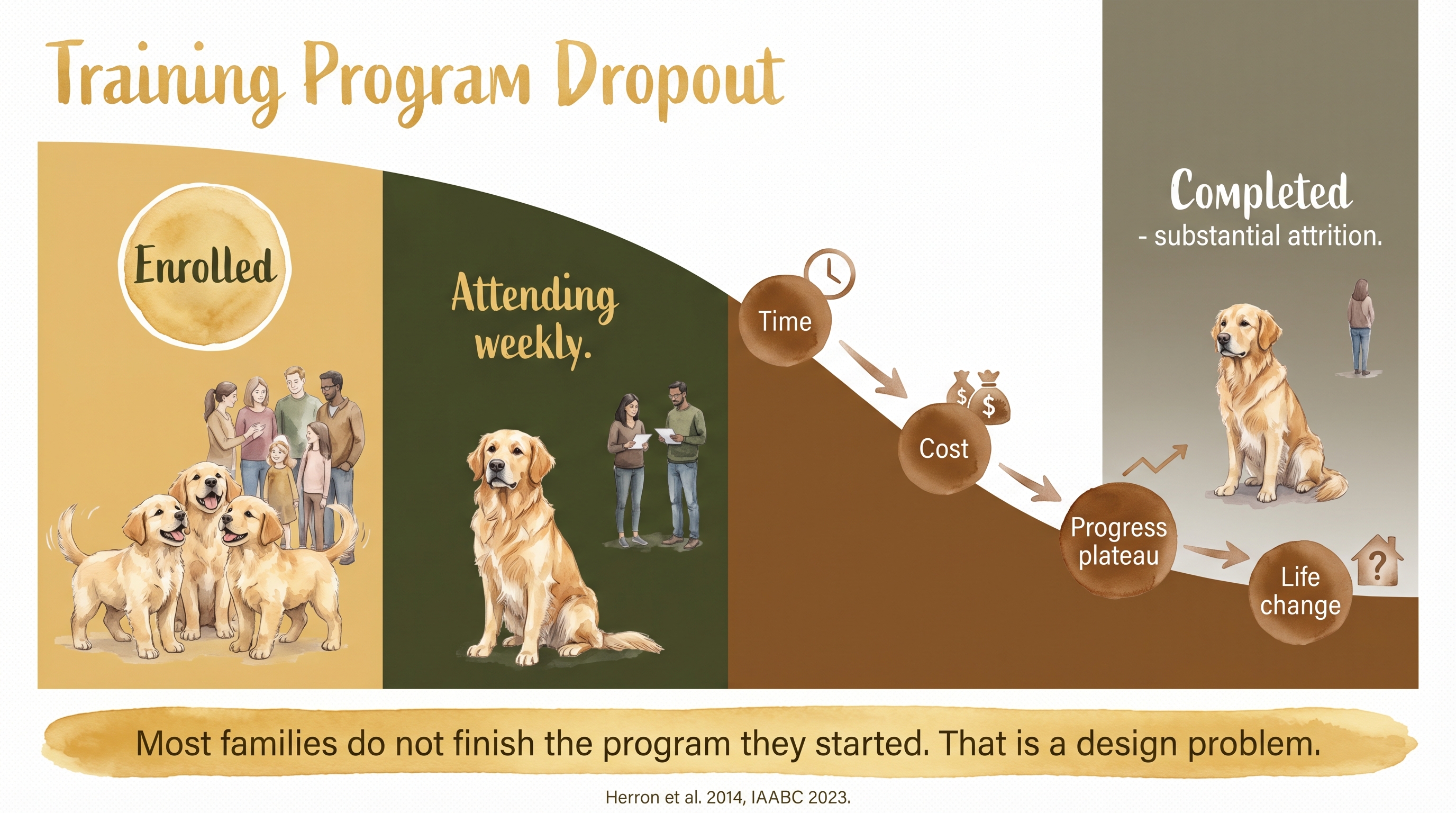
Most families do not finish the program they started - that is a design problem.
Key Takeaways
- Dog-training dropout is common enough that it should be read as part of the real-world outcome, not as a trivial logistics issue.
- Programs with high attrition may look more successful than they feel to average families because only completers remain visible at the end.
- A finishable routine integrated into daily life often benefits dogs more than an impressive plan that collapses after early enthusiasm.
- JB reads dropout as evidence about fit between program demands and normal family capacity, not only as a willpower problem.
The Evidence
This entry uses observed claim-level tags beyond the dedicated EvidenceBlocks below. These tags mark JB program observation or practice-derived claims that need dedicated EvidenceBlock coverage in a later content pass.
- Harris et al. (2019)dogs in training programs
Reported 43.1 percent dropout in a free face-to-face course, 100 percent in a free online version, and 24.1 percent in a paid comparison group. - Clark and Boyer (1993)dog-training participants
Found approximately 25 percent non-completion in a training setting. - Gaille and Perry (1994)dog-training participants
Documented very high dropout that improved after an intervention, showing attrition can respond to program design. - human adherence research
Shows that routines typically require weeks to months to stabilize and are sensitive to clarity, defaults, and friction.
- domestic dogs
No single dataset directly resolves the full population picture for training program dropout and completion rates without the usual survey, sampling, and threshold limitations.
SCR References
Sources
- Harris, R., et al. (2019). Animals.
- Seksel, K., Mazurski, E. J., & Taylor, A. (1999). Journal of the American Veterinary Medical Association.
- Gaille, P. M., & Perry, E. A. (1994). Anthrozoos.
- Clark, G. I., & Boyer, W. N. (1993). Applied Animal Behaviour Science.
- Lally, P., et al. (2010). European Journal of Social Psychology.
- Gollwitzer, P. M., & Sheeran, P. (2006). Implementation intentions and goal achievement: A meta-analysis of effects and processes. Advances in Experimental Social Psychology, 38, 69-119. https://doi.org/10.1016/S0065-2601(06)38002-1