Compliance and Adherence in Dog Training
An intervention can be biologically sound and still fail in a household if the household cannot carry it. That is the central lesson of adherence science, and it maps onto dog training almost perfectly. In medicine, clinicians distinguish efficacy from adherence: a treatment may work under ideal conditions and still underperform if patients do not take it as prescribed. Dog training has the same structure. A protocol may be elegant, humane, or technically powerful, but the dog's actual outcome depends on whether the family can remember it, repeat it, fit it into daily life, and stay with it long enough for it to matter. Takeuchi, Houpt, and Scarlett 2000 showed how fragile this can be. Owners of dogs in behavior treatment followed only part of the recommendations they were given, and improvement odds worsened when the instruction load exceeded five items. Kanji et al. 2012 found that clear recommendations improved adherence odds roughly sevenfold. Adams et al. 2005 found full compliance was dramatically likelier with simpler schedules. Lally et al. 2010 estimated a median of 66 days for habits to become automatic, with enormous variation around that median. These findings come from different contexts, but together they point toward the same family-dog truth: what people can sustain beats what people only admire. Documented
The dog-training field sometimes talks as if better outcomes are achieved by finding the most effective technique. Documented Adherence science adds a more sobering equation. Practical effectiveness is the product of method quality and human follow-through. If one of those terms collapses, the whole expression shrinks. That does not make adherence a soft issue. It makes it the mechanism through which most interventions become real.
Several features of family dog life make adherence especially challenging. Practice has to compete with work, children, travel, fatigue, weather, and embarrassment. Many households get their first dog at the same time they are trying to stabilize other parts of life. A plan that requires special equipment, long homework blocks, perfect timing under stress, or repeated setup of artificial scenarios may look polished in a manual and still have weak odds of surviving Tuesday evening.
JB treats this as design information. The Five Pillars are structured to ride inside ordinary family behavior rather than demand a separate training identity from the adults. Feeding, greeting, leash movement, settling, and transitions are not outside training. They are where adherence either takes root or disappears.
What It Means
Efficacy and Adherence Are Different Questions
A common field mistake is to merge "can work" with "will happen." Those are different claims. A method may have excellent efficacy under supervision, in a class, with a trainer controlling the environment, and still produce disappointing household results if the owners cannot reproduce the contingencies. The medical literature summarized in the human behavior-change notebook makes this distinction explicit. DiMatteo 2002, Haynes 2005, and Nieuwlaat 2014 all point to adherence as a major determinant of whether otherwise sensible interventions succeed outside ideal conditions.
Dog training often acts as if the family is merely responsible for trying harder. The adherence literature suggests something more useful. Human behavior is engineered by clarity, friction, defaults, routines, and identity. The owner who forgets to practice is not always uncommitted. The plan may be too complicated, too socially awkward, too poorly integrated, or too devoid of early reward to survive.
What Supports Follow-Through
Several factors repeatedly improve adherence. Clear instructions matter. Kanji et al. 2012 found strong gains from clearer recommendations. Documented Regimen simplicity matters. Adams et al. 2005 found that once- or twice-daily schedules had far better compliance than three-times-daily ones. Implementation intentions matter. Gollwitzer and Sheeran 2006 showed that if-then planning improves follow-through across domains. Defaults matter too, as Jachimowicz et al. 2019 summarized. Identity congruence matters, as Oyserman's work suggests: people persist more readily when the behavior feels like part of who they are becoming.
Each of these variables translates into family dog life. "When we come in from a walk, we pause at the kitchen threshold until the dog settles" is an implementation intention. Keeping a leash by the same door is a default. Asking for one predictable settle before dinner is simpler than asking for six disconnected drills. Framing the family as calm adults raising a stable dog is identity work, not just motivation.
What Breaks Adherence in Dog Households
The notebooks give the dog-specific version of the same problem. Owners are often given too many recommendations. Only some concerns get discussed in the appointment, as Roshier and McBride 2013 showed. Documented Professionals can overestimate success, as Lamb et al. 2018 showed, which means they may also underestimate how much the family is quietly struggling. Tami et al. 2008 found that many families modified or discontinued plans by six months. Odom et al. 2024 found substantial noncompliance in veterinary treatment settings and noted that many clients had never been shown exactly how to do what was being asked.
Adherence fails in dog training for recognizable reasons. The routine is too hard to remember. The gear is inconvenient. The owner feels embarrassed performing the exercise in public. Progress is too slow to feel reinforcing. The rest of the household is not aligned. The dog improves in one room but not in the front yard, which makes the plan feel fake. Confidence drops, then repetition drops with it.
Structured Leadership is not only about the dog accepting boundaries. It is also about adults building routines sturdy enough to outlast mood, fatigue, and discouragement. A routine that disappears under pressure is not yet structure.
JB as Adherence Engineering
This is where JB's design logic becomes clearer. A raising framework that asks families to embed expectations into feeding, greetings, leash handling, thresholds, and settling is also a framework that lowers friction. It does not depend on a separate performance window carved out from the rest of life. It uses the events that were already going to happen. That is adherence engineering in the strongest sense. The family is not remembering to "go train." The family is living the pattern while already doing family life.
That design does not guarantee success. It does improve the odds that the plan stays real for long enough to shape the dog. A brilliant intervention that is abandoned in twelve days loses to a simpler one that becomes part of the household's nervous system.
Why It Matters for Your Dog
From the dog's point of view, adherence is the difference between a household rule and a household mood. Dogs learn from repetition dense enough to become reliable. If the adults only implement the plan when they are fresh, calm, and focused, the dog experiences a rule that exists sporadically. That produces hesitation, testing, and confusion because the contingencies are not stable enough to organize behavior. Documented
Imagine a Golden Retriever who jumps on guests. The family is told to interrupt access, wait for four paws on the floor, reward calm greeting, keep a drag line on for management, and prevent rehearsal with advance setup. Every one of those steps makes sense. Now place that plan into a real month of life. Grandparents visit unexpectedly. One parent is on a call. The leash is in the other room. A child opens the door too fast. The adults feel silly asking every guest to wait. By the third week, the plan has become a half-memory. The dog has not refused the protocol. The household has stopped delivering it.
That is why some dogs seem to "know better" in one context and act wildly in another. The difference is often not canine dishonesty. It is adherence density. In the trainer session, every element was in place. At home, only fragments remain. The dog is responding to the real pattern, not to the household's intention.
This issue becomes even more important during adolescence. Families are tired, the dog is stronger, progress no longer feels linear, and embarrassing behavior is now happening in public. That is exactly when adherence breaks. If the original plan depended on ideal mood and ideal scheduling, it will unravel when the family needs it most. A dog then starts rehearsing the very patterns the adults believed had already been addressed.
Goldens are a revealing breed here because their charm buys them extra inconsistency. Families excuse rough greetings, door-rushing, or excited mouthing because the dog is friendly and lovable. Those exceptions feel harmless in the moment. Over months, they become adherence erosion. The official family rule stays on the lips while the actual family pattern drifts underneath it. The dog learns the drift.
Visible progress also matters enormously. Patronek and Dodman 1999 noted that perceived early improvement can sustain owner adherence. The opposite is also true. If the family does not see enough change quickly enough, motivation drops. That does not mean plans should promise miracles. It means good plans should be designed to produce early clarity where possible: fewer rehearsals, cleaner management, simpler expectations, and concrete wins the household can feel.
A dog benefits from that design because it reduces the emotional volatility around training. When adults stop framing every rough day as failure, they become easier for the dog to live with. The family is no longer lurching between strict weekends and permissive weekdays. The dog receives a steadier social world.
The practical implication is surprisingly reassuring. Families do not need the most sophisticated protocol on the market. They need the plan they can still run when the baby did not sleep, work was chaotic, it is raining, and the dog is in an adolescent mood. That is not settling. It is matching the intervention to the life in which the dog must actually succeed.
Adherence also changes how families should choose professional help. A trainer who delivers a beautiful in-session performance but leaves the adults with an unwieldy homework burden may have transferred very little. A less theatrical professional who trims the plan to a handful of repeatable habits may do more for the dog's life because the family can keep it going after the appointment ends.
This also explains why some households feel as if they are constantly "starting over." They are not always facing a uniquely difficult dog. They may be repeatedly selecting plans that ask more routine discipline, more embarrassment tolerance, or more environmental control than the family can consistently provide. The dog then receives islands of structure surrounded by oceans of drift. Adherence science helps name that pattern without turning it into a moral verdict.
Another subtle benefit of good adherence is that it lowers social noise for the dog. A family following one coherent plan tends to talk less, repeat fewer cues, and improvise less under pressure. The dog is no longer trying to sort today's version of the rules from yesterday's. In that sense, adherence is not only about human discipline. It is about creating an environment with fewer contradictions in it.
What This Means for a JB Family
For a JB family, the right question is not "What is the strongest possible protocol?" but "What can we actually live truthfully every day?" The answer should include greetings, doors, meals, walks, settling, and recovery after excitement because those are the repeating contexts where behavior is shaped. Documented
Build the plan around defaults. Keep gear where it is needed. Use short repeatable phrases. Tie one expectation to one routine rather than chasing ten targets at once. Decide what calm entry, calm feeding, and calm leash departure look like, then make those moments boringly consistent.
Treat early visible wins as fuel. If a simpler setup prevents a greeting explosion for three days in a row, that matters. The family feels the difference, confidence rises, and adherence becomes easier. This is not manipulative psychology. It is how humans build stable habits.
Also protect against shame. If the plan starts slipping, redesign it before concluding that the household lacks discipline. A smaller plan honestly followed is stronger than a larger plan that lives only in family intention. Structured Leadership includes the courage to simplify without calling that simplification weakness.
That is one reason JB fits ordinary homes. It does not ask adults to become a separate caste of hobby trainers. It asks them to raise a dog through the routines they already own. When the plan and daily life are the same thing, adherence has a real chance.
The more faithfully a family can hold that alignment, the less dog raising depends on bursts of motivation. The house itself starts doing part of the work. That is one of the most valuable kinds of reliability a family can build.
Seen this way, adherence is almost a form of kindness. It spares the dog the confusion of living under rules that only exist when the adults are especially motivated. A believable plan is not less ambitious than an elaborate one. It is simply more respectful of how real families and real dogs learn over time.
That respect matters because a dog cannot consent to living inside human inconsistency. Adults choose the pattern. A humane family therefore chooses the one it can actually keep.
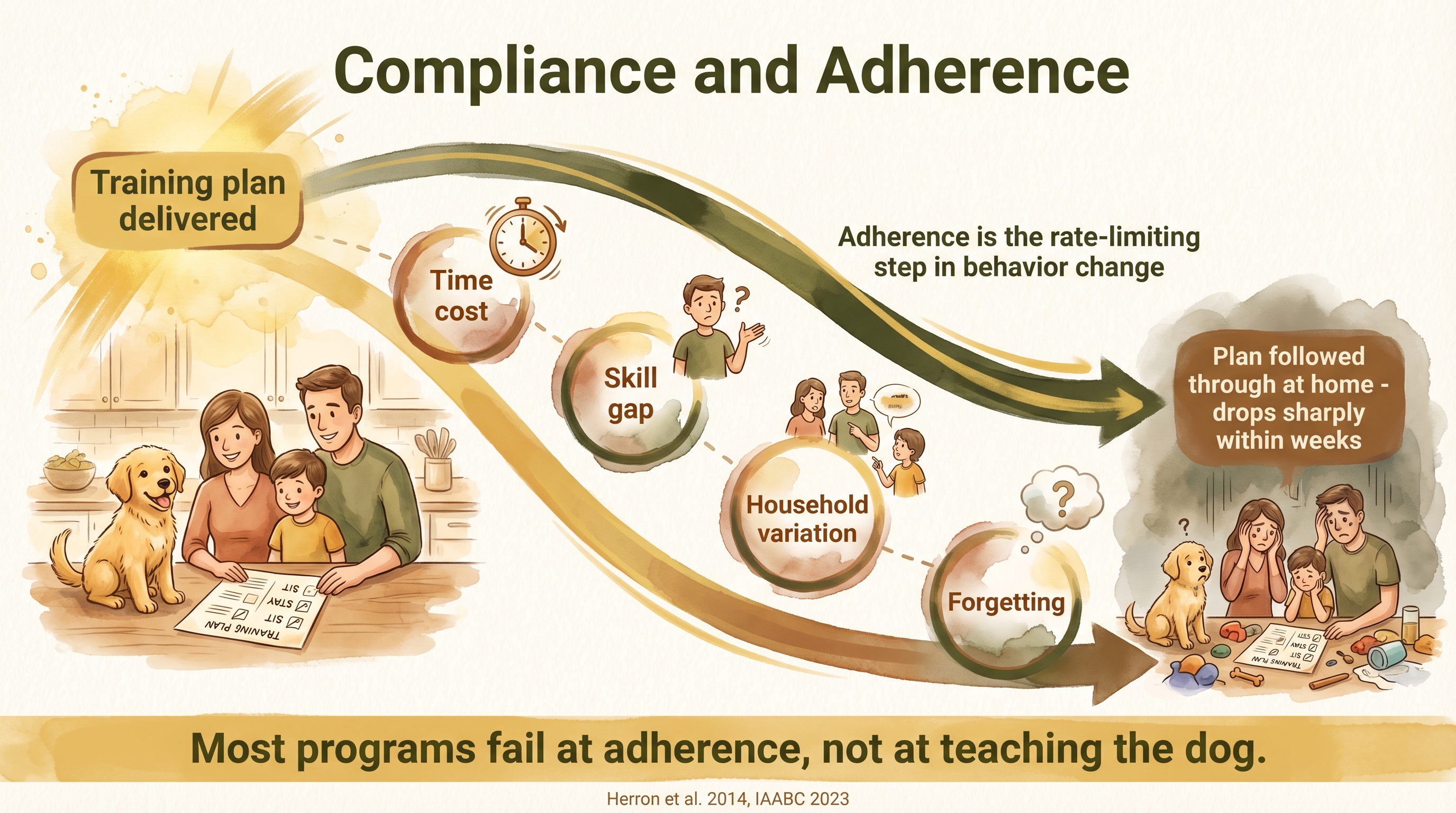
Adherence is the rate-limiting step in behavior change, not teaching the dog.
Key Takeaways
- A behavior plan that works only under ideal conditions may still fail the dog if the family cannot sustain it.
- Clarity, simplicity, defaults, and early visible wins all increase the odds that a household will keep a plan alive.
- Dog-training success is partly a human behavior-change problem, not only a canine learning problem.
- JB's design makes everyday routines carry the training load, which is one reason it fits adherence science well.
The Evidence
- Takeuchi, Houpt, and Scarlett (2000)dogs in behavior treatment
Owner compliance with prescribed recommendations was partial and declined as recommendation complexity increased. - Kanji et al. (2012)human adherence research
Clear recommendations improved adherence odds substantially, supporting the value of simplicity and clarity. - Adams et al. (2005)veterinary treatment compliance
Simpler schedules were far more likely to be followed fully than more complex ones. - Lally et al. (2010)human habit formation
Automaticity typically takes weeks to months, which cautions against assuming immediate routine stability in dog-owning households.
- domestic dogs
No published long-term study directly compares compliance and adherence in dog training against structured relational raising and no-intervention controls across ordinary companion-dog homes.
SCR References
Sources
- Takeuchi, Y., Houpt, K. A., & Scarlett, J. M. (2000). Journal of the American Veterinary Medical Association.
- Kanji, N., et al. (2012). Journal of Veterinary Internal Medicine.
- Adams, V. J., et al. (2005). Journal of the American Veterinary Medical Association.
- Lally, P., et al. (2010). European Journal of Social Psychology.
- Gollwitzer, P. M., & Sheeran, P. (2006). Advances in Experimental Social Psychology.
- Jachimowicz, J. M., et al. (2019). Behavioural Public Policy.
- Roshier, A. L., & McBride, E. A