The Long-Term Training Outcomes Evidence Gap
Compound evidence detail1 SCR / 2 parts
- Documentedthe structural absence of an industry-wide standardized canine behavioral outcome measurement and reporting system, supported by Hsu and Serpell 2003 (C-BARQ instrument), Lamb 2018 (LAIR clinician-overestimate finding), Mills 2020 (LCAS validation), Wright 2012 (DIAS validation), Daniels 2022 (UK client-rated equivalence regardless of method), and the IAABC Foundation Journal 2023 review of informal-assessment dependence
- Heuristicthe JB framing comparing the dog-training industry's outcome-measurement vacuum to adjacent helping professions (veterinary medicine, human psychology, education) where outcome measurement is regulatorily mandated or conventionally standardized, with the qualifier that the structural claim concerns industry-scale practice and does not deny that individual trainers measure outcomes in their own work
One of the most important facts about dog-training research is not a finding but a missing measurement. The field has surprisingly little long-term outcome evidence. Most published studies look at what happens during training, shortly after training, or within a limited window of weeks to months. Very few follow dogs for years. Fewer still track the combination of welfare, behavior stability, relationship quality, and life outcome that families actually care about when they ask whether a method "worked." Documented
The notebooks for this dispatch identify this as one of the field's thinnest areas. They note that comparative studies rarely assess long-term behavioral maintenance, almost never measure attachment quality, and do not tell us whether different methods change a dog's developmental trajectory through social maturity. Even stronger-looking studies such as Vieira de Castro 2020 or China 2020 tell us more about acute effects and short-term outcomes than about what the dog becomes over years.
There are bits of long-term material in the broader literature. Demant et al. 2011 looked at training frequency and long-term memory in a more limited sense. Puppy-class follow-up papers such as Seksel 1999, Duxbury 2003, Dale's later follow-up work, and Gonzalez-Martinez 2019 provide some adulthood or later-behavior glimpses. Casey et al. 2024, as synthesized in the notebooks, pushes further by following owners over twelve months and linking escalation toward aversive methods with worse later problem reports. But none of this adds up to a mature science of long-term training outcomes.
JB treats this gap as a constraint on everyone, not as a weapon only against competitors. The field cannot currently tell us, at a high level of certainty, whether dogs trained under method X are calmer at age five, less likely to be relinquished, more resilient under life stress, or better attached to their families than dogs trained under method Y. It also cannot directly test JB's own deeper claim that prevention-first relational raising produces superior adult welfare. That uncertainty should stay visible.
What It Means
What the Field Usually Measures Instead
Dog-training studies usually measure easier things. Observed-JB Did the dog perform the behavior by the end of the session? Did owner-reported obedience improve over several weeks? Did the dog show more or fewer stress behaviors while the method was applied? These questions are not trivial, but they are much easier to answer than whether the dog became a more stable companion over years of family life.
The notebooks are explicit here. The comparative literature is strongest on acute welfare signals and immediate task compliance, moderate on owner and handler variables, and weakest on long-term maintenance. That means the field has clearer evidence about how a training event feels than about what a developmental pathway ultimately produces.
The Specific Questions That Remain Open
Several questions families assume have answers do not actually have good answers yet. Does early method choice change adult behavior stability at three, five, or eight years? Do certain methods increase or decrease lifetime relinquishment risk independent of owner variables? Do dogs trained through more aversive means show different long-term attachment or baseline arousal? Does reward-based training produce durable behavior without high ongoing maintenance in real homes? No well-known body of research answers these directly. Documented
The notebooks also stress an even bigger missing comparison. No definitive randomized study compares structured relational raising, formal training-based intervention, and no-intervention control across time. Documented That means the field cannot directly test the industry's implicit assumption that teaching specific trained behaviors is the best route to producing a well-behaved family dog. Nor can it directly confirm JB's alternative claim that raising can outperform later training. Both sides live partly beyond the data here.
Why the Gap Exists
Long-term animal research is expensive, slow, and hard to maintain. Documented Families move, drop out, change routines, or stop responding. Dogs age into different life stages, households, and environments. Researchers need money, follow-up infrastructure, and incentive to keep measuring. The dog-training industry, meanwhile, is mostly set up to sell immediate solutions, not to fund multi-year behavioral epidemiology.
The methodological problems pile up fast. Over years, confounds multiply. A dog may switch methods, trainers, equipment, homes, family composition, or health status. Owners may become better or worse handlers. Breed and temperament differences become more visible. By the time a five-year outcome is measured, it can be difficult to attribute much of anything to the original training method with confidence. The gap is understandable. It is still a gap.
JB sees the long-term gap as one reason the industry keeps mistaking trained compliance for adult maturity. If the field mostly measures the early visible layers, it should not surprise us that the deeper developmental questions remain unsettled.
What Can Still Be Said Honestly
A gap is not a blank slate. The field can still say some things. It can say aversive-heavy methods carry more acute welfare concern. It can say owner compliance decays and that many protocols are hard to maintain. It can say long-term evidence is not strong enough to turn short-term success into sweeping lifetime claims. That is already a meaningful boundary.
The right conclusion is not that every long-term claim is false. It is that many are interpretive. Some may later prove correct. Some may not. The honest reading is to mark them as claims that outrun the current direct evidence base.
Why It Matters for Your Dog
For a Golden Retriever family, this gap matters because almost every important purchase decision is being made with a long-term hope attached to it. Families do not pay for a trainer because they want a single good week. They want a dog who will be safe, sociable, manageable, and steady years from now. The problem is that the field often markets those long-term hopes with short-term evidence.
Imagine a family choosing between a reward-based class, a board-and-train, an e-collar recall package, or a more prevention-focused household plan. Each option will imply something about adult outcome. Better relationship. More confidence. Permanent recall. Less reactivity later. Yet the long-term literature is so thin that these promises usually exceed what has actually been measured.
That does not mean families should freeze. It means they should ask better questions. What happens six months after the package ends? What maintenance is expected from the owner? What relapse patterns are common? How often do dogs look successful in the training environment and regress in ordinary life? What outcomes are actually tracked rather than simply assumed? Those questions get sharper once the family understands that the field as a whole rarely gives strong multi-year answers.
Goldens make this especially important because they often mature slowly and socially. A twelve-month-old retriever can look impressive under structured training and still be developmentally unfinished. Families may then believe they have already purchased the adult dog they want, when in fact they have purchased a temporary performance layer that still has to survive adolescence, family inconsistency, guests, children, travel, and the ordinary loss of training intensity over time.
A concrete example shows the risk. Suppose a one-year-old Golden completes a six-week program and comes home walking neatly, greeting politely, and recalling well in the trainer's field. The family is thrilled. The long-term evidence gap means we cannot simply infer from that moment what the dog will look like at age four under suburban life, holiday guests, schedule disruptions, and inconsistent reinforcement. The dog may remain excellent. The dog may regress. The field does not track that often enough to license strong certainty.
This gap also matters for softer philosophical claims. JB says prevention and calm relational raising likely produce better adult dogs than downstream corrective training. That may be right. The long-term research gap means JB should not dress that position up as if a decisive longitudinal literature already exists. Families deserve to know where the claim is reasoned from broader evidence and where it is directly tested.
The practical effect of knowing the gap is liberating. It makes families less vulnerable to guarantees. A trainer promising a permanently transformed dog in three weeks is making a stronger claim than the field can really support. A more modest trainer who speaks about maintenance, follow-up, developmental stages, and household consistency is often being more scientific by sounding less absolute.
Most of all, the long-term gap should redirect attention to what households can control well: daily life, not slogans. If the field cannot guarantee adult stability from a short training window, then calm routines, sleep, prevention, and coherent adult behavior become even more important. Those are not second-best because research is limited. They are the parts of dog life families can actually maintain across years.
Because development is seasonal, not linear, this matters more than it first appears. A Golden may look settled at eight months, unravel at fourteen, and re-stabilize at three years under the same family. A research design that measures only the exciting middle intervention can miss the broader arc completely. Documented Families who understand that are less likely to panic when adolescence exposes unfinished work and less likely to confuse one successful training snapshot with a completed developmental story.
There is also a quiet record-keeping lesson here. Since the field does not give families many strong multi-year maps, households can help themselves by noticing what really changes over time in their own dog: recovery after excitement, ease around guests, persistence of recall, flexibility across environments, and the amount of support still required to maintain those gains. That does not create publishable science, but it creates a more reality-based picture than memory alone.
Long follow-up also matters because some costs and benefits arrive late. A method that looks wonderfully efficient in the first month may prove brittle when the household gets busier, the dog gets stronger, or life stress hits. Another approach may look slower up front and then hold better once the dog and family have matured together. The field's lack of long-range measurement means families should stay modest about early victories and patient about slower foundational work.
What This Means for a JB Family
The first takeaway is to distrust any long-term promise that is much stronger than the evidence base. Guaranteed permanent calm, lifelong recall from a brief program, or claims that one method definitively produces better adult welfare should all trigger more questions than confidence.
The second takeaway is to respect the difference between performance and trajectory. A Golden can perform beautifully at the end of a protocol and still be early in its developmental story. Families should choose plans that build habits the household can sustain, not only moments the trainer can stage.
Third, hold JB to the same standard. When JB claims that prevention-first raising likely improves long-term outcomes, that claim should remain tagged where the direct comparison data are missing. The absence of decisive long-term studies does not make the claim wrong. It does make it a claim that still needs rhetorical discipline.
Finally, let the gap pull you toward sturdier fundamentals. Since the field cannot promise lifetime results confidently, it is rational to invest in the things that make lifetime results more plausible: calmness, structure, prevention, realistic expectations, and adult consistency. Those are not a substitute for evidence. They are the most durable response to what the evidence has not yet managed to measure.
Just as useful, choose professionals who speak naturally in follow-up language. Good signs include discussion of developmental stages, likely relapse windows, owner maintenance, and what the dog may still need a year later. Weak signs include permanent-sounding promises attached to short timelines. The long-term gap does not make every promise false, but it does make modesty look more scientific than swagger.
That attitude also protects JB from making the same mistake it critiques. If prevention-first raising truly produces better adult dogs, that advantage should be durable enough to survive careful wording rather than requiring inflated certainty. Families benefit more from a philosophy that stays honest about the evidence gap than from one that borrows the industry's habit of selling the future as if it were already fully measured.
One practical response is to choose programs that assume development will continue after the invoice is paid. Look for plans with follow-up, re-entry points, realistic maintenance expectations, and language about adolescence and changing contexts. Those are not merely customer-service details. In a field with weak long-term evidence, they are signs that the professional understands how uncertain long-term prediction really is. Ambiguous
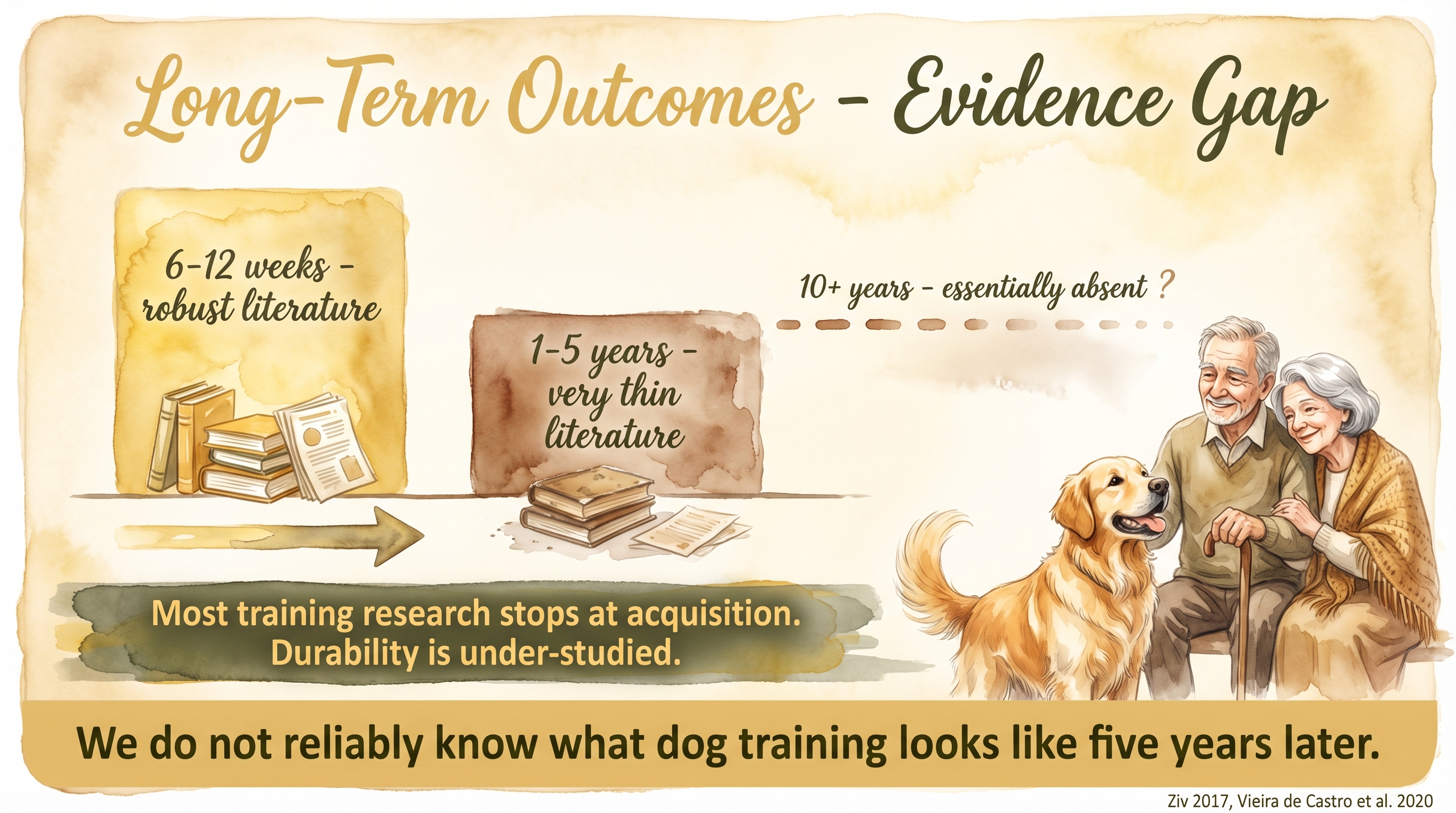
We do not reliably know what dog training looks like five years later.
Key Takeaways
- The field knows far more about short-term task performance and acute welfare than about multi-year behavioral and relational outcomes.
- Several high-value questions families care about most are still poorly measured or completely unmeasured.
- This gap constrains trainer marketing claims and JB philosophical claims alike.
- In the absence of strong long-term evidence, households should favor approaches they can sustain calmly across years rather than dramatic short-term promises.
The Evidence
This entry uses observed claim-level tags beyond the dedicated EvidenceBlocks below. These tags mark JB program observation or practice-derived claims that need dedicated EvidenceBlock coverage in a later content pass.
This entry uses ambiguous claim-level tags beyond the dedicated EvidenceBlocks below. These tags mark claims where the literature remains unsettled or multiple interpretations coexist.
- companion dogs
Explicitly identifies long-term behavioral maintenance as one of the literature's thinnest areas and notes the absence of multi-year developmental measures. - companion dogs
Shows that compliance decay, dropout, and transfer problems complicate any simple assumption that short-term training success predicts long-term outcome. - Casey et al. (2024) as synthesized in the notebookscompanion dogs
Provides one of the few longer follow-up datasets, yet still remains limited to owner-reported patterns over about twelve months. - Puppy-class follow-up studies such as Seksel (1999), Duxbury (2003), and Gonzalez-Martinez (2019)companion dogs
Offer partial later-life glimpses without constituting a full long-term comparative science of methods.
- domestic dogs
No single dataset directly resolves the full population picture for the long-term training outcomes evidence gap without the usual survey, sampling, and threshold limitations.
SCR References
Sources
- Demant, H., Ladewig, J., Balsby, T. J. S., & Dabelsteen, T. (2011). Applied Animal Behaviour Science.
- Seksel, K., Mazurski, E. J., & Taylor, A. (1999). Applied Animal Behaviour Science.
- Duxbury, M. M., Jackson, J. A., Line, S. W., & Anderson, R. K. (2003). Evaluation of association between retention in the home and attendance at puppy socialization classes. JAVMA, 223(1), 61-66.
- Casey, R. A., Foret, C., Rooney, N. J., & Sherwin, C. (2024). Longitudinal associations between training methods and problem behavior in companion dogs. Applied Animal Behaviour Science. Exact volume/pages should be checked in a future citation housekeeping pass.
- Seksel, K., Mazurski, E. J., & Taylor, A. (1999). Puppy socialisation programs: Short and long term behavioural effects. Applied Animal Behaviour Science, 62(4), 335-349.
- Duxbury, M. M., Jackson, J. A., Line, S. W., & Anderson, R. K. (2003). Evaluation of association between retention in the home and attendance at puppy socialization classes. JAVMA, 223(1), 61-66.
- Gonzalez-Martinez et al. (2019) puppy-class follow-up literature.