Training and Dog Retention in the Home
The most meaningful outcome for a companion dog is not whether it passed a class. It is whether it stayed in its home and functioned as a family member over time. Training enters that question because behavior problems are among the most common reasons dogs are relinquished, returned, or informally rehomed. Salman et al. 2000, using shelter data from twelve U.S. shelters and 1,984 relinquished dogs, found that 40 percent of surrendered dogs had at least one behavioral reason attached to the decision. Patronek et al. 1996 reported that about 96 percent of relinquished dogs in their sample had received no obedience training. Lambert et al. 2015 reviewed the relinquishment literature and found behavior problems cited in roughly 10.8 to 34.2 percent of surrenders across studies. Kisley et al. 2024 found behavioral issues listed in 28 percent of more than 2,800 U.S. shelter records. Those are sobering numbers, but they do not prove a simple causal story that "training prevents surrender." They show that behavior, owner engagement, and retention are tightly linked. Documented
That distinction matters. Owners who attend training classes may already be more attached, better resourced, or more determined to keep the dog. Kwan and Bain 2013 found relinquished dogs were not necessarily less likely to have attended training, even though problem behavior strongly influenced surrender decisions. Powell, Sumpter, Loveridge, and Roney 2025 found no significant overall difference in return rates between trained and untrained adopted dogs, yet the reasons for return differed sharply: trained dogs were more often returned for owner-related reasons, while untrained dogs were more often returned for behavior reasons. Training therefore looks less like a magic shield and more like one strand inside a larger retention system.
JB reads the question from the dog's point of view. Families do not really want "training success" as a separate prize. They want a dog who can remain in the home without becoming socially, emotionally, or behaviorally unmanageable. Retention is the meaningful endpoint because it captures whether the human-dog relationship stayed livable.
That is one reason Prevention sits so centrally in the JB model. The best training outcome is not a dramatic rescue after the home has become unstable. The best outcome is that the behaviors most likely to fracture the placement never gather enough strength to make surrender feel thinkable.
What It Means
Behavior Problems Are Retention Problems
The shelter and relinquishment literature makes one point with unusual consistency: behavior problems are not peripheral inconveniences. They are among the strongest pathways by which dogs lose homes. Salman et al. 2000 listed aggression, destructiveness, disobedience, house soiling, hyperactivity, and excessive barking among the common behavior-related surrender reasons, and many of those relinquishments occurred within the first three months of ownership. That timeline matters. It suggests households are often deciding very early whether life with the dog feels manageable.
Lambert et al. 2015 broadened the evidence by showing substantial variation across studies while still confirming that behavior is a major surrender category. Documented Diesel et al. 2010 described the scale of behavior-related shelter burden in the United Kingdom. Kisley et al. 2024 confirms that behavior remains a major recorded reason in contemporary U.S. shelter records. The field does not need a perfect percentage to make the practical point. Behavior instability regularly translates into loss of placement.
What Training Seems to Protect, and What It Does Not
Patronek et al. 1996 is one of the most frequently cited studies in this area because it identified lack of obedience-class participation as a modifiable risk factor. Documented It is tempting to treat that as proof that classes themselves protect retention. The more careful reading is that training participation may be partly a marker for owner engagement, planning, and persistence. Owners who seek help early may also be the owners willing to tolerate more friction, adapt faster, and invest more in the relationship.
The later literature complicates simple optimism in useful ways. Kwan and Bain 2013 did not find that relinquished dogs were uniformly less likely to have attended training. Powell et al. 2025 found similar overall return rates for trained and untrained adopted dogs, but with very different return reasons. That suggests training may shift the shape of risk rather than erase it. A trained dog may still be returned if the owner's housing, finances, health, or expectations collapse. An untrained dog may more often be returned because behavior itself never became manageable enough to support the bond.
Training Is Only One Piece of Retention
Reading the literature as a whole makes retention look multifactorial. Attachment matters. Household stability matters. Expectations matter. The dog's baseline temperament matters. Behavior problems matter both directly and through their effect on owner stress. Training matters because it can reduce problem behavior, increase owner confidence, and create a sense of agency. It also matters because attending class may signal that the owner sees the dog as a relationship worth investing in.
This is why retention is a broader and more important endpoint than obedience. A dog may learn sits, downs, and place while still being returned because the home cannot manage fear, anxiety, conflict with children, or separation distress. Conversely, a dog may have fairly modest formal skills and still remain securely placed because the household is calm, attached, realistic, and behavior problems never reached a breaking point.
The phrase "behavioral incompatibility" is helpful here because it keeps the analysis honest. Many surrender-triggering behaviors are not signs that the dog is abnormal in a biological sense. They are signs that the dog and the home are failing to mesh at a sustainable level. That mismatch can still end the placement. Recognizing the mismatch early gives the family a better chance to change the home conditions before the relationship starts to feel impossible. Documented
Prevention is retention strategy. If the family prevents the house-soiling, panic, aggression, and chronic dysregulation patterns that most strain attachment, it lowers the odds that the dog ever becomes negotiable.
JB's Retention Reading
JB therefore treats retention as the true practical horizon of dog raising. Heuristic The point is not to produce a dog who performs on cue for social approval. The point is to help produce a dog who can stay in a family system through ordinary stress, developmental stages, guests, travel, children, and the accumulated frustrations that break weaker placements. Training has value inside that goal, but the goal is larger than training.
That is also why the first months matter so much. If the household's early experience is dominated by biting, chaos, pulling, barking, soiling, fear, or constant conflict, the relationship is being taxed before attachment has fully deepened. Prevention in the early window may therefore matter more for retention than later technical polish.
Why It Matters for Your Dog
For your dog, retention is not an abstract welfare statistic. It is the difference between one stable social life and a cascade of disruption. Rehoming is not always catastrophic, but it is always consequential. The dog loses familiar people, routines, cues, sleeping spaces, and expectations. If the surrender is to a shelter, the dog may also lose predictability, social contact quality, and the buffering effects of an ordinary home.
That is why common family-dog problems carry more weight than they first appear to. House soiling is not only mess. Destructiveness is not only damage. Barking is not only noise. Aggression is not only a training challenge. Each of these behaviors places repeated stress on the human side of the relationship. If they pile up quickly enough, they change how the dog is emotionally represented inside the household. Documented The dog is no longer experienced mainly as loved company. The dog becomes associated with strain, embarrassment, conflict, cost, or fear.
Goldens often enter homes with a strong reputational advantage because families expect them to be naturally easy. That helps in one sense, but it also creates a risk. When a Golden is noisy, mouthy, overexcited, separation-distressed, or difficult to settle, the mismatch between expectation and reality can hit hard. Families may feel they did not get the dog they thought they were buying. If early support is weak and behavior rehearsals continue, disappointment can mature into serious retention risk even in a breed known for family appeal.
Training interacts with this in several ways. Good help can reduce owner helplessness. A family that knows how to interrupt rehearsal, manage space, structure greetings, and prevent escalation often feels hope return quickly. That emotional shift matters because owners who feel effective are less likely to start imagining surrender as the only exit. At the same time, the literature warns against assuming that enrollment alone solves the problem. A family can attend classes and still fail to integrate the plan at home. A dog can learn visible skills while the daily relationship remains too strained.
The practical issue is therefore not merely "Did this dog get trained?" It is "Did the home become workable?" A dog retained in the home usually lives in a system where the adults can predict the dog, guide the dog, and recover from rough stretches without the whole relationship feeling unstable. Training contributes to that only when it improves daily life where daily life is actually lived.
This is why retention belongs in family decision-making from the first weeks. Every prevention step that lowers the probability of house soiling, greeting explosions, leash chaos, guarding, panic at separation, or conflict around handling is not only making the dog more pleasant. It is protecting the bond from avoidable corrosion.
When families remember that, everyday management starts to look less petty and more protective. Closing rehearsal pathways early is not about having a tidier house for its own sake. It is about reducing the number of moments that teach the home to feel unsustainable.
The stakes are highest when families are embarrassed to say how stressed they are. Many surrender decisions are preceded by long stretches of private strain. The dog may still be loved, photographed, and publicly described as part of the family while the household privately feels near its limit. By the time the question of keeping the dog is openly discussed, the relationship may already be badly depleted. Early, honest attention to livability matters because it addresses risk before the situation becomes emotionally brittle.
Dogs also benefit when the family stops treating retention as a passive assumption. "Of course we will keep him" is emotionally important, but it becomes more meaningful when paired with active management of the behaviors that most often threaten placement. Hope without structure can still fail under sustained pressure. Hope with prevention, calm, and follow-through has a much better chance of surviving hard seasons.
This is one reason retention should be spoken about before the family feels ashamed. The earlier adults can admit that certain patterns are eroding household goodwill, the more options they have. Waiting until resentment has built for months usually means the dog has been rehearsing the problem for months too. Early honesty keeps the placement flexible enough to save.
There is also a systems lesson here. Some dogs are lost because the home expected a decorative companion and received a social mammal with real needs, arousal patterns, and developmental vulnerabilities. Retention improves when the family stops bargaining with that reality and starts organizing around it. The dog then becomes easier to keep because the humans are no longer asking the impossible from an animal they still say they love.
What This Means for a JB Family
JB families should think in terms of lifetime livability. The question is not whether the dog can impress other people or pass a class certificate. The question is whether the dog can remain easy enough to love during ordinary human stress.
That means paying disproportionate attention to the behaviors that most often fracture placements: house soiling, destructive boredom, chronic overarousal, fearful avoidance, aggression, uncontrolled greetings, and separation-related distress. Prevention is the right lens because it acts before those patterns become expensive emotionally.
It also means using outside training help strategically. Seek support when the goal is to make family life more stable, not merely to collect skills. A trainer is useful if the dog becomes more retainable in the home, not only if the dog looks sharper in a lesson.
Most importantly, keep the relationship central. A retained dog is not simply a trained dog. It is a dog whose behavior, household fit, and emotional bond stayed strong enough that the placement remained unbroken. JB's framework exists for that outcome. The Five Pillars aim to create a dog who is easier to keep, easier to trust, and easier to live with across years rather than across one program.
That broader frame can also calm families during rough periods. A hard month does not mean the placement is doomed. It means the family should refocus on the behaviors most tied to household strain and rebuild steadiness there first. Retention is protected step by step, not by wishful thinking.
Families sometimes need explicit permission to think this way. Retention-focused raising is not cold or transactional. It is loving in a very concrete sense because it takes seriously the behaviors most likely to put the relationship at risk. Protecting the placement is one of the deepest forms of loyalty a household can offer the dog.
It also keeps the family from being distracted by low-value victories. A stylish heel or cute trick matters far less than whether the dog can settle in the house, greet people without chaos, and stay emotionally workable through ordinary stress. The retained dog is the relevant success story.
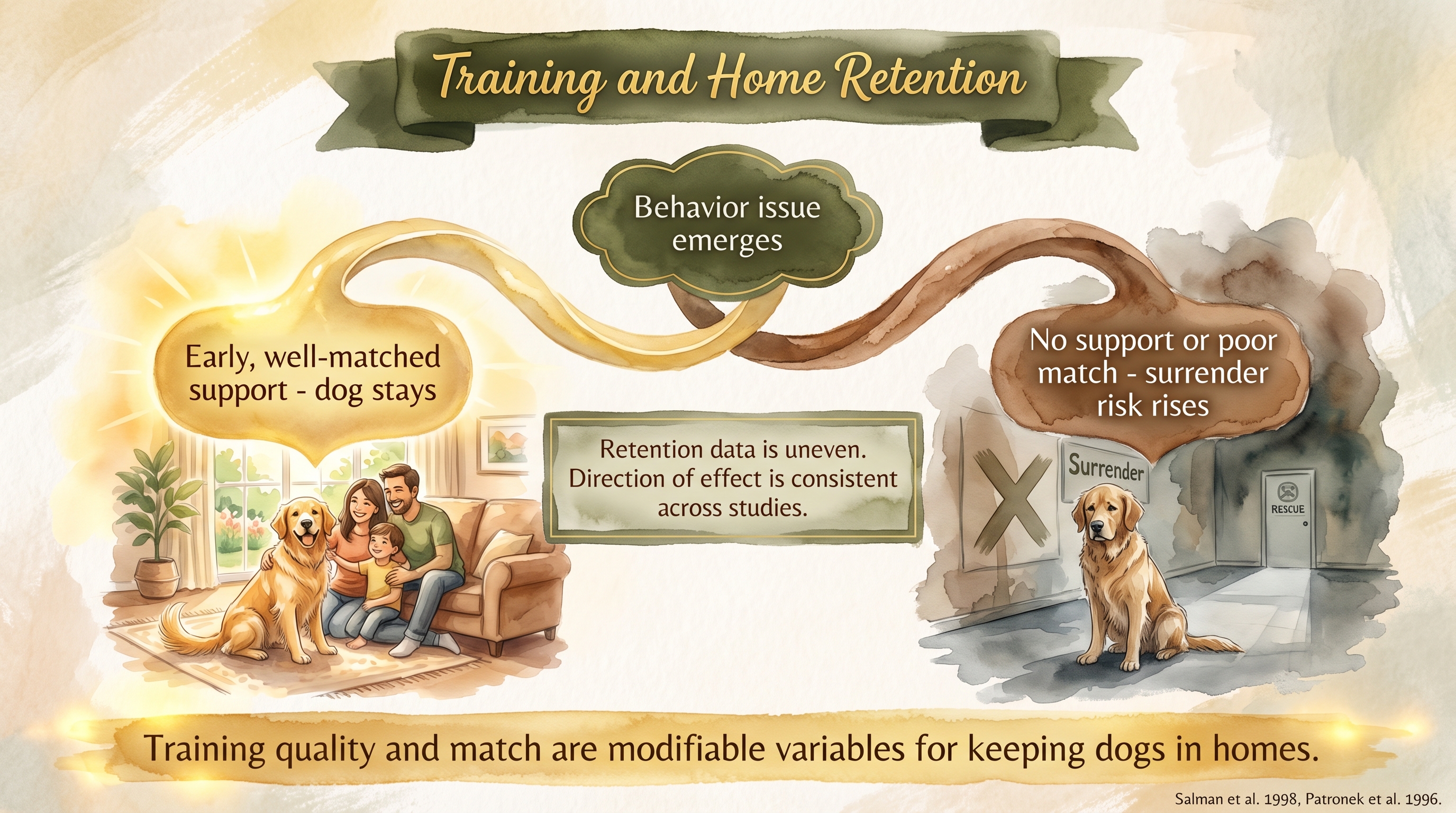
Training quality and match are modifiable variables for keeping dogs in homes.
Key Takeaways
- Behavior problems are among the strongest recurring reasons dogs lose homes.
- Training appears connected to retention, but part of that connection likely reflects owner engagement and household capacity, not classes alone.
- The most meaningful endpoint is whether the dog remains livable in the home over time, not whether it completed a program.
- JB's Prevention pillar should be read partly as a lifetime-placement strategy.
The Evidence
This entry uses heuristic claim-level tags beyond the dedicated EvidenceBlocks below. These tags mark JB interpretive application rather than direct study findings.
- Salman et al. (2000)relinquished dogs
Forty percent of surrendered dogs had at least one behavioral reason attached to relinquishment. - Patronek et al. (1996)dogs relinquished to shelters
Lack of obedience-class participation appeared as a major modifiable risk factor in the sample. - Lambert et al. (2015)surrender literature
Behavior problems were cited in a substantial fraction of relinquishment studies across multiple settings. - Powell et al. (2025) and Kwan and Bain (2013)adopted and relinquished dogs
Show that training status interacts with return reasons and owner characteristics rather than acting as a simple guarantee of retention.
- domestic dogs
No published long-term study directly compares training and dog retention in the home against structured relational raising and no-intervention controls across ordinary companion-dog homes.
SCR References
Sources
- Salman, M. D., et al. (2000). Journal of Applied Animal Welfare Science.
- Patronek, G. J., Glickman, L. T., Beck, A. M., McCabe, G. P., & Ecker, C. (1996). Journal of the American Veterinary Medical Association.
- Lambert, K., Coe, J., Niel, L., Dewey, C., & Sargeant, J. M. (2015). Journal of Applied Animal Welfare Science.
- Kwan, J. Y., & Bain, M. J. (2013). Journal of Applied Animal Welfare Science.
- Kisley, C., et al. (2024). Animals.
- Powell, L., Sumpter, C., Loveridge, M.