The Prevalence of Common Dog Behavior Problems
Common dog behavior problems are not small statistical curiosities. They are a central fact of companion-dog life. The exact prevalence depends on who is asked, how the question is worded, and what counts as a problem, but the broad message is strikingly consistent: a large fraction of owned dogs show at least one behavior pattern their owners experience as difficult or undesirable. Dinwoodie et al. 2019 found at least one reported problem in 85 percent of 4,114 dogs from a U.S. owner survey. Meyer et al. 2023 found at least one behavior problem in 34 percent of a more representative Danish sample of 5,054 dogs. Salonen et al. 2020 found noise sensitivity in 32 percent of more than 13,700 Finnish dogs, along with substantial levels of dog fear, stranger fear, and fear of novel situations. Serpell and Powell's Dog Aging Project analyses found broad prevalence ranges for anxiety, fear, aggression, and separation-related issues in more than 43,000 dogs, with the apparent percentage moving sharply depending on the threshold chosen. Documented
Those numbers are not contradictory once the method differences are understood. A convenience survey filled out by owners already interested in behavior will usually produce higher prevalence than a more representative sample. Observed-JB A study asking whether the dog ever shows a behavior will produce more cases than one asking whether the behavior is moderately serious. A free-text prompt will miss problems that a structured checklist reveals. Brand et al. 2024 showed exactly that, with only 35 percent of owners spontaneously reporting a problem in open-ended text.
So the honest statement is not "X percent of all dogs have problems." The honest statement is that across countries, instruments, and definitions, behavior problems are common enough to be considered normal risks of companion-dog ownership rather than unusual exceptions.
JB reads that prevalence fact as both descriptive and diagnostic. It describes the modern dog population, and it also suggests that current raising patterns are not reliably protecting dogs from the most common forms of behavioral trouble.
What It Means
Prevalence Depends on Definition
One reason prevalence debates become chaotic is that people often compare unlike numbers as if they were direct competitors. Meyer et al. 2023 reported 34 percent with at least one behavior problem in a representative national sample. Estimated Dinwoodie et al. 2019 reported 85 percent in a self-selected survey population. Blackwell et al. 2008 reported a mean of 11.3 undesirable behaviors per dog in another owner-report sample. The Dog Aging Project material initially produced a startling 99.12 percent figure when a very low threshold was used and then fell to much lower ranges when the threshold was tightened. These are not merely statistical squabbles. They show how much the result depends on where the line is drawn.
That matters because a startled bark once a year is not the same phenomenon as severe clinical fear. Mild leash frustration is not the same as dangerous dog-directed aggression. Epidemiology works best when it keeps those severity layers visible.
Fear-Related Behaviors Dominate Many Datasets
Across many studies, fear and anxiety-related behaviors appear especially prevalent. Documented Salonen et al. 2020 reported noise sensitivity in 32 percent of Finnish dogs, fear of other dogs in 17 percent, fear of strangers in 15 percent, and fear of novel situations in 12 percent. Dinwoodie et al. 2019 found fear and anxiety in 72.5 percent of dogs in their survey. Serpell and Powell's analyses of Dog Aging Project data found large but still substantial ranges for anxiety and fear depending on threshold. Blackwell, Bradshaw, and Casey 2013 further showed that owners frequently underrecognize fear, especially in the context of noise sensitivity.
This makes fear-related behavior epidemiologically important even before one reaches specialty-care definitions. A large number of dogs appear to be living with some degree of environmental, social, or noise-related insecurity.
Aggression, Separation Problems, and Everyday Conflict Behaviors
Aggression estimates vary, but they remain meaningful in nearly every major dataset. Dog-directed aggression, stranger-directed aggression, and owner-directed aggression all have different prevalence patterns depending on the instrument used. Documented Separation-related behavior also appears regularly, including the approximately 9.3 percent figure identified in the Dog Aging Project reanalysis noted in the JB source notebook. House soiling, destructiveness, barking, and overexcitability may sound less clinically dramatic, but they recur throughout owner surveys and surrender data because they are the forms of conflict that many families live with most often.
That is why prevalence should not be read through drama alone. Some of the most common problems are not the most dangerous in a narrow sense. They are the most relentless in daily family life.
When a problem is common across populations, adults can make one of two mistakes. They can treat it as destiny, or they can treat it as a warning that prevention deserves more seriousness. JB chooses the second reading.
What the High Numbers Actually Imply
The prevalence picture implies that current companion-dog systems are not reliably delivering behavioral stability at scale. That does not mean every owner is negligent or every problem is preventable. Genetics, illness, trauma, and plain bad luck still matter. It does mean the field should stop talking as if serious behavior issues were rare failures in otherwise healthy systems. They are frequent enough that the systems themselves deserve scrutiny.
That scrutiny includes the training industry, but it does not end there. Housing patterns, isolation from adult dogs, early environment, breeder practices, owner expectations, and the social meaning of the modern pet all likely contribute. Documented Prevalence is therefore not merely a veterinary or trainer statistic. It is a measure of how companion-dog life is currently being organized.
Why It Matters for Your Dog
For a Golden Retriever family, prevalence data changes the emotional posture of raising. Documented If fear, anxiety, overarousal, separation-related behavior, and conflict behaviors are common, then the household should not wait for unmistakable crisis before acting with structure. Many dogs drift into trouble gradually. The early signs are often ordinary enough that families explain them away.
A puppy who struggles to settle after visitors may simply seem social and excited. An adolescent who startles at sounds may seem a little sensitive. A dog who vocalizes when left alone may be called needy. A young dog who barks frantically at the window may be described as protective. Prevalence data encourages a different response. These are not always trivial quirks. They are recognizable pathways into some of the most common behavior problems recorded across large populations.
This matters because common problems usually become expensive through repetition rather than through sudden catastrophe. Destructiveness strains patience. Barking strains relationships with neighbors. House soiling erodes tolerance indoors. Fear of strangers makes routine social life harder. Dog-directed tension turns walks into constant management. Separation-related distress narrows the family's freedom. None of these needs to be spectacular to become deeply consequential.
Goldens are not exempt. Their public reputation for friendliness can obscure the fact that they can still become noise-sensitive, overexcited, separation-distressed, rough in greetings, or socially worried in adolescence if their early environment and later household rhythm are not protective. Families sometimes read breed reputation as an assurance policy. Epidemiology is a reminder that reputation shifts probability, not reality.
The prevalence picture also helps households set priorities. If fear and anxiety are especially common, then building a calm nervous system and good recovery matters. If owner-reported aggression is not rare, then frustration, social overwhelm, and rough handling deserve early caution. If common nuisance behaviors are among the most likely to threaten retention, then house manners and regulation are not lesser goals compared with flashy obedience.
This is one place where a population-level map genuinely improves one dog's life. The family no longer has to guess which behavioral failures are plausible. The field has already shown where trouble tends to cluster. A thoughtful home can then act early on those pressure points.
There is also emotional relief in seeing that common does not mean shameful. Families with a struggling dog often feel isolated, as if they are uniquely failing. Prevalence data says otherwise. The dog may still need serious attention, but the family is not alone and the problem is not absurdly rare.
At the same time, common should not become complacent. "Lots of dogs do this" is not the same as "this will sort itself out." Because these problems are common, they deserve earlier and more deliberate responses, not less. Epidemiology helps when it turns normalization into preparation rather than into excuse.
That is especially true in the first year. A problem that is widespread at population level can still be small enough in one puppy to reshape gently if the family notices it early. Once the pattern has months of rehearsal behind it, the household is no longer preventing a risk. It is unwinding a practiced identity.
The same data also helps families choose where not to waste energy. If fear and anxiety dominate many surveys, then building recovery and calmness deserves more attention than polishing flashy obedience in a dog whose nervous system is still chronically unsettled. If overarousal-related problems show up everywhere, then preventing rehearsal at doors, windows, and greetings may matter more than adding more stimulation in hopes that the dog will become tired enough to be easier.
Prevalence also helps families read nuisance behaviors with proper seriousness. Excessive barking, poor settling, or chronic destructiveness may not sound as dramatic as aggression, but because they are common and relentless they often do enormous relational damage over time. A population lens helps adults see those issues as retention risks rather than as mere annoyances.
It also helps families understand why certain kinds of advice feel disproportionately useful. Advice that reduces rehearsed arousal, lowers fear load, protects sleep, simplifies daily structure, and builds calmer social behavior is not merely philosophically attractive. It is aimed at exactly the zones where the epidemiology says trouble is densest.
That recognition can save families from spending energy on low-priority polish while the bigger population risks remain active. A dog who can perform a cue beautifully and still cannot recover from sound, settle after excitement, or tolerate separation is still sitting close to the same prevalence clusters the literature keeps finding. The smartest homes learn to solve for those clusters first.
What This Means for a JB Family
JB families should read prevalence data as motivation for seriousness without panic. Many companion dogs develop exactly the kinds of behavior problems JB is trying to prevent. That makes early calm structure, mentorship, and prevention feel less optional and more humane.
It also means that apparently small issues deserve clear eyes. Difficulty settling, noise startle, rough greetings, growing avoidance, and escalating leash chaos are worth attention because they sit on pathways the literature sees repeatedly.
The right response is not to become hypervigilant or to pathologize every puppy fluctuation. The right response is to create a home where the common risks have less room to root. That is a quieter and steadier goal than trying to out-train a problem after it has matured.
In that sense, prevalence data supports the JB worldview without proving every philosophical layer of it. The modern dog population is carrying a large load of behavior trouble. JB's answer is to move the intervention earlier, make it more relational, and treat calmness and prevention as household architecture rather than as emergency repair.
A family that keeps that in mind will often make better daily decisions. It will not be shocked by common risks, and it will not casually rehearse them either.
That shift in timing may be the most practical value of the whole literature. Once families understand that many behavior problems are common at scale, they can stop waiting for certainty before acting on early signs. Prevention becomes easier because the household no longer needs to be convinced that the risk is real.
It also makes the family's standards more compassionate. If the culture around dogs keeps producing common trouble, then a household that chooses to raise differently is not being severe. It is trying to spare one dog from becoming a very ordinary statistic.
That is the JB use of prevalence at its best. Not panic, not stigma, not deterministic prediction. Just a clear enough view of the landscape that adults become harder to surprise and more willing to protect the dog early.
The point is not to obsess over risk. It is to make calm, relational, preventive raising feel proportionate to the scale of the problem the field is already documenting. Once the population map is visible, JB's emphasis on early structure starts to look less eccentric and more humane.
That alone has value.
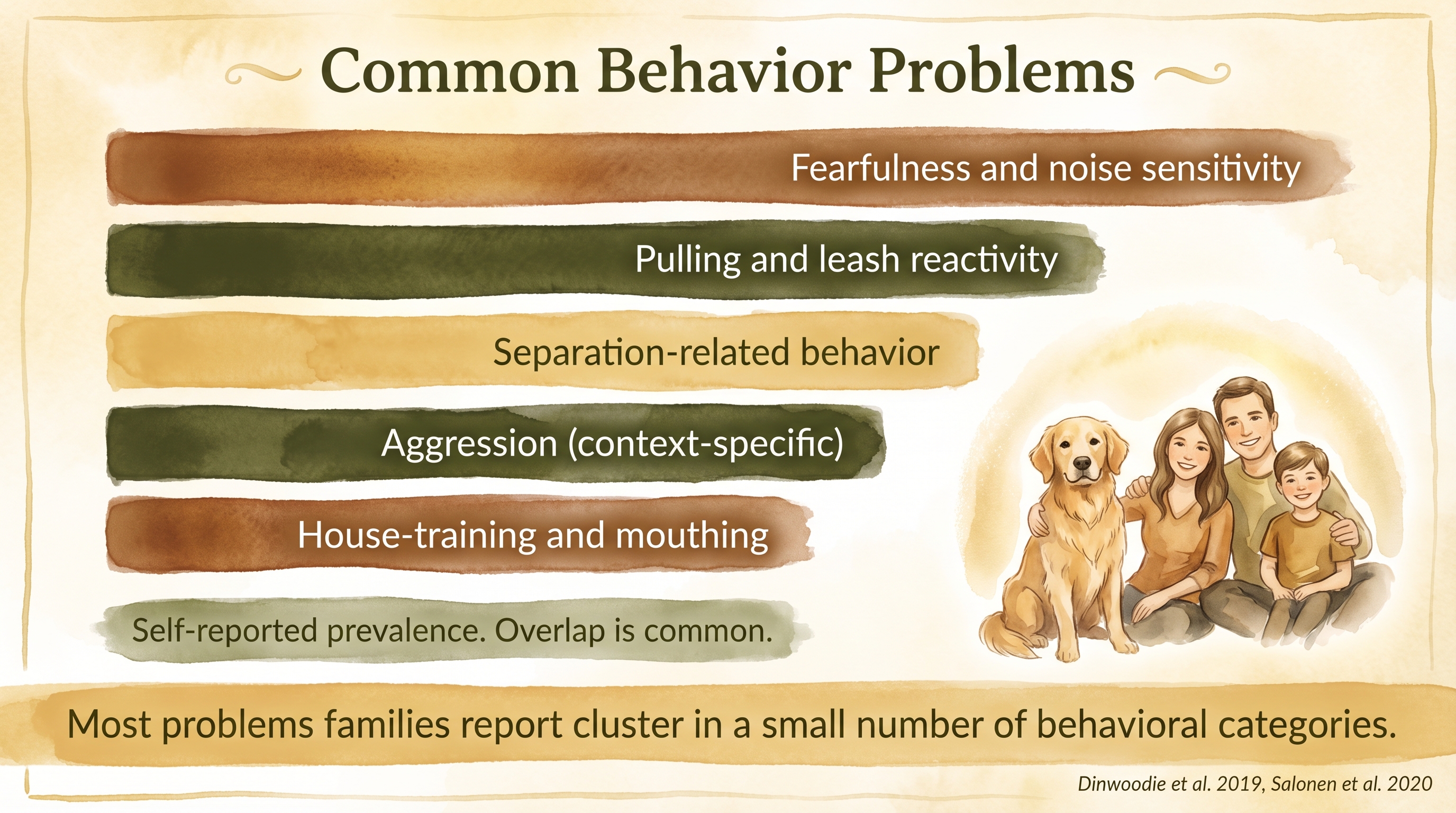
Most problems families report cluster in a small number of behavioral categories.
Key Takeaways
- There is no single universal prevalence percentage because surveys ask different questions and define problems differently.
- Fear, anxiety, aggression-related behavior, separation problems, and everyday household conflict behaviors are all common enough to matter at population scale.
- Common does not mean trivial, and common does not mean inevitable.
- JB reads the prevalence picture as a reason to intervene earlier through raising, not merely later through technical training.
The Evidence
This entry uses observed claim-level tags beyond the dedicated EvidenceBlocks below. These tags mark JB program observation or practice-derived claims that need dedicated EvidenceBlock coverage in a later content pass.
This entry uses estimated claim-level tags beyond the dedicated EvidenceBlocks below. These tags mark approximate ranges or timing claims that should remain bounded by the cited sources.
- Meyer et al. (2023)owned dogs in Denmark
Reported at least one behavior problem in 34 percent of a representative sample. - Dinwoodie et al. (2019)owned dogs in the United States
Reported at least one behavior problem in 85 percent of dogs in an owner-completed online survey. - Salonen et al. (2020)Finnish companion dogs
Found high prevalence of noise sensitivity and multiple other fear-related traits across a very large sample. - Brand et al. (2024) and Dog Aging Project analysescompanion dogs
Show that prevalence shifts dramatically with prompt design and severity threshold, even when the overall signal remains large.
- domestic dogs
No single dataset directly resolves the full population picture for the prevalence of common dog behavior problems without the usual survey, sampling, and threshold limitations.
SCR References
Sources
- Brand 2024 plus Dog Aging Project literature supports prevalence sensitivity to survey design and measurement method. The local Serpell & Powell 2024/2025 shorthand is superseded by Beaver et al. (2024), Journal of Veterinary Behavior, 74, 1-9, and Serpell & Powell (2026), Journal of Veterinary Behavior, 83, 61-67.
- Dinwoodie, I. R., Dwyer, B., Zottola, V., Gleason, D., & Dodman, N. H. (2019). Demographics and comorbidity of behavior problems in dogs. Journal of Veterinary Behavior, 32, 62-71.
- Meyer, I., Forkman, B., Lund, T. B., & Sandoe, P. (2023). Behavior problems in dogs: An assessment of prevalence and risk factors based on responses from a representative sample of Danish owners. Journal of Veterinary Behavior, 61, 33-41.
- Salonen, M., Sulkama, S., Mikkola, S., Tenhunen, J., Hakanen, E., Tiira, K., Arata, S., & Lohi, H. (2020). Prevalence, comorbidity, and breed differences in canine anxiety in 13,700 Finnish pet dogs. Scientific Reports, 10, 2962.