Surrender and Rehoming Data: What Behavior Problems Cost
Behavior problems do not stay inside the behavior column. At population scale, they help determine whether dogs keep homes, enter shelters, get returned after adoption, or are euthanized because the social fit around them collapses. U.S. shelter systems take in millions of dogs in a typical year, and behavior remains one of the recurring reasons behind owner surrender and post-adoption return. Salman et al. 2000, using twelve shelters and 1,984 relinquished dogs, found that 40 percent had at least one behavioral reason attached to surrender. Lambert et al. 2015 found behavior problems cited in roughly 10.8 to 34.2 percent of relinquishment studies. Kisley et al. 2024 reported behavioral issues in 28 percent of more than 2,800 U.S. shelter records. Diesel et al. 2010 described a large behavior-related shelter burden in the United Kingdom. These are not identical metrics, but they converge on a hard point: behavior problems cost dogs homes. Documented
The reasons look familiar to anyone who has lived with a struggling dog. Aggression, destructiveness, house soiling, excessive barking, hyperactivity, escape behavior, and separation-related distress appear repeatedly in surrender data. Documented Shore 2005 also found that many returns happen quickly, with nearly half occurring within fourteen days in the sample reviewed. That tells us some family-dog mismatches become acute almost immediately.
Rehoming outside formal shelters matters too. Not every dog who leaves a home enters a public shelter. Some are passed quietly to relatives, rescues, neighbors, or breed networks. That means official surrender data likely understates the true behavioral cost of failed placement.
JB reads this literature morally as well as statistically. A behavior problem is not just an inconvenience if it is one of the roads by which a dog loses its family. Retention is measured in lives, attachments, and social worlds, not merely in training outcomes.
What It Means
Behavior Is a Recurrent Surrender Driver
Across decades of shelter literature, behavior keeps reappearing as a major cause of relinquishment. Documented Salman et al. 2000 remains important because it gives a multi-shelter picture of common behavior-linked reasons: aggression, destructiveness, disobedience, house soiling, hyperactivity, and excessive barking. Lambert et al. 2015 then shows that although percentages vary by study design and setting, the general finding survives. Kisley et al. 2024 shows that the pattern remains current in more recent shelter records.
One useful conceptual move in the JB notebook is Patronek, Bradley, and Marder 2021's phrase "behavioral incompatibility." Many surrender-triggering behaviors are species-typical behaviors occurring in the wrong home, at the wrong intensity, or without enough support. That does not make them harmless. It does change how the field should think about cause.
The Timeline Can Be Short
Many relinquishment decisions build over months, but some happen quickly. Shore 2005 reported that nearly half of returns occurred within fourteen days, and the source notebook notes that many families who relinquished for behavior reasons observed the problem within the first twenty-four hours. Documented This is a crucial insight. It means some surrender pathways are not the endpoint of years of deterioration. They begin with a bad fit, unrealistic expectations, or an immediately unmanageable behavior pattern.
That in turn makes prevention and expectation-setting more important. If the first days are emotionally decisive, then early household support matters enormously.
Surrender Data Understates the Full Cost
Formal shelter relinquishment is only the visible part of the phenomenon. Many dogs are rehomed privately. Some are passed through rescue groups. Some are returned to breeders. Some move through informal networks precisely because owners want to avoid the moral weight of "taking the dog to a shelter." Epidemiologically, that means the true population burden of behavior-related placement failure is larger than the shelter intake numbers alone suggest. Documented
The return literature sharpens another point: post-adoption support matters. Powell et al. 2025 found that trained and untrained adopted dogs had similar overall return rates, but very different return reasons. That suggests behavior problems may influence the path of return even when they do not wholly determine the frequency.
It also suggests that "keeping the dog" is not one simple endpoint. Some families can tolerate a great deal of behavior friction because housing, attachment, finances, and expectations all still hold. Others are structurally more fragile. Behavioral epidemiology has to keep that human side in view because the same dog problem lands differently depending on the home's margin for strain.
That does not reduce the dog's burden. It clarifies why prevention and support must be broad. The goal is not only to create a more skilled dog. It is to create a home-dog fit sturdy enough to survive ordinary life pressures before those pressures recruit behavior into the argument.
It also reminds professionals to think beyond the dog alone. A behavior problem inside a high-support home is not the same emergency it becomes inside a family already under housing, money, childcare, or health stress. If support is going to protect placements, it has to be realistic about the whole system carrying the dog.
Once a dog is in the home, prevention is not abstract philosophy. It is protection of the placement itself. The fewer rehearsed problems that gather force, the fewer reasons a family has to imagine life without the dog.
Why the Data Is So Serious
The surrender literature is serious because the endpoint is serious. A returned dog may face shelter stress, reduced social stability, uncertain future placement, and in some settings higher euthanasia risk. Historically, behavior-surrendered dogs have often fared worse than dogs surrendered for purely logistical or medical reasons because the receiving system must solve not only placement but safety and manageability.
That is why "behavior problem" should never be heard as a cosmetic phrase. In a population system, it names one of the main routes by which a dog stops being securely owned.
Why It Matters for Your Dog
For an individual dog, surrender and rehoming data puts emotional weight under ordinary household decisions. A barking problem, a destructive phase, fear around guests, rough child interactions, or escalating dog-directed aggression does not instantly mean a dog is at risk of losing the home. It does mean the family is standing in the same terrain that many failed placements have crossed.
That matters because behavior problems often become surrender drivers by accumulation. Observed-JB No single day seems decisive. The dog chews another object, soils inside again, panics when left, startles and snaps, drags a child, or barks through the evening. Each event is survivable. Months later the household is exhausted, tense, and privately wondering how long this can continue. By the time surrender is being discussed openly, the dog's behavior has often been reshaping the emotional climate of the home for a long time.
Goldens carry a special kind of risk here because their breed reputation encourages optimistic underreaction. Families may tolerate chaotic greetings, rough mouthing, overattachment, or destructive loneliness longer because they still see the dog as sweet and lovable. That generosity is admirable, but it can also delay decisive prevention. The dog's friendliness does not neutralize the stress the household is accumulating.
The data also helps explain why early support matters so much after placement. If some return trajectories begin almost immediately, then the first weeks are not merely an orientation period. They are a high-stakes attachment period. A family that gets help quickly, structures the environment, prevents rehearsals, and normalizes asking for support may protect the bond before it becomes brittle.
This is another reason training should be judged by retention value rather than by showmanship. A program that slightly improves a sit but does not reduce the behaviors that threaten placement has not done the most important work. The real question is whether family life is becoming more stable, more predictable, and less emotionally expensive.
Dogs themselves pay the cost when that does not happen. Even a successful private rehome can fracture attachment, routine, and social continuity. A shelter surrender can be much harsher. The literature therefore encourages an unromantic but compassionate reading of prevention: reducing behavior risk is part of reducing the chance that the dog ever has to absorb those losses.
Families should also understand that shame often delays intervention. Owners may feel disloyal admitting that they are struggling. They may hide the severity of the problem from friends, breeders, or professionals until they are very near a breaking point. Surrender data should be read partly as a warning against that silence. Behavioral strain is common enough that early honesty is an act of protection, not betrayal.
This is one reason a good breeder-family relationship matters so much. If the owner knows support is available without condemnation, the household has more chances to stabilize before the placement question gets dangerously real. Data about surrender is not just about what went wrong. It is also about where a rescue path might have existed earlier.
That early rescue path is often ordinary rather than dramatic. A simpler daily routine, better confinement management, clearer greeting boundaries, earlier veterinary evaluation, and more realistic family expectations can all lower the emotional temperature of the home. The dog does not need a miracle every time. Sometimes the difference between retention and surrender is whether the family got realistic support before exhaustion turned into conclusion.
The more families understand that, the less likely they are to read mounting strain as private shame. Shame isolates. Support distributes the load. The dog benefits whenever adults reach for support before the placement question hardens into a decision.
This is especially true with rehoming whispers. By the time a family starts floating the idea indirectly to friends or relatives, the emotional break may already be half made. Earlier support is valuable because it gives the home another story to live inside before that internal break becomes final.
That alternative story often begins with very unromantic work. Sleep gets protected. Management becomes tighter. Guests are handled differently. Expectations for novelty, freedom, and constant social access are lowered. The dog is not suddenly easy, but the household becomes less overwhelmed. Many placements are saved in that unglamorous middle before crisis language takes over.
Families who understand surrender data early often become much more willing to value quiet correction over dramatic rescue. They stop waiting for spectacular proof that the dog is better and start respecting smaller signs that the placement is becoming less strained. Lower tension at bedtime, fewer explosive greetings, more confidence about confinement, and fewer arguments between adults about what to do next all matter because they mark a home that is becoming livable again.
What This Means for a JB Family
JB families should treat retention as sacred in practical terms, not only sentimental terms. Love for the dog matters, but so do the concrete routines that keep behavior from slowly poisoning that love.
That means acting early on the behaviors most associated with surrender: aggression, house soiling, destructive coping, noise conflict, separation distress, uncontrolled greetings, and chronic overarousal. These are not peripheral manners. They are placement variables.
It also means keeping communication open. A family under strain should ask for help before the idea of rehoming has become emotionally settled. Prevention works best while the bond is still strong and the household still believes change is plausible.
For JB, this is one of the clearest reasons dog raising matters morally. A stable, well-raised dog is easier to keep. An easier-to-keep dog is more likely to remain inside one loving social world for life.
That is a high standard, but it is also the humane one. The behavioral epidemiology of surrender says the stakes are already high whether families speak about them in those terms or not.
Seen this way, retention work is not grim. It is hopeful. It assumes the dog is worth organizing life around early enough that the relationship never has to become negotiable at all.
That hope is practical rather than sentimental. It lives in management, honesty, support, and prevention. Those ordinary actions are often what keep a dog's social world from breaking apart.
For JB families, that is the real moral horizon of dog raising. A well-kept placement is not an administrative success. It is a life protected from unnecessary rupture.
That is why surrender data belongs in a category about industry and evidence, not only in shelter policy discussions. It tells families what is at stake if behavior is treated as a nuisance until it becomes a fracture.
It also reminds adults that many broken placements were ordinary homes before they were crisis cases. Reading the literature early is one way of keeping a preventable fracture from becoming part of your own story.
That is practical mercy in family form.
It is also worth defending before desperation rewrites the bond.
Early and plainly.
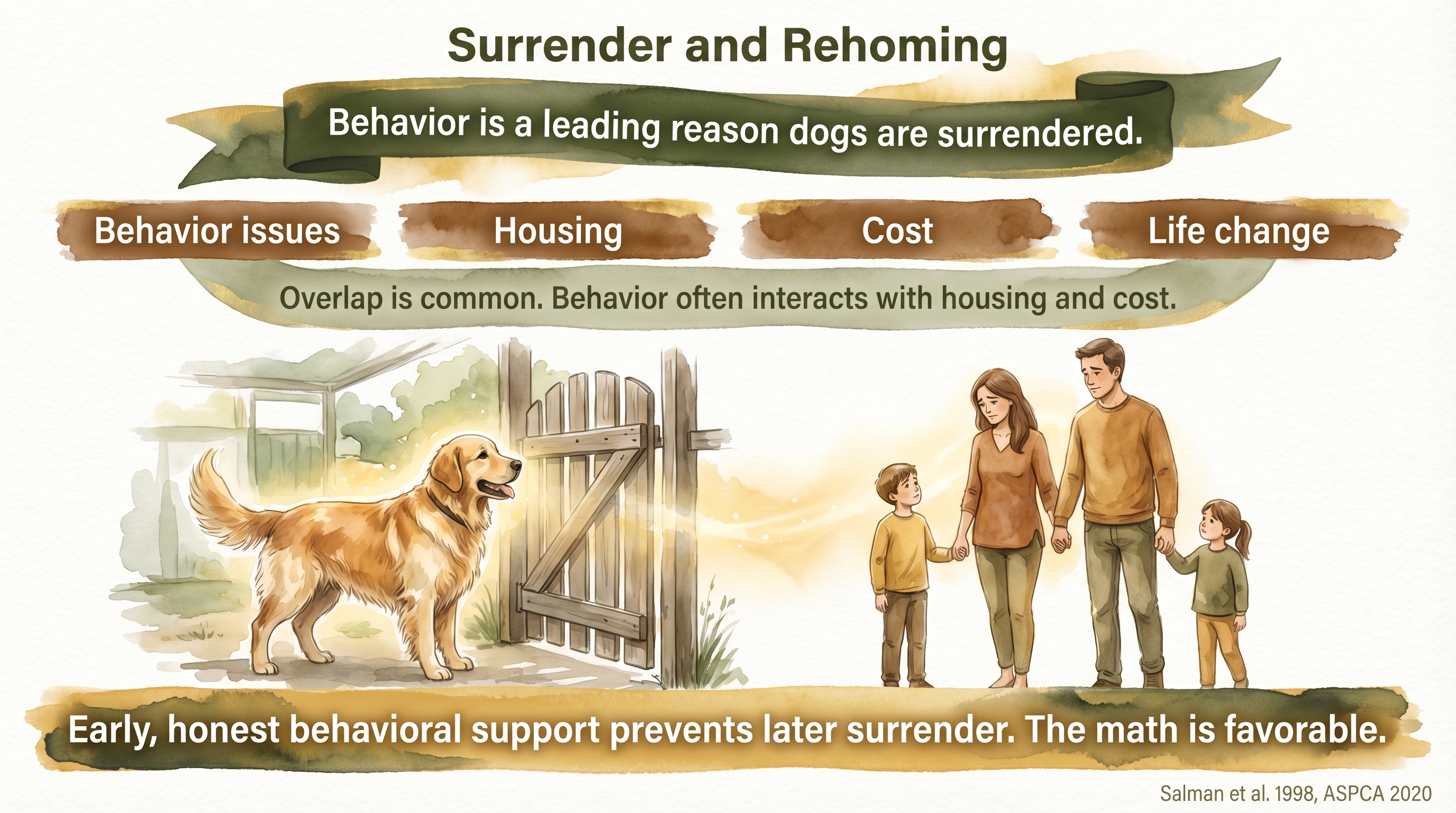
Early, honest behavioral support prevents later surrender - the math is favorable.
Key Takeaways
- Behavior problems regularly cost dogs homes through surrender, return, or quieter forms of rehoming.
- The official shelter data likely understates the true population burden because many dogs are rehomed informally.
- The behaviors that threaten placement are often ordinary household conflicts repeated over time rather than only dramatic crises.
- JB treats prevention as attachment protection: reduce the behaviors that make keeping the dog feel untenable.
The Evidence
This entry uses observed claim-level tags beyond the dedicated EvidenceBlocks below. These tags mark JB program observation or practice-derived claims that need dedicated EvidenceBlock coverage in a later content pass.
- Salman et al. (2000)relinquished dogs
Found that 40 percent of surrendered dogs had at least one behavioral reason for relinquishment. - Lambert et al. (2015)surrender literature
Reported that behavior problems appeared in a substantial fraction of relinquishment studies across settings. - Kisley et al. (2024)shelter records
Found behavioral issues recorded in 28 percent of a contemporary U.S. shelter sample. - Shore (2005) and Powell et al. (2025)returned and adopted dogs
Showed that return pathways can begin quickly and that behavior shapes reasons for return even when total return rates are similar.
- domestic dogs
No published study directly isolates the long-term dog-level and family-level effects of surrender and rehoming data: what behavior problems cost across ordinary companion-dog contexts.
SCR References
Sources
- Kisley et al. (2024). Reasons for owner relinquishment of companion animals to an open-admission shelter. Animals. Exact volume/article metadata should be checked in a future citation housekeeping pass.
- Lambert, K., Coe, J., Niel, L., Dewey, C., & Sargeant, J. M. (2015). A systematic review and meta-analysis of the proportion of dogs surrendered for dog-related and owner-related reasons. Preventive Veterinary Medicine, 118(1), 148-160.
- Salman, M. D., Hutchison, J., Ruch-Gallie, R., Kogan, L., New, J. C., Kass, P. H., & Scarlett, J. M. (2000). Behavioral reasons for relinquishment of dogs and cats to 12 shelters. Journal of Applied Animal Welfare Science, 3(2), 93-106.
- Shore, E. R. (2005). Returning a recently adopted companion animal: Adopters' reasons for and reactions to the failed adoption experience. Journal of Applied Animal Welfare Science, 8(3), 187-198.
- Powell, L., Sumpter, D., Loveridge, A., & Roney, L. (2025). Investigating the relationship between canine training classes and post-adoption return rates in North American shelters. Applied Animal Behaviour Science, 275, 106297.