The Industry of Behavior Problems
Compound evidence detail1 SCR / 2 parts
- Documentedthe structural absence of an industry-wide standardized canine behavioral outcome measurement and reporting system, supported by Hsu and Serpell 2003 (C-BARQ instrument), Lamb 2018 (LAIR clinician-overestimate finding), Mills 2020 (LCAS validation), Wright 2012 (DIAS validation), Daniels 2022 (UK client-rated equivalence regardless of method), and the IAABC Foundation Journal 2023 review of informal-assessment dependence
- Heuristicthe JB framing comparing the dog-training industry's outcome-measurement vacuum to adjacent helping professions (veterinary medicine, human psychology, education) where outcome measurement is regulatorily mandated or conventionally standardized, with the qualifier that the structural claim concerns industry-scale practice and does not deny that individual trainers measure outcomes in their own work
This entry carries the most interpretive claim in the whole history set, so the evidence line matters. The documented pieces are clear enough: dog training in the United States is an unregulated profession, credentialing varies widely, owner help-seeking is often reactive, and the industry has limited standardized outcome measurement. What JB adds is a structural reading of those facts. JB reads the modern dog-training market as organized primarily around problems that are already visible, billable, and urgent. That is a philosophical interpretation of the structure, not a claim that trainers cause those problems or behave in bad faith. Heuristic
The source layer supplies the scaffolding for that interpretation. Browne and colleagues in 2024 found that only 5 percent of surveyed US owners used a professional trainer for behavior concerns, while 60 percent sought advice online or from friends and family first. The same source document catalogs certification fees, course tuition, referral systems, board-and-train business models, and a profession with no common licensure floor. It also notes that formal behavioral outcome measurement remains limited, with the IAABC Foundation Journal describing ordinary practice as relying largely on informal observation rather than standardized baseline and progress instruments. Those are documented facts. The inference that the system is structurally reactive is JB's reading of them. Documented
Why does that matter? Because JB is not a training program but a raising program. If many common family-dog problems are heavily shaped by the early developmental environment, then a market built mainly to intervene after those problems appear will always be downstream of the place where much of the real leverage lives. That claim should stay in heuristic voice, and JB means it that way. It is a way of understanding the system, not a published experiment proving that a prevention-centered breeder model would eliminate demand for training services at population scale. Heuristic
What It Means
What Is Documented About the Structure
The modern dog-training field is plainly organized around intervention. Families seek help when the dog is pulling, guarding, barking, lunging, panicking, biting, or behaving in ways that have become costly inside daily life. The source document repeatedly shows this orientation. Browne et al. describe owners turning to help sources after concerns arise. The certification landscape is organized around people selling knowledge, courses, memberships, exams, consultations, classes, or behavior work. CCPDT charges exam fees. IAABC charges application fees. KPA runs a structured paid training program. Board-and-train businesses take possession of dogs for intensive intervention. None of those facts is a criticism by itself. They are how the field operates.
The same document also identifies a second fact: no shared outcome system exists that would tell the profession, at scale, which interventions generate the most durable family-level results. The IAABC Foundation Journal's 2023 review notes that formal behavior assessment tools for pet dogs in homes remain limited. Documented SCR-177 captures the implication. If measurement is weak, the field has limited ability to distinguish success from satisfaction, novelty, or temporary suppression.
Why Prevention Is Structurally Different
Preventive work looks different economically and culturally. Prevention often happens before a dog is visibly failing. It is quiet, ordinary, and harder to market because there is no crisis image attached to it. Families do not usually search frantically for a trainer because their puppy has calmly learned household rhythm, tolerated frustration well, and moved through transitions with increasing maturity. They search when the dog is already hard to live with.
That difference matters to the JB reading. A profession can be full of decent people and still be arranged around late-stage demand. Medicine is full of good doctors even though preventive care is often less funded than acute intervention. Education is full of good teachers even though remediation frequently gets clearer institutional pathways than upstream family support. The analogy is structural, not moral. JB places dog training inside that same kind of asymmetry.
What the Source Layer Shows About Reactivity
Several documented features reinforce this reading. The profession is unregulated in the United States. Families cannot rely on a universal standard that would direct them early into one coherent prevention model. Cavalli and Fenwick's 2025 survey found 138 training programs and 39 exam-based certifications, with a third of trainers self-educated. DeLeeuw and Williams in 2026 described a field split by ethical frameworks and evidentiary loyalties. Browne et al. showed that owners often look first to the internet, friends, and family, not to a prevention system built into puppy acquisition.
Taken together, those facts describe a market that becomes most visible once problems are already behaviorally or emotionally legible. The stronger JB inference is that this is not accidental. It is how the structure has evolved to meet demand.
What JB Is and Is Not Claiming
This is the point where slippage matters most. JB is not claiming that trainers create behavior problems on purpose. JB is not claiming that training services are useless. JB is not claiming that every problem could have been prevented by any breeder, any family, or any philosophy. Those statements would outrun the evidence and would turn a structural interpretation into a moral accusation.
What JB is claiming, in explicitly heuristic voice, is narrower. The current industry is mostly paid to appear after problems are present. It has few mechanisms for rewarding breeder-level prevention, family-level developmental scaffolding, or calm early raising that reduces future case demand. Heuristic A market can be sincerely helpful and still be downstream.
Why This Matters Historically
This is why the history section closes here. The rise of the dog-training profession can be read as more than the appearance of new methods. JB reads it as the historical moment when ordinary dog raising was increasingly translated into a technical service category. Once that translation happens, social immaturity, overarousal, poor boundaries, dependency, and household chaos begin to look like specialist referral material rather than like failures of early developmental environment.
That reading remains heuristic. Yet it fits the pattern the category has been tracing from Most and Koehler, through behaviorism and the positive revolution, into fragmentation, social media, and credential patchworks. The public keeps being taught to ask which intervention works best. JB keeps asking what kind of life produces fewer interventions in the first place.
JB reads the industry's reactive structure as a reason to move work earlier, not as a reason to disparage trainers. Prevention is not hostility to treatment. It is an attempt to need less treatment later.
Why It Matters for Your Dog
For a Golden Retriever family, this history matters because it changes when you start thinking about behavior. In the reactive market, behavior enters the conversation when the dog is already pulling hard, jumping on children, shredding the house when left alone, frantic at the door, or unraveling in adolescence. The family then feels pressure to find the right expert, the right tool, or the right camp. That is understandable. It is also late.
JB's concern is not that late help is bad. Many families need it, and many trainers do excellent work there. The concern is that if you only start thinking seriously at the crisis stage, you have already given months of developmental time to habits, emotional states, and household routines that were shaping the dog every day. Goldens are forgiving enough that families often do not notice the drift until the puppy is large, strong, and socially practiced in the wrong patterns.
A familiar example is the "friendly" Golden who has never been taught how to be calm around people. For months the household rewards full-body excitement, chaotic greetings, overhandling, and constant stimulation because the puppy looks happy and social. At ten months the same dog is bowling over visitors, screaming on leash, and unable to settle when the house is active. The reactive market now names a behavior problem. JB says the more important story started much earlier, in the way excitement was cultivated as normal life.
The same thing happens with dependency. A puppy that is constantly entertained, talked to, cuddled through every wobble, and prevented from building quiet self-regulation may later look "suddenly" anxious or clingy. Again, the later behavior help may be useful. JB's point is that the family should notice the developmental runway, not just the runway crash.
This matters because Goldens are the sort of dogs for whom early relational climate counts enormously. They are affiliative, socially observant, and very responsive to household emotion. A home that lives in excitement creates a different dog from a home that lives in calm order. That difference is often bigger than whichever formal technique the family later buys to patch the outcome.
Seeing the industry historically also protects the family from panic spending. When a problem appears, the market offers urgency. Book the package. Book the board-and-train. Start the protocol. Try the specialist. Sometimes that is necessary. But a family who understands the structural story can ask a steadier question first: what daily pattern is this dog living, and what part of it can still be repaired upstream at home?
That question does not solve everything. Genetics, trauma, illness, and plain bad luck exist. It does change the family's posture. Instead of treating the dog as a project handed off to experts, the family begins to see its own role as the primary developmental environment. For most Goldens, that shift alone is protective.
It also changes how families interpret ordinary nuisance problems. Counter surfing, frantic greetings, demand barking, chewing, clinginess, and chronic inability to settle often get marketed as separate cases with separate solutions. Sometimes that categorization is useful for teaching. JB's heuristic reading is that these patterns often share one upstream story, the dog has been living inside too much stimulation, too much inconsistency, and too little calm structure. When families see that pattern earlier, they spend less time treating every symptom like its own commercial emergency.
The same perspective can make a family less vulnerable to urgency marketing. Once you understand that many everyday problems have deep rehearsal histories, you stop expecting one package, one trainer, or one weekend away from home to rewrite the whole dog instantly. That realism is part of prevention too.
It also helps families recover a sense of time. Many problem behaviors look sudden only because nobody was reading the earlier pattern. Once that becomes visible, the family stops living as if the only real story starts when money changes hands for intervention.
That shift in timing is part of the whole JB point. If the family can see the early pattern while it is still only a pattern, not yet a labeled problem, it regains options the reactive market only offers after the fact.
That earlier visibility is one of the family's greatest protective advantages. That kind of earlier seeing does not solve everything, but it changes what the family can still prevent. It gives the family a chance to act while the dog's future is still cheaper, calmer, and more changeable. That earlier window matters.
What This Means for a JB Family
For a JB family, the takeaway is not to become suspicious of every trainer. The takeaway is to stop imagining that the trainer marketplace is where the real story begins. The real story begins in the breeder environment, the handoff into the home, the tone of daily life, the pace of stimulation, the clarity of boundaries, and the habits that are either prevented or rehearsed.
That means you should use professional help as support, not as the organizing center of dog development. If you need a class, take a class. If you need behavior work, get behavior work. If you need a consultant, hire one. JB is not anti-help. JB is anti-downstream dependence as the default life plan for ordinary family dogs.
This is where the Five Pillars matter most clearly. Mentorship means the puppy learns from stable adults, not from endless correction after the fact. Calmness means the baseline is regulated before the family begins searching for techniques to manage arousal. Structured Leadership means the adults organize life in a way that keeps the puppy from drifting into self-appointed chaos. Prevention means the household refuses to rehearse behaviors it already knows it will later dislike. Indirect Correction means disapproval can remain low-drama and relational instead of waiting until frustration forces blunt punishment.
The breeder-to-family transition sits inside this same logic. A good breeder can give a puppy a soft landing only if the family continues the developmental picture. If the family instead assumes that any future trouble can always be solved later by buying training, it breaks the continuity that matters most.
So the JB answer to the industry of behavior problems is not cynicism. Heuristic It is responsibility. Raise so that help, when needed, is an enhancement rather than a rescue mission. That is the difference between living inside a reactive market and living inside a prevention philosophy.
That framing still leaves room for respect. Good trainers are often doing difficult downstream work for families who genuinely need them. JB's point is not to diminish that labor. It is to remind the family that even the best intervention happens after a dog has already been living somewhere every day. The home remains the first environment and, usually, the deepest one.
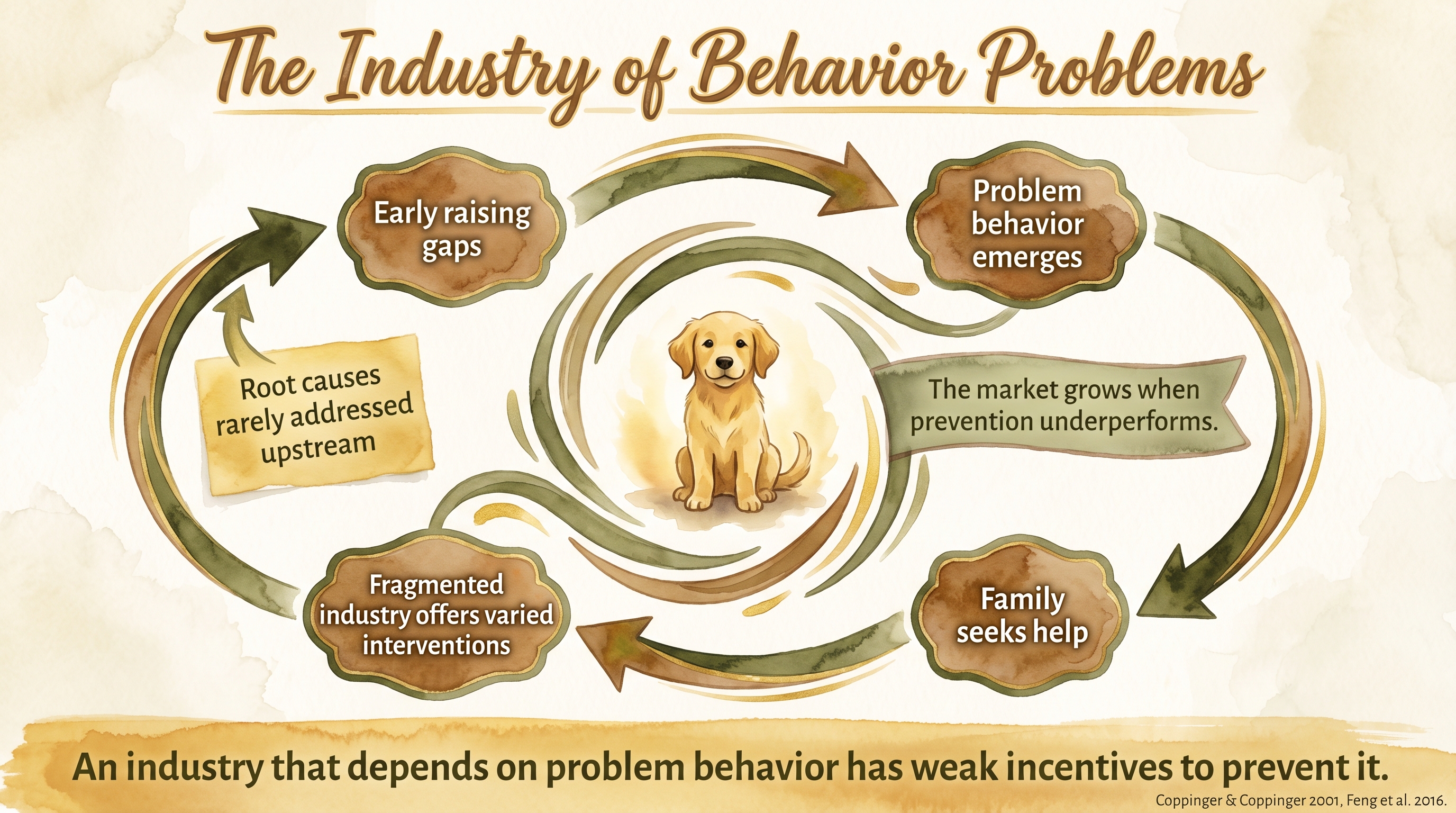
An industry that depends on problem behavior has weak incentives to prevent it.
Key Takeaways
- The documented structure of dog training is reactive, fragmented, and weakly standardized; JB's stronger claim is that this arrangement is inherently downstream of prevention.
- The entry is not accusing trainers of causing problems or acting in bad faith.
- For families, the most important shift is temporal: start behavior thinking earlier, in the raising phase, not only once visible problems appear.
- JB responds to the industry's structure by moving the center of gravity back to calm, mentored, prevention-focused daily life.
The Evidence
This entry uses documented claim-level tags beyond the dedicated EvidenceBlocks below. These claims should remain tied to the entry Sources and SCR references during the next evidence-chain authoring pass.
- Browne et al. (2024)US dog owners
Shows that help-seeking often begins after owners already perceive a problem, with online and informal advice preceding professional intervention. - Cavalli & Fenwick (2025) and DeLeeuw & Williams (2026)professional dog trainers
Document a fragmented, unregulated field with varied pathways, making early unified prevention models culturally weak. - IAABC Foundation Journal (2023) and SCR-177dog training profession
Show that standardized outcome measurement remains limited, constraining the field's ability to compare long-term results across interventions. - JB philosophical synthesisfamily-dog raising
Supports the interpretive claim that a market organized around interventions after visible failure is structurally downstream of developmental prevention.
- domestic dogs
No published study directly isolates the long-term dog-level and family-level effects of the industry of behavior problems across ordinary companion-dog contexts.
SCR References
Sources
- Johnson, A. C., & Wynne, C. D. L. (2024). Training methods used by dog guardians in the United States: Prevalence, sources of information, and reasons for use. Animals, 14(9), 1310.
- Cavalli and Fenwick 2025 plus DeLeeuw and Williams 2026. Use as industry-structure citations, not as proof that any credentialing route improves dog outcomes.
- IAABC Foundation Journal and SCR-177 support the industry-structure/evidence-gap discussion as professional and internal-governance sources. They do not establish peer-reviewed outcome data for certification or trainer claims.