Trainer Claims vs Measured Outcomes
Compound evidence detail1 SCR / 2 parts
- Documentedthe structural absence of an industry-wide standardized canine behavioral outcome measurement and reporting system, supported by Hsu and Serpell 2003 (C-BARQ instrument), Lamb 2018 (LAIR clinician-overestimate finding), Mills 2020 (LCAS validation), Wright 2012 (DIAS validation), Daniels 2022 (UK client-rated equivalence regardless of method), and the IAABC Foundation Journal 2023 review of informal-assessment dependence
- Heuristicthe JB framing comparing the dog-training industry's outcome-measurement vacuum to adjacent helping professions (veterinary medicine, human psychology, education) where outcome measurement is regulatorily mandated or conventionally standardized, with the qualifier that the structural claim concerns industry-scale practice and does not deny that individual trainers measure outcomes in their own work
Dog trainers make outcome claims constantly. Reliable recall in two weeks. Off-leash freedom after one package. Aggression solved in a six-week board-and-train. A calmer family dog through one set of sessions. Some of these claims are made carefully, but many are stronger than the evidence architecture of the field can really support. This entry is therefore intentionally written in a heuristic voice. The point is not that all trainer claims are false. It is that the gap between what is marketed and what is independently measured is larger than most families realize. Heuristic
The dispatch notebooks give several documented reasons for caution. The field relies heavily on owner report, short follow-up, and convenience samples. Compliance decays. Trainers and clinicians can overestimate success relative to validated measures, as Lamb et al. 2018 showed. Owner personality and attachment are associated with outcomes in behavioral-medicine cases, as Powell et al. 2021 showed. Long-term tracking is weak. None of those findings directly prove that trainer marketing overclaims. Together they create a setting in which overclaiming is structurally easy.
The most important missing piece is independent, standardized outcome tracking at scale. Most trainers are not running multi-month follow-up with blinded observers, validated stress measures, and clear relapse reporting. They are reporting satisfied clients, visible demonstrations, and memorable wins. That is understandable from a business perspective. It is not the same thing as strong evidence.
JB includes this entry because the same discipline must apply to JB's own claims. If the industry often sells more certainty than it has measured, JB should not answer by doing the same thing in a more philosophical accent. The best service to families is to show what can be documented, what can only be inferred, and what still sits at the level of honest expectation rather than demonstrated population outcome.
What It Means
Why Marketing and Measurement Drift Apart
The drift begins with incentives. Trainers need to attract clients, and clients buy hope before they buy methodology. A crisp promise, a dramatic before-and-after clip, or a story of transformation sells more easily than a nuanced discussion of confounds, maintenance, and relapse. That alone does not make the trainer dishonest. It does create a built-in pressure toward cleaner stories than the underlying evidence usually deserves. Observed-JB
The notebooks document several field conditions that amplify this pressure. Most studies are short. Documented Many outcomes are owner-reported. Long-term follow-up is sparse. Trainers often work without standardized metrics. Once those conditions are in place, it becomes easy to treat client relief, visible session control, or trainer intuition as proof that a robust long-term outcome has been achieved.
The Common Failure Modes Behind the Claims
One failure mode is context dependence. A dog behaves well in the trainer's facility, on the trainer's equipment, or around the trainer's timing, then regresses once the family takes the leash. Another is maintenance dependence. The dog looks transformed as long as the family keeps using the exact routine, exact reward schedule, or exact collar the program installed. A third is suppression error. The visible problem decreases, but the underlying emotional issue is not resolved and may reappear under stress.
None of these failure modes is hypothetical. The compliance and transfer literature supports their plausibility. Takeuchi et al. 2000 documented owner adherence problems in behavior plans. Lamb et al. 2018 showed optimism bias in success assessment. The notebooks repeatedly emphasize transfer gaps and the weak long-term literature. The heuristic step is connecting those documented patterns to the broader market language trainers use every day.
Why Testimonials Are So Persuasive and So Weak
Testimonials are powerful because they are humanly vivid. An exhausted family says the dog is finally listenable. A dramatic greeting video shows obvious change. Documented A trainer posts before-and-after clips with confident narration. None of that is meaningless. It is simply low-tier evidence. Highly selected success stories do not tell families how often the method fails, how much maintenance the client is doing off camera, what happened three months later, or how the dog's welfare shifted underneath the performance.
This is where the evidence hierarchy matters. A hundred polished testimonials do not equal a careful follow-up study. They mainly prove that a trainer can identify and present the most compelling cases. For families making expensive decisions, that distinction is crucial.
JB reads the industry's outcome language as another sign that method often becomes self-justifying. The field promises that the next technique package will solve problems that the larger developmental system keeps reproducing.
The Reflexive Problem, Including for JB
The final complication is reflexive. JB itself makes outcome-flavored claims. JB says prevention-first raising is likely to produce calmer, more socially mature adult dogs. That claim may be wise and defensible. It is still partly heuristic because the field has not run the decisive comparison study. This matters because critique has to be symmetrical if it is going to be intellectually serious.
The right move is not to stop making practical judgments. Families still need to decide. The right move is to keep the difference visible between directly measured outcomes, strongly supported inference, and honest philosophical expectation. That is the only way this entry can criticize the industry's overclaiming without turning into another example of it.
Why It Matters for Your Dog
For a Golden Retriever family, this entry matters because your biggest training decisions are often made under emotional pressure. The dog is adolescent, embarrassing, physically strong, overexcited with guests, or unsafe around doors and cars. That is exactly when strong promises become most persuasive. The trainer who sounds most certain can feel like the safest choice.
This is where measured-outcome thinking becomes protective. Suppose a trainer promises a fully reliable recall after a short package. A family that understands the evidence gap asks different questions. Ambiguous Reliable where? With what maintenance? Under whose handling? For how long after the package? Measured by whom? Compared with what baseline? Those questions do not ruin hope. They keep hope from being purchased as certainty.
A Golden-specific example shows how easily claims can outrun measurement. Imagine a board-and-train video of a young retriever walking beautifully at heel, recalling on command, and greeting calmly after several weeks away. The family watching sees the adult dog they have been longing for. What the video does not tell them is whether the dog will hold those behaviors when returned to a louder home, with children, inconsistent routines, and less skilled timing. It does not show whether the dog's calm is relaxed composure, learned inhibition, or simple context-specific compliance. Without follow-up, the family is being asked to infer more than the clip can justify.
This matters especially for Goldens because their friendliness can make many programs look better than they are. A Golden may remain socially soft enough that families interpret general tolerance as proof of good training. The dog may still be dependent on equipment, still overshoot threshold at home, or still regress when the reinforcement or correction structure changes. Measured outcomes would separate those possibilities. Marketing usually does not.
Families also need this lens when evaluating humane-sounding claims. Overclaiming is not exclusive to aversive camps. A reward-based trainer who promises lasting calm after a six-week protocol may also be selling more than the literature warrants. The problem is not the moral branding of the method. It is the size of the outcome claim relative to the amount of actual measurement.
There is another layer that matters for household trust. When clients buy certainty and later experience relapse, they often assume they failed. Sometimes they did fail to follow through. Sometimes the problem is that the original claim was too broad for what the intervention could really deliver. A more measured trainer may actually feel less charismatic up front and produce a healthier client relationship later because expectations were aligned with reality.
For JB families, this entry should also create a useful humility. Calm raising, prevention, and structured leadership may indeed produce better long-term dogs. The family may even observe that directly in their own home. Still, if the field has not measured that at scale against alternatives, JB should not market the claim like a tech guarantee. The point of the philosophy is not to become another certainty machine.
The practical result is better questions. Families can ask how outcomes are tracked, what relapse looks like, what the trainer counts as success, and what happens when the dog leaves the most controlled setting. Those questions shift attention from performance theater to actual durability.
Marketing also hides denominators. Families see the successful cases that became testimonials, not the quieter cases that plateaued, relapsed, required constant maintenance, or left the program with a narrower gain than the sales page implied. Without denominator information, even sincere success stories can create a distorted sense of how reliably a method travels across ordinary homes. That is one reason measured-outcome thinking is so protective. It reminds families that visibility and frequency are not the same thing.
One subtle danger is that overclaiming can reshape the owner's memory of the dog. If a trainer promises transformation and the family buys that promise, later regression may be narrated as owner failure rather than as a predictable limit of the intervention. A more disciplined measured-outcome frame keeps that from happening as easily. It leaves room for the reality that some gains are partial, some are context-bound, and some require lifelong maintenance that should have been named up front.
Families also need to remember that behavior change is often stacked on hidden support. A dog's new manners may depend on lower house chaos, stricter management, better sleep, fewer rehearsals, medication, or sheer maturation during the same period. None of that makes the trainer's contribution unreal. It does mean the outcome is usually co-produced. Marketing tends to compress that whole system into one heroic intervention story, and measured-outcome thinking pushes back against that compression.
What This Means for a JB Family
The first JB takeaway is to downgrade confidence in any promise that sounds cleaner than the field's measurement tools. A short package may help dramatically. It rarely justifies a lifelong guarantee.
The second takeaway is to ask trainers for outcome architecture, not just outcomes. How do they define success? How long do they follow clients? What percentage of dogs need refresher work? How many results depend on equipment or heavy management? What happens when the dog returns to normal family disorder? Trainers with real seriousness usually have humbler answers.
Third, apply the same discipline inside JB life. If a prevention-first plan is working beautifully, let the lived result strengthen confidence without pretending that one household's success substitutes for a comparative science the field has not yet done. Confidence grounded in experience is useful. Inflated certainty is not.
Finally, favor approaches that remain believable even when the marketing is stripped away. A method that depends on dramatic claims to feel compelling is usually weaker than one that still makes sense when described modestly. Calm adults, clear routines, prevention, humane teaching, and realistic follow-up survive that test well.
A useful household practice is to write down the promised outcome before buying the service. Not the emotional impression, but the actual claim: recall where, greeting who, leash walking under what distractions, aggression reduced by what measure, maintenance expected for how long. Later, compare the result against that written claim instead of against the trainer's charisma or the family's temporary relief. This simple habit makes outcome inflation much easier to spot.
Taken together, that approach produces steadier families and fairer expectations. Trainers get judged on what was really offered and really maintained. Owners stop blaming themselves for not preserving a promise that may never have been well supported. JB stays in the healthier role of helping families think clearly rather than competing to sound most certain. Heuristic
It also gives families permission to prefer honest modesty over theatrical certainty. The strongest professional may be the one who says a dog can probably improve a great deal, explains what that improvement will still depend on, and makes room for relapse and maintenance in the original plan. In a market full of outcome inflation, that kind of restraint is not weak selling. It is one of the clearest signals that the trainer may actually be tracking reality.
Families usually feel calmer under that kind of honesty too. The plan becomes something they can participate in intelligently instead of something they are expected to believe in as a finished miracle. That shift alone often produces better follow-through and less disappointment.
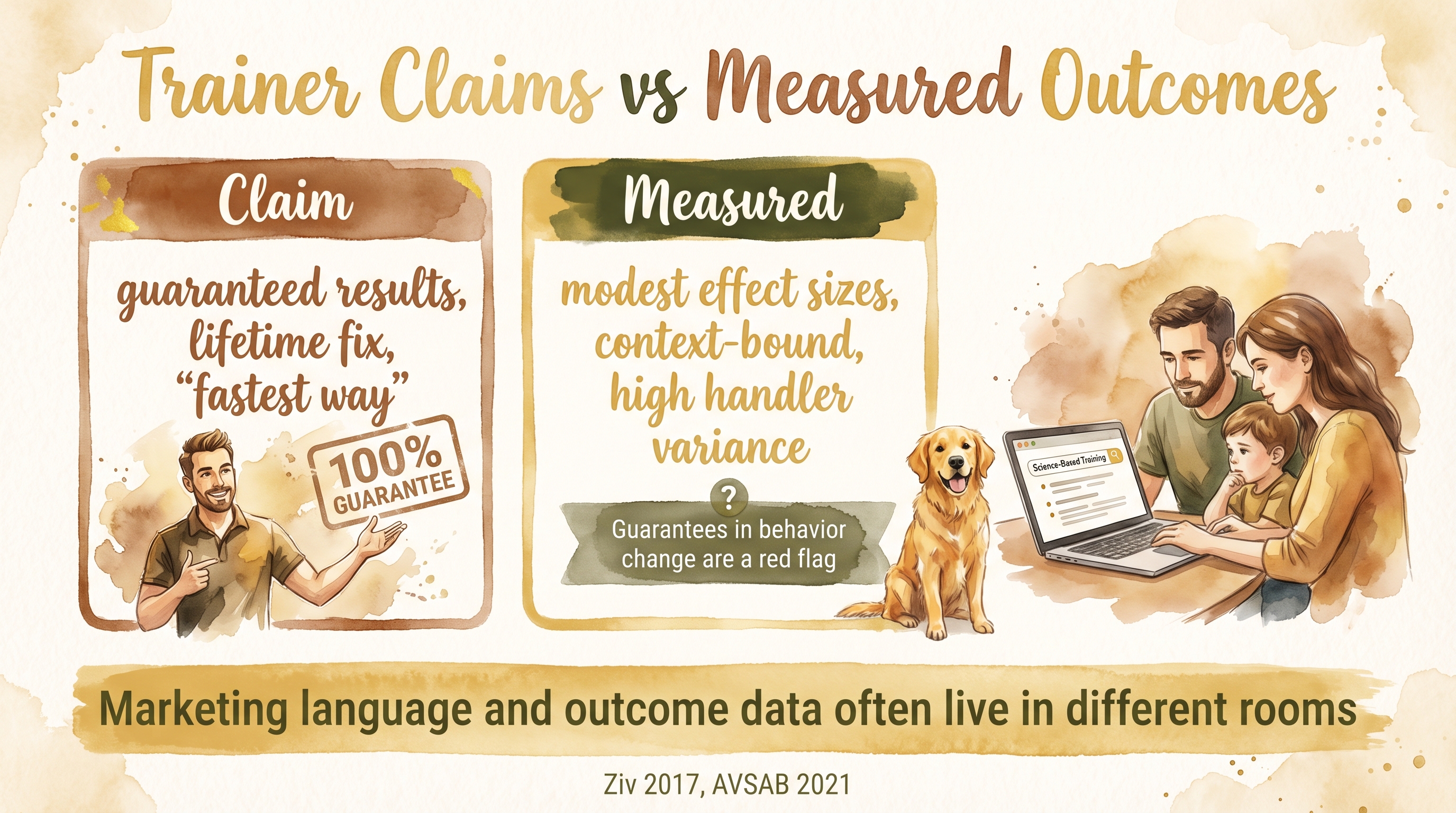
Marketing language and outcome data often live in different rooms.
Key Takeaways
- The claim that trainer marketing often outruns measurement is a strong inference from the field's documented weaknesses, not a directly quantified fact about every trainer.
- Testimonials and dramatic demonstrations are persuasive precisely because they show success without showing denominator, durability, or fallout.
- Families protect themselves by asking how outcomes are defined, followed, and verified after the controlled training context ends.
- JB should submit its own outcome claims to the same discipline rather than answering industry overclaiming with a rival form of certainty.
The Evidence
This entry uses documented claim-level tags beyond the dedicated EvidenceBlocks below. These claims should remain tied to the entry Sources and SCR references during the next evidence-chain authoring pass.
This entry uses observed claim-level tags beyond the dedicated EvidenceBlocks below. These tags mark JB program observation or practice-derived claims that need dedicated EvidenceBlock coverage in a later content pass.
This entry uses ambiguous claim-level tags beyond the dedicated EvidenceBlocks below. These tags mark claims where the literature remains unsettled or multiple interpretations coexist.
- companion dogs
Documents compliance decay, transfer problems, and the weak long-term outcome base that make broad marketing claims fragile. - Lamb et al. (2018)companion dogs
Shows that professional assessments of success can systematically outrun validated measures. - Powell et al. (2021)companion dogs
Shows that owner traits shape outcome, complicating simple trainer-attribution stories. - companion dogs
Highlights the lack of long-term, independent, comparative outcome measurement in the field.
- domestic dogs
No published study directly isolates the long-term dog-level and family-level effects of trainer claims vs measured outcomes across ordinary companion-dog contexts.
SCR References
Sources
- Lamb, L., et al. (2018). Frontiers in Veterinary Science.
- Powell, L., Stefanovski, D., Siracusa, C., & Serpell, J. A. (2021). Frontiers in Veterinary Science, 7, 630931. https://doi.org/10.3389/fvets.2020.630931
- Takeuchi, Y., Houpt, K. A., & Scarlett, J. M. (2000). Evaluation of treatments for separation anxiety in dogs. Journal of the American Veterinary Medical Association.
- Lamb, L., Affenzeller, N., Hewison, L., McPeake, K. J., Zulch, H., & Mills, D. S. (2018). Development and application of the Lincoln Adherence Instrument Record for assessing client adherence to advice in dog behavior consultations and success. Frontiers in Veterinary Science, 5, 37.
- Powell, L., Stefanovski, D., Siracusa, C., & Serpell, J. A. (2021). Owner personality, owner-dog attachment, and canine demographics influence treatment outcomes in canine behavioral medicine cases. Frontiers in Veterinary Science, 7, 630931.