The Board-and-Train Industry
Compound evidence detail1 SCR / 2 parts
- Documentedthe structural absence of an industry-wide standardized canine behavioral outcome measurement and reporting system, supported by Hsu and Serpell 2003 (C-BARQ instrument), Lamb 2018 (LAIR clinician-overestimate finding), Mills 2020 (LCAS validation), Wright 2012 (DIAS validation), Daniels 2022 (UK client-rated equivalence regardless of method), and the IAABC Foundation Journal 2023 review of informal-assessment dependence
- Heuristicthe JB framing comparing the dog-training industry's outcome-measurement vacuum to adjacent helping professions (veterinary medicine, human psychology, education) where outcome measurement is regulatorily mandated or conventionally standardized, with the qualifier that the structural claim concerns industry-scale practice and does not deny that individual trainers measure outcomes in their own work
Board-and-train is one of the clearest examples of how the dog-training industry sells relief. The model is simple: the family drops the dog off at a facility or trainer's property for an intensive stay, usually lasting somewhere between two and eight weeks, and later receives a handoff session showing what the dog now does. For exhausted households, that proposition can sound almost magical. The dog leaves chaotic and returns improved. In a busy modern family, it is easy to understand the appeal. Documented
The structure itself, however, creates serious questions. The JB source base identifies board-and-train as one of the industry's highest-revenue service models, commonly priced around $1,500 to $5,000 or more, while also noting minimal transparency, an inherent transfer gap, and an absence of peer-reviewed outcome studies. Ambiguous Those facts do not prove that all board-and-train programs are bad. They do prove that families are often being asked to hand over money, control, and direct visibility without an evidence base strong enough to make blind trust reasonable.
This entry also sits near regulation for a reason. Massachusetts passed Ollie's Law in 2024 after the death of a young dog following catastrophic injury at a daycare and boarding setting, and the law now specifically addresses commercial boarding and training kennels. That does not condemn every operator. It does establish that kennel safety is not a theoretical concern. Public regulation tightened because real harms occurred.
The fairest reading is therefore mixed but sober. Some board-and-train programs are conscientious, skilled, and carefully run. Others are structurally weak, opaque, and dangerous. Families should approach the model as something that requires unusually careful scrutiny, not as a shortcut that can be judged by a polished website and a transformation video.
What It Means
Why Families Buy It
The attraction of board-and-train is emotional as much as practical. A family with a mouthy adolescent retriever, a dog that barks through the day, or a strong dog that drags on leash often feels underwater. Outsourcing the most exhausting phase promises relief, speed, and expert control. Unlike a class, board-and-train sounds decisive. The adults do not need to become trainers themselves. They can hire the process out.
That pitch lands especially well in households where time is genuinely scarce. Parents working full time, caring for children, and managing a busy home may hear "drop the dog off and get a calmer dog back" as a lifeline rather than as a commercial offer. The model thrives because it speaks to that strain directly.
The Structural Problem Built Into the Model
The central weakness of board-and-train is not necessarily cruelty. It is transfer. The trainer teaches the dog in the trainer's setting, with the trainer's timing, the trainer's routines, the trainer's body language, and often the trainer's equipment. Then the dog returns to a family that did not build those skills and to a house that still contains the original triggers, rhythms, and habits. The source layer describes this as a transfer gap by design, and that phrase is fair.
That does not mean nothing useful can happen during the stay. Some dogs do learn useful patterns away from home. The issue is that the family usually remains the long-term environment, and the family is the part that most needs education. When the human side of the system changes least, the dog's improved performance often proves fragile.
Transparency, Oversight, and Safety
Board-and-train also concentrates risk because the dog is largely out of sight. Families may not know who is handling the dog overnight, how many dogs are present, what supervision ratio is being used, what tools are normal at the facility, whether staff can read stress signals well, or how dogs are separated when arousal rises. The JB source layer explicitly notes that many programs operate with minimal transparency and that families often cannot observe what happens during training.
Massachusetts's recent kennel-safety reforms show why those details matter. Documented Ollie's Law, signed on September 20, 2024, specifically empowered the state to develop rules for commercial boarding and training kennels, clarify licensing, require injury reporting, and build operational safety standards. A legal response of that kind does not emerge in a vacuum. It emerges because existing oversight left dangerous gaps.
The board-and-train model often moves the dog away from the family at the exact moment the family most needs to learn how to become the dog's steady environment. That is a structural mismatch, not just a marketing issue.
The Quality Spectrum Is Real
None of this means every board-and-train is a disaster. Some programs are highly supervised, humane, transparent, and excellent at follow-up. Some trainers use the model sparingly for specific cases, keep numbers low, allow observation, document methods, and spend significant time training the family before and after the stay. Those programs do exist.
The problem is that the good and bad versions often look superficially similar from the outside. Both can use polished before-and-after videos. Both can advertise behavior transformation. Documented In an unregulated profession, the family is left doing the quality control that a stronger system would perform for them.
Why It Matters for Your Dog
Golden Retrievers make the board-and-train sales pitch especially tempting. They are large enough to overwhelm a house when under-guided, social enough to be easily overstimulated, and often so eager with people that families feel they have created a lovable but unmanageable cyclone. In that moment, sending the dog away can sound easier than changing the home.
The question JB asks is different: what problem is the family actually trying to solve? If the real problem is that the humans have not yet learned how to manage greetings, transitions, rest, boundaries, and rehearsal, then removing the dog for three weeks may improve surface performance without educating the people who recreate the problem every day.
Imagine a ten-month-old Golden who jumps on children, raids counters, melts down at dusk, and drags through every threshold. A board-and-train may get cleaner sits, crisper leash behavior, or a stronger place command in the trainer's environment. The family then takes the dog home and immediately restores the old conditions: loud entries, no coherent rest rhythm, chaotic guest greetings, and inconsistent follow-through. The dog does not fail because the trainer taught nothing. The dog fails because the family system remained mostly untouched.
That does not mean the model is useless. There are cases where an intensive reset, safety management period, or focused skill-building block can help. The family just needs to understand what the stay can and cannot do. It can train the dog in a controlled setting. It cannot automatically turn the household into a better raising environment.
The welfare side matters too. Board-and-train places the dog inside an unfamiliar environment, often around unfamiliar dogs and staff, for an extended period. For some dogs that is manageable. For others it is highly stressful. Goldens are often socially tolerant, which can mask stress until the dog is already overtaxed. Families therefore need specific answers about sleep, overnight monitoring, social group management, emergency plans, separation structure, and whether dogs are ever left without direct observation in risky conditions.
The right pre-enrollment questions are practical, not abstract. Who handles the dog each day? Is there overnight staff on site? How many dogs does one person supervise at once? Are owners allowed to visit during the stay? What tools are used if the dog does not comply? How are injuries reported? Are there cameras, written contracts, insurance, and veterinary emergency protocols? A trustworthy operator should not resent those questions.
A Golden-specific observation is especially useful here: if the dog's biggest issues are social over-arousal, immature inhibition, and family inconsistency, then the adults may need coaching more than the dog needs immersion elsewhere. That is the kind of case where board-and-train can become an expensive detour.
Another hidden cost is that the dog may become fluent in the trainer's system without the family becoming fluent in it. The dog learns how this particular adult moves through thresholds, interrupts rehearsal, structures crate time, and times reinforcement or correction. Then the household receives a brief handoff and is expected to preserve the result under normal family pressure. If the trainer's success depended on dozens of small handling habits the family never learned, the return home can feel like a silent collapse rather than a clean transfer.
Families should also ask what comes back with the dog besides commands. Does the program send daily notes, transfer videos, written management instructions, and follow-up coaching that continues after the stay? Or does the whole model lean on a dramatic pickup lesson and a promise that the dog has been fixed? The more a program treats the handoff as theater rather than education, the more likely the household is to discover that the real curriculum was never built for them.
The deeper JB concern is relational. Raising is something the family does with the dog over time. Board-and-train can sometimes produce trained responses, but it often leaves the family less developed than the dog, which is backwards for companion life. When the humans are the ones who need to grow, outsourcing the dog is often the wrong direction.
There is a rhythm problem hiding inside that concern. Many programs can create cleaner behavior during a tightly managed stay because meals, exercise, rest, thresholds, and interruptions are all run by professionals on a predictable schedule. Documented The dog returns to a louder house with school pickups, visitors, inconsistent sleep, and different rules across adults. If the family never learns how to recreate enough of the stabilizing rhythm, even a good program can wash out faster than the sales pitch suggested.
What This Means for a JB Family
For a JB family, board-and-train is usually a high-caution service, not an automatic no and not an easy yes. The family should begin by asking whether the dog's problem is really a dog problem or a household-pattern problem. If the latter is true, sending the dog away may create the impression of progress while leaving the cause mostly intact.
That is why JB generally favors family coaching over dog outsourcing for ordinary companion cases. Goldens usually need adults who can create calmer routines, clearer boundaries, steadier transitions, and less self-reinforcing excitement. Those are human environment tasks. A board-and-train stay cannot permanently install them by remote control.
If a family still considers the model, transparency becomes non-negotiable. Humane methods, open observation, written safety standards, veterinary emergency planning, injury reporting, and real handoff coaching should all be present. Documented A refusal to discuss these details is itself useful information.
If the family proceeds, the best version of the model is the one that keeps teaching the humans the whole time. That means pre-stay goal setting, mid-stay communication, plain-language explanations of what the dog is rehearsing, and structured lessons after the dog returns. A good board-and-train should make the family more competent by the end of the process, not merely more impressed.
JB's caution is therefore about where the center of gravity sits. If the program treats the dog as a product moving through a transformation pipeline, the fit is usually poor for companion life. If the program treats the stay as one temporary piece of a larger family-learning process, the odds improve. Even then, the adults still have to become the dog's daily environment, because that part cannot be outsourced permanently.
Urgency is where families are most likely to miss that distinction. A chaotic adolescent, a new baby, an upcoming move, or a bite scare can make the offer of immediate relief feel impossible to resist. That is exactly when the family should slow down enough to ask whether the service is creating real transfer or merely renting out temporary competence. Relief matters, but false relief is expensive for both dog and household.
Even a strong program should therefore be read as a specific intervention, not as a replacement for raising. Some dogs may genuinely benefit from a short, well-run intensive block. The question is whether the stay supports the family becoming better stewards afterward. If the answer is no, the program may still produce a cleaner demo than a better life.
For most JB households, that is the decisive screen. The service should leave the family more capable, more observant, and more orderly than before, not merely relieved for a weekend.
That distinction is the real quality test.
The final takeaway is simple. Board-and-train can be excellent in rare hands, passable in others, and catastrophic in the wrong ones. Because the profession is under-regulated and outcome evidence is thin, the burden of discernment falls heavily on the family. JB's bias is to keep the learning relationship where it belongs whenever possible: with the dog and family growing together under guidance, not apart from one another.
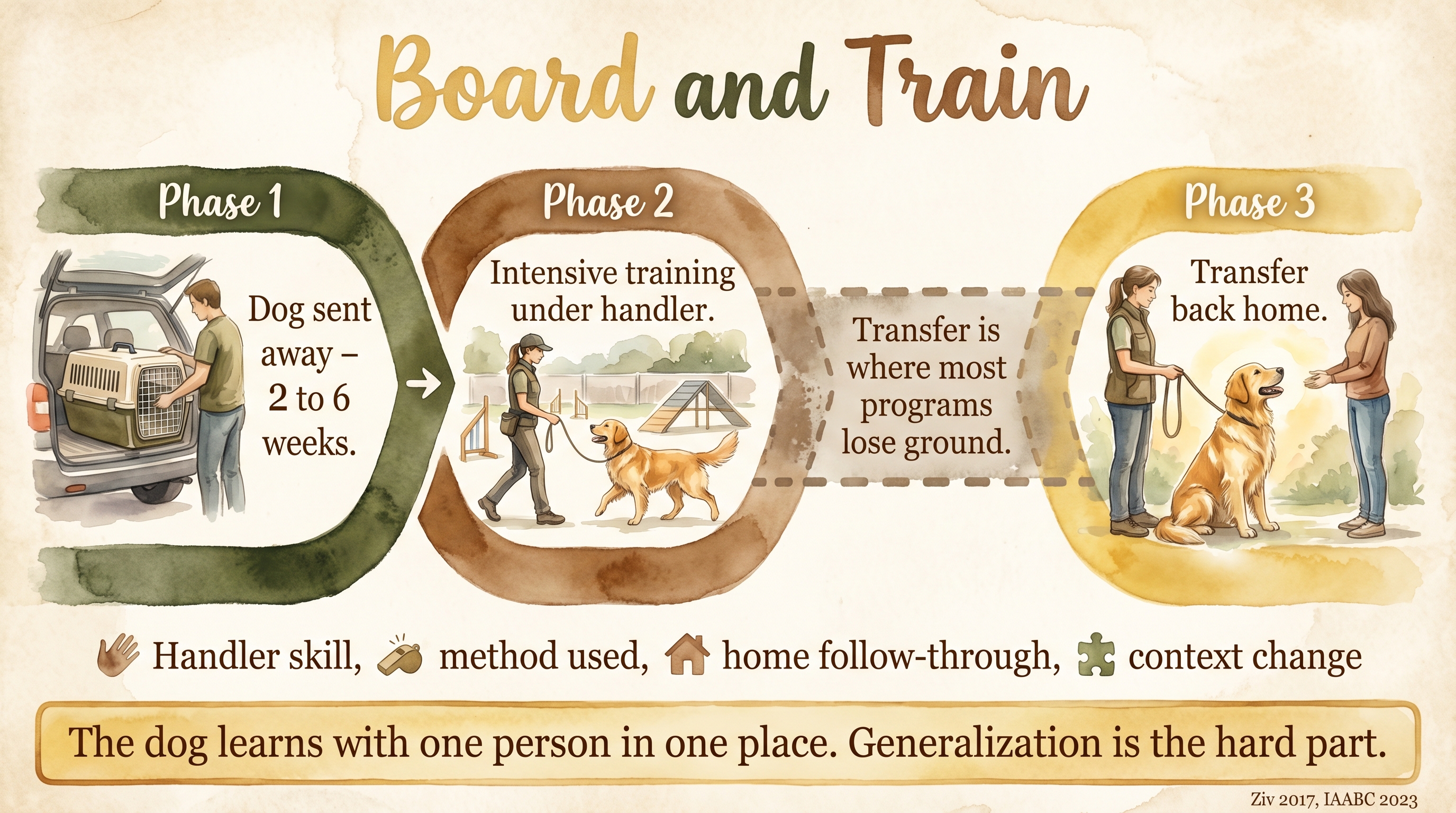
The dog learns with one person in one place - generalization is the hard part.
Key Takeaways
- Board-and-train is attractive because it sells relief, but the model builds in a transfer problem by teaching the dog away from the family system.
- Quality varies dramatically, and low transparency makes bad programs hard to distinguish from good ones at a glance.
- Massachusetts's recent kennel-safety reforms are a reminder that boarding and training risks are not hypothetical.
- For JB families, many ordinary companion-dog problems are better solved by teaching the humans how to raise the dog than by sending the dog away.
The Evidence
This entry uses ambiguous claim-level tags beyond the dedicated EvidenceBlocks below. These tags mark claims where the literature remains unsettled or multiple interpretations coexist.
- dog training business models
Documents the board-and-train model as a high-revenue segment with common pricing around $1,500 to $5,000 or more, minimal transparency, and no peer-reviewed outcome studies. - Massachusetts Ollie's Law materialsboarding and training kennel regulation
Show that Massachusetts responded to real kennel-safety failures by tightening oversight, injury reporting, and regulatory authority over commercial boarding and training kennels. - SCR-170regulatory environment
Supports the broader point that dog training remains largely unregulated as a profession in the United States. - SCR-177outcome measurement
Supports the claim that the industry lacks standardized long-term outcome tracking, which is especially relevant to a model built on before-and-after promises.
- domestic dogs
No published long-term study directly compares the board-and-train industry against structured relational raising and no-intervention controls across ordinary companion-dog homes.
SCR References
Sources
- Massachusetts Department of Agricultural Resources. "Ollie's Law Information."
- Massachusetts Department of Agricultural Resources. "Healey-Driscoll Administration Confirms Advisory Committee to Begin Implementation of Ollie's Law."
- Session Law - Acts of 2024 Chapter 213.