Aggression Rates and Risk Factors in Companion Dogs
Aggression is one of the most serious behavior categories in companion dogs because its consequences extend beyond inconvenience into injury risk, social isolation, legal problems, and euthanasia pressure. Epidemiologically, aggression is not one thing. Studies distinguish aggression by target and context because stranger-directed aggression, owner-directed aggression, and dog-directed aggression do not behave as one unified phenomenon. Even with that separation, meaningful prevalence remains. Meyer et al. 2023 reported aggression toward unfamiliar people in 3 percent of a representative Danish sample and aggression toward other dogs in 8 percent. Dinwoodie et al. 2019 found aggression in 11.5 percent of dogs in a U.S. owner survey. The Dog Aging Project reanalyses summarized in the JB source notebook produced a wide aggression range from about 1.2 to 30.4 percent depending on category and threshold. Those numbers vary for good reasons, but the field-level message is stable: aggression is common enough to be a population concern and serious enough to shape retention, safety, and end-of-life decisions. Documented
Risk factors also recur. Fear and anxiety show up repeatedly as co-presenting drivers. Poor early socialization matters. Pain and medical problems matter. Household method matters. Casey et al. 2014 found that owner use of positive punishment was associated with greater odds of aggression and other behavior problems in dogs. Documented Herron et al. 2009 showed aggressive responses to confrontational methods in many dogs already presenting for behavior concerns. The AVSAB dominance statement argues explicitly against reading most companion-dog aggression through a dominance lens and instead emphasizes fear, anxiety, conflict, and environmental context.
This is important because the public story about aggression is still often polluted by old hierarchy mythology. The literature points somewhere more practical and humane. Aggression is frequently built on fear, conflict, overwhelm, pain, or poor social development, not on a simple dog ambition to outrank the family.
JB's reading sits comfortably inside that shift. If fear and dysregulation are major foundations of aggression, then calmness, prevention, and structured early raising are not peripheral virtues. They are directly relevant to one of the behavior outcomes families most fear.
What It Means
Aggression Must Be Split Into Types
One reason aggression discourse becomes confusing is that the word covers too much. Stranger-directed aggression, owner-directed aggression, dog-directed aggression, and familiar-dog aggression have different triggers, different developmental histories, and different practical consequences. Documented C-BARQ-based research helped standardize these distinctions, which is one reason epidemiology can now say more than "aggressive dog" and stop there.
The prevalence differences matter. A dog who growls when handled at the veterinarian belongs to a different risk pattern from a dog who attacks unfamiliar dogs on walks. A dog who snaps during resource conflict is not necessarily the same kind of case as a dog with broad stranger-directed aggression. Grouping all these into one bucket blurs both science and treatment thinking.
That distinction also matters for families because it slows the urge to narrate everything as "an aggressive dog." Naming the context more precisely often changes both urgency and intervention. Some aggression categories are tightly linked to fear, others to handling conflict, others to social overload, and others to frustration or pain. Precision is protective.
The Best-Supported Risk Factors
Fear and anxiety sit near the center of many aggression pathways. The AVSAB position statement pushes this point clearly, arguing against dominance-based interpretations of common companion-dog aggression. Casey et al. 2014 provides complementary epidemiologic support by linking punishment-heavy owner method with higher aggression odds. Puurunen et al. 2020 suggests one developmental route into later social fearfulness, which is relevant because chronic fear can later express as aggression. Pain and medical illness also deserve serious attention because they alter tolerance, predictability, and response to handling.
Early experience matters too. Dogs who lack adequate socialization or who undergo rough, chaotic, or frightening early handling may enter later life with thinner social confidence and lower recovery capacity. That does not guarantee aggression, but it alters the terrain on which aggression can later develop.
Why Dominance Stories Persist Anyway
Dominance stories persist because they are emotionally simple. They make aggression look like a moral struggle the human can win through stronger control. Epidemiology, veterinary behavior, and ethological critique all point away from that narrative in ordinary companion cases. Aggression more often reflects a dog whose coping systems are overmatched, conflicted, frightened, frustrated, painful, or socially misread.
This does not make aggression less dangerous. In some ways it makes it more urgent, because it means the dog is often behaving from a disturbed internal state rather than from a cool strategic decision. A fear-driven or pain-influenced dog cannot be reliably managed by mythology.
If aggression often grows from fear, conflict, and poor recovery, then Calmness is not a soft ideal. It is one of the most practical anti-aggression investments a family can make during raising.
The Golden Retriever Picture
Goldens generally carry a favorable aggression profile at breed-average level. C-BARQ-based work has placed them among the less aggressive breeds toward humans and dogs on average. That is useful, but it should never be used to dismiss the individual dog. A Golden can still become socially worried, handling-sensitive, dog-selective, or conflict-prone. Breed average reduces odds. It does not cancel them.
This matters because owners of breeds with good public reputations can miss early aggression-related signals. Documented A low growl, freeze, avoidance pattern, or repeated hard barking response may be explained away as a quirk because "Goldens are friendly." Epidemiology argues for reading the actual dog first.
Why It Matters for Your Dog
Aggression changes household life faster than many other behavior problems because adults immediately begin reorganizing around safety. Documented Doors are managed differently. Guests are warned or avoided. Walk routes change. Children are supervised more tightly. The home becomes strategic around the dog. Even relatively mild aggression can therefore alter the family's emotional climate long before anyone uses severe language.
That is why early interpretation matters so much. A dog who stiffens, freezes, avoids, or shows low-level conflict signals is giving information before the behavior reaches a bite threshold. Families who still read these patterns through dominance folklore often choose the wrong response. They add confrontation to conflict, which can deepen the dog's fear or defensive pressure. Families who read the same signs as fear, stress, or pain risk are more likely to slow down, reduce pressure, and seek appropriate help.
Goldens deserve special caution here precisely because their average friendliness lowers suspicion. A Golden who growls over handling, panics around certain strangers, or becomes explosive around dogs can catch a family off guard. The surprise can lead either to minimization or to overreaction. Epidemiology helps with both. It says aggression is not impossible in this breed, and it also says aggression is often linked to understandable developmental and emotional drivers rather than to a cartoon villain story.
That is part of why medical and developmental assessment belong early in the picture. A dog who is becoming aggressive is often telling the adults something about pain, stress load, predictability, social fear, or environmental saturation long before the family has a polished explanation. The earlier those signals are respected, the more room there is to change the trajectory without an incident forcing the issue.
Another reason this entry matters is that aggression is disproportionately likely to threaten placement and life itself. A house may live with barking, pulling, or mild destructiveness for a long time. Aggression shortens the runway. Families begin fearing liability, child safety, neighborhood conflict, or the prospect of euthanasia after an incident. Prevention is therefore precious in this domain because the stakes rise quickly once aggression is established.
The literature also points families toward better questions. Has the dog been thoroughly checked for pain or medical contributors? What early socialization history did the dog have? Are the aggressive moments clustered around fear, handling, space, food, dogs, strangers, or frustration? What methods has the family already been using, and could those methods be increasing conflict? These are all better questions than "How do we show the dog who is boss?"
The answer matters in everyday scenes. A dog who lunges at unfamiliar dogs on leash may be carrying social fear, frustration, or prior bad rehearsal. A dog who growls at children approaching a bed may be defending space from conflict and poor predictability. A dog who snaps during grooming may be dealing with pain, fear, touch sensitivity, or learned conflict around restraint. Each case may eventually include aggression. The route into aggression is different, and prevention lives in reading that route correctly.
Families benefit emotionally from that reframing too. Dominance language often generates anger, while developmental and fear-based language more often generates seriousness without theatricality. The dog still needs management and sometimes urgent help. The adults are simply less likely to escalate the problem while trying to solve it.
This is where the JB emphasis on calm adult behavior becomes concrete. Adults who can regulate themselves, reduce pressure, notice early signs, and prevent chaotic rehearsal are building the conditions less likely to feed aggressive outcomes. That will not solve every case, but it is far better aligned with the literature than the old contest model.
Aggression data should therefore not frighten families into suspicion of every rough moment. It should teach them to respect the early warning signs and to understand that the most serious behavior category in companion dogs is often built on softer, earlier patterns that could have been read differently.
The family that learns this early is not becoming paranoid. It is becoming literate in risk. That literacy often keeps both overreaction and underreaction from taking over, which is one of the best gifts an evidence-informed home can give a dog.
It also helps adults aim at the right end state. The goal is not merely a dog who suppresses outward signs under pressure. The goal is a dog whose underlying conflict and fear load are lower, because that is the route most likely to reduce real danger over time.
For that reason, aggression work is often slower and less theatrical than families hope. Real safety usually grows from clearer assessment, lower conflict, cleaner management, better medical awareness, and a dog who is no longer being asked to cope above threshold every day. Those changes are less dramatic than a domination story, but they are far more consistent with what the evidence actually suggests.
What This Means for a JB Family
JB families should think of aggression as a late-stage expression of problems that usually start earlier and smaller. Fear, poor recovery, social overwhelm, handling conflict, and chronic overarousal all deserve attention before the dog has any history of serious aggressive behavior. Documented
That means the practical anti-aggression work is often calmness work, socialization work, pain-awareness work, and prevention work. It is less glamorous than corrective folklore, but it fits the evidence better.
It also means refusing dominance stories as the default explanation. A dog showing aggression should be taken seriously, but seriousness is not the same thing as myth. The first response should be assessment, management, and careful support, not a power contest.
For Goldens especially, the family should remember that a favorable breed average is not immunity. If this dog is showing conflict signals, then this dog is the one who matters.
JB's broader promise in this area is modest but important: if a dog is raised in more calm, with more structure, with better early social support, and with less chronic rehearsal of dysregulation, some of the foundations that commonly feed aggression become less likely to build. That is a prevention claim, and the literature gives it meaningful support.
That claim should make families feel responsible, not doomed. Aggression is serious, but many of its common foundations are visible earlier than the final behavior itself. A household that acts at that earlier stage is giving the dog the best chance to avoid the most expensive version of the problem.
This is why good aggression prevention rarely looks dramatic at first. It looks like calmer handling, better observation, more thoughtful exposure, and quicker respect for the dog's signs. Those ordinary adult choices are often the place where later safety begins.
For JB families, that is a reassuring kind of seriousness. It means the household is not helpless until aggression becomes obvious. Some of the most relevant anti-aggression work happens while the dog is still only showing stress, conflict, startle, or social unease.
The practical meaning is simple: read smaller warnings as meaningful. Earlier respect for those warnings often gives the family more room to keep everyone safe without ever needing the most dramatic version of the lesson.
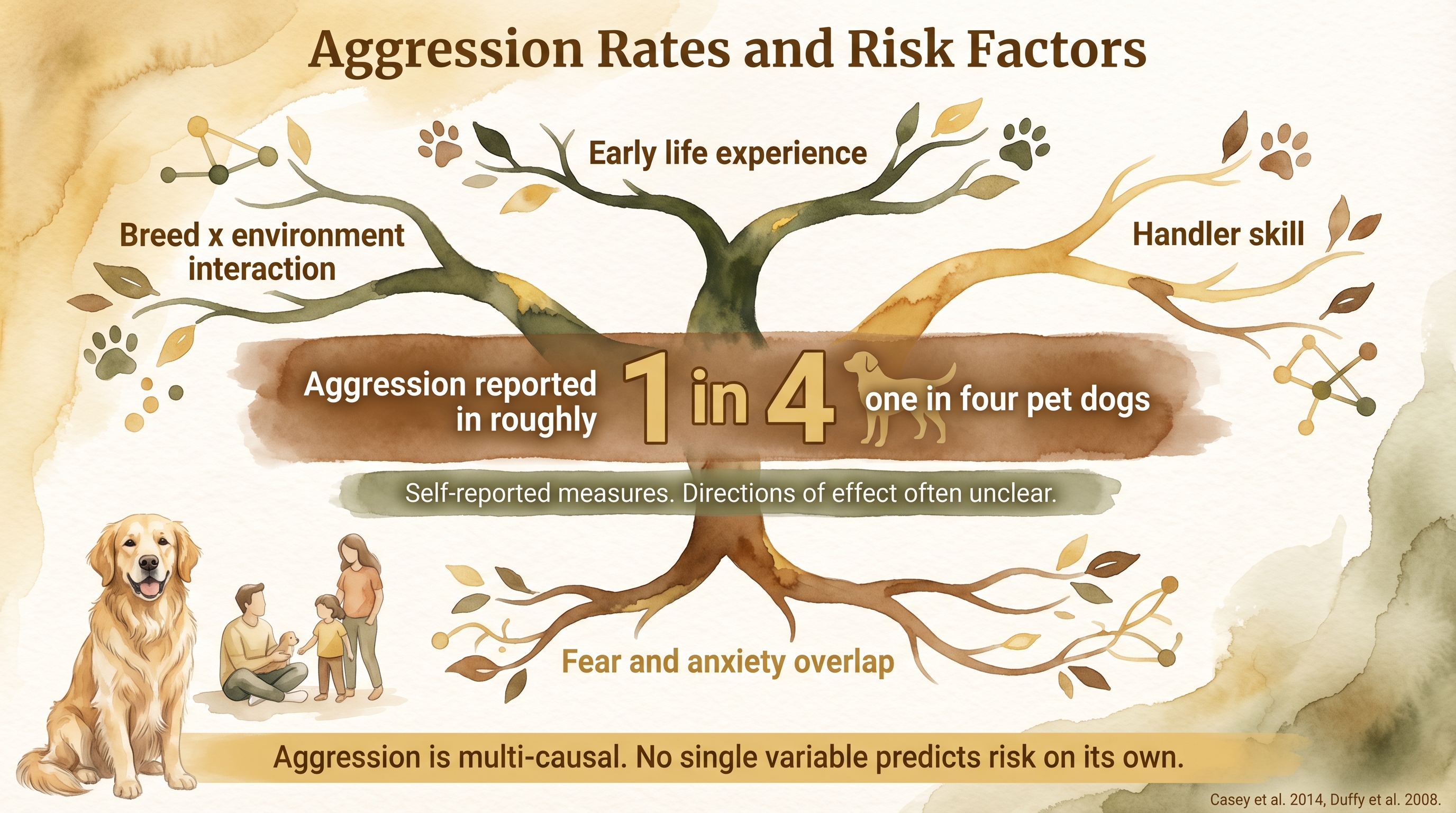
Aggression is multi-causal - no single variable predicts risk on its own.
Key Takeaways
- Aggression is not one behavior category but a family of context-specific problems that should be separated carefully.
- Fear, anxiety, pain, early social history, and family method all matter more than dominance folklore suggests.
- Breed-average risk can be informative without excusing the family from reading the individual dog honestly.
- JB's prevention-oriented emphasis on calmness and early structure fits the aggression literature better than confrontation-first models do.
The Evidence
- Meyer et al. (2023) and Dog Aging Project analysescompanion dogs
Show that aggression prevalence varies by category and threshold but remains meaningful across datasets. - Dinwoodie et al. (2019)owned dogs
Reported aggression in 11.5 percent of dogs in an owner survey. - Casey et al. (2014)companion dogs
Linked positive punishment use with higher odds of aggression and other problem behaviors. - Herron et al. (2009) and the AVSAB dominance statementcompanion dogs
Argue against simplistic dominance explanations and highlight conflict, fear, and confrontational handling as relevant factors.
- domestic dogs
No single dataset directly resolves the full population picture for aggression rates and risk factors in companion dogs without the usual survey, sampling, and threshold limitations.
SCR References
Sources
- Meyer, I., et al. (2023). Scientific Reports.
- Dinwoodie, A. T., et al. (2019). Animals.
- Casey, R. A., et al. (2014). Applied Animal Behaviour Science.
- Herron, M. E., Shofer, F. S., & Reisner, I. R. (2009). Applied Animal Behaviour Science.
- AVSAB Position Statement on Dom