Shaping and Free-Shaping in Dog Training
Shaping is the systematic reinforcement of successive approximations to a target behavior. Instead of guiding the dog physically into the finished response, the trainer rewards closer and closer versions of it until the final behavior emerges. Free-shaping is the more stripped-down version in which the trainer avoids lures and prompts and waits for the dog to offer behaviors actively. The dog experiments, the trainer marks useful approximations, and the behavior is built through selection rather than direct guidance. Documented
The lineage is important. Skinner's laboratory work formalized shaping as a general learning principle, and later reward-based trainers carried it into applied dog training. Documented Karen Pryor and the clicker-training movement helped make the method visible outside research and marine-mammal work. In dog culture, shaping came to represent a more elegant and cognitively interesting alternative to luring because it asked the dog to solve, not merely follow.
That reputation is deserved in part. Shaping can produce robust, thoughtful, repeatable behaviors with excellent handler-dog engagement. It often builds cleaner understanding because the dog is discovering the behavior structure rather than being physically steered into it. Observed-JB At the same time, the method asks more of both parties. The trainer has to see tiny increments clearly, and the dog has to tolerate trial and error without tipping into frustration. Those requirements are why some families love shaping and others abandon it after two sessions.
JB sees shaping as one of the most respectable formal techniques in the modern field because it uses low-force teaching and can create genuine participation. JB still refuses to confuse that with the whole developmental picture. A dog may become brilliant at solving a shaped task and still need mentorship, calmness, boundaries, and social maturity in the rest of life. Skillful shaping is real. Whole-dog raising is still larger.
What It Means
Successive Approximation Is the Core Idea
The essence of shaping is not complexity. It is sequencing. The trainer chooses a final behavior, identifies small steps that point toward it, and reinforces each useful step in order. A dog may first look at a mat, then take one step toward it, then place front feet on it, then all four feet, then sit, then lie down, then stay settled while the trainer moves away. None of those steps is the finished behavior, but each one builds the path.
Free-shaping removes more help. The dog is not lured onto the mat. The dog is invited to experiment, and the trainer captures approximation after approximation through timing and reinforcement. That changes the emotional flavor of the lesson. The dog becomes an active problem solver, not just a follower of hand motion.
Why Trainers Value the Method
Shaping is prized because it often produces strong engagement and clarity. The dog is not only getting paid. The dog is learning how to influence the session through offered behavior. Many trainers feel that shaped behaviors become more resilient because the dog has assembled the action from repeated successful approximations rather than being repeatedly maneuvered.
The method is also excellent for behaviors that are awkward to lure. Rear-end awareness, object interaction, cooperative-care positions, sports foundations, and highly precise body placements often benefit from shaping. The trainer can reward the exact slice of progress that matters without physically crowding the dog.
What Free-Shaping Builds Beyond the Target Behavior
One appealing claim around free-shaping is that it builds more than one behavior at a time. It may also encourage persistence, creativity, frustration tolerance, and willingness to keep working with the human. There is truth in that claim, though it should not be inflated into a grand theorem. Some dogs visibly become more active participants when their experimentation matters.
That said, "problem-solving dog" rhetoric can become romantic quickly. Not every dog enjoys this style at first. Some dogs become frantic. Some guess wildly. Some stare helplessly because the trainer's criteria are muddy. Free-shaping is therefore not morally superior simply because it looks clever. It is a technique with a profile, not a virtue in itself.
Shaping is strongest when the adult reads the dog well enough to keep experimentation safe, clear, and emotionally stable. That makes it an unusually good reminder that even a low-force method still depends on adult judgment rather than on technique alone.
The Practical Costs of the Method
Shaping is slower than luring in many beginner contexts, especially when the family wants a recognizable behavior quickly. It also punishes vague humans. If the trainer cannot split criteria finely, mark on time, and reset the dog without chatter, the session gets muddy fast. The very thing that makes shaping beautiful in expert hands can make it frustrating in ordinary ones.
There is another limit JB cares about. Because shaping can be intellectually satisfying, trainers sometimes give it more territory than it deserves. They begin treating all behavioral development as if it should happen through operant puzzle-solving. But many forms of mature family-dog behavior are not best understood as trick construction. They emerge from rhythms, modeling, inhibition, attachment, and the simple predictability of daily life.
Shaping also changes session tempo in a way families should notice. Because the dog is searching actively, the emotional arousal of the lesson can climb if criteria are unclear or reinforcement pauses get too long. Ambiguous Expert shapers keep the dog thoughtful without tipping into frantic guessing. Beginners often discover too late that a method celebrated for creativity can still generate noise and frustration when the adult loses the thread of the approximation plan.
Why It Matters for Your Dog
For a Golden Retriever family, shaping can be a very good fit in the right doses because many Goldens enjoy working with people and will offer behavior readily. That makes shaping useful for tasks such as mat settle, chin rest, platform work, polite object interaction, crate games, and cooperative care.
The family benefit is often psychological as much as technical. Shaping encourages owners to watch the dog more carefully. Instead of talking constantly, they start noticing tiny behavior changes: weight shifts, offered eye contact, hesitation, paw movement, breathing changes, and the point at which the dog starts to understand. That observational habit is valuable well beyond formal sessions.
A Golden example makes the benefit concrete. Suppose the family wants a stable chin rest for grooming and veterinary handling. Luring can create a rough position quickly, but shaping may build a more deliberate, durable behavior because the dog is learning exactly which head placement and duration earn reinforcement. The final response can become calmer and more cooperative because the dog is participating in the build, not merely following the food.
Yet shaping also exposes household limits quickly. If the adults are impatient, inconsistent, or teaching after the puppy is already over-tired, the session can deteriorate into random offering or obvious frustration. Some Goldens then start pawing, barking, spinning, or throwing old behaviors at the trainer in a burst of optimism. Families sometimes interpret that as intelligence. It may simply be confusion under pressure.
That is why the dog's emotional state matters so much in shaping work. A dog who is rested, settled, and slightly curious is easier to shape than a dog who has just come in wild from the yard, missed a nap, or is trying to work in the middle of a chaotic family transition. The method is low-force, but it is not low-demand. It still depends on a nervous system capable of participating calmly.
The same point matters at a larger level. A Golden can become excellent at shaped exercises and still remain messy in greetings, transitions, and household pacing if those parts of life are never addressed upstream. Shaping teaches what you shape. It does not automatically repair the entire environment the dog lives in. Families sometimes overestimate the spillover.
Free-shaping can also tempt families into over-valuing cleverness. A dog who offers twelve behaviors in thirty seconds can look brilliant. That brilliance is not the same as steadiness. A family dog ultimately needs both. Goldens in particular can become very enthusiastic offerers without becoming calmer, quieter, or more mature unless the home is organized around those qualities too.
So shaping matters because it is a strong tool and because it reveals a larger truth. Even some of the most refined modern techniques still depend on good raising around them. The cleaner the household rhythms, the more effective the shaped session becomes. The more chaotic the household, the more likely shaping becomes one more isolated island of competence in a sea of disorder.
There is another household pattern worth naming. Some families discover shaping and then start turning every small challenge into a puzzle game. The puppy hesitates near the crate, the family shapes. The dog delays on leash, the family shapes. The dog struggles to settle after dinner, the family shapes. A little of that curiosity is healthy. Too much of it can mean the adults are trying to operantly engineer moments that would be easier to solve through simpler structure, calmer timing, or straightforward prevention.
Shaping is also worth reading through the lens of adolescence. A young Golden in a suggestible, bouncy stage may offer behaviors with huge enthusiasm and weak stability. That can make a session look wonderfully productive even when the dog's body is not fully organized. Families then assume the dog is becoming more mature because the dog is becoming more inventive. The two can overlap, but they are not the same developmental achievement.
That gap between cleverness and maturity is exactly where families need the wider JB frame. Ambiguous
It keeps the session in proportion.
That matters in real homes too.
And in family development.
This is why the reset between repetitions matters so much. A thoughtful shaper resets the dog's body, breath, and orientation, not only the target object. Families who reward a burst of offering without clean pauses can accidentally build agitation around the exercise itself. Then the dog looks brilliantly engaged while drifting farther away from the kind of settled participation the family actually wants in ordinary life.
What This Means for a JB Family
There is another reason the JB reading values restraint here. Shaping can become addictive for humans because it makes progress feel elegant and visible. Families who remember that elegance is not the same thing as maturity are less likely to mistake a good session for a fully organized dog.
That observation matters for Goldens because their enthusiasm is so easy to praise. A shaping session full of fast offering, paw slaps, spins, and bright anticipation can feel like a success simply because the dog looks eager. Sometimes it is a success. Sometimes it is the first sign that the dog is crossing from thoughtful participation into over-aroused guessing. Families who can tell the difference use the method much better.
For a JB family, shaping is worth respecting and worth sizing correctly. It is one of the better modern training tools for building clean behavior without force, and it often teaches the adults to observe better. Those are meaningful strengths.
The family should use it where active problem solving helps: cooperative care, small body positions, careful stationing, precision behaviors, and tasks that do not benefit from visible lures. It should not be used as evidence that all meaningful canine development is best produced by operant construction.
JB families also need to protect the dog's emotional footing during shaping. Keep sessions short. Train when the dog is rested. Split criteria generously. Stop before enthusiasm turns into frantic guessing. The method works best when the dog remains thoughtful rather than aroused.
Most importantly, keep the home bigger than the exercise. A shaped settle on a mat is helpful. A household that never stops over-stimulating the dog is still the deeper problem. Shaping can build a behavior elegantly; the adults still have to build a life the behavior can actually live inside.
Once that hierarchy is clear, shaping becomes easy to appreciate. It is an advanced teaching craft, not a substitute for raising. Used inside that boundary, it can be one of the most satisfying formal methods a family learns.
Some families benefit from pairing every shaping plan with one plain-life question: what part of this problem should be taught deliberately, and what part should simply become easier because the adults are organizing the day better? That question keeps the method from spreading into places where it is impressive but unnecessary. It also protects the dog from living inside a household that feels like a constant laboratory.
JB families can also use shaping as a diagnostic tool instead of only a teaching tool. If the dog cannot stay thoughtful for sixty seconds of low-pressure shaping, the problem may not be a missing behavior at all. Documented It may be fatigue, overarousal, poor timing of the session, or a broader lack of regulation. Reading that information honestly makes the method more valuable and keeps the adults from demanding elegant learning out of a body that is not ready for it.
Seen that way, shaping becomes doubly useful. It can build clean behavior, and it can reveal how much calm attention the dog actually has available. Both are worth knowing. Neither eliminates the need to keep the rest of the dog's life simple enough for those gains to matter.
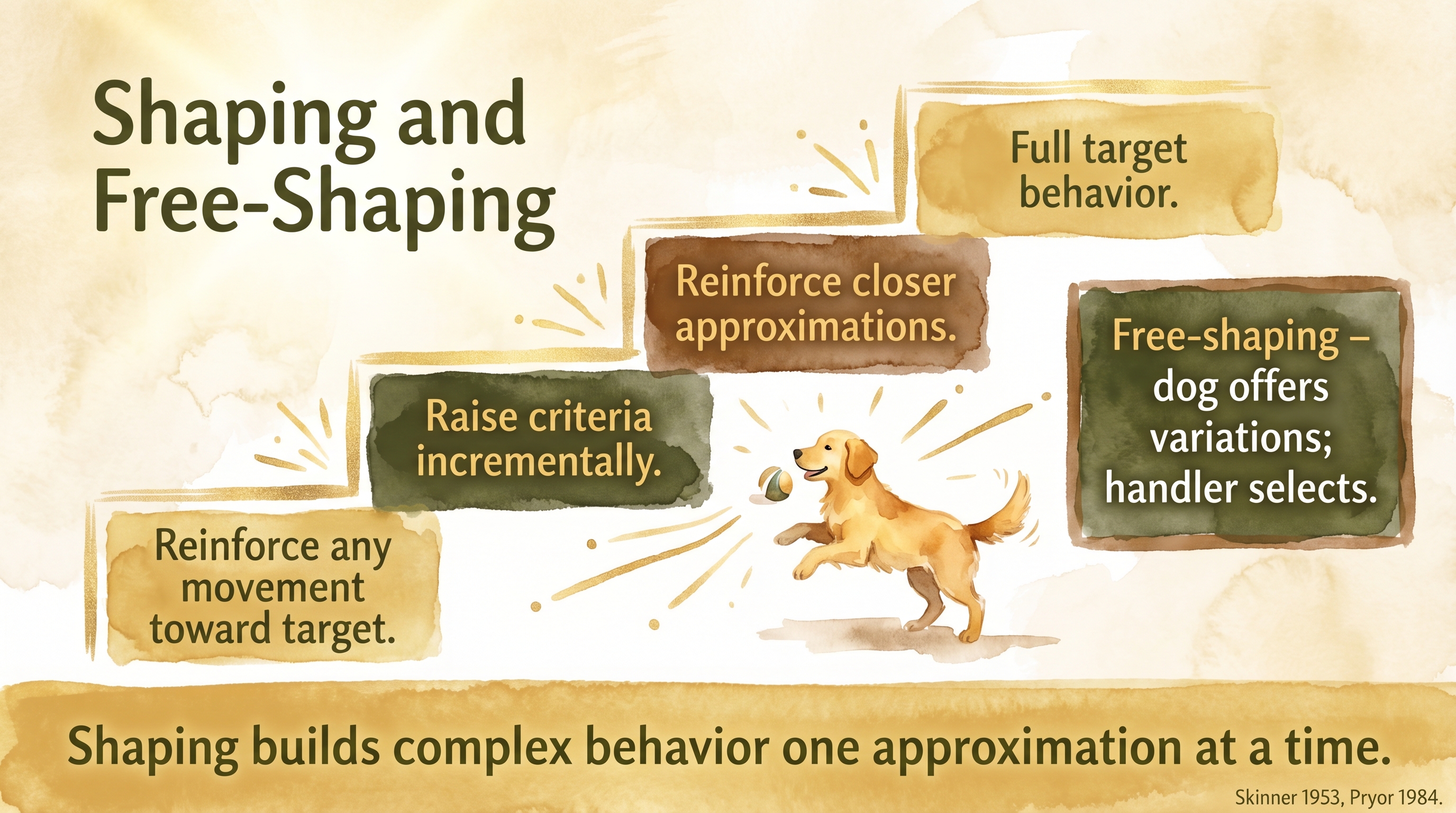
Shaping builds complex behavior one approximation at a time.
Key Takeaways
- Shaping builds behavior by rewarding closer and closer approximations to the final response.
- Free-shaping can create strong engagement because the dog is actively offering behavior rather than merely following a prompt.
- The method is powerful and demanding: it rewards precise human observation and punishes muddy criteria quickly.
- JB values shaping as a refined skill-teaching tool while rejecting any claim that it can replace whole-dog raising.
The Evidence
This entry uses observed claim-level tags beyond the dedicated EvidenceBlocks below. These tags mark JB program observation or practice-derived claims that need dedicated EvidenceBlock coverage in a later content pass.
This entry uses ambiguous claim-level tags beyond the dedicated EvidenceBlocks below. These tags mark claims where the literature remains unsettled or multiple interpretations coexist.
- companion dogs
Supports the broader finding that reward-based acquisition methods can build target behaviors effectively without the welfare costs seen in aversive-heavy approaches. - Skinner and later shaping lineage as summarized in the source layerlearning theory across species
Provides the conceptual background for successive approximation as a formal behavior-construction process. - Fugazza & Miklosi (2015)companion dogs
Offers a useful comparison point showing that operant shaping can be effective while social-learning pathways may generalize differently for some tasks. - companion dogs
Supports the caution that socially situated learning channels still matter even when operant techniques work well.
- domestic dogs
No published long-term study directly compares shaping and free-shaping in dog training against structured relational raising and no-intervention controls across ordinary companion-dog homes.
SCR References
Sources
- Fugazza, C., & Miklosi, A. (2015). Applied Animal Behaviour Science.
- Pryor, K. (1984). Don't Shoot the Dog!