Clicker and Marker Training
Clicker training is one of the clearest examples of a narrow technique becoming a cultural identity. At its core, the method is simple. A distinct sound, often a mechanical click, is paired repeatedly with a primary reinforcer such as food until the sound itself becomes meaningful to the dog. Once that pairing is established, the click can mark the precise instant a desired behavior occurs, and the reward can follow a moment later. That timing advantage is the method's entire point. Documented
The idea was not born in suburban puppy classes. It grew out of behavior analysis and marine-mammal work, then moved into dog culture through Karen Pryor and later reward-based schools. In public language, the clicker became a symbol of humane, science-based teaching because it offered accuracy without physical coercion. Trainers could stop wrestling with the question of whether their praise landed too late. The marker froze the exact instant they wanted to pay.
The method works because learning is sensitive to timing. The more clearly the dog can identify which movement earned the consequence, the faster the behavior can be split, repeated, and shaped. That is especially useful in tasks with very small target moments: a chin rest for cooperative care, the first flick of eye contact, one rear-foot step toward heel position, or the instant a dog chooses to reorient away from distraction. A click or carefully conditioned marker word can isolate that moment more cleanly than casual praise.
JB respects that advantage while drawing one strong boundary. A clicker is a conditioned training signal, not a natural canine social signal. It can be brilliant for teaching a behavior. It cannot carry the full relational meaning that dogs derive from posture, spatial allowance, body softness, proximity, silence, and the long history of life with the adult. That is not a criticism of clicker work. It is a scope reminder.
What It Means
What a Marker Actually Does
A clicker or marker word is usually described as a secondary or conditioned reinforcer. The signal gains value because it predicts the arrival of something the dog already wants. Once conditioned, it does two jobs at once. It tells the dog exactly which behavior earned payment, and it bridges the short delay before the primary reward arrives.
That bridging function is the practical breakthrough. If a dog offers a tiny head turn toward the handler and the trainer takes a second to reach the food, ordinary praise may blur into everything the dog did in that second. The click lands exactly on the target moment. The food can come after. For complex behavior building, that precision is a real mechanical advantage.
Why the Method Became So Influential
Clicker training spread because it solved a common trainer problem elegantly. Humans are slow, noisy, and inconsistent. We talk too much, move too much, and often reward the wrong slice of behavior. Observed-JB The clicker narrowed the communication channel. It let trainers split behavior into cleaner pieces and pay those pieces faster than vague praise usually allows.
Karen Pryor's role matters here. After work with dolphins and other marine mammals, she brought marker logic into mainstream public dog culture. That migration changed more than one tool. It changed how many trainers thought about learning itself. Behaviors could be built through precise reinforcement history rather than compelled into place physically.
Verbal markers later broadened the practice. Some trainers became clicker purists. Others argued that a consistent verbal "yes" or another short word could function similarly if conditioned with care. That practical divergence still exists. The underlying logic remains the same: precision first, reward second.
The historical landmarks make the lineage easier to see. B. F. Skinner supplied the operant framework, Karen Pryor popularized marker logic for companion-animal audiences in 1984, the Karen Pryor Academy later institutionalized that style of teaching, and canine social-learning work such as Fugazza and Miklosi 2015 helps show why a precise conditioned marker is powerful without being the only serious learning channel dogs possess. Documented
What Marker Training Does Well
The method is strongest where exact behavior slices matter. Shaping thrives on it. Cooperative care thrives on it. Novel body awareness, sports foundations, and advanced trick work often improve under it. Marker training also helps new handlers learn to observe better, because the act of clicking forces them to ask, "What exact movement am I paying?"
That question alone can improve training quality. Instead of delivering a treat because the dog generally looked cute or vaguely cooperative, the handler has to identify the criterion. Criterion awareness is one reason clicker-trained exercises often look cleaner than loosely rewarded ones.
JB agrees that precision matters. The disagreement is about channels. A conditioned marker can create training precision; it should not be mistaken for the full social precision dogs also read from body position, timing of access, stillness, and relational history.
The Limits Hidden by the Method's Elegance
The first limit is human competence. Marker systems look tidy in theory and sloppy in ordinary hands surprisingly fast. Late clicks, accidental clicks, reward fumbling, extra chatter after the click, and inconsistent conditioning all degrade the signal. Many owners think they are using a marker when they are really producing a blur.
The second limit is philosophical inflation. Because marker work is mechanically elegant, some trainers begin to treat it as the best language for the whole dog-human relationship. That is where JB parts company. A click can mark a sit. It does not replace the dog's reading of adult composure, steadiness in a doorway, or quiet disapproval communicated through spatial change. Documented
The third limit is contextual. Marker training excels at the construction of specific behaviors. It is far less complete as a theory of how a dog becomes socially mature in a household. A dog may offer exquisite trained responses to a clicker and still lack the everyday regulation that family life asks for between sessions.
There is also a planning limit many families never see coming. Marker work asks the human to know what the next approximation is before the dog offers it. Without that plan, families click too much, click too late, or raise criteria in jumps that confuse the dog. The tool then gets blamed for failures that actually came from poor lesson design. Good marker training is precise because the trainer is thinking in small steps, not because the click itself is magical.
Why It Matters for Your Dog
For a Golden Retriever family, clicker and marker training can be genuinely useful because Goldens often learn fast, enjoy repetition, and remain engaged with human-directed teaching. A clicker can make early lessons cleaner and reduce the temptation to over-handle or over-talk. That is especially helpful for families who tend to chatter at the puppy until the puppy is drowning in language.
A concrete example shows why. Suppose a Golden puppy is learning to settle on a mat. Without a marker, the family may reward too late and end up paying for standing, stepping off, or bouncing back up. With a clean marker, they can pay the instant elbows hit the mat, then later the instant the hips soften, then later the first genuine exhale. The dog receives a clearer picture much sooner.
The same precision helps in cooperative care. A family working on chin rest for brushing, stationing for nail trims, or stillness for ear checks benefits from being able to mark one second of success before the dog breaks position. The dog does not need to guess which micro-movement earned reinforcement.
Still, the method can mislead families if it becomes their whole mental model. Goldens are social enough that adults may start clicking everything and forget to ask what the dog's broader day feels like. The puppy learns sessions. The family forgets transitions. The puppy earns treats for calm behavior and then spends the rest of the afternoon getting over-amped by frantic greetings, late naps, and chaotic room energy. Documented
That mismatch is one reason some owners become disillusioned with clickers. The tool did exactly what it was built to do. It marked behavior precisely. What it did not do was redesign the household. The family then blames the clicker for failing at a job it never claimed to do.
Marker work also reveals a difference between trained precision and lived fluency. A Golden may understand that a click predicts food and still respond far more deeply to the way the adult moves through the home. Quiet blocking, a slow doorway pause, the absence of excited speech, or the adult sitting down before the puppy escalates can all shape the dog's behavior through channels that are not reducible to the click alone.
This matters in adolescence because marker systems can tempt owners into staying at the drill layer when the real issue is emotional load. Documented A young Golden who unravels when guests arrive may need station training, yes. The dog may also need a calmer entry sequence, less rehearsal at windows, different pacing of social intensity, and adults who stop feeding frenzy with their own voices. A clicker helps only one piece of that picture.
For many families, the healthiest use of marker training is modest and confident. Use it where precision truly helps. Do not turn it into a belief that every part of good dog life must be conditioned from scratch through engineered sound-and-food events. Dogs are already reading far more than that.
Marker work can also create a subtle attentional shift in the human that is good when it stays bounded and unhealthy when it spreads everywhere. In a lesson, it is useful to notice tiny increments. Outside lessons, some families start hovering over the dog, waiting to capture every movement, and filling daily life with constant micro-feedback. Goldens can become busy in that kind of household because the adults have made every moment feel contingent and watched. The dog may become highly trained and oddly less at ease.
A second practical issue is delay tolerance. Clicker training works because the marker bridges time between behavior and reward, but families often misuse that bridge as if it were infinite. They click, then fumble, then talk, then search pockets, then hand over food several seconds late. The dog still learns something, but not always what the adults think. The lesson for family life is simple: if you choose this precise tool, respect the precision all the way through reward delivery.
Marker work also shows its limits in busy multi-person homes. One adult clicks cleanly, another talks over the moment, and a child repeats the marker as a joke sound. The dog is left trying to decide which sound still predicts anything meaningful. In those households, the method often succeeds only after the family becomes quieter and more coordinated, which is another reminder that the adult system is still more important than the device.
The cleaner the home gets, the cleaner the marker usually becomes.
What This Means for a JB Family
This is also why clickers often work best as temporary intensifiers rather than permanent companions. They can sharpen the first weeks of a behavior beautifully, then become less necessary once the dog understands the exercise and the family can reinforce more naturally. Goldens usually do well with that progression because they enjoy the clarity without needing the marker to narrate every future repetition.
For a JB family, marker training is easiest to place when it is treated as a scalpel, not a worldview. It is excellent for building clean discrete skills. It is not the total language of raising. That distinction lets the family use the tool without letting the tool colonize every interaction.
In practice, that means reaching for a clicker or marker word when the behavior slice is tiny and clarity matters: cooperative care, new cues, precise leash-position work, foundation recall games, target behaviors, careful shaping. It does not mean narrating the dog's whole life through a conditioned signal.
JB families also benefit from remembering that the dog's native channel never went away just because a clicker exists. Goldens still learn from stillness, movement, access, rhythm, imitation, calm adult presence, and the patterning of daily life. Marker work can strengthen that bigger picture when it sits inside it. The method becomes distorting only when it is mistaken for the whole thing.
That is why the best JB use of marker training is disciplined and unsentimental. Train what truly needs precise teaching. Then put the clicker down and go back to raising the dog through ordinary, coherent family life. A conditioned marker can sharpen a moment. It cannot replace a mature household.
The family should feel free to value both truths at once. Precision is real. Social life is bigger than precision. Once those are separated cleanly, clicker and marker training becomes easier to appreciate and harder to overclaim.
That usually looks like a very ordinary routine. Keep a marker available for grooming practice, station work, recall foundations, or body-awareness games. Do not carry it as if the whole relationship depends on it. Let meals, walks, greetings, rest, and household transitions still teach through calm patterns and adult predictability. When the tool is placed inside that wider rhythm, it tends to improve learning without distorting the atmosphere of the home.
Families often relax once they hear that permission. They do not have to become clicker people in order to use a clicker well. They only need to recognize when a conditioned marker genuinely sharpens the lesson and when quieter social information is already doing the job. That proportion keeps the tool helpful instead of obsessive.
Families also discover that the marker becomes more useful once it stops being a badge. When it is just one precise tool among several, the dog can benefit from it without the adults feeling obligated to engineer every daily interaction around it.
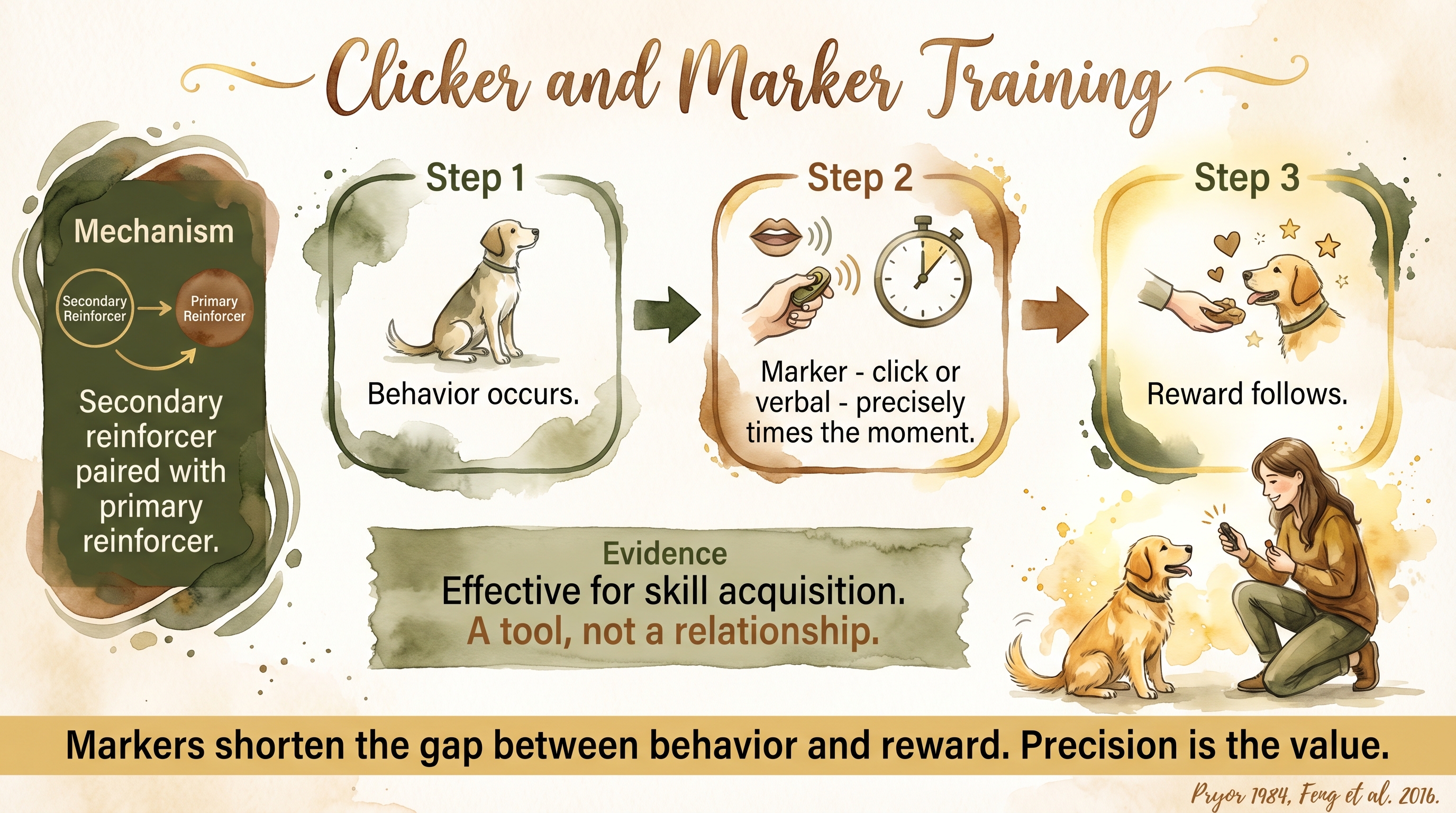
Markers shorten the gap between behavior and reward - precision is the value.
Key Takeaways
- Clicker and marker training use a conditioned signal to mark the exact moment a desired behavior occurs.
- The method is genuinely valuable where timing and tiny behavior slices matter.
- Its most common failure mode is not the clicker itself but inconsistent human delivery and overreach about what the method can explain.
- JB sees marker systems as excellent teaching tools and incomplete models of whole-dog development.
The Evidence
This entry uses observed claim-level tags beyond the dedicated EvidenceBlocks below. These tags mark JB program observation or practice-derived claims that need dedicated EvidenceBlock coverage in a later content pass.
- companion dogs
Supports the broader point that reward-based acquisition methods work partly through clearer timing and lower welfare cost than aversive-heavy systems. - Pryor's public marker-training lineage as summarized in the source layerdog-training history
Documents the historical migration of clicker logic from marine-mammal work into mainstream dog training. - Fugazza & Miklosi (2015)companion dogs
Provides a useful comparison point showing that social learning can outperform shaping/clicker methods for some tasks, which helps define clicker work as a tool rather than a complete learning theory. - companion dogs
Supports the broader JB caution that canine social cognition includes channels richer than conditioned reinforcement alone.
- domestic dogs
No published long-term study directly compares clicker and marker training against structured relational raising and no-intervention controls across ordinary companion-dog homes.
SCR References
Sources
- Pryor, K. (1984). Don't Shoot the Dog!
- Fugazza, C., & Miklosi, A. (2015). Applied Animal Behaviour Science.