Service Animal Law Under the ADA
Service-animal law under the Americans with Disabilities Act is one of the most widely discussed and most widely misunderstood legal topics in the dog world. Families hear phrases like "service dog," "therapy dog," "ESA," and "registration," then encounter contradictory advice online about access rights. The ADA itself is actually much narrower and clearer than the internet makes it sound. For most public-access questions, the law is not asking whether a dog is emotionally comforting, impressive, expensive, or certified. It is asking whether the dog is individually trained to do work or perform tasks for a person with a disability. Documented
DOJ's current ADA guidance states that service animals are dogs of any breed or size trained to perform tasks directly related to a person's disability. Documented The same guidance also says what service animals are not. They are not required to be professionally trained, not required to wear a vest, and not required to have a state-issued certificate or online registration document. Businesses and state or local governments generally must allow them where the public can go, even if the place has a no-pets policy.
That clarity matters because the legal benefits are significant. A genuine service dog team has broad public-access rights under Title II and Title III settings, while emotional support animals do not receive those same ADA public-access protections. DOT rules for airlines also changed on December 2, 2020, and now follow a service-dog model close to the ADA rather than the older emotional-support-animal framework. If people blur these systems together, they make bad legal assumptions in airports, stores, housing disputes, and routine public life.
For a family knowledge base, the goal is not to turn owners into amateur lawyers. The goal is to keep the definitions clean enough that families do not accidentally misuse a disability-rights framework or misread what public access does and does not mean.
What It Means
What the ADA Actually Defines
The ADA's current guidance is direct. A service animal is a dog trained to do work or perform tasks for the benefit of an individual with a disability. DOJ's service-animal page adds several clarifiers that matter in everyday life: the dog can be any breed or size, certification is not required, a vest is not required, and businesses may not demand documentation as a condition of entry. Those are named legal facts, and they cut through much of the internet folklore immediately.
Task training is the central hinge. The ADA FAQ gives a useful example in the anxiety context. If a dog has been trained to sense an oncoming anxiety attack and take a specific action that helps avoid or lessen it, that can qualify as service work. If the dog's mere presence is comforting, that is not an ADA service animal. The difference is not whether the disability is visible or invisible. The difference is trained task performance.
What Businesses Are Allowed to Ask
One of the most practical pieces of ADA guidance is the two-question rule. When it is not obvious that the dog is a service animal, staff may ask only two questions: whether the dog is required because of a disability, and what work or task the dog has been trained to perform. They may not ask for documentation, require the dog to demonstrate the task, or ask about the nature of the person's disability.
That rule protects both sides. It gives businesses a lawful way to screen without forcing handlers to disclose private medical details. It also means that internet claims about "papers" or "service-dog certificates" are usually legally misplaced in ordinary ADA public-accommodation settings.
When a Service Dog Can Still Be Excluded
Public access does not mean unlimited access under every condition. ADA guidance allows exclusion when a service dog is out of control and the handler does not take effective action to control it, when the animal poses a direct threat to health or safety, or when its presence would fundamentally alter the nature of the service. Documented A sterile operating room is the classic example of the last category. The ADA protects access. It does not erase all safety and function limits.
This matters because some public discussion treats the legal status as if it removed all behavioral expectations. Documented The opposite is closer to the truth. A service dog still has to function in public. The handler remains responsible for care, supervision, toileting, and overall control.
Service-animal law is one of those areas where a small definitional mistake creates a large practical mistake. The right question is not whether the dog helps emotionally. The right question is what the dog is trained to do.
How the ADA Differs From Air Travel and Other Systems
The ADA is not the only relevant legal regime, which is why confusion spreads so easily. DOT's service-animal rules under the Air Carrier Access Act were revised on December 2, 2020. The current federal air-travel rule defines a service animal as a dog individually trained to do work or tasks for a qualified person with a disability, no longer recognizes emotional support animals as service animals, allows airlines to require DOT forms, and permits airlines to limit handlers to two service dogs. That is close to the ADA approach but not identical in procedure.
The housing system is different again. Under HUD's assistance-animal guidance, emotional support animals can qualify for reasonable accommodation in housing even though they do not have ADA public-access rights. That is why families need to keep legal categories separate rather than collapsing them into a general feeling that a helpful dog should be allowed everywhere.
Why It Matters for Your Dog
Most Golden Retriever families are not raising ADA service dogs. That makes this law easy to ignore, but it still matters for two reasons. First, some families do live with disabilities and may genuinely need to understand the service-dog framework. Second, even families with no intention of training a service dog move through a public world shaped by these rules and the backlash around them.
Goldens are common service-dog prospects because of their sociability, biddability, handler focus, and physical capacity. That means Golden families may encounter this topic more often than some other breed communities, whether through formal training organizations, public-access conversations, or simple curiosity about whether a particularly steady dog "could be a service dog." The law matters because admiration for the breed is not a legal category. Task training and disability-related purpose are.
A practical example helps. Imagine a calm Golden that naturally lies against a handler during stressful moments and makes the person feel safer. Many people online would casually call that a service dog. Legally, the analysis is more precise. Has the dog been individually trained to perform a specific task related to the disability, such as interrupting self-harm, retrieving medication, guiding around obstacles, or providing trained pressure on cue in a way tied to disability mitigation? If not, the dog may be emotionally valuable without qualifying for ADA public-access status.
That distinction protects legitimate teams. Fraudulent or sloppy claims make life harder for disabled handlers because businesses and the public become more skeptical. When people buy fake registrations, put "service dog" patches on pets, or insist that comfort alone creates public-access rights, they do more than bend rules. Documented They increase friction for people whose dogs truly are working under legal protection.
The law also matters because public access is demanding. A Golden that is kind, clever, and well loved is still not ready for service-dog work if it cannot remain under control in busy stores, around food, in medical settings, or during long transport. The legal definition is only part of the picture. The working standard is equally high.
Families should also understand that ADA status does not exempt a service dog from ordinary public-health rules. DOJ's FAQ makes clear that service animals are still subject to local vaccination, licensing, and registration requirements. A handler with a legally protected service dog still has to comply with those basic civic rules.
There is another reason this entry matters for ordinary pet homes. Public misunderstanding around service dogs often spills into broad dog etiquette. Observed-JB People assume that a vest proves legal status, that any calm dog should be allowed in a store, or that challenging obvious misbehavior is anti-disability. The actual law is more disciplined. A properly trained service dog has broad access. A pet wearing equipment does not automatically enter that category.
For a Golden family considering service work seriously, the takeaway is sober and hopeful at once. Goldens can be excellent candidates. The pathway is real. It is also demanding, disability-specific, and not reducible to temperament alone.
Fraud and confusion create practical fallout long before a courtroom appears. Businesses train staff badly, disabled handlers face more suspicion, and ordinary pet owners get tempted into thinking a vest or internet certificate will smooth over access friction. The law does not support that shortcut. More importantly, the shortcut makes public life harder for teams whose dogs genuinely are working under legal protection.
Task specificity matters here because the public often hears broad emotional language where the law requires something more exact. "My dog helps my anxiety" may be deeply true and still legally incomplete. The clearer question is what the dog has been trained to do when the disability-related event occurs. That precision protects everyone involved, including the dog, because it ties public access to real work rather than to admiration or sympathy.
Working reliability matters for the same reason. A legally qualifying task is not the whole picture if the dog cannot remain under control in the environments where access is being claimed. Public access asks a great deal of the animal and the handler at once. Families considering the path seriously should expect the standard to include neutrality, recoverability, and steadiness around ordinary public pressure, not only the existence of a named task.
That honesty matters when candidates do not make it. Some well-bred, well-loved dogs are not suited for sustained public-access work, and pretending otherwise helps no one. Respecting the category includes respecting the possibility that a promising dog may still be better as a beloved pet than as a working service animal in demanding public settings.
What This Means for a JB Family
For a JB family, the main takeaway is precision. Do not use "service dog" as a compliment. Do not use it as shorthand for "very well behaved." Do not use it as a workaround for pet rules. Use it only when the legal standard is actually met.
That precision serves both ethics and practicality. It respects disabled handlers, keeps the family from making false assumptions in public spaces, and prevents the dog from being placed into settings it has not been trained to navigate. A household that stays honest about the category usually makes better decisions for the dog as well as for the public.
If a JB family truly is pursuing service-dog work, the dog's raising environment matters enormously. Calmness, social stability, environmental neutrality, recoverability, and clear adult guidance all matter long before formal task training is layered on top. The law does not replace that developmental foundation. It assumes the team will eventually meet it.
If the family is not pursuing service work, the rule is even simpler. Respect the category, teach your Golden good public manners, and do not borrow disability-law language for convenience. The cleaner the language stays, the better the public environment is for the teams who actually need its protections.
That discipline in language is part of ordinary respect. A service dog is not a compliment category for an unusually steady pet. It names a legal and functional role inside a disability framework. Families who keep that distinction clean reduce confusion for staff, for the public, and for disabled handlers whose dogs have to move through those same spaces every day.
JB can support that clarity without hostility. The point is not to turn every public encounter into a legal argument. It is to keep categories accurate, expectations realistic, and dogs out of roles they have not been trained to carry. Precision here is both lawful and humane.
That is also how families protect the dignity of the teams who genuinely rely on this framework every day. It keeps the law serving its real purpose instead of becoming one more loose dog-culture slogan. That clarity is a courtesy to the dog as much as to the public, and it keeps admiration for a good dog from hardening into a legal claim the team cannot actually support. That is a cleaner outcome for handlers, businesses, and working dogs alike, and it is a kinder one in practice for everyone involved in the encounter, and the dog stays inside work it performs.
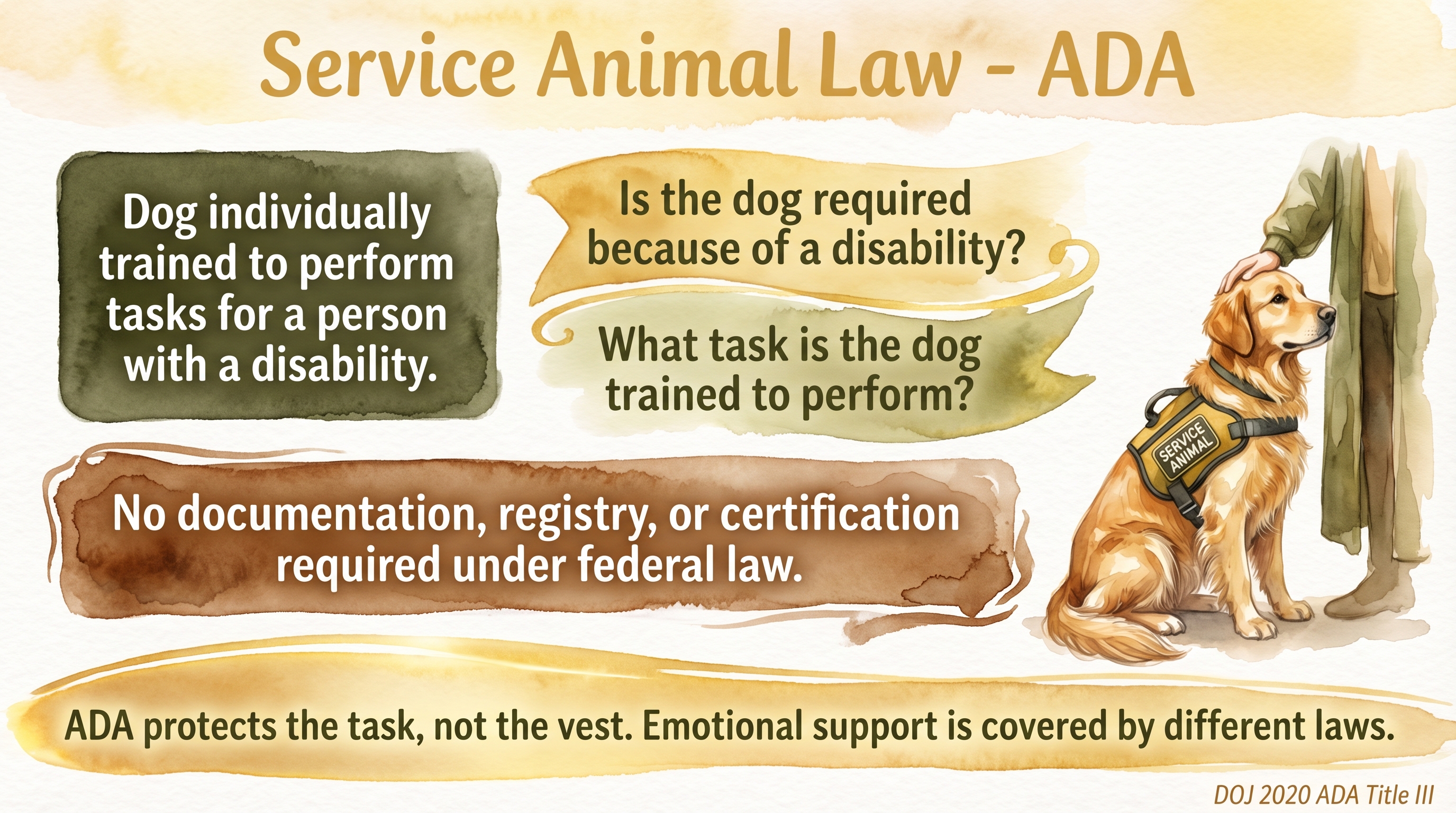
ADA protects the task, not the vest - emotional support is covered by different laws.
Key Takeaways
- Under the ADA, a service animal is a dog individually trained to do work or perform tasks for a person with a disability.
- Businesses may usually ask only two questions, and they may not demand papers, proof, or task demonstrations.
- Emotional support animals do not receive ADA public-access rights, even though housing law may treat them differently.
- For JB families, the most important discipline is to keep the category clean and not borrow service-dog language for convenience or praise.
The Evidence
This entry uses observed claim-level tags beyond the dedicated EvidenceBlocks below. These tags mark JB program observation or practice-derived claims that need dedicated EvidenceBlock coverage in a later content pass.
- DOJ ADA service-animal guidanceservice-dog law
Defines service animals as dogs individually trained to do work or tasks for a person with a disability, explains the two permissible questions, and clarifies that certification, vests, and professional training are not required. - DOJ ADA FAQservice-dog law
Distinguishes psychiatric service dogs from emotional support animals and confirms that service dogs remain subject to local vaccination and licensing rules. - DOT final rule and service-animal guidanceair-travel law
Document the December 2, 2020 ACAA rule change that stopped treating emotional support animals as service animals and allowed DOT forms for airline travel. - HUD assistance-animal guidancehousing law
Supports the narrower point that the housing framework is different from ADA public-access law, which is why families must keep the systems separate.
- domestic dogs
No published study directly measures how service animal law under the ada changes long-term dog welfare, family outcomes, and retention across jurisdictions and enforcement contexts.
SCR References
Sources
- U.S. Department of Justice. "Frequently Asked Questions about Service Animals and the ADA."
- U.S. Department of Justice. "ADA Requirements: Service Animals."
- U.S. Department of Transportation. "Service Animals."
- U.S. Department of Transportation. "Final Rule - Traveling by Air with Service Animals."
- HUD. "Assistance Animals."