Dog Regulation in the United States: An Overview
Dog regulation in the United States is not one system. It is a stack of systems. Families often picture "the law" as a single body of rules covering dogs in a uniform way. In practice, dogs sit inside a layered legal landscape where federal agencies regulate some narrow but important topics, states regulate broad ownership and public-health issues, and cities or counties control many of the rules ordinary families notice most in daily life. That structure is the first thing families need to understand. Documented
At the federal level, the big institutions are real but limited. USDA APHIS administers the Animal Welfare Act for regulated breeders, dealers, exhibitors, and transporters. FDA regulates pet food under the Federal Food, Drug, and Cosmetic Act. DOT governs airline accessibility and consumer rules around service animals and pet travel. CDC now controls major parts of dog importation into the United States, especially after the updated rule that took effect on August 1, 2024. Documented Those are important powers, but they do not create a comprehensive federal code for ordinary family dog ownership.
Most direct regulation of living with a dog happens below that level. State law usually determines core issues such as dog licensing frameworks, dangerous-dog processes, rabies compliance, breeder statutes, cruelty offenses, and bite liability structure. Local governments then add the rules families feel most concretely: leash rules, noise ordinances, kennel zoning, nuisance enforcement, and in some places breed restrictions.
The practical result is variation. A breeder in Massachusetts, a renter in Colorado, and a traveler bringing a dog into Hawaii are all living under different combinations of law. That is not a flaw in understanding. It is the actual structure of the system today.
What It Means
The Federal Layer Is a Floor, Not the Whole House
Federal dog regulation tends to be topic-specific. The Animal Welfare Act is the clearest example. It matters a great deal for certain commercial breeders and handlers, but it does not regulate ordinary pet ownership. APHIS's own licensing guide explains that direct sales of domestic pets to pet owners in person, where seller, buyer, and animal are physically present, are exempt regardless of sales volume. Documented That is one reason many small direct-to-family breeders sit outside the main federal licensing framework.
Federal oversight still matters in important ways. FDA regulates pet food and animal feed, requiring that animal food be safe, produced under sanitary conditions, free of harmful substances, and truthfully labeled. DOT regulates service animals in air travel under the ACAA and maintains separate consumer rules for pets on planes. CDC now plays a major role in dog importation, especially since the 2024 rule requiring all dogs entering the United States to appear healthy, be at least six months old, be microchipped, and be accompanied by a CDC Dog Import Form receipt.
Those federal systems are not minor. They simply do not answer most neighborhood-level dog questions. They do not tell a family whether its town requires a license tag on the collar, whether a landlord can restrict pets, whether a county has a leash rule in parks, or how a dangerous-dog hearing works after a bite. Those questions almost always drop to state or local law.
State Law Handles the Core Ownership Framework
State law is where dog ownership starts to feel personal. States commonly regulate rabies vaccination, dog licensing structure, dangerous-dog procedures, civil liability for bites, import requirements, breeder categories, cruelty offenses, and kennel definitions. Massachusetts is a useful example because the General Laws define commercial boarding or training kennels, commercial breeder kennels, and personal kennels in Chapter 140 section 136A. That kind of definitional work shapes which operations need local licenses and what rules apply to them.
State law also matters because it often sets the procedural backbone for what happens after something goes wrong. Dangerous-dog hearings, appeals, confinement rules, vaccination enforcement, and some breeder standards all tend to live here rather than at the federal level. The family therefore cannot safely assume that a national article, a social-media explainer, or a neighboring state's rule applies to their own situation.
The JB source layer also highlights the New England service area directly. Massachusetts, Maine, New Hampshire, Connecticut, Rhode Island, and Vermont all lack trainer licensure, but each state still has its own wider dog-law environment around licensing, rabies, liability, kennels, or special-purpose animal rules. That is exactly why "the law on dogs" is too broad a phrase to be useful without jurisdiction attached.
Local Governments Shape Everyday Compliance
Most day-to-day owner contact with dog regulation happens locally. Municipal or county governments usually manage dog licensing administration, off-leash rules, nuisance complaints, noise issues, local park restrictions, and some zoning questions around kennel operation or animal density. In some places they also maintain breed-specific or breed-restricted ordinances if state law permits them.
This matters because local rules are the ones families are most likely to break by accident. A federal breeder-license issue is rare for an ordinary owner. A local leash citation, an expired municipal license, a housing conflict, or a park-use violation is common by comparison. The legal architecture is therefore upside down from what many people expect. The most visible rules are often the most local.
Dog law makes more sense when families ask, "Which layer is this?" before asking, "What is the rule?" Federal, state, and local systems answer different questions.
Why Jurisdictional Variation Is the Real Story
APHIS says it directly on its interstate pet-travel page: domestic movement requirements are set by the receiving state or territory. That sentence captures the whole regulatory landscape well. Even where federal agencies matter, the practical rule often depends on where the dog is going, where the owner lives, or which property controls access. Heuristic
That is why sweeping statements about dog law are often misleading. The best legal summary is usually a map, not a slogan. Federal law gives a floor in narrow domains. State law carries the main ownership structure. Local law controls much of the daily texture.
Why It Matters for Your Dog
A Golden Retriever family rarely sits down hoping to study federalism. Documented What they need is enough legal literacy to avoid preventable mistakes.
That starts with understanding where risk actually lives. If the family is buying dog food, FDA rules matter. If they are choosing a breeder, state kennel and federal AWA issues may matter depending on the breeder's business model. If they are flying with a service dog, DOT rules matter. If they are importing a dog into the United States, CDC and APHIS rules matter. If they are walking through the neighborhood or local conservation land, local leash law probably matters more than anything in Washington.
A practical example shows the layering clearly. Suppose a Massachusetts family buys a Golden puppy from a small breeder who sells directly to pet homes, later licenses the dog with the city, travels interstate for vacation, rents a cottage that has a pet rule, and eventually flies once with the dog. That one dog's life has already touched a federal breeder exemption question, state licensing and rabies structure, local municipal licensing, local housing rules, interstate travel requirements set by a receiving state, and federal airline or accessibility rules. None of those rules fully replaces the others.
This matters for breeders too. A breeder may correctly understand Massachusetts kennel definitions and still need to know the receiving state's import requirements if a puppy is traveling. A family may assume that because a breeder is not USDA licensed the breeder is operating illegally, when in fact direct in-person sales may fall into a federal exemption. Another family may assume the opposite and conclude that lack of federal licensure proves quality, which is equally wrong. The legal floor and the quality judgment are different questions.
The overview also protects families from the opposite problem: overconfidence. Many adults casually assume that if a dog-related practice were risky, "it would be illegal." In this space, that is not a safe assumption. Much of dog life is regulated lightly, indirectly, or not at all until a problem occurs. Weak regulation does not mean weak consequences. It means the family often carries more preventative responsibility.
Golden families benefit from this awareness because Goldens are often easy enough socially that owners can drift into informality. The dog is friendly, so they stop thinking about local leash rules. The breeder seems wonderful, so they never ask about legal category or health-record transport. The rental looks dog-friendly, so they do not verify the written policy. The airline allows pets, so they forget that service-animal law and pet-carrier rules are different systems. Most of the time, nothing dramatic happens. When something does, the household discovers too late that it was relying on assumptions instead of rules.
There is also a calmer use of this entry. Knowing the legal landscape helps families avoid unnecessary fear. Not every dog issue is a federal matter. Not every breeder question needs a federal enforcement frame. Not every housing problem implicates disability law. Once the layers are understood, the family can usually narrow the right question much faster.
This layered awareness becomes especially valuable in stressful moments. A lost dog may become a local animal-control and licensing issue before it is anything else. Documented A bite incident may move first through municipal reporting or state dangerous-dog procedure. A move across state lines may turn on animal-health paperwork rather than on ordinary ownership law. Families who know which layer governs the event can respond faster and with less panic.
Records matter for the same reason. Rabies certificates, municipal licenses, health certificates, travel forms, proof of vaccination, and written housing policies all belong to different legal moments, but they are easier to manage when the family already understands the map. Legal literacy is not only about knowing abstract rules. It is about keeping the right documents ready for the type of question that is most likely to arise.
That is especially relevant in New England, where families routinely cross state lines for breeders, veterinary specialists, vacations, or second homes. The dog may sleep in Massachusetts, hike in New Hampshire, board in Maine, and fly from Boston. A household that assumes one familiar rule follows the dog everywhere is more exposed than a household that treats each step as a separate jurisdictional check.
For a JB audience, this overview supports better stewardship. Raising a dog well includes knowing which rules govern transport, housing, health compliance, public access, and basic civic obligations. That kind of practical literacy reduces friction for the family and often makes life safer for the dog.
What This Means for a JB Family
For a JB family, the biggest takeaway is that dog law must be read at the right layer. Federal law matters, but it usually governs narrow domains. State and local rules are where most ordinary family obligations live. That one mental shift prevents a lot of confusion.
It also reinforces JB's general caution against mistaking the legal floor for the moral or developmental standard. A breeder or trainer can be operating legally and still fall below what a family should want. A family can also be acting with good intentions and still overlook a very ordinary licensing or travel requirement. Legal compliance and good raising overlap, but they are not the same category.
Practically, JB families should build the habit of checking jurisdiction before acting. Which state? Which town? Which park system? Which airline? Which housing type? Which agency? That sounds bureaucratic until it prevents the wrong assumption at the wrong time.
JB also benefits from treating primary sources as the default for legal questions. A social-media explainer may be a helpful pointer, but the family should still end up at the statute, the agency FAQ, the posted park rule, or the written lease language. That habit is slower by a few minutes and safer by a mile.
There is a prevention principle underneath all of this. Legal problems with dogs rarely feel legal at first. They feel like travel plans, neighborhood routines, lease logistics, a breeder conversation, or a question at a store counter. Adults who read the governing layer early prevent the escalation in which a small misunderstanding turns into a citation, denied boarding, housing dispute, or public-access confrontation.
One practical way to live this out is to keep a simple dog-law folder. Rabies certificate, municipal license, microchip details, travel forms, lease language, and any accommodation records can all live in one place. That does not make the family legal experts. It makes them easier to help when a rule suddenly matters.
The calmer and better-prepared household is usually the one that treats regulation as navigation, not as background noise. That is all this overview is trying to provide: the map before the family starts asking for directions.
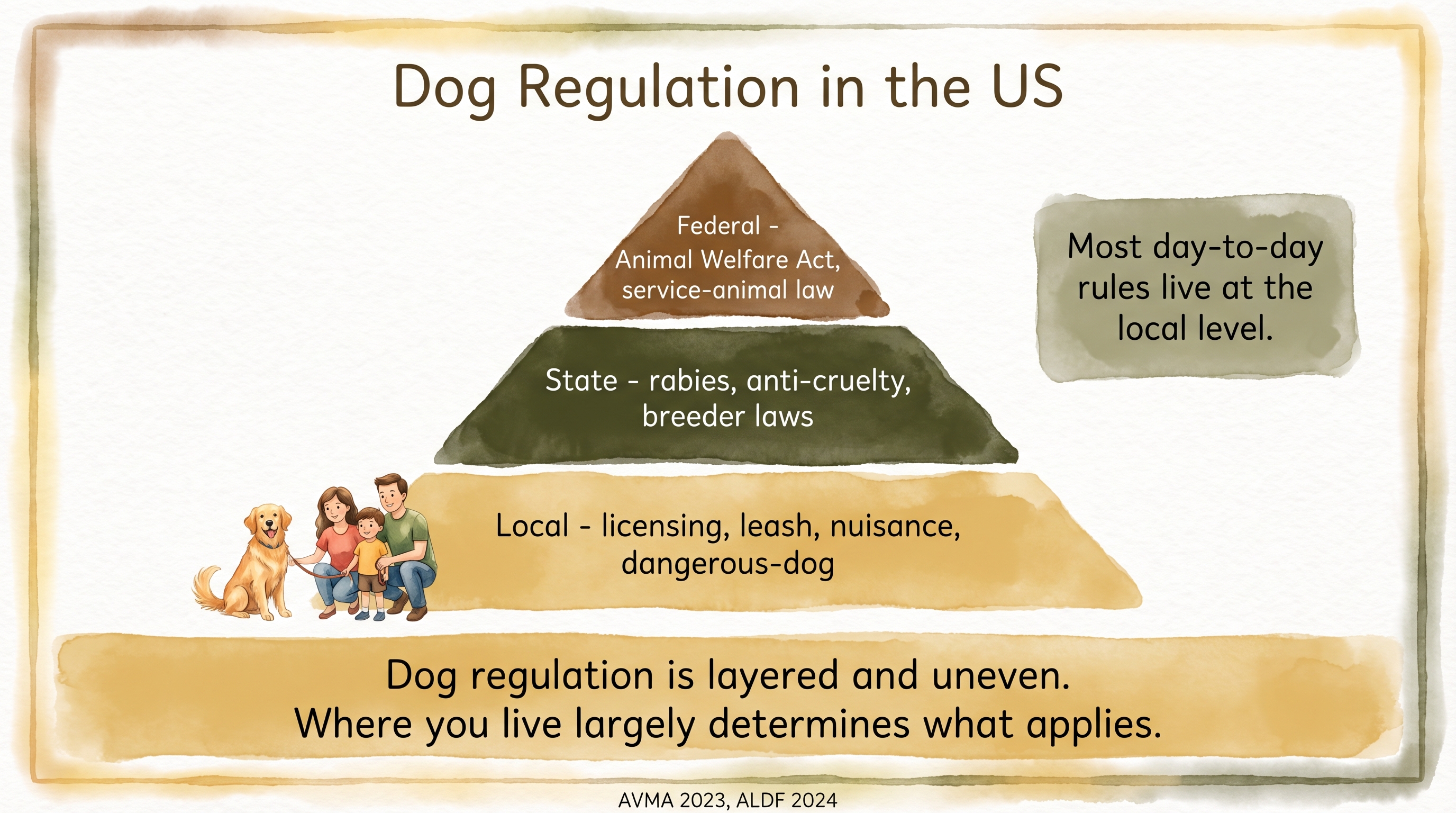
Dog regulation is layered and uneven - where you live largely determines what applies.
Key Takeaways
- Dog law in the United States is layered: federal agencies handle narrow national domains, states control much of the ownership framework, and local governments shape everyday compliance.
- Most direct regulation of ordinary dog ownership happens at the state and local levels, not through one uniform national dog code.
- Families and breeders get into trouble when they assume one legal layer answers every dog question.
- For JB families, the practical habit is simple: identify the governing jurisdiction before assuming you know the rule.
The Evidence
This entry uses heuristic claim-level tags beyond the dedicated EvidenceBlocks below. These tags mark JB interpretive application rather than direct study findings.
- dog regulation
Documents the broad distinction between federal limits, state ownership frameworks, local enforcement, and the absence of trainer licensure in the United States. - USDA APHIS licensing guide and pet-travel pagesanimal welfare and pet travel
Show that direct in-person sales of pets are federally exempt under the AWA framework and that interstate movement requirements are set by the receiving state or territory. - FDA pet-food regulation pagespet food regulation
Document the federal role in pet-food safety, labeling, and sanitary production. - CDC and DOT dog-travel materialsdog import and air travel regulation
Support the current federal role in dog importation and service-animal air travel.
- domestic dogs
No published study directly measures how dog regulation in the united states: an overview changes long-term dog welfare, family outcomes, and retention across jurisdictions and enforcement contexts.
SCR References
Sources
- USDA APHIS. "Licensing and Registration Under the Animal Welfare Act."
- USDA APHIS. "Travel With a Pet."
- USDA APHIS. "Take a Pet From One U.S. State or Territory to Another."
- FDA. "Pet Food."
- CDC. "CDC Updates Dog Importation Regulation; New Rules Will Start August 1, 2024."
- U.S. Department of Transportation. "Service Animals."
- Massachusetts General Laws, Chapter 140, sections 136A and 137.