Emotional Support Animal Law
Emotional support animal law is one of the most emotionally charged corners of the dog-regulation landscape because it sits at the intersection of disability, housing, mental health, and public skepticism. The category is real. So is the abuse. Families therefore need a definition that is accurate enough to respect legitimate need without importing rights the law does not actually grant. Documented
An emotional support animal, in ordinary legal use, is an animal whose presence alleviates symptoms of a person's disability and is needed as a reasonable accommodation in housing. The key federal framework is not the ADA public-access system. It is the Fair Housing Act, together with HUD guidance and, in some settings, section 504 of the Rehabilitation Act. That legal placement matters because it immediately answers one of the most common questions: an ESA is not an ADA service animal for ordinary public accommodations.
This distinction became even more important after the Department of Transportation's December 2, 2020 final rule under the Air Carrier Access Act. That rule stopped treating emotional support animals as service animals for airline purposes. Documented In practical terms, that means the old internet idea that an ESA letter unlocks air travel or broad public access is out of date.
The housing role remains real, though. HUD's guidance says a housing provider may have to grant a reasonable accommodation for an assistance animal, including an emotional support animal, even when the property has a no-pets rule or pet-related restrictions. That is why the category still matters so much in family life, especially for renters. It also matters because landlords, neighbors, airlines, and businesses are often talking past one another when they publicly use the same three letters.
What It Means
The ESA Category Lives in Housing Law, Not Public-Access Law
The first thing families need to separate is legal domain. ESA law is mainly a housing accommodation issue. DOJ's ADA guidance excludes emotional support animals from ordinary ADA service-animal status because comfort by presence alone is not enough for ADA public access. Documented HUD guidance, by contrast, recognizes that an assistance animal may provide disability-related support in housing even if it is not individually trained to perform a task.
That difference is not a loophole. It reflects different legal aims. Public-accommodation law is about broad access to stores, restaurants, and public-facing spaces. Housing law is about the right of a person with a disability to use and enjoy a dwelling. The standards overlap in some moral ways but not in definition.
What Housing Providers May Ask For
HUD's current assistance-animal guidance gives a practical framework. If the disability and disability-related need are obvious, a housing provider should not ask for more information. If they are not obvious, the provider may request reliable documentation that the person has a disability and a disability-related need for the animal. The provider may not require a particular government certificate, may not demand special training for an ESA, and may not rely on internet registration papers as if they were legal proof.
That documentation question is one reason online ESA-letter mills became so prominent. They offered quick letters to people who wanted housing exceptions without a real therapeutic relationship. HUD's guidance directly warns housing providers to assess whether documentation is reliable and whether it reflects personal knowledge from a health-care professional acting within the scope of that profession. Documented
What Protections ESAs Do Not Have
The negative space around ESA law is as important as the positive. ESAs do not have ordinary ADA public-access rights. Businesses do not have to admit them just because they provide emotional support. Airlines do not have to treat them as service animals under the current federal air-travel rule. There is no federal legal status created by buying a vest, purchasing an online registration card, or printing a badge from a website.
That matters because a great deal of public confusion begins when people treat the ESA category as a general-purpose dog exemption. Documented Legally, it is narrower than that. The housing framework is the central protection.
ESA law works best when families keep the category exactly where the law keeps it. Housing accommodation is not the same thing as public access, and internet paperwork is not the same thing as a legal framework.
Why the Category Is Both Necessary and Contested
The conflict around ESAs comes from the fact that both sides of the public argument contain truth. Emotional support from an animal can be profoundly real for people living with psychiatric disability, trauma, or chronic mental-health conditions. At the same time, the category has been stretched and marketed in ways that damaged public trust. Once letter mills and fake-certification sites spread, landlords, airlines, and businesses became more skeptical across the board.
That skepticism does not erase legitimate ESA use. It does mean families should approach the topic honestly and avoid making the category carry rights it does not have.
The safest way to think about the category is narrow and specific. An ESA claim is strongest when it rests on a real disability-related housing need, reliable documentation when required, and a dog whose presence actually supports stable life in the home. The farther the claim drifts from that core, the more likely the family is leaning on internet folklore instead of law.
Why It Matters for Your Dog
For a Golden Retriever family, ESA law matters most in housing and almost nowhere else. That simple sentence clears away a lot of confusion.
Goldens are affectionate, people-oriented, and often deeply regulating to live with. That makes them plausible emotional support animals in the ordinary human sense of the phrase. Heuristic Yet the legal category still turns on disability-related need in housing, not on the dog's sweetness, obedience, or general therapeutic vibe.
A practical example helps. Suppose a renter with a documented anxiety disorder or depression finds that living with a calm Golden materially stabilizes daily functioning, sleep, or panic management at home. That may fit the housing-accommodation logic well. The same fact does not turn the dog into an ADA service animal for restaurants or stores. If the family keeps those categories separate, decisions become much cleaner.
This distinction also protects the dog. A Golden wearing an ESA vest into crowded public environments may be pushed into work the law does not require and the dog may not be prepared to handle. That is unfair to the dog and confusing for everyone around the team.
Families should also understand the landlord side. A landlord may still ask for reliable documentation when the disability-related need is not obvious, and a housing provider can deny a requested accommodation in some limited circumstances such as direct threat or undue financial or administrative burden. The law is protective, but it is not a blank check.
The online-letter problem matters at family level too. People under housing pressure are vulnerable to easy promises, and ESA-mill websites know it. A family should be cautious about any service selling instant legality. Real housing accommodation is stronger when it rests on truthful disability documentation and a genuine treatment relationship.
There is another practical reason this entry matters for Golden owners. Because the breed is widely welcomed and emotionally connective, families may underestimate how quickly legal categories get muddy once they rely on affection-based language. "He helps my anxiety" can be a deeply true personal statement. It is not by itself a complete legal argument.
For households that do legitimately need ESA accommodation, careful preparation helps. Keep records organized. Understand the housing provider's process. Stay clear and honest about what the dog is and is not. That steadier posture usually produces better outcomes than defensive improvisation.
Roommate and building culture matter more than families sometimes expect. A housing provider may grant the accommodation, and the day-to-day reality can still be stressful if hallways are crowded, elevator traffic is constant, or neighbors are fearful of dogs. Legal protection solves one problem. It does not erase the need for a dog who can live calmly in shared space.
Goldens can make this easier and harder at the same time. Their affectionate nature means they may genuinely provide meaningful emotional support at home. Their size, sociability, and adolescent enthusiasm can also create friction in apartments if the family mistakes the legal accommodation for proof that the dog is ready for any housing environment. The law helps keep the dog housed. Good raising helps keep the situation workable.
The online-letter industry deserves one more plain warning. Families under housing pressure are especially vulnerable to the promise of instant legitimacy, and those services market urgency aggressively. Yet a fast letter cannot substitute for understanding the actual rule, the landlord's lawful questions, or the responsibilities that continue once the dog is in the building. A shaky foundation makes the accommodation harder to defend and harder to live with.
There is also a long-term household question behind the paperwork. If the dog's regulation benefit depends on quiet companionship at home, then the family should protect the conditions that make that companionship real. Sleep, routine, toileting logistics, neighbor management, exercise, and calm re-entry into the apartment all affect whether the dog's presence remains stabilizing or becomes another source of stress. Housing accommodation gets the dog through the door. Daily stewardship determines whether the arrangement actually helps.
That is one reason honesty about the dog's actual behavior matters so much. A dog that barks through every hallway transition, panics when left alone, or creates repeated conflict with neighbors may still be emotionally beloved and still be a difficult housing fit. The family does not strengthen an ESA request by pretending those problems do not exist. It strengthens the overall situation by managing them directly and by making sure the dog can actually live in a way that supports the accommodation claim.
That practical honesty is often what separates a durable accommodation from a fragile one built on paperwork alone.
What This Means for a JB Family
For a JB family, the main takeaway is honesty with definitions. If the dog is functioning as an emotional support animal in housing, say that clearly and keep the claim inside that legal box. Do not stretch it into public-access language the law does not support.
This matters ethically as much as legally. It respects people with genuine disability-related need, protects disabled handlers of actual task-trained service dogs from additional skepticism, and keeps the Golden from being drafted into settings that are outside both its legal role and perhaps its behavioral preparation.
JB families also benefit from remembering that the best support dog in a home is often the one whose daily life is calm, structured, and relationally secure. A dog can be deeply stabilizing without becoming a public-rights project. That perspective keeps the family focused on the real therapeutic relationship rather than on exploiting the label.
If a family truly needs housing accommodation, the path is straightforward: use real documentation, know the scope of the protection, and keep the category clean. Precision makes life easier for everyone involved.
That precision also protects the dog from being asked to carry a social argument it never signed up for. A Golden that can settle well at home may still be overwhelmed by public venues, crowded travel, or high-pressure interactions. Keeping the claim inside housing law lets the dog remain what the law actually recognizes it as: support in the dwelling, not a universal-access animal.
JB can therefore treat ESA law as a narrow but legitimate accommodation path. The family does not need to apologize for a real need, and it also does not need to inflate the category to make that need sound more persuasive. Clean language, organized records, and a dog that can live peacefully in the home are the strongest combination.
That combination is often quieter than people expect. The strongest ESA cases are rarely the loudest or most theatrical ones. They are the ones where the need is real, the documentation is credible, and the dog's actual life in the dwelling supports the purpose the family is claiming.
JB can value that quietness. The goal is not to win a culture-war argument about dogs in public. The goal is to secure a stable home environment in which the dog genuinely supports the person's functioning. When the family remembers that, the legal category stays cleaner and the dog's role stays more humane.
That is usually the path that protects both the person's housing stability and the dog's daily quality of life. It keeps the accommodation anchored to home life, which is where the law actually intends it to work. That narrowness is not a weakness. It is what makes the category legible and defensible, and families usually do best when they let it stay that way. The dog, the landlord, and the neighbors usually do too because everyone reads the picture more clearly inside the home over time inside ordinary home life.
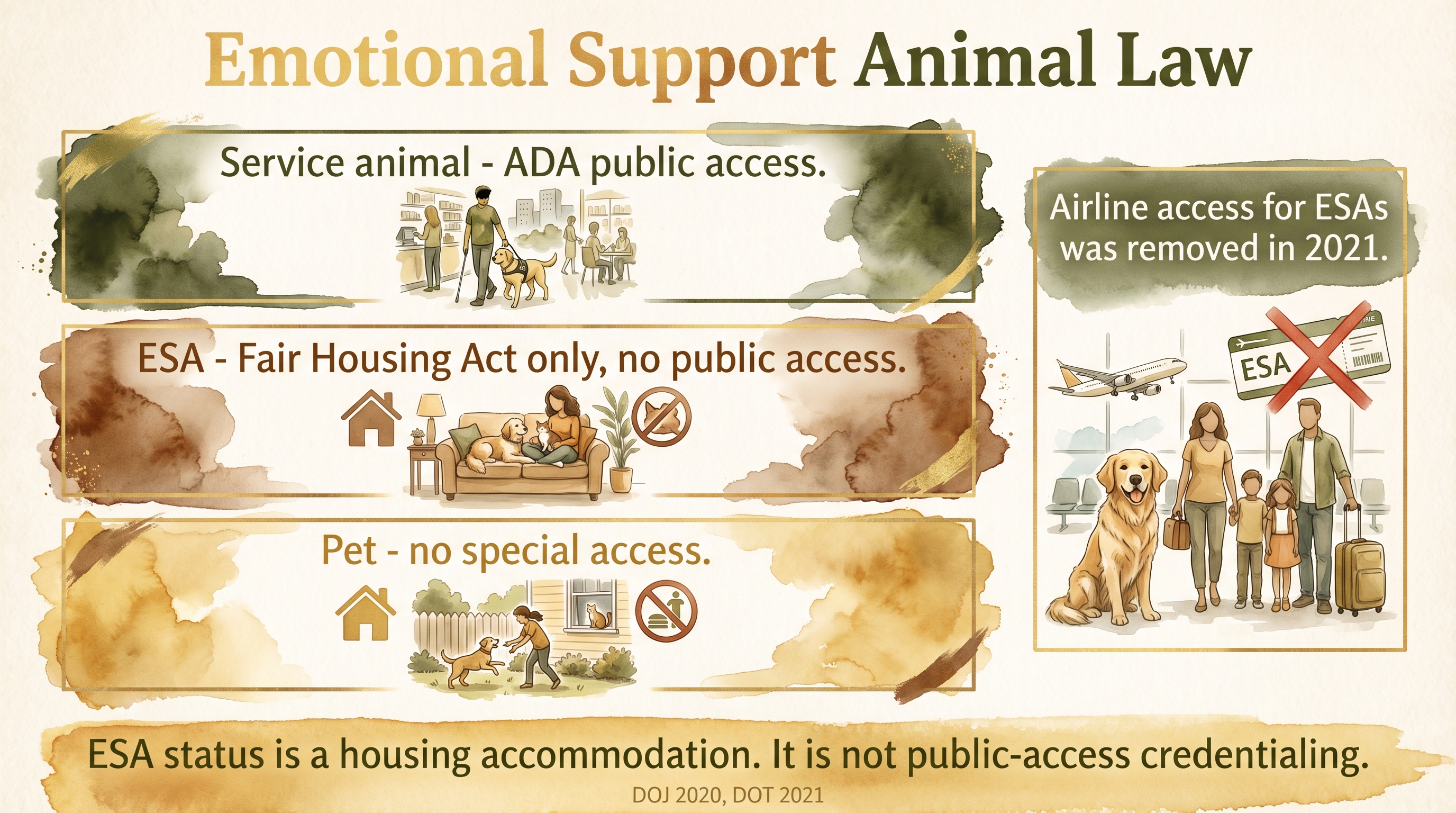
ESA status is a housing accommodation - it is not public-access credentialing.
Key Takeaways
- ESA law is mainly a housing-accommodation issue under the FHA and related federal guidance, not an ADA public-access system.
- Reliable documentation can matter when disability-related need is not obvious, but internet registrations and vests are not legal proof.
- ESAs do not have ordinary public-access rights and have not had federal airline-service-animal status since the December 2, 2020 DOT rule.
- For JB families, keeping the category narrow and honest is the most practical and ethical approach.
The Evidence
This entry uses heuristic claim-level tags beyond the dedicated EvidenceBlocks below. These tags mark JB interpretive application rather than direct study findings.
- HUD assistance-animal guidancehousing law
Documents the reasonable-accommodation framework, the role of reliable documentation, and the distinction between assistance animals and ordinary pets in housing. - DOJ ADA service-animal guidancepublic-accommodation law
Clarifies that emotional support animals are not ADA service animals because comfort by presence alone does not create public-access status. - DOT final rule on service animalsair-travel law
Documents the December 2, 2020 rule change under which airlines no longer have to treat emotional support animals as service animals. - Rehabilitation Act section 504 housing context as reflected in HUD materialsfederally assisted housing
Supports the narrower point that disability accommodation duties can also arise in certain federally assisted settings.
- domestic dogs
No published study directly measures how emotional support animal law changes long-term dog welfare, family outcomes, and retention across jurisdictions and enforcement contexts.
SCR References
Sources
- HUD. "Assistance Animals."
- U.S. Department of Justice. "Frequently Asked Questions about Service Animals and the ADA."
- U.S. Department of Transportation. "Final Rule - Traveling by Air with Service Animals."