Rental Housing Pet Policies and the Fair Housing Act
Compound evidence detail1 SCR / 2 parts
- Documentedthe three legally distinct rental-housing dog categories per HUD FHEO Notice 2020-01 and Fair Housing Act 42 USC sections 3601 through 3619: ordinary pet policy with discretionary fees and deposits, disability accommodation under the assistance-animal framework which prohibits fees for the assistance animal itself, and damage rules under ordinary security-deposit law applying regardless of animal classification
- Heuristicthe JB three-category framework for rental-housing dog disputes, an interpretive synthesis layered on the legal facts that downstream documents must not present as regulatory consensus, while preserving the HUD assistance-animal fee prohibition and the species-neutral damage liability principle
Rental housing is where many families discover that loving dogs and accommodating dogs are not the same thing. Landlords may genuinely like dogs and still impose no-pet rules, breed restrictions, size limits, pet rent, pet deposits, or insurance requirements. For ordinary pets, that is usually legal unless state or local law says otherwise. The complication is that housing law also contains disability-accommodation rules that can override standard pet policies in specific cases. Documented
The central legal framework is the Fair Housing Act. HUD's assistance-animal guidance makes clear that a housing provider may have to grant a reasonable accommodation for a service animal or emotional support animal even when the property has pet restrictions. Documented That is because assistance animals are not treated as pets in the ordinary policy sense when they are needed because of disability. This is one of the most important distinctions renters can understand before conflict starts.
At the same time, most rental housing questions are not assistance-animal disputes. They are ordinary lease questions. Can the tenant keep a dog at all? Are there breed or weight limits? Is there pet rent? Is there a refundable or nonrefundable fee? Are vaccinations required? Will the landlord require proof of renters insurance? Those issues vary by state, city, insurer, and building.
The cleanest way to think about the topic is to separate three boxes: ordinary pet policy, disability accommodation, and local or state fee rules. Families get into trouble when they assume one box answers all three.
Written terms matter because rental conflict often begins with assumptions rather than hostility. Observed-JB A family reads "pet-friendly," imagines flexibility, and only later meets the actual weight cap, fee schedule, insurance requirement, or documentation request that governs the unit in practice.
What It Means
Ordinary Pet Rules Usually Belong to the Landlord
As a starting point, landlords usually may set ordinary pet policies. They can choose to allow no dogs, some dogs, dogs under a certain weight, dogs outside certain breeds, or dogs only with deposits or monthly pet rent, subject to whatever state or local housing rules apply. Documented That is the baseline market reality for ordinary pets.
This matters because many renters assume dog-friendly culture has turned dog ownership into an implied tenant right. Documented It has not. Outside disability-accommodation law or special local restrictions, the lease and property rules usually control.
The Fair Housing Act Changes the Picture for Assistance Animals
The Fair Housing Act modifies that baseline where disability accommodation applies. HUD's assistance-animal guidance says a housing provider may need to make a reasonable accommodation for an assistance animal even if pets are otherwise banned or restricted. The provider may not simply apply a pet rule mechanically if the animal is needed because of disability.
That is where families need a second distinction. "Assistance animal" in housing may include both ADA-type service animals and emotional support animals. The legal issue in housing is not whether the dog qualifies for public access at restaurants. The issue is whether the tenant has a disability-related need for the animal in the dwelling.
Fees, Deposits, and Pet Rent Need Careful Reading
One of the most practical misunderstandings concerns money. For ordinary pets, landlords may often charge pet rent, pet deposits, or other pet-related fees if state or local law permits it. For assistance animals covered by fair-housing accommodation, HUD's guidance says housing providers may not charge pet fees or pet rent because the animal is not being treated as a pet for that purpose.
That does not mean a tenant with an assistance animal can ignore damage. If the dog causes actual property damage, the tenant can still be charged for that damage on the same basis as any other tenant-caused damage. The protection is against pet fees as a condition of accommodation, not against responsibility for real loss.
In rental housing, one of the most important legal distinctions is between a fee for having a pet and a charge for actual damage. The first may be barred for an assistance animal. The second is not automatically erased.
Why Documentation and Communication Matter
HUD's framework also explains why documentation questions become sensitive. If disability and disability-related need are not obvious, a housing provider may ask for reliable information supporting the request. That information does not need to be a magic form, and online registration documents are not the same thing as reliable support. What matters is whether the request is credible, disability-related, and presented in a way the provider can assess lawfully.
Good communication can prevent a great deal of conflict. Renters who know the category they are invoking, keep records organized, and speak clearly tend to have smoother interactions than renters who arrive with internet paperwork and expansive assumptions about what the label means.
Timing matters here too. Asking the right questions before signing a lease is very different from trying to renegotiate the whole relationship after the dog is already in the unit. Families who clarify policy, accommodation process, fees, and insurance expectations early are far less likely to create a crisis that feels personal but actually began as preventable ambiguity.
Why It Matters for Your Dog
Golden Retriever families often make housing decisions emotionally because the breed feels so obviously family-friendly. The dog is pleasant, affectionate, and usually a social asset. The lease may still say something else. That is why this topic matters before the puppy comes home, not after.
A practical example shows the stakes. A family signs a lease, assumes the "pet-friendly" listing covers a Golden, then discovers a weight cap, breed-screening policy, monthly pet rent, and proof-of-vaccination requirement. Another renter believes an ESA letter will solve every housing issue and then collides with a landlord who requests documentation properly but is treated like a villain by internet folklore. In both cases, the real problem is not malice. It is category confusion.
The dog's quality of life is on the line too. Housing mismatch creates instability. If a family brings home a Golden into a building with unrealistic pet policies, weak planning, or unresolved accommodation disputes, the dog enters a stressful environment from day one. A breed that thrives on social steadiness is being asked to live inside human uncertainty.
This is one reason JB places real value on calm, well-raised dogs in rental settings. Landlords are not irrational when they worry about noise, damage, nuisance complaints, and common-area conflict. A Golden who can settle, move politely through doors and hallways, and live cleanly with neighbors is not only easier to love. That dog is easier to house.
Families should also think beyond approval and ask about daily logistics. Where will the dog toilet? What are the elevator or stair rules? How close are neighbors? What does visitor traffic look like? What happens during work hours? A housing policy can allow dogs while the actual building culture remains a bad fit for the specific dog the family plans to raise.
For households with a genuine disability-related need for an assistance animal, preparation matters. The family should keep written communication organized, understand which law they are relying on, and avoid inflating claims. Clarity is stronger than indignation in most housing disputes.
Even for families without any accommodation issue, this entry matters because it reframes dog-friendly housing as a relationship, not a checkbox. Landlords often welcome dogs that are quiet, predictable, and well managed. They fear dogs that bring conflict into shared space. A family's raising choices therefore affect not only the dog but the durability of the housing arrangement itself.
The Golden-specific takeaway is therefore simple. Do not assume the breed's popularity solves the lease question for you. Verify the rules, understand the category, and remember that a calm dog strengthens the family's position far more than a clever legal argument after the fact.
Move-in logistics are part of the same picture. A building may allow dogs and still be a poor fit if the only toileting option requires an elevator ride through crowded hallways, if the stairwell amplifies barking, or if entry and exit happen through a lobby packed with delivery traffic. Families often focus on getting the dog approved and think too little about what daily management will feel like once the lease begins.
Insurance and breed-screening rules can add another layer even where the landlord is personally comfortable with dogs. A property manager may be constrained by carrier requirements, condo association rules, or owner directives that sit behind the leasing conversation. That does not erase the family's need. It does mean renters benefit from understanding which restrictions come from the lease itself and which come from a broader building or insurance structure.
Neighbors matter as well. Shared housing turns ordinary dog behavior into community behavior quickly. Hallway barking, lunging at doorways, frantic elevator greetings, or rough play on thin floors can strain a tenancy even when the dog is technically allowed. Families who prepare for those pressure points early usually protect both the dog and the housing relationship better than families who treat the lease as the end of the planning process.
Move-out and damage questions belong here too. A family may have a legally protected accommodation or a perfectly valid pet approval and still damage the relationship with the property through unmanaged scratching, urine issues, chewed trim, or repeated complaints. Housing law and housing trust overlap without being identical. The more orderly the dog's daily life is, the less likely the tenancy is to become a running negotiation about avoidable consequences.
The practical takeaway is that housing fit should be judged over time, not only at approval. A building that technically accepts dogs may still be exhausting if the family is improvising management every day, avoiding neighbors, or constantly apologizing for ordinary transitions. A good housing arrangement is one the dog can actually live inside without becoming a source of chronic conflict.
What This Means for a JB Family
For a JB family, housing should be treated as part of the raising environment. A good lease fit, clear rules, and a dog who can live politely with neighbors all support the larger goal of stability. That is true whether the dog is an ordinary pet or an assistance animal under housing law.
The practical order matters. First verify the written policy. Then understand whether any disability-accommodation framework genuinely applies. Then think about whether the building itself fits the dog you plan to raise. Families who reverse that order often end up trying to use legal language to solve a planning problem.
JB also sees rental life as a place where everyday raising pays off visibly. Heuristic A Golden who can settle, wait, move through shared spaces without spectacle, and recover quickly from stimulation is easier for landlords and neighbors to welcome. Good raising does not abolish the law, but it often makes ordinary housing life much smoother.
The final takeaway is simple. In housing, clarity early is kindness later. Know the policy, know the law, know the dog's actual needs, and do not assume those four things will sort themselves out after move-in.
That sequence protects the family from using legal language to solve a behavioral or planning problem that should have been solved upstream. A calm dog in a well-chosen building often needs very little legal drama. A poorly matched dog-building combination can make every ordinary rule feel adversarial.
JB can therefore treat housing as an extension of stewardship rather than as a bureaucratic obstacle course. The right lease, the right category, and the right daily management plan all support the same outcome: a dog who can live securely and quietly inside the family's real life.
That framing gives families a calmer way to choose. Instead of asking only whether a building will tolerate the dog, they can ask whether the building, the policy, and the dog's needs actually fit one another. The better that fit is on day one, the less likely the household is to need legal friction, emergency renegotiation, or wishful thinking later. That is usually the difference between merely winning permission and actually building stable housing life with a dog, and families who understand that difference usually make calmer moves and create calmer homes.
That is the sort of prevention that never looks dramatic and saves a great deal of future conflict. It also gives the dog something every good housing situation should provide: a life that feels settled instead of perpetually conditional. That is often what families were really looking for all along, because stable housing is a welfare issue too. The dog feels that stability every day, so does the rest of the household, and shared stability is usually what keeps the tenancy healthy over time for everyone involved in the building for dogs who must share walls, hallways, and routines.
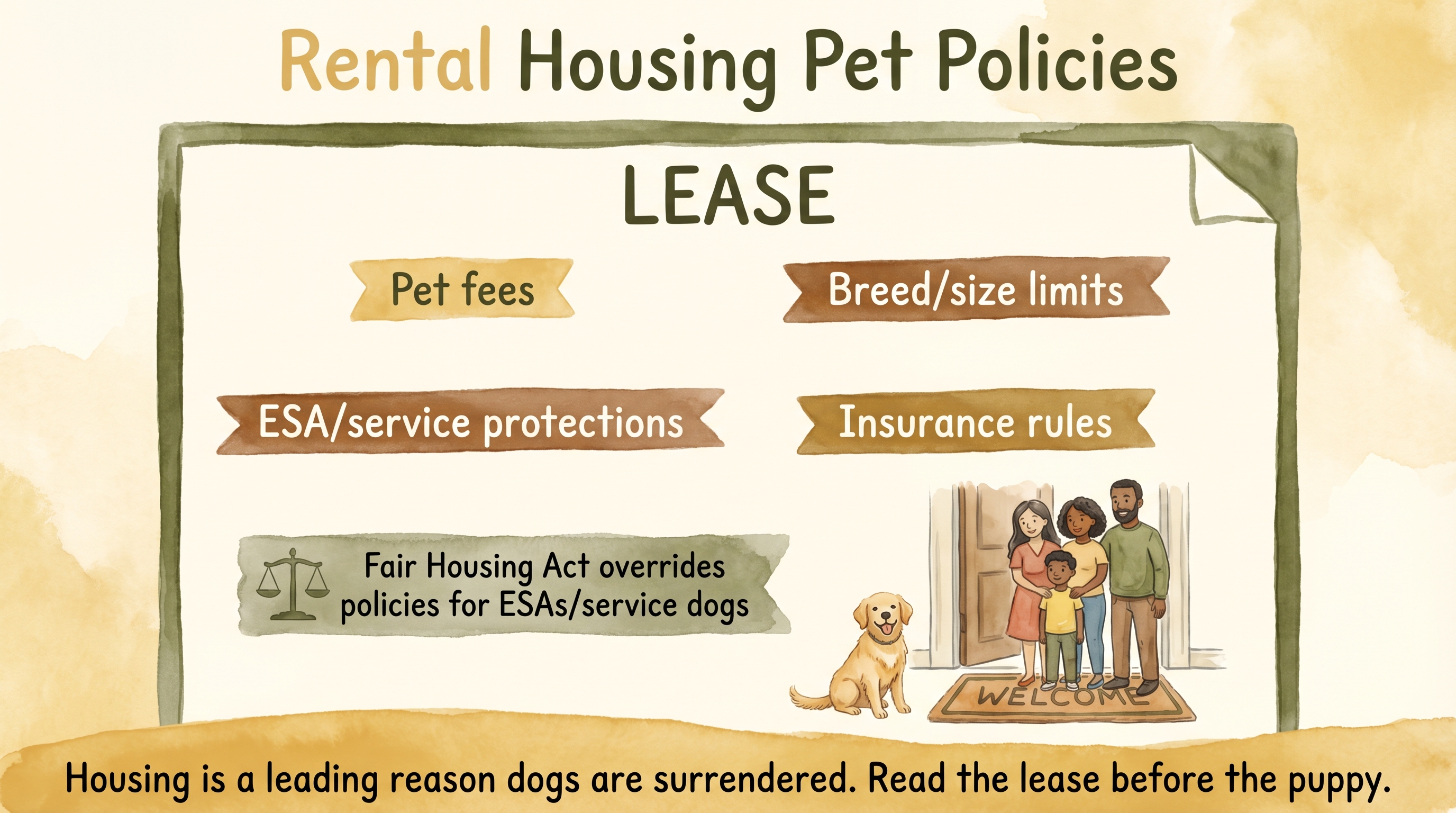
Housing is a leading reason dogs are surrendered - read the lease before the puppy.
Key Takeaways
- Ordinary pet policy in rental housing is usually set by the landlord, but fair-housing accommodation can change the result for assistance animals.
- Service animals and emotional support animals in housing are not treated simply as pets, which is why no-pet rules and pet fees may not automatically apply.
- Pet fees and actual damage charges are not the same thing, and families should keep that distinction clear.
- For JB families, the best housing outcome starts with a lease that fits the dog and a dog that can live calmly inside shared space.
The Evidence
This entry uses observed claim-level tags beyond the dedicated EvidenceBlocks below. These tags mark JB program observation or practice-derived claims that need dedicated EvidenceBlock coverage in a later content pass.
This entry uses heuristic claim-level tags beyond the dedicated EvidenceBlocks below. These tags mark JB interpretive application rather than direct study findings.
- HUD assistance-animal guidancehousing law
Documents the reasonable-accommodation framework for service animals and emotional support animals, including documentation and no-pet policy exceptions. - Fair Housing Act framework as reflected in HUD materialshousing discrimination law
Supports the claim that ordinary pet rules can be displaced where disability accommodation is required. - DOJ ADA guidancepublic-access law
Clarifies that ADA public-access rules are a different legal system from rental housing accommodation. - HUD fee guidance on assistance animalshousing fees
Supports the rule that pet fees or pet rent may not be charged for an assistance animal, while actual damage may still be charged.
- domestic dogs
No published study directly measures how rental housing pet policies and the fair housing act changes long-term dog welfare, family outcomes, and retention across jurisdictions and enforcement contexts.
SCR References
Sources
- HUD. "Assistance Animals."
- U.S. Department of Justice. "Frequently Asked Questions about Service Animals and the ADA."