Dog Travel Regulations: Air, International, and State
Dog travel law is another area where families often think there is one simple rule and discover instead that there are several different systems stacked together. Interstate travel, airline travel, international export, dog import, and Hawaii entry all run on different combinations of rules. The safest assumption is not that travel is easy because the dog is healthy. The safest assumption is that the destination controls. Documented
USDA APHIS says this explicitly on its interstate pet-travel page: when you travel with a pet, your destination state or territory may have animal health requirements such as a health certificate, vaccinations, testing, or treatment. APHIS does not regulate the interstate movement of pets by their owners; the receiving state or territory does. Documented That is one of the most useful travel facts a family can know.
Air travel adds another system. Service-dog travel on airlines follows DOT's current ACAA rule, while pets traveling in cabin or cargo follow airline-specific pet policies layered on top of broader federal consumer and animal-health rules. International travel adds APHIS export certificate procedures, destination-country vaccination and testing rules, and sometimes USDA endorsement. Hawaii is a special case again, with one of the strictest entry frameworks in the United States.
The practical meaning is simple: dog travel is governed less by one national dog-travel code than by a sequence of checkpoints. Airline, destination state, destination country, and island or quarantine rules all matter.
That sequence matters because families often plan travel in the reverse order. They book the trip first, then ask what the dog needs. With dogs, the safer approach is usually the opposite. Start with the destination rule, then work backward through airline policy, veterinary timing, document lead times, and the dog's actual ability to tolerate the trip.
What It Means
Interstate Travel Is Mostly a Destination-State Question
Families often underestimate interstate travel because it feels domestic and ordinary. APHIS's current guidance makes the structure clear. Destination states may require an official health certificate, updated vaccinations, diagnostic testing, or treatments, and questions should be directed to the receiving state animal health official. That means the family does not get legal certainty merely from leaving one U.S. state for another.
This is especially relevant for breeders and families moving puppies across state lines. A Certificate of Veterinary Inspection, often called a CVI or health certificate, is widely used in these moves even though everyday owner enforcement is uneven. The wise family behaves as if documentation matters before travel, not only after a dispute or inspection point.
Air Travel Splits Into Service-Dog Rules and Pet Rules
Air travel confuses families because two very different systems operate at once. A task-trained service dog traveling with a disabled handler falls under DOT's current ACAA service-animal framework. Pets and emotional support animals do not. For pets, airlines retain their own policies on carrier dimensions, cabin limits, embargoes, temperature or seasonal limits, and whether cargo travel is offered at all.
That airline-specific layer matters most for larger dogs. A Golden Retriever is rarely an in-cabin pet on major U.S. airlines. The family is therefore dealing with cargo restrictions, checked-pet rules where available, or simply the reality that some trips are poor fits for the dog. Brachycephalic breeds receive extra restrictions on many airlines because heat and airway risk are higher, but all dogs face carrier, weather, and safety constraints.
International Travel Is Paperwork-Heavy by Design
International travel is the place where families most clearly see APHIS's formal role. APHIS's pet-travel export pages direct owners to destination-country requirements, international health certificates, rabies documentation, and USDA endorsement where required. Documented Some countries require only a valid rabies certificate and health certificate. Others require microchips, waiting periods, tapeworm treatment, import permits, or rabies antibody titers.
The broad rule is therefore not "get one form." It is "check the destination country's official entry requirements early, then match the APHIS export process to them." That lead time matters because titer tests and waiting periods can turn a casual plan into a multi-month preparation project.
Travel with dogs works best when the family stops asking, "Can we take the dog?" and starts asking, "What does this exact destination require, and when do those requirements start?"
Hawaii Is the U.S. Special Case
Hawaii deserves separate treatment because its rabies-prevention framework is far stricter than ordinary mainland travel. The Hawaii Department of Agriculture requires advance preparation for direct airport release and quarantine alternatives, including microchip, rabies documentation, timing requirements, health certification, and pre-arrival submission steps. Families who assume Hawaii works like any other state can make expensive and upsetting mistakes quickly.
That is why Hawaii appears in nearly every serious dog-travel guide. It is the clearest domestic example of why destination-specific rule-checking matters.
Veterinary timing is one of the hidden practical issues underneath all of this. Health certificates expire, endorsements can take time, vaccine windows matter, and some destinations require steps that cannot be compressed at the last minute. Families who involve their veterinarian only after the trip is fully scheduled sometimes discover that the legal timeline and the human timeline no longer match. That alone justifies early planning.
Why It Matters for Your Dog
Golden Retriever families often discover dog-travel law at exactly the wrong moment: after booking flights, after planning a vacation, or after deciding to move. The dog then becomes a deadline problem rather than a planning problem.
For most Goldens, interstate car travel is the most common real-world scenario. A family drives from Massachusetts to Maine, Vermont, or farther south and assumes the only question is whether the dog likes the car. In reality, destination states may have import or health-certificate expectations even when roadside enforcement is uncommon. The family may never be stopped, but that is not the same thing as the rule not existing.
Air travel is even more practical because the dog's size changes the options immediately. A Golden usually does not fit the casual "small pet in cabin" picture. The family therefore has to think about whether the airline even transports larger dogs on that route, what weather embargoes exist, whether the dog is suited for the stress, and whether the trip is humane for that specific animal rather than merely technically possible.
A useful family-level observation is that travel law often intersects with dog welfare. A trip may be legal and still be a poor idea for the dog. Long delays, hot tarmacs, seasonal restrictions, unfamiliar handling, and separation from the owner matter in lived experience, not only in policy.
This is especially relevant for puppies. Families sometimes imagine taking a young Golden everywhere immediately, but travel rules often intersect with vaccination status, documentation, age, and stress tolerance. Observed-JB Even where the law permits the trip, the dog's developmental stage may make the trip unwise.
Hawaii shows the planning principle at its most dramatic. A family that starts checking the rules early can prepare calmly. A family that treats the dog like a suitcase addon may end up in quarantine or cancellation chaos. The same logic, in smaller form, applies to all dog travel.
For JB families, this topic also reinforces a broader truth: the dog's life should not be organized around human spontaneity alone. A Golden can be an adaptable traveler, but the adults still need to create orderly, lawful, low-stress transitions. That is part of stewardship.
Road trips deserve their own practical caution even when families never board a plane. Interstate driving feels informal, which can tempt adults to assume the dog is traveling under no meaningful framework at all. Yet destination-state rules, hotel policies, campground dog limits, vaccination expectations, and local leash rules still follow the trip. The journey may feel casual. The legal and logistical layers are not.
Young dogs add another complexity because their developmental stage changes the welfare equation fast. A puppy may be technically old enough for a move or vacation and still be a poor candidate for long confinement, public-exposure intensity, or repeated transitions between strange places. Families should separate "allowed" from "wise" every time a young Golden is involved.
Contingency planning matters more than families expect. Flights are delayed, weather embargoes appear, health certificates get questioned, and destination requirements change. A calm travel plan has backups: extra supplies, veterinary contacts, copies of documents, and a willingness to change course if the dog or the paperwork picture is no longer a good fit. Documented Travel competence is partly about what the family does when the first plan breaks.
Families should also think about the dog's day, not just the arrival point. Long waits, airport noise, car rest stops, unfamiliar elimination areas, missed meals, warm pavement, and abrupt handoffs can turn a technically lawful trip into a poor experience quickly. The adults who travel well with dogs are usually the ones who plan for the dog's ordinary bodily needs with the same seriousness they bring to paperwork.
International travel magnifies that truth because the dog may be moving through multiple handoffs, inspection points, and documentation checks while also absorbing jet lag, confinement, and novel environments. Families sometimes imagine the legal work as something they do for the border. In reality, the same advance planning often determines whether the dog experiences the trip as organized and manageable or as a chain of confusing stressors.
That is why truly dog-centered travel planning starts weeks or months before departure. The family is not only collecting documents. It is practicing crates if needed, testing car tolerance, arranging hydration and rest stops, checking seasonal heat or cold risk, and deciding whether each leg of the trip still makes sense for this particular dog. Legal compliance works best when it is folded into that broader preparation rather than treated as an isolated paperwork chore.
What This Means for a JB Family
For a JB family, the practical order is straightforward. Start with the destination. Then check the governing agency or carrier. Then involve the veterinarian early enough that timing-sensitive paperwork does not become a crisis. That sequence prevents most avoidable errors.
JB also treats travel as a raising question, not just a logistics question. A dog that has learned to rest in crates, recover from novelty, ride calmly, and move through transitions without emotional spiraling is easier to travel with lawfully and humanely. Good raising does not replace paperwork, but it makes the whole process much more manageable.
The calmest family is usually the one that is willing to say no to a trip when the legal and practical fit is poor. A Golden does not need every journey to prove the family is adventurous. Sometimes the most responsible travel decision is not to take the dog.
So the takeaway is both legal and philosophical. Check the rule, check the timing, check the dog's actual welfare, and do not confuse a plausible plan with a lawful or humane one.
That stance often saves money and stress as much as it protects the dog. Observed-JB Families who accept early that some trips are bad dog trips make cleaner decisions about boarding, pet sitters, alternate transport, or leaving the dog in a familiar environment. The dog does not experience the choice as deprivation. The dog experiences the reality the adults create.
One practical habit can help enormously: keep a travel folder before you need it. Vaccination records, microchip number, health certificates, airline contacts, destination requirements, and emergency veterinary information are all easier to manage when they are not scattered across inboxes and glove compartments the night before departure.
That habit also makes it easier to say no early. When the paperwork picture is messy, the destination rule is burdensome, or the dog's stress tolerance is clearly too low, the family can make a calm alternative plan before the trip becomes a crisis. Responsible travel is not only about getting the dog through the journey. It is about knowing when the best dog-travel plan is not to travel the dog at all. Families who can make that call early are often the ones traveling most responsibly, not the least creatively, because that kind of restraint is often the clearest sign that the adults are planning for the dog, not only around the dog and the paperwork.
Sometimes the most successful travel decision is choosing excellent care at home and keeping the dog out of a trip that was built for people rather than for canine welfare. When families can do that without guilt, they are usually making the most dog-centered choice available. The dog does not need the trip. The dog needs good adult judgment, and that is worth remembering before the tickets are bought, when the kindest and least expensive decisions are still available and the family still has the widest range of truly good alternatives before money, weather, or momentum make the wrong plan feel inevitable.
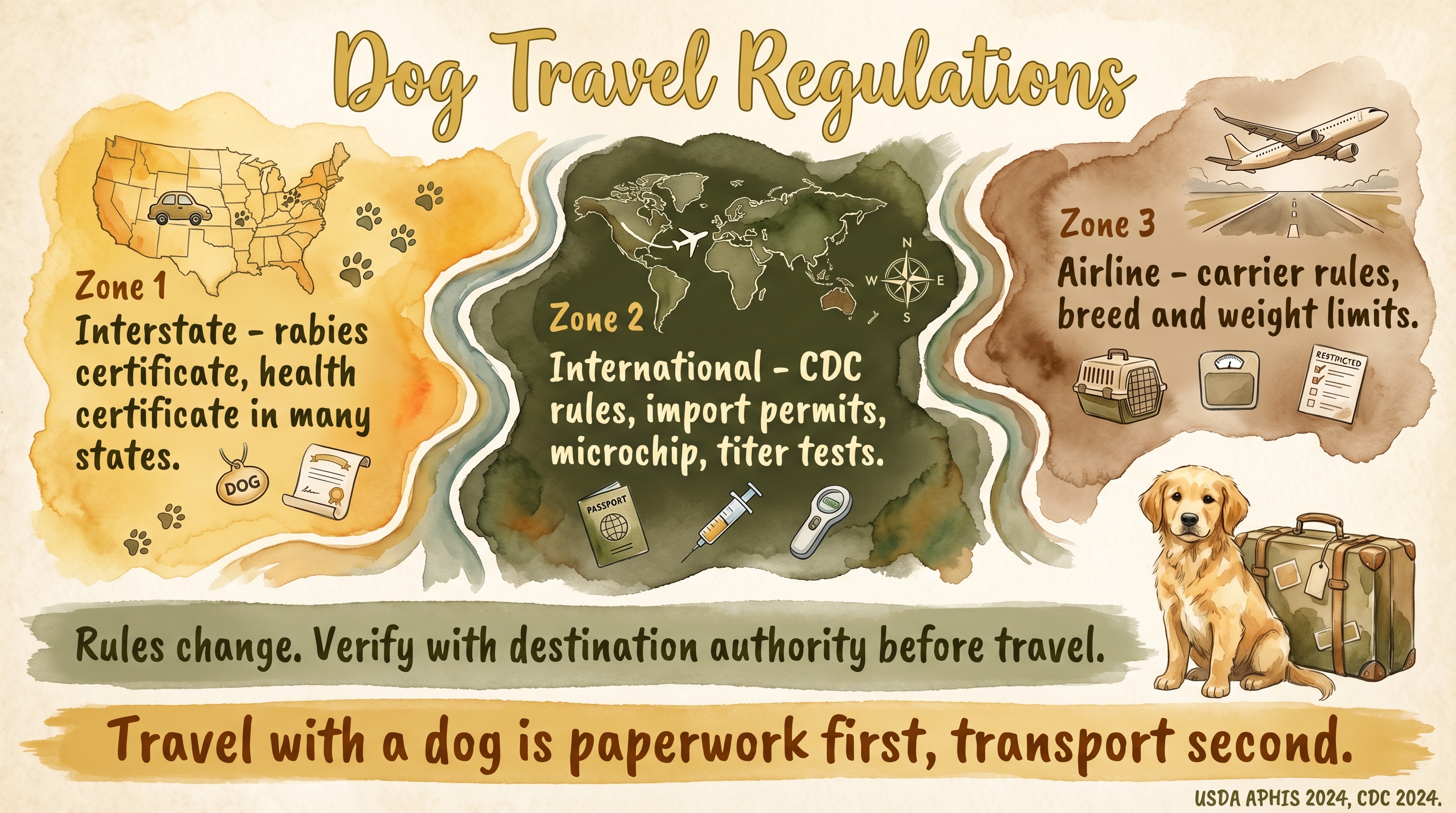
Travel with a dog is paperwork first, transport second.
Key Takeaways
- Interstate dog travel is mainly controlled by the receiving state or territory, not by one uniform federal rule for owners.
- Air travel combines federal service-animal rules with airline-specific pet policies and practical restrictions, especially for larger dogs.
- International travel requires early destination-country research and often APHIS-linked paperwork, not last-minute improvisation.
- For JB families, good travel planning means checking the rule early and checking whether the trip is actually good for the dog.
The Evidence
This entry uses observed claim-level tags beyond the dedicated EvidenceBlocks below. These tags mark JB program observation or practice-derived claims that need dedicated EvidenceBlock coverage in a later content pass.
- USDA APHIS interstate travel guidancedomestic pet travel
Documents that destination states and territories set animal-health requirements for interstate pet movement. - USDA APHIS pet-travel export guidanceinternational pet travel
Documents the federal export process and the need to follow destination-country requirements for certificates, vaccination, and testing. - DOT final rule on service animalsair travel
Supports the distinction between service-dog air travel and ordinary pet travel. - Hawaii Department of Agriculture animal quarantine materialsstate import rule
Document Hawaii's stricter preparation and release framework for incoming dogs.
- domestic dogs
No published study directly measures how dog travel regulations: air, international, and state changes long-term dog welfare, family outcomes, and retention across jurisdictions and enforcement contexts.
SCR References
Sources
- USDA APHIS. "Take a Pet From One U.S. State or Territory to Another."
- USDA APHIS. "Pet Travel."
- U.S. Department of Transportation. "Final Rule - Traveling by Air with Service Animals."
- Hawaii Department of Agriculture. Animal Quarantine forms and guidance.