Dog Licensing and Registration
Compound evidence detail1 SCR / 2 parts
- Documentedthe municipal dog licensing record including its low-friction civic and public-health functions of rabies vaccination compliance, lost-dog return, and municipal revenue, alongside the structurally distinct microchip-registration system that maintains a nationally searchable record keyed to an implanted identifier rather than a tag
- Heuristicthe JB framing that licensing and microchip registration are additive recovery systems serving different scenarios rather than substitutable, an interpretive synthesis that downstream documents must not present as a regulatory consensus position
Dog licensing is the most ordinary form of dog regulation in the United States and perhaps the easiest for families to ignore because it feels administrative rather than meaningful. In most municipalities, licensing requires a modest fee, current rabies information, and periodic renewal. Because the process is so unglamorous, compliance often falls behind. That is unfortunate, because licensing is one of the simplest civic obligations in ordinary dog ownership. Documented
Licensing serves several practical functions at once. It helps municipalities tie dogs to owners, supports rabies compliance, gives animal control a way to identify dogs more efficiently, and creates a small revenue stream for local administration. Documented In some cities or towns, fee structures also vary by spay-neuter status. The system is not elegant, but it is functional.
Families should also separate licensing from microchip registration. A dog license is usually a local or municipal government record. A microchip registry is usually a database linked to a chip number and owner contact details. The two systems overlap in practical value but are not the same thing. A licensed dog can still be difficult to reunite if chip information is outdated. A microchipped dog can still be out of compliance with a local license requirement.
The practical family message is therefore plain: licensing is cheap, low-drama, and worth doing.
That may sound almost too simple for a legal topic, but simplicity is part of the point. Municipal licensing is one of the few places where dog law, public health, and ordinary family organization overlap cleanly. Families who treat it casually often discover its value only when a dog is lost, picked up, quarantined, or involved in an incident that suddenly makes the local record matter.
What It Means
Municipal Licensing Is an Ownership Record, Not a Quality Label
A dog license mainly tells the municipality that the dog exists, who keeps it, and whether the rabies requirement has been met through the local process. It is not a sign that the dog is trained, behaviorally safe, or specially approved. It is an administrative record tied to local government.
That is why licensing feels small until the dog is lost, picked up, involved in an incident, or checked during another animal-control interaction. Suddenly the small record becomes useful.
Rabies Compliance Is Usually the Core Gate
One of the most common licensing requirements is proof of current rabies vaccination. Massachusetts law is a useful example here because state law requires local licensing of dogs and ties the system closely to rabies compliance. Municipal licensing offices commonly ask for the current rabies certificate as part of the process.
This structure makes sense from a public-health perspective. Rabies is one of the few dog-health issues where local administration, veterinary recordkeeping, and legal compliance overlap very directly.
Why Compliance Rates Often Lag
The licensing process is simple enough that families often procrastinate. Many municipalities also enforce lightly until the dog is already interacting with animal control, a complaint, or another formal process. Documented That enforcement pattern makes the obligation feel optional until it suddenly does not.
A second reason licensing lags is that many families believe microchipping has replaced it. Microchips are hugely valuable for recovery, but they do not eliminate local licensing requirements. The systems do different jobs. One is a government registration and public-health record. The other is primarily a recovery and identity tool.
Licensing and microchipping support different parts of responsible ownership. Families should use both rather than assuming one system silently replaces the other.
Why the Requirement Is Usually Worth Respecting
Municipal dog licensing is one of the rare dog obligations that is both low-cost and reasonably useful. It is not complicated training theory. It is not a lifestyle debate. It is simply part of being a citizen with a dog in a shared community.
For families who want the simplest practical rule, this is it: if the town requires a dog license, just comply and keep the information current.
Renewal details vary more than owners sometimes think. Some municipalities issue annual licenses, some tie timing to calendar windows, and some differentiate pricing by spay-neuter status or age. That variation is another reason families should stop relying on vague memory from a previous town and read the current local page directly. Dog licensing is local administration in the most literal sense.
Licensing can also become relevant in ways that have nothing to do with being lost. Rabies quarantine questions, nuisance complaints, neighborhood bites, and animal-control encounters all land differently when the dog's ordinary records are current versus neglected. Documented The license does not solve those situations, but it often makes them easier to navigate because the family is already in visible compliance with the most basic civic layer.
Tag display and proof requirements can matter in a similarly practical way. Some municipalities expect the license tag to be attached to the dog's collar or available on demand, while others care mainly about the record itself. Families do not need to become anxious about every administrative nuance. They do benefit from reading what their own town expects instead of assuming all licensing systems function identically.
Why It Matters for Your Dog
Golden Retriever families often focus on the emotional and developmental parts of dog life because those parts feel more important. They are important. Licensing still matters because it becomes relevant precisely when something unexpected happens.
If a Golden slips a gate, disappears during a storm, bolts from a family member, or is picked up after a neighborhood incident, current records help reunification and compliance. The dog does not need to be habitually difficult for this to matter. One accident is enough.
The distinction from microchipping also matters practically. A lost Golden with a current microchip and updated registry details may be easier to reunite than one relying only on a tag. A licensed dog may still be easier for local animal control to route quickly through municipal systems. The best setup is redundancy, not an either-or choice.
Families sometimes dismiss licensing because the fee feels symbolic. That is exactly why it is worth doing without drama. The burden is small. The consequences of noncompliance often arrive only at inconvenient moments.
There is another reason this entry matters for Goldens specifically. Their sociability means they are often picked up by kind strangers rather than disappearing into feral invisibility. That increases the odds that identification systems will actually be used. A dog that runs to people can be found quickly if the records behind the dog are current. Documented
Licensing also reinforces a healthy adult mindset. The family is not only loving the dog privately. It is carrying a public responsibility. That orientation matters in a breed whose friendliness can make ownership feel effortless during easy periods.
From the JB perspective, civic details like this support the larger raising environment. The calm, organized family tends to keep ordinary paperwork current as well as routines. Disorder in one area often mirrors disorder in another.
Moving households are especially prone to missing this obligation. A family relocates, updates the microchip, maybe changes the veterinary clinic, and forgets that the dog now lives under a different municipality with its own licensing office and deadlines. Nothing feels urgent until the dog slips a door, is picked up by animal control, or appears in a local record system that no longer matches the address on file.
Puppyhood creates its own version of the same problem. Families are rightly focused on sleep, biting, house training, and vaccinations, so local administration slides to the bottom of the list. Yet the first year is exactly when routines are being built. Getting the license, registering the microchip, and storing the rabies paperwork together teaches the adults to treat dog stewardship as both emotional care and orderly follow-through.
Identification layers work best when they reinforce each other. Collar tag, microchip, municipal license, and current contact information do not compete. They create redundancy. That redundancy matters because different recovery situations activate different systems. A neighbor may read a tag. A shelter may scan a chip. Animal control may look first at the municipal record. The dog benefits from all of them being current.
Licensing is also one of the easiest ways to notice whether the household is drifting into administrative wishfulness. Families who keep delaying a low-cost annual license often discover they are delaying other unglamorous responsibilities too, from vaccination reminders to address updates to emergency contact planning. The dog does not need perfection. The dog does benefit from adults who can keep the boring parts of ownership in good order.
The issue becomes concrete again any time another institution touches the dog. Boarding facilities, groomers, trainers, landlords, and some municipalities may ask for vaccination or identification records. A family who can produce current documents quickly usually moves through those interactions with less friction. Administrative order does not create good raising by itself, but it does remove avoidable stress from the dog's human world.
This matters for handoffs as well. If a pet sitter, relative, or emergency caregiver ever has to take the dog to a veterinarian, animal-control office, or boarding facility, clear records make the transfer safer and calmer. Documented Licensing is part of that preparedness. It helps ensure that the adults around the dog are not improvising basic civic information under pressure.
The same preparation helps after storms, evacuations, or any other situation where the dog may leave the ordinary routine suddenly. Families who know where the records are, who keep the tag current, and who maintain both licensing and microchip details are easier to reunite with, easier to assist, and less likely to lose time in administrative confusion when the household is already stressed.
What This Means for a JB Family
For a JB family, dog licensing should be treated as routine stewardship. It is not a moral trophy and not a bureaucratic enemy. It is one of the simplest ways to stay in good order with the community the dog lives in.
The practical sequence is easy. License the dog on time, keep rabies records current, register the microchip, and update both when contact information changes. Families who do those basic things remove a surprising amount of unnecessary friction from future problems.
JB also reads this topic as a reminder that raising includes administration. Loving the dog well does not end with training, socialization, or emotional attunement. It includes the quiet civic habits that make the dog's life safer if something unexpected happens.
That is why the best summary is almost boring: license the dog, register the chip, and keep both current. Boring is good here.
The yearly rhythm can be made almost effortless. Put the renewal on the household calendar, keep the rabies certificate in one obvious place, and update contact details the same day they change elsewhere. A family who treats licensing as a recurring routine instead of a surprise errand usually spends almost no emotional energy on it.
JB can value that kind of order without inflating it into moral theater. The point is not that a license tag makes someone a superior dog owner. The point is that small civic responsibilities are part of the calm, competent adult environment a dog lives inside. Licensing is mundane, and mundane stewardship is often exactly what keeps future problems smaller.
Families who handle these details early usually notice a quiet benefit: the dog stops feeling like a bundle of unresolved errands. Once the paperwork is current, the household can give more attention to the relational parts of life with the dog without carrying an avoidable administrative loose end in the background.
That is part of what calm stewardship looks like in practice. The dog is not waiting on the adults to finish the basics before life can settle down. The basics are already handled, which leaves more room for training, routine, and ordinary enjoyment to happen without administrative clutter hanging over them.
That orderliness often pays off at exactly the moment the family is busiest. New baby, move, illness, holiday travel, emergency boarding, or a lost-dog scare all become easier to manage when the ordinary records are already current. Licensing is not dramatic preparedness. It is quiet preparedness, which is usually the kind that proves useful.
For many families, that is reason enough to treat the renewal as a small annual reset in responsible ownership. It is also one of the few dog-law tasks that rewards consistency almost immediately and punishes procrastination in the most inconvenient possible moments. That makes it an ideal place for families to practice the kind of low-drama follow-through that helps every other part of dog life run more smoothly. It is boring in the best possible way, and that is usually enough when life gets busy in ordinary family life reliably.
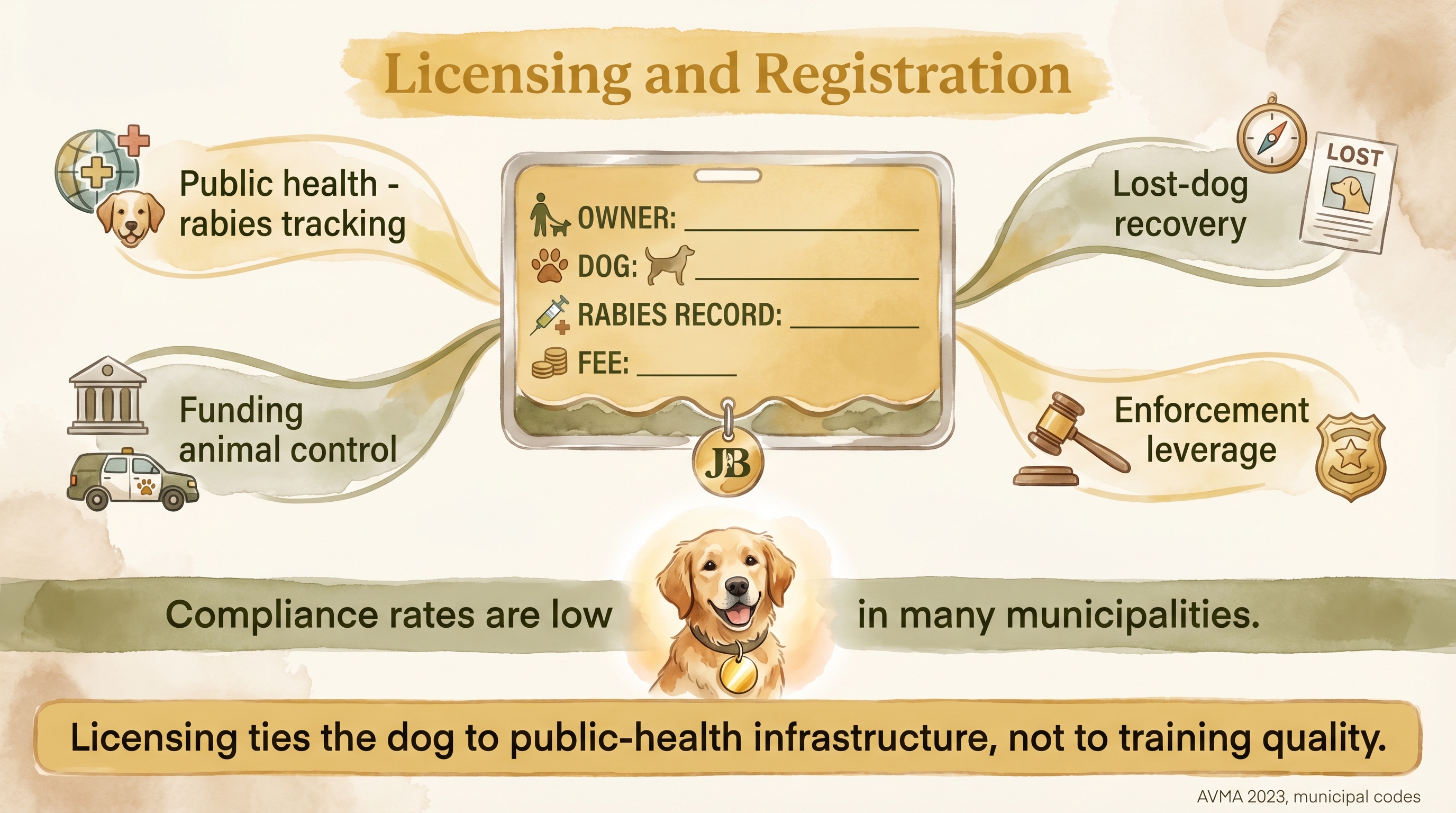
Licensing ties the dog to public-health infrastructure, not to training quality.
Key Takeaways
- Dog licensing is mainly a local administrative and public-health record, not a quality seal.
- Rabies documentation is commonly the core requirement for obtaining or renewing a license.
- Licensing and microchip registration are different systems that work best together.
- For JB families, licensing is one of the easiest and most worthwhile dog-law obligations to complete without drama.
The Evidence
- State and municipal dog-licensing frameworkslocal dog law
Support the common structure of licensing fees, rabies proof, renewal, and local ownership registration. - Massachusetts dog-licensing lawstate dog law
Provides a service-area example tying local dog licensing to state law and rabies compliance. - Municipal licensing pages such as Boston'slocal administration
Illustrate the ordinary practical requirements of licensing and renewal. - dog regulation
Supports the broader claim that dog regulation is often local and administrative rather than centralized.
- domestic dogs
No published study directly measures how dog licensing and registration changes long-term dog welfare, family outcomes, and retention across jurisdictions and enforcement contexts.
SCR References
Sources
- Massachusetts General Laws, Chapter 140, Section 137.
- Boston.gov. Dog licensing materials.